
Quick answer: IP67 is a static immersion rating. It does not test vibration fatigue, thermal cycling, hydraulic oil, DEF, or high-pressure washdown. Forestry CAN harnesses fail because the conductor, contact, or seal degrades under dynamic stress before water ever enters the connector. A forestry-grade harness needs ISO 16750-3 vibration testing, ISO 16750-5 chemical testing, and IP6K9K washdown protection.
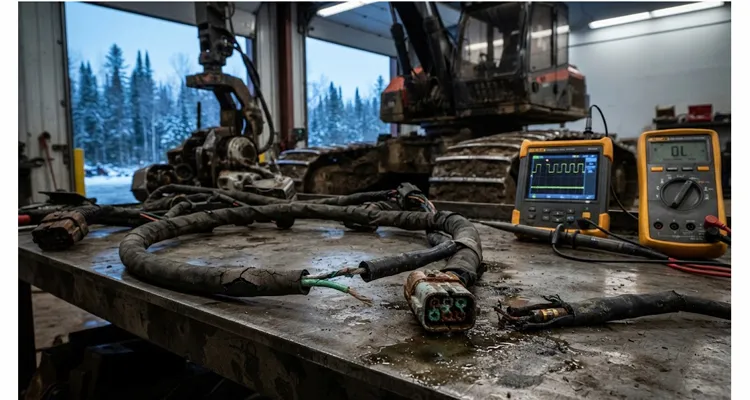
I was called to a feller-buncher in northern Quebec that had derated three times in six weeks. The dealer swapped the ECU twice. The same SPN 639 FMI 9 fault came back after the next rainstorm. When we put an oscilloscope on the J1939 backbone, the problem was not the controller. It was the physical layer: a green-stick fracture at the articulation joint, corrosion wicked into an unsealed Deutsch connector, and a termination resistor that had corroded open inside a heatshrink tube. That machine is a textbook example of why IP67 connectors forestry CAN networks cannot be specified on the rating alone.
That operation was losing just under eight thousand dollars a year in avoidable costs: diagnostic labor, downtime, and parts-cannon replacements. The number is not unusual in forestry. What is unusual is how many OEM engineering teams still specify harnesses primarily on IP67 and stop there. IP67 is a baseline, not an acceptance criterion.
The machine was a tracked feller-buncher in mixed hardwood. The operator reported intermittent CAN faults after heavy rain or pressure washing. The dealer followed the standard path: SPN 639 FMI 9 meant lost communication on J1939, so the ECM was replaced. Three ECUs later, the fault persisted.
We started with resistance across the diagnostic connector. The reading was 118 ohms. That points to one terminating resistor open or missing. Physical inspection found three separate problems in the same harness. That sequence mirrors what we see in forestry J1939 harness failures field repairs across multiple machine brands.
Problem one was a green-stick fracture at the articulation joint. The harness crossed the machine center where the frame flexes constantly. The conductor strands had fractured inside the insulation. From the outside, the cable looked fine. Under flex, resistance shifted. Under vibration, the fracture opened and closed, causing intermittent signal loss.
Problem two was moisture ingress at an IP67 connector. The seal had been compromised by thermal cycling and vibration. Water wicked into the terminal cavity and created a conductive path between CAN_H and CAN_L. The short-circuit resistance dropped into a measurable range and corrupted differential signals. This is the same pin-to-pin leakage mechanism we documented in moisture ingress pin-to-pin leakage current.
Problem three was a corroded termination resistor. The 120-ohm resistor was buried inside a heatshrink tube where the CAN backbone spliced to a stub. Moisture entered through a pinhole, corroded the resistor element, and opened the circuit. No ECU replacement would ever fix that. The hot-and-cold resistance shift that follows this kind of corrosion is covered in J1939 hot-cold termination resistance shift.
The repair replaced the entire backbone harness with a forestry-grade assembly: tinned copper conductors, XLPO insulation, gold-plated Deutsch connectors with proper strain relief, and sealed diagnostic breakout points. The machine has not thrown a CAN-related fault since. The fleet avoided roughly eight thousand dollars in the first quarter after the repair, about the cost of two ECUs and the associated diagnostic labor. That repair math is consistent with the cases in forestry CAN harness eight thousand dollars saved.
That case shows the core problem. IP67 measures static performance, not dynamic survival. A connector can pass a one-meter, thirty-minute immersion test and still fail catastrophically in a forestry environment where vibration, thermal cycling, and chemical exposure work together to destroy the seal.
What Does IP67 Actually Test, And What Does It Miss?
IP67 tells me a connector survived thirty minutes under one meter of still water. It tells me nothing about what happens when that same connector sees 20 to 200 Hz at the boom tip, then gets hit with 100 bar at 80 degrees Celsius during washdown. On forestry machines, those two events happen on the same shift. That is why we stopped treating IP67 as an acceptance criterion and started treating it as a baseline.
The IP67 rating comes from IEC 60529, the international standard that classifies degrees of protection against dust and water ingress. It covers dust ingress and temporary immersion. The connector is immersed without vibration, without thermal cycling, without chemical exposure, and without the mechanical stresses of real machine operation. In forestry, none of those conditions hold.
A harvester head operates at frequencies between 20 and 200 Hz. Accelerations can exceed 10 g at the boom tip. The harness sees continuous flex at the articulation joint. It sees thermal cycling from subzero cold starts to hydraulic oil temperatures above 90 degrees Celsius. It sees hydraulic oil, diesel exhaust fluid, and pressure-wash spray at up to 100 bar. IP67 does not test any of that.
Research from Tampere University on connector reliability in mining drill machinery, an environment with similar stress profiles, found that IP67-coded connectors failed in multiple test modes when subjected to combined humidity and vibration. The study tracked two failure mechanisms: waterproofness failure, measured by short-circuit resistance between signal wires, and fatigue damage, measured by pass-through resistance. In dynamic tests with vibration, the fatigue failure mode consistently appeared before waterproofness failure. The wire broke or detached from the solder contact inside the connector before water ever entered.
That finding is critical. You can have a perfectly sealed connector that still fails because the internal wire strands fracture under vibration. IP67 does not test for that.
Table: Test condition comparison
| Test Condition | IP67 | IP6K9K | Forestry Reality |
| Water pressure | Zero | About 100 bar | 100 to 150 bar |
| Water temperature | Ambient | About 80 C | Up to 90 C |
| Vibration | None | None | 20 to 200 Hz, up to 10 g |
| Chemicals | None | None | Hydraulic oil, diesel, DEF |
IP6K9K is the rating that covers high-pressure, high-temperature spray. It requires testing with water at approximately 100 bar and 80 degrees Celsius, sprayed from multiple angles. That rating is common in automotive underhood applications and is increasingly specified for off-highway equipment. But even IP6K9K does not address vibration fatigue or chemical exposure. You need all three: IP6K9K for washdown, ISO 16750-3 for vibration, and ISO 16750-5 for chemical load. If you are writing a supplier specification, the questions in J1939 harness supplier qualification questions will help you separate a real forestry supplier from a catalog reseller.
The Static IP67 Test Does Not Simulate Pressure Washing
Forestry machines are pressure-washed regularly, often daily during mud season. A typical pressure washer delivers water at 100 to 150 bar at temperatures up to 90 degrees Celsius. IP67 tests immersion at zero pressure and ambient temperature. The two conditions have almost nothing in common.
IP6K9K is the rating that covers high-pressure, high-temperature spray. It requires testing with water at approximately 100 bar and 80 degrees Celsius, sprayed from multiple angles. That rating is common in automotive underhood applications and is increasingly specified for off-highway equipment. But even IP6K9K does not address vibration fatigue or chemical exposure.
Chemical Exposure Degrades Seals and Insulation
Hydraulic oil, diesel fuel, DEF, and biodiesel are standard in forestry operations. Each attacks different seal and insulation materials. Hydraulic oil attacks many EPDM and natural rubber compounds. It causes swelling, softening, and eventual loss of sealing force. Diesel fuel and DEF are aggressive toward PVC insulation and low-grade thermoplastic elastomers. Biodiesel blends, B20 and higher, are more aggressive than straight diesel and have been shown to degrade standard connector seals within months of exposure.
ISO 16750-5 specifies chemical load testing for automotive electrical components. The test involves dipping the component in the specified chemical for five minutes, allowing it to drip dry, then storing it at 80 degrees Celsius for 48 hours. A forestry harness should be tested against hydraulic fluid, diesel, DEF, and coolant under this protocol. Most IP67-only harnesses are not. For coastal or salt-exposed forestry operations, the same logic applies to corrosion testing, as covered in salt spray testing OBD harnesses coastal fleet.
Why Do Forestry CAN Harnesses Fail Under Vibration?
Vibration fatigue in CAN harnesses is not a single failure mode. It is a cascade. Each stage makes the next one worse. The most common field failure we see is not conductor breakage first. It is insulation wear.
We pulled a forwarder harness at three thousand one hundred operating hours. The corrugated loom had worn through to bare copper in four places along a single run. The conductor was still electrically continuous, but insulation resistance had dropped from greater than one hundred megohms to under two megohms. That harness was about two hundred hours away from an intermittent fault that would have looked exactly like an ECU problem.
CAN bus conductors are typically 20 to 22 AWG. At that gauge, the copper strands are thin enough that metal fatigue occurs readily under high vibration and repeated flex. The fracture begins as a partial crack in the outer strands and propagates inward. Resistance increase is initially too small to trigger a fault code, but signal integrity degrades. The machine may throw phantom faults that come and go with no consistent pattern.
Even if the conductor survives, connector contacts can fail. Continuous micromotion between contact interfaces causes loss of normal force, fretting corrosion, and temporary opens that fall below ECU fault thresholds. The contacts look fine under visual inspection but fail intermittently under vibration. Crimp resistance drift is another hidden contributor, and we cover the milliohm-level measurement approach in crimp resistance drift 3.2 milliohm J1939 ground offset. When the same harness runs next to welders, VFDs, or high-current motors, the same physical-layer weaknesses also open the door to conducted and radiated EMI. The shielding and grounding rules we apply in industrial-grade EMI shielding for OBD2 and J1939 cables are the same rules that keep a forestry CAN backbone stable under vibration.
By the time the conductor or contact has degraded, the seal has usually been compromised by thermal cycling and mechanical stress. Moisture enters, accelerates corrosion, and the failure becomes permanent.
Table: Vibration fatigue stages and field data
| Stage | Field Symptom | Typical Hours | Test That Catches It |
| Insulation abrasion | Visual wear, exposed copper | 2,500 to 4,000 | Visual plus insulation resistance |
| Conductor fatigue | Intermittent resistance shift | 3,000 to 6,000 | Flex test plus milliohm measurement |
| Contact fretting | Phantom faults, wiggle test | 1,500 to 5,000 | Contact resistance under vibration |
| Seal failure | Moisture in cavity, corrosion | 2,000 to 5,000 | IP6K9K plus thermal cycling |
ISO 16750-3 specifies vibration testing for electrical equipment in road vehicles. For commercial vehicle applications, Test VI and Test VII are the relevant profiles. These tests apply sinusoidal vibration across a frequency range with temperature cycling superimposed. The pass criterion is no loss of electrical continuity, defined as resistance not exceeding seven ohms, during the entire test duration.
Most forestry harnesses are never subjected to this testing. They are assembled to a drawing, given a continuity check, and shipped. That is not enough for a machine that will see ten thousand hours of vibration. If you are building a new machine or replacing a chronic failure, the protection strategies in forestry J1939 harness protection strategies are a practical starting point.
Chemical Exposure: The Slow Failure Nobody Tests For
Hydraulic oil, diesel fuel, DEF, and biodiesel are standard in forestry operations. Each attacks different seal and insulation materials. Hydraulic oil attacks many EPDM and natural rubber compounds. It causes swelling, softening, and eventual loss of sealing force. Diesel fuel and DEF are aggressive toward PVC insulation and low-grade thermoplastic elastomers. Biodiesel blends, B20 and higher, are more aggressive than straight diesel and have been shown to degrade standard connector seals within months of exposure.
ISO 16750-5 specifies chemical load testing for automotive electrical components. The test involves dipping the component in the specified chemical for five minutes, allowing it to drip dry, then storing it at 80 degrees Celsius for 48 hours. A forestry harness should be tested against hydraulic fluid, diesel, DEF, and coolant under this protocol. Most IP67-only harnesses are not.
We stopped using PVC on forestry CAN backbones after a customer in Scandinavia returned three harnesses with cracked insulation at the articulation joint. The machines had seen two winters. The PVC had a cold bend failure at minus thirty-five degrees Celsius. The replacement XLPO harnesses have now run four winters without a cold crack.
Table: Material compatibility for forestry exposure
| Material | Hydraulic Oil | Diesel | DEF | Cold Bend at Minus 40 C | Relative Cost |
| PVC | Poor | Poor | Poor | Cracks | Low |
| XLPO | Good | Good | Good | Passes | Medium |
| TPE | Fair | Fair | Fair | Passes | Medium |
| Silicone | Good | Fair | Fair | Passes | High |
The material choice is not a cost decision. It is a life-cycle decision. A PVC harness that costs four hundred fifty dollars and fails at one thousand eight hundred hours is more expensive than an XLPO harness that costs nine hundred eighty dollars and runs six thousand two hundred hours. The field repair math always favors the correctly specified harness. The problem is that the cost of the cheap harness is not visible on the purchase order. It shows up in the maintenance log, the downtime report, and the annual parts budget.
What Does a Forestry-Grade CAN Harness Look Like?
The difference between a standard IP67 harness and a forestry-grade assembly comes down to four things: conductor material, insulation compound, connector selection, and strain relief design.
Conductor: Tinned Copper, Not Bare Copper
Tinned copper, not bare copper. Bare copper corrodes rapidly in moisture and salt. Tinned copper strands resist corrosion and maintain low contact resistance even after moisture ingress. For CAN bus applications where signal integrity depends on consistent differential impedance, this matters. For high-flex locations, use stranded conductor, not solid. Strand count matters. A 19-strand 20 AWG conductor will survive far more flex cycles than a 7-strand equivalent.
Insulation: XLPO or Cross-Linked PE, Not PVC
XLPO or cross-linked PE, not PVC. PVC is the default for most automotive harnesses. It is cheap, easy to process, and adequate for passenger cars. In forestry, it is a liability. Cross-linked polyethylene and cross-linked polyolefin insulations resist hydraulic oil, diesel, DEF, and UV exposure far better than PVC. They also maintain flexibility at low temperatures. The temperature rating for XLPO is typically minus forty to plus one hundred twenty-five degrees Celsius, compared to minus twenty to plus eighty for standard PVC. If your specification includes jacket flammability or flex requirements, the test logic in UL-94 V0 diagnostic cable jacket thickness flex is worth reviewing before you lock the drawing.
Connectors: Sealed, Gold-Plated, with Terminal Position Assurance
Deutsch DT and DTM series connectors are the industry standard for off-highway applications. They are available with gold-plated contacts, which resist fretting corrosion better than tin. Gold plating is not a luxury in high-vibration environments. It is a reliability requirement. Terminal position assurance clips are equally important. We have seen multiple field failures where a terminal backed out of its connector cavity because the TPA clip was missing or not fully seated. The machine ran fine until vibration worked the terminal loose, then threw a fault that disappeared when the operator wiggled the connector. That is a diagnostic nightmare. For a side-by-side comparison of connector families, see Deutsch DT vs Amphenol AT connectors. In tight frame pockets where a standard straight connector exceeds the bend radius, a J1939 90 degree right angle cable for tight spaces Y splitter Deutsch DT can solve the routing without compromising the seal.
Strain Relief: The Most Overlooked Design Element
Most harness failures in forestry originate at transitions: where the harness exits a connector, where it passes through a bulkhead, where it crosses an articulation joint. These transition points concentrate stress and are where abrasion and fatigue begin. Effective strain relief means boots at connector exits, grommets at bulkhead pass-throughs, service loops at articulation joints, and routing clamps spaced to prevent rubbing. A harness that is perfectly specified in materials but poorly routed and strain-relieved will still fail. Design and installation are inseparable.
Why the Factory Behind the Harness Matters More Than the Datasheet
You can specify all the right materials and still get a harness that fails in the field. The difference is in the manufacturing process. We do not ask customers to trust a certificate. We show them the crimp force monitoring chart for the terminal lot, the pull-out force record for the wire batch, and the traceability number that links the finished harness back to the reel of tinned copper and the connector date code. If a field failure happens, we can trace it to the shift, the crimper, and the material lot within twenty minutes. That is stronger than saying we are ISO 9001 certified. The traceability system behind that claim is described in IATF 16949 cable assembly traceability.
We hold ISO 9001 for quality management and ISO 14001 for environmental management. For automotive and off-highway OEM supply, IATF 16949 is the relevant quality standard. RoHS, CE, UL, and REACH compliance ensure that the harness materials meet the required market and legal standards. For OEMs selling into the European Union, RoHS and REACH are legal requirements. For everyone else, they are a reasonable indicator that the factory is managing its material supply chain.
The physical environment matters too. Wire and connector materials are sensitive to humidity. A factory with climate-controlled storage maintains the material properties that the datasheet promises. A factory without it may deliver harnesses whose insulation has already absorbed moisture before the machine ever leaves the assembly line. 5S management, sort, set in order, shine, standardize, sustain, is not a marketing slogan. It is the difference between a harness built to the drawing and one assembled with the wrong terminal because two bins look similar.
The Four-Step Quality Inspection
Our four-step quality inspection is not a claim. It is a process. Step one is incoming material inspection: conductor resistance, insulation thickness, and tensile strength for every reel of wire; contact resistance and seal integrity for every batch of connectors. Step two is in-process inspection: crimp height and pull-out force measured every two hours per crimping machine; terminal insertion depth verified; seal orientation checked before connector assembly. Step three is electrical testing after assembly: continuity, resistance, and dielectric withstand on every harness; CAN impedance and propagation delay on a sample basis. Step four is final inspection and functional test: routing, labeling, and connector engagement checked; a sample from each production lot undergoes vibration testing and seal testing per the customer specification. That continuity and insulation-resistance testing follows the same logic we described in continuity 500VDC IR testing CAN bus failures.
Environmental Management and Climate Control
We have been a direct factory for more than twenty years. We build full-plastic connector designs for corrosive environments. There is no galvanic couple between dissimilar metals, no corrosion at the shell-to-shell interface, and no paint adhesion issues at the mounting point. Every harness is 100 percent tested before it ships. We can provide PPAP Level 3 documentation for OBD cable assemblies for OEM programs.
How Do You Qualify a Forestry CAN Harness Supplier?
The datasheet can tell you what the harness is supposed to do. The supplier qualification process tells you whether it will actually do it. Use a scorecard with pass and fail thresholds. That gives an OEM engineer something usable in a supplier audit. The same audit logic is expanded in audit custom OBD cable supplier 7 questions.
Table: Supplier qualification scorecard
| Criterion | Weight | Pass Threshold | Red Flag |
| PPAP capability | 20 percent | Level 3 available | Cannot provide PFMEA |
| Vibration test | 20 percent | ISO 16750-3 | Outsources without reports |
| Chemical test | 15 percent | ISO 16750-5 | No hydraulic oil test |
| Crimp control | 20 percent | Pull-out force monitored | Visual inspection only |
| Traceability | 15 percent | Reel-to-harness | No lot records |
| Field data | 10 percent | Failure rate by hours | No field data |
Step 1: Request PPAP Documentation
For any forestry OEM program, the supplier should provide a Production Part Approval Process package. At minimum, Level 3 PPAP should include design records and dimensional results, material and performance test results, process flow diagram and PFMEA, control plan, measurement system analysis, and sample parts with full dimensional layout. A supplier that cannot provide PPAP documentation is not qualified for OEM supply.
Step 2: Verify Test Capability
Ask for the supplier internal test lab capabilities. A forestry harness manufacturer should be able to perform vibration testing per ISO 16750-3 or an equivalent off-highway standard, chemical resistance testing per ISO 16750-5 for hydraulic oil, diesel, and DEF, salt spray testing per ISO 9227 for corrosion resistance, thermal cycling from minus forty to plus one hundred twenty-five degrees Celsius, and seal integrity testing per IP67 and ideally IP6K9K. If the supplier outsources all of these tests, ask for the third-party lab reports and verify that the test conditions match your application requirements.
Step 3: Audit the Manufacturing Process
A supplier audit should cover crimp process control, including pull-out force monitoring and crimp height measurement; terminal insertion verification, including TPA clip installation; seal installation and inspection; harness routing and strain relief validation; and labeling and traceability. Ask to see calibration records for the crimping equipment and the test equipment. An out-of-calibration crimper produces out-of-spec crimps, no matter what the inspection records say.
Step 4: Request Field Failure Data
A supplier with real forestry experience will have field failure data. Ask for failure rate by application and operating hours, most common failure modes, corrective actions implemented, and customer references in forestry or similar heavy equipment applications. A supplier that cannot provide field data is a supplier that has not been in the field long enough to generate it.
Step 5: Confirm OEM Customization Capability
For OEM programs, the harness must match the machine exact routing, connector types, and electrical requirements. The supplier should offer logo and brand customization on labels and connector boots, length customization to match machine routing without excess service loops, color coding for maintenance and diagnostic convenience, and AWG customization based on current requirements and voltage drop limits. A supplier that only offers catalog products is not an OEM supplier. The procurement checks in custom J1939 harness forestry OEM procurement are a useful next step.
The Field Repair Math: What It Actually Costs to Do It Right
Let me put the economics in perspective with the feller-buncher case. The original harness was a standard IP67 assembly with PVC insulation and tin-plated contacts. Unit cost was approximately four hundred fifty dollars. It lasted approximately one thousand eight hundred operating hours before the first intermittent fault appeared.
The replacement harness was a forestry-grade assembly with tinned copper conductors, XLPO insulation, gold-plated Deutsch connectors, and molded strain relief boots. Unit cost was approximately nine hundred eighty dollars, roughly twice the original.
But the replacement harness has now run six thousand two hundred hours without a CAN-related fault. The original harness would have been replaced approximately three and a half times in that same interval, at a total parts cost of one thousand five hundred seventy-five dollars, not counting the diagnostic labor, downtime, and ECM replacements that each failure triggered.
Table: Annual cost of chasing intermittent CAN faults
| Cost Item | Per Incident | Annual Frequency | Annual Cost |
| Field service dispatch | One thousand two hundred dollars | 6 | Seven thousand two hundred dollars |
| Diagnostic labor, 4 hours | Four hundred dollars | 6 | Two thousand four hundred dollars |
| ECM replacement, unnecessary | Three thousand dollars | 2 | Six thousand dollars |
| Downtime, production loss | Two thousand dollars per day | 3 days | Six thousand dollars |
| Total avoidable annual cost | Twenty-one thousand six hundred dollars |
That table is conservative. We have seen operations where a single chronic intermittent fault consumed more than thirty thousand dollars in a year across multiple machines. The root cause was a harness that cost a few hundred dollars to manufacture correctly in the first place.
The field repair math always favors the correctly specified harness. The problem is that the cost of the cheap harness is not visible on the purchase order. It shows up in the maintenance log, the downtime report, and the annual parts budget.
If you are evaluating a harness specification for a forestry machine right now, I would be happy to walk through the application with you. We can review the vibration profile, the chemical exposure, and the routing to determine what materials and construction actually make sense. Reach out on WhatsApp for a technical conversation: https://api.whatsapp.com/send/?phone=8617307168662&text=Need+Help%3F+Chat+linda+WhatsAPP&type=phone_number&app_absent=0
You can also use our Contact page to send over your specifications: https://obd-cable.com/contact/
We build harnesses for OEMs and equipment manufacturers. That means we work from your drawings and your machine requirements, not from a catalog. Custom lengths, custom connector configurations, custom labeling, logo, brand, color, and AWG customization are all standard for us. If you need engineering support to define the right specification for a new machine or to fix a chronic field failure, that is what we do.
What Should You Specify for a New Forestry CAN Harness?
If you are writing a specification for a new forestry CAN harness, start with the environment, not the connector. The environment defines the test matrix.
Specify tinned copper stranded conductor. For 20 AWG, use 19 strands or more. Specify XLPO or cross-linked PE insulation. Do not accept PVC for high-flex or chemical-exposed runs. Specify sealed Deutsch DT or DTM connectors with gold-plated contacts and terminal position assurance clips. Specify molded strain relief boots at every connector exit and grommets at every bulkhead pass-through.
Require IP6K9K for washdown. Require ISO 16750-3 vibration testing with temperature cycling. Require ISO 16750-5 chemical testing against hydraulic oil, diesel, DEF, and coolant. Require ISO 9227 salt spray testing for corrosion resistance. Require thermal cycling from minus forty to plus one hundred twenty-five degrees Celsius.
Require PPAP Level 3 documentation for OEM programs. Require reel-to-harness traceability. Require crimp pull-out force records. Require sample vibration and seal testing per production lot. Require field failure data from similar applications. If a supplier cannot provide these, they are not a forestry harness supplier. They are a catalog harness supplier.
For machines that need a sealed service tap without cutting the backbone, specify a J1939 9-pin pigtail breakout cable green male to black green female. For diagnostic tools that interface the machine J1939 port to a Deutsch DT service connection, a J1939 9-pin female to DT 12-pin male adapter cable for heavy duty truck diagnostic tools keeps the adapter sealed and strain-relieved. These are the kind of details that decide whether the diagnostic port survives the same vibration and washdown as the backbone.
Frequently Asked Questions
My harness is IP67 rated. Why is it failing in the field?
Short answer: IP67 does not test vibration, thermal cycling, hydraulic oil, or pressure washing. In forestry, the conductor or contact often fails before water enters the connector.
Field data: On a feller-buncher, a 118-ohm reading across the diagnostic connector pointed to an open termination resistor, not an ECU. The connector was IP67. The resistor had corroded open inside a heatshrink tube.
Specification: Require ISO 16750-3 vibration and ISO 16750-5 chemical testing in addition to IP67.
What is the difference between IP67 and IP6K9K?
Short answer: IP67 tests immersion in one meter of water for thirty minutes at ambient temperature and zero pressure. IP6K9K tests high-pressure spray at approximately 100 bar and 80 degrees Celsius from multiple angles.
Field data: Forestry machines are pressure-washed at high temperature and pressure. IP67 does not simulate that. IP6K9K is the more relevant rating for washdown.
Specification: Require IP6K9K for any connector exposed to washdown.
How do I know if my CAN bus harness is suffering from vibration fatigue?
Short answer: Intermittent faults that appear and disappear with no consistent pattern, faults that correlate with machine movement or articulation, and resistance readings that change when the harness is flexed.
Field data: A forwarder harness at three thousand one hundred hours had insulation resistance drop from greater than one hundred megohms to under two megohms. The conductor was still continuous, but the harness was two hundred hours from an intermittent fault.
Specification: Use an oscilloscope to check signal integrity under flex. A multimeter will not show the degradation.
What conductor material should I specify for a forestry CAN harness?
Short answer: Tinned copper stranded conductor.
Field data: Bare copper corrodes rapidly in moisture and salt. Tinned copper maintains low contact resistance after moisture ingress. A 19-strand 20 AWG conductor survives more flex cycles than a 7-strand equivalent.
Specification: Tinned copper, stranded, 19 strands or more for 20 AWG.
What insulation compound is best for forestry applications?
Short answer: Cross-linked polyethylene or cross-linked polyolefin.
Field data: A Scandinavian customer returned three PVC harnesses with cracked insulation at the articulation joint after two winters. The PVC had a cold bend failure at minus thirty-five degrees Celsius. The replacement XLPO harnesses have run four winters without a cold crack.
Specification: XLPO or cross-linked PE, rated minus forty to plus one hundred twenty-five degrees Celsius.
Can I use a standard automotive Deutsch connector?
Short answer: Deutsch is the right family, but you need the right specification.
Field data: We have seen terminals back out of connector cavities when the TPA clip was missing. The machine ran fine until vibration worked the terminal loose, then threw a fault that disappeared when the operator wiggled the connector.
Specification: Gold-plated contacts, TPA clips, and a sealed rear boot for strain relief.
How do I test a harness for chemical resistance?
Short answer: ISO 16750-5 specifies the protocol.
Field data: Dip the component in the chemical for five minutes, let it drip dry, then store it at 80 degrees Celsius for 48 hours. The chemicals most relevant to forestry are hydraulic oil, diesel fuel, DEF, and coolant.
Specification: Require ISO 16750-5 test reports for all four chemicals.
What documentation should I request from a harness supplier?
Short answer: For OEM supply, request a Level 3 PPAP package.
Field data: A supplier that cannot provide PFMEA, control plan, and measurement system analysis is not qualified for OEM supply. Ask for material certificates, vibration and chemical test reports, calibration records for crimping and test equipment, and field failure data from similar applications.
Specification: Level 3 PPAP, reel-to-harness traceability, and crimp pull-out force records.
How often should forestry CAN harnesses be replaced?
Short answer: There is no fixed interval. Replace when resistance measurements indicate degradation, when visual inspection shows insulation abrasion or connector corrosion, or when intermittent faults correlate with harness movement.
Field data: A correctly specified forestry-grade harness should last the life of the machine. A PVC harness may fail at one thousand eight hundred hours. An XLPO harness with gold-plated contacts has run six thousand two hundred hours without a CAN fault.
Specification: Inspect at every major service. Measure resistance under flex. Replace if resistance shifts more than ten percent.
Can you build a harness to replace a specific OEM part?
Short answer: Yes.
Field data: We work from OEM drawings, sample parts, or machine measurements. Custom lengths, connector types, labeling, color coding, logo, brand, and AWG are all part of our standard OEM customization service.
Specification: Send us the drawing or the failed part. We will provide engineering support to define the right specification and build to it.
If you are dealing with a chronic CAN fault or specifying a new forestry harness, reach out on WhatsApp for a technical conversation: https://api.whatsapp.com/send/?phone=8617307168662&text=Need+Help%3F+Chat+linda+WhatsAPP&type=phone_number&app_absent=0
You can also use our Contact page to send over your specifications: https://obd-cable.com/contact/
We are a direct factory with more than twenty years of harness manufacturing experience. We hold ISO 9001, ISO 14001, IATF 16949, RoHS, CE, UL, and REACH. We build full-plastic connector designs for corrosive environments, manage 5S and climate-controlled storage, and test 100 percent of our harnesses before shipment. If you need OEM customization, engineering support, or PPAP Level 3 documentation, that is what we do.
