
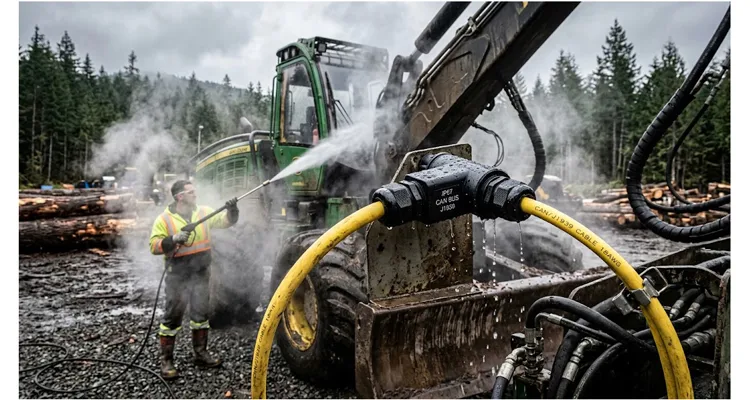
I have watched a harvester operator finish a shift, open the side door, and point a hot-water pressure washer straight at the valve block. He was not doing anything careless by forestry standards. He was cleaning the machine. The CAN bus did not go down immediately. It went down the next morning, then came back after the sun warmed the connector body. That is the normal life of a forestry CAN network if the connectors are not specified for water.
The mistake is not always the pressure washer. The mistake is assuming that a connector that survived a truck engine bay or an agricultural implement will survive a logging site. It usually will not.
The Washdown That Finds Every Weak Connector
A forestry machine gets washed in a way that no passenger vehicle ever gets washed. The operator is not detailing a car; he is blasting off a week of resin, sawdust, and frozen mud. The water is hot. The pressure is high. The nozzle is close. The operator is tired and aiming at the places where chips, pine resin, and hydraulic oil collect. That means the CAN connectors, the bulkhead pass-throughs, the boom harness, the joystick base, and the chassis frame connectors all get hit.
One case that stays with me came from a contractor running a Tigercat 630C in northern Alberta. The machine would intermittently lose the joystick, throw J1939 communication errors, and then recover after an hour. The pattern was always after washdown. The ECU was dry. The problem was a four-pin DT-style connector at the boom bulkhead. Water had wicked past the rear wire seal because the cable outside diameter was 0.2 mm under the minimum seal range for that connector. That is all it took.
Water did not pour in. It migrated in slowly, sat against the pins, and formed a weak conductive path between CAN_H and CAN_L. The network did not fail hard. It failed just enough to corrupt frames.
Forestry Is Not a Truck Application
It is tempting to reuse a proven automotive or off-highway connector family and call the job done. I have been on both sides of that decision, and forestry can be harsher than either. If you have not spent time around a harvester head, the failure modes below will explain why.
Vibration and Shock in Forestry CAN Connectors
A harvester head hits stems, stumps, and rocks. The boom sees continuous impulse loads. The chassis sees torsional twist on uneven ground. A connector that seals well on a test bench can lose its seal face preload after six months of that vibration if the locking latch, coupling ring, or flange mounting is not rigid. I have pulled connectors off a harvester that were still latched but no longer compressed the seal at all, a failure I have seen documented in forestry J1939 harness field repairs.
Temperature Cycles and IP67 Connector Seals
A machine may be shut down at -20°C and then washed with +80°C water. That is a 100-degree thermal shock. The connector shell expands, the seal contracts or hardens, and the wire insulation moves inside the seal. After a few hundred cycles, the seal no longer fills the cavity the way it did when it was new.
Chemical Exposure vs IP67 Sealing Materials
Forestry washdown is not just water. Operators use degreasers, alkaline cleaners, and sometimes diluted hydraulic oil emulsifiers. I have seen an alkaline degreaser used widely by contractors in northern Alberta soften a silicone interface seal to the point where it extruded out of the connector body after one winter. Some of these chemicals attack silicone, EPDM, and PVC. A seal that is fine in fresh water can swell or shrink after repeated contact with a strong degreaser. The result is either a seal that extrudes out of the connector or one that becomes hard and loses compression.
Debris and Mechanical Damage on CAN Connectors
Bark, sap, ice, and dirt pack around connector bodies. The pressure washer removes some of it, but before washing, that debris holds moisture against the connector interface. I have dug bark out from behind a connector with a screwdriver just to get it unplugged. If the connector is mounted horizontally or with the rear seal upward, water can pool and wick along the cable.
The point is simple: forestry is not a clean agricultural field. It is not a truck chassis. It is a high-vibration, high-chemical, high-thermal-shock environment where water is forced into places it was never meant to go.
IP67, IP69K, and the Pressure Washer Reality
On a forestry CAN network, IP67 is not a premium feature. It is the line you do not cross. A connector rated IP65 belongs behind glass, inside a dry cab. The moment it moves out onto the boom or a chassis rail, it is one pressure wash away from taking down the bus.
According to the IP code, IP67 means the connector can sit in a meter of still water for half an hour. A harvester washdown is not still water. It is an 80-degree needle jet moving across the connector at a hand’s width.
IP69K is closer to what the operator actually does. Imagine standing a hand’s width away from a connector with an 80-degree nozzle at close to 1,500 psi. Do that from four directions, half a minute each. That is the test. It is also a Tuesday morning in a Canadian logging yard.
But here is the part that gets missed. Many IP69K connectors are bulky, expensive, and not always available in the connector families that forestry OEMs have already standardized on. So the practical engineering position is this: IP67 is the minimum acceptable rating for any connector on a forestry CAN network that can see water. If the connector will be directly hit by a pressure washer at close range, either use IP69K, shield the connector, move it, or enforce a nozzle-distance rule. You will find more on these trade-offs in forestry J1939 harness protection strategies.
Ingress Protection Comparison
| Rating | Dust | Water | Test Condition | Forestry Reality |
| IP65 | Dust-tight | Low-pressure jets from any direction | 6.3 mm nozzle, 12.5 L/min, 30 kPa at 3 m | Fine for a cab door seal, useless on a harvester head |
| IP67 | Dust-tight | Temporary immersion up to 1 m for 30 min | Immersion tank | Minimum baseline for flooding, splash, and indirect spray |
| IP69K | Dust-tight | High-pressure, high-temperature jets | 80°C water at 8–10 MPa, 14–16 L/min, 100–150 mm | Realistic for daily steam-jet cleaning |
If a machine has an IP65 connector on a CAN node, it is not a question of whether it will fail. It is a question of which wet day it fails.
What Water Did to a Tigercat 630C Boom Connector
SAE J1939 does not tolerate a third resistor. The network is designed around a 60-ohm differential load. Water doesn’t read the spec. It introduces a parallel path that changes the bus impedance just enough to corrupt a recessive bit.
Water Creates a Parallel Resistance Path in CAN Bus
When water sits between CAN_H and CAN_L, it does not usually create a dead short. It creates a high-resistance conductive path. A drop of water with dissolved minerals, detergent, or wood sap can have a resistance anywhere from a few kilo-ohms to several hundred kilo-ohms. That parallel path pulls the differential voltage down and distorts the recessive level.
The result is not always a hard bus-off. Often it is intermittent frame errors. The machine may still run, but the joystick is sluggish, the engine derates, or a node drops out and comes back.
Corrosion Changes Contact Resistance on CAN Terminals
Once water sits on tin-plated or poorly plated terminals, corrosion starts. The contact resistance rises from a few milliohms to several ohms. On a power pin, that creates voltage drop. On a CAN pin, it changes the signal edge and can cause reflections.
The Connector Shell Becomes Part of the CAN Circuit
If water bridges a pin to the shell or to a grounded drain wire, the CAN transceiver may see a short to ground. Some transceivers survive this. Many do not. A failed transceiver inside a sealed ECU is far more expensive to replace than a connector body.
Condensation Inside the IP67 Connector Cavity
Even if no liquid water enters, a warm connector that cools after washdown can draw humid air through a compromised rear seal. That humidity condenses inside the connector. The next cold morning, the network faults. The operator blames the ECU. The actual problem is a connector that breathes.
Sealing Is a System, Not an Ingress Rating
A connector does not seal because it has an IP67 label. It seals because the entire sealing system is correct.
Interface Seal for IP67 Connectors
The interface seal sits between the male and female connector bodies. It must be made of a material that survives the chemicals used on the machine. Silicone is common and flexible, but some degreasers degrade it. EPDM is better in many outdoor applications. The seal must be compressed evenly. A bent latch or a warped flange reduces compression and creates a leak path.
Rear Wire Seal on Forestry CAN Harnesses
The rear wire seal is the most common failure point on forestry CAN harnesses. It is a rubber grommet with individual holes for each wire. The wire outside diameter must fall within the seal’s specified range. If the cable OD is too small, water wicks along the insulation. If the OD is too large, the seal tears or the terminal cannot seat. That 0.2 mm undersized cable in the Alberta 630C is the reason we now check every seal against the actual cable OD, not the drawing’s nominal OD. I have written more about this in forestry J1939 harness failure patterns.
Unused Cavity Plugs in CAN Connectors
Every empty cavity must be plugged. An empty cavity in a 4-pin connector used as a 2-pin CAN connector is an open door for water. I once found a forwarder where two unused cavities had no plugs. After one washdown, the connector body held enough water to cover the pins, and the machine would not communicate until the connector was opened and blown out. The plug must be the correct part for that connector series. A generic rubber plug that does not lock into the cavity can pop out under pressure.
Terminal and Wire Selection for Forestry CAN
The terminal must match the wire gauge and the seal. A terminal that is too small for the wire may cut strands. A wire that is too large for the seal may not enter. For forestry CAN, use high-strand-count wire with cross-linked insulation that does not shrink back when the harness is flexed.
Connector Body Material for IP67 CAN Connectors
The connector body should be glass-filled nylon, PBT, or another engineering resin that resists diesel, hydraulic oil, UV, and cold impact. A cheap nylon body can become brittle at -40°C and crack when a branch hits it.
Key Sealing Elements for a Forestry CAN Connector
| Element | What It Does | Common Failure |
| Interface seal | Seals male-to-female interface | Twisted, missing, or softened by alkaline degreaser |
| Rear wire seal | Seals each wire entry | Wrong cable OD, torn during terminal insertion |
| Cavity plug | Seals unused cavities | Missing or wrong plug |
| Terminal | Maintains electrical contact | Corroded, not locked, or wrong crimp |
| Latch/ring | Keeps connector mated under vibration | Broken or partially seated |
| Shell material | Protects internal seal system | Brittle crack, UV damage, chemical attack |
A connector is only as good as the weakest one of these elements.
A Step-by-Step Audit for a Harvester CAN Network
When I look at a forestry machine that has intermittent CAN faults after washing, I do not start replacing ECUs. I start with the connectors. The following audit takes less than a day on most harvesters.
Step 1: Map Every CAN Node and Connector
Walk the machine and identify every CAN connector on the backbone and the implement bus. Note the connector series, pin count, location, and whether it is exposed to direct washdown. Most forestry machines have a backbone from the cab to the engine, a boom harness, a head harness, and several sensor drops.
Step 2: Identify Connectors Below IP67
Any connector that is not dust-tight or not protected against temporary immersion gets flagged. These are usually Deutsch DT, Amphenol AT, or weather-pack connectors in older machines. Some are only IP65. Those are the first to replace.
Step 3: Check Every Rear Wire Seal on CAN Connectors
Open the connector and inspect the rear seal. The wire insulation should fill the seal hole completely. There should be no gap, no tear, and no hardening. If the cable OD is undersized, use a reducing seal or a different cable.
Step 4: Check Unused Cavities in CAN Connectors
Any empty cavity must have the correct plug. If the plug is missing, do not just fill it with silicone. Install the correct sealing plug. I have seen RTV used to fill an empty cavity, and it popped out after two washdowns because it never locked into the connector body.
Step 5: Check Mounting Orientation for IP67 Connectors
A connector mounted with the rear seal facing up will collect water along the cable and hold it against the seal. I have seen this on forwarders where the boom harness enters a bulkhead from above. The cable acts like a gutter. If possible, mount the connector with the rear seal facing down or route the cable with a drip loop so water runs away from the connector.
Step 6: Define a Washdown Procedure for Forestry CAN
Even with IP67 connectors, do not allow a 150-bar nozzle to be held 50 mm from a connector. Set a rule: keep the nozzle at least 300 mm away from electrical connectors, avoid zero-degree spray tips, and do not dwell on connector bodies. If a connector must be hit directly at close range, it needs IP69K or a shield.
Step 7: Test the CAN Bus After Washing
After the machine is washed, check the CAN bus before it leaves the service area. Do not wait until the next morning. A quick termination resistance check and a fault code scan will catch most water ingress before it becomes a field failure. Using a J1939 9-pin pigtail breakout cable makes it much easier to probe CAN_H and CAN_L without piercing the harness insulation.
Common Mistakes That Look Correct but Are Not
I see the same mistakes repeated across harvesting operations, fleets, and even some machine builds.
Using Dielectric Grease or RTV Silicone as an IP67 Waterproofing Method
Dielectric grease helps with terminal insertion and corrosion prevention, but it does not turn a non-sealed connector into an IP67 connector. I once opened a connector that had been smeared with RTV. The outside was dry. Inside, the tin plating had turned black, and the RTV had formed a dam that held water against the pins for a month. RTV silicone squeezed around a connector body creates a temporary cover, but it traps moisture, makes future service difficult, and often fails after a few thermal cycles. It is a patch, not a fix.
Heat Shrink as a Seal on CAN Connectors
Heat shrink over a connector is not a sealing system. It may reduce direct spray, but it does not seal the interface or the rear wire entries. Water gets under the shrink and stays there. I have pulled heat shrink off a connector that looked perfect from the outside, and the metal shell underneath was wet to the touch.
Reusing Seals After Re-pinning CAN Connectors
When a terminal is removed, the rear wire seal is often damaged. Reusing a seal that has been pierced, stretched, or exposed to solvent is a false economy. A new seal costs almost nothing relative to a field call.
Mixing Connector Manufacturers on CAN Harnesses
A Deutsch-compatible connector body from one manufacturer and a terminal from another may look identical but have different tolerances. The seal may not compress correctly. The latch may not hold. Stick to one connector system, or verify full interchangeability with the connector maker.
Ignoring the Drip Loop on Forestry CAN Harnesses
A harness that runs straight down into a connector will channel water directly to the seal. A drip loop changes the direction of water flow and gives it a place to fall away before reaching the connector.
Using the Wrong Cable Jacket on CAN Wiring
PVC cable jacket can harden and crack in cold weather. A small crack in the jacket lets water travel inside the insulation to the connector. Use cross-linked polyethylene or another forestry-rated jacket material.
How to Confirm the Fix Before the Machine Goes Back to the Woods
Replacing a connector is not the end of the job. You need proof that the network is healthy under field conditions. But after a washdown, a 60-ohm reading is not proof of health. It only tells you the termination resistors are still there. Water can create a 5k parallel path that drops the reading to 55 ohms—not enough to alarm anyone, but enough to corrupt frames.
Check Termination Resistance on CAN Bus
With the machine off, measure resistance between CAN_H and CAN_L at the diagnostic connector. A healthy J1939 network should read about 60 ohms because the two 120-ohm termination resistors are in parallel. If the reading is 120 ohms, one termination is missing. If it is 40 ohms or lower, there may be an extra termination or a conductive path from moisture. A reading of 55 ohms after a washdown is not normal. Investigate before the machine leaves the yard. I go deeper into this in split termination vs 120-ohm guide.
Check CAN Voltage Levels on J1939
With the ignition on, measure CAN_H and CAN_L to ground. On a J1939 network at idle, both lines should sit near 2.5 volts. During active traffic, CAN_H should swing above 2.5 volts and CAN_L below 2.5 volts. A line stuck near ground or battery voltage points to a short or a failed transceiver. If the voltage looks fine but the bus still drops nodes after washing, do not trust it. Water damage is often load-dependent.
Run a Fault Code Scan on the CAN Network
Clear all J1939 diagnostic trouble codes, run the machine through a full function test, and re-scan. Any communication-related code that returns after a washdown means the repair is not complete.
Watch the CAN Waveform for Water Damage
If you have an oscilloscope, probe the bus and look for clean differential edges. Rounded edges, excessive ringing, or a reduced differential voltage can indicate a marginal connector, corrosion, or a wiring issue. For a practical guide on what to look for, see reading J1939 waveforms like a pro.
Do a Controlled Washdown Test on IP67 Connectors
Wash the machine the way the operator normally would, then test again. If the network survives three consecutive washdown cycles with no communication faults, you have a real fix.
Typical 4-Pin CAN Connector Reference
| Pin | Typical J1939 Function | Common Wire Color |
| A | Battery positive | Red |
| B | Ground | Black |
| C | CAN_H | Yellow |
| D | CAN_L | Green |
This is an example only. Always confirm against the machine schematic. Wire colors and pin assignments vary by OEM and connector series.
What We Do Differently When Building Forestry CAN Harnesses
I work on the manufacturing side now, not just on the service side. That changes how I look at connectors.
Because the crimping stations are set up under IATF 16949, we check crimp height after every setup. In a forestry harness, a loose crimp plus water gives you a green corrosion path that no multimeter will find until the bus is down. The forestry harness line follows the same four-step inspection process we use for our automotive customers: crimp height verification after every terminal setup, pull-force testing on sample crimps, continuity testing on every circuit, and a final visual inspection under magnification.
The warehouse is climate-controlled and managed under 5S. That matters more than people think. An EPDM seal stored next to a hot compressor for a summer will not perform like the drawing says. We keep seal material and finished assemblies in a controlled environment so the components behave the way they were specified.
We are a direct factory, not a trading company. We have been building cable assemblies for more than twenty years. That means we can match connector series, pinout, cable length, color, AWG, and branding without asking a customer to re-engineer the machine. We handle RoHS and REACH as a baseline, and our ISO 14001 environmental management system keeps the factory floor aligned with the same discipline. CE and UL apply to specific cable and connector combinations, and we verify those when the application calls for it.
For OEM customers, we customize the harness to their part numbers. Logo, brand, length, color, AWG, connector orientation, labeling. The point is not to sell a generic cable. The point is to make the harness fit the machine and the service environment.
When to Stop Patching and Replace the Harness Section
There is a point where replacing individual connectors no longer makes sense. If the harness has been re-pinned multiple times, the wires are stiff, the jacket is cracked, or the connectors are from three different series, the best decision is to replace the section.
A new forestry CAN harness section can be built to the correct length with the right connectors, the right seals, and the right cable. It eliminates the accumulated tolerance stack-up from years of field repairs. It also gives you a known baseline for future diagnostics.
Get Engineering Support Instead of Another Guess
If your harvester or forwarder has a CAN fault that only appears after pressure washing, do not guess. A wrong connector choice on a CAN bus can take down the whole machine, and the field cost of downtime is usually far higher than the cost of doing the connector work correctly the first time.
I would rather look at the actual application before recommending anything. If you are dealing with a CAN fault that only appears after pressure washing, send me the machine model and a photo of the connector. I will tell you which seal size is missing.
- Contact Page: https://obd-cable.com/contact/
- WhatsApp: https://api.whatsapp.com/send/?phone=8617307168662&text=Need+Help%3F+Chat+linda+WhatsAPP&type=phone_number&app_absent=0
We are not selling from this page. We are offering engineering support, because that is what a direct factory should do.
FAQ: IP67 Connectors for Forestry CAN Networks
1. Is IP67 enough if I pressure wash my harvester every day?
IP67 is the minimum acceptable rating. It will handle splash, indirect spray, and temporary flooding. If the connector is directly hit by a hot-water pressure washer at close range, IP67 may not be enough. Use IP69K, add a shield, or enforce a minimum nozzle distance. Daily washing shortens the margin. The same connector that survives weekly washing may fail after thirty consecutive days of thermal shock.
2. What is the difference between IP67 and IP69K?
IP67 is tested by temporary immersion in water up to 1 meter for 30 minutes. That is a static test. It does not simulate a pressure washer. IP69K is tested with 80°C water at high pressure from multiple angles. Imagine a hot-water lance held a hand’s width from the connector, moved around all sides. That is IP69K territory. For a harvester, IP69K is closer to reality, but IP67 is the floor.
3. Can I seal a non-waterproof connector with silicone or dielectric grease?
No. Silicone and dielectric grease are not substitutes for an IP67 sealing system. They may provide temporary relief, but they trap moisture and fail with thermal cycling. I have opened connectors where RTV held water against the pins until the tin plating turned black. Replace the connector with a properly sealed unit. Do not patch it.
4. Why do CAN faults show up only after the machine has dried overnight?
This is the classic pattern I saw on the Alberta Tigercat 630C. Water can condense inside a connector as the machine cools. The moisture may not create a fault while the machine is warm. After a cold night, the condensation path changes resistance—often jumping to several hundred kilo-ohms—and causes intermittent CAN errors. The machine may recover after the connector warms up, which makes the fault look like an ECU problem when it is not.
5. How close can I put a pressure washer nozzle to an IP67 connector?
Keep the nozzle at least 300 mm away from electrical connectors. Avoid zero-degree spray tips and do not dwell on connector bodies. If the connector must be hit directly at close range, specify IP69K. A 150-bar zero-degree nozzle at 50 mm will find a way into almost any connector, regardless of rating.
6. What is the most common sealing mistake on forestry CAN harnesses?
The rear wire seal is the most common failure point. Using a cable with an outside diameter outside the seal’s specified range allows water to wick along the wire insulation. That 0.2 mm undersized cable in the Alberta 630C is the reason we now check every seal against the actual cable OD, not the drawing’s nominal OD. Always measure the cable, not the drawing.
7. Can I reuse connector seals when I replace a terminal?
It is not recommended. Rear wire seals are often stretched or torn during terminal removal. A damaged seal is a hidden water path. Replace seals whenever you re-pin a connector. The cost of a new seal is negligible compared to a service call in the woods.
8. How do I test a CAN network after a washdown?
Check termination resistance at the diagnostic connector. It should read about 60 ohms. But after a washdown, 60 ohms is not proof of health. Also check CAN_H and CAN_L voltage levels to ground. Run a fault code scan and, if possible, view the CAN waveform with an oscilloscope. Repeat the test after several washdown cycles. A network that passes once but fails on the third washdown was never fixed.
9. Do I need to replace the whole harness or can I splice in new connectors?
For a single damaged connector, a proper replacement with the correct seal and terminal is fine. But if the harness has multiple failed connectors, cracked insulation, or mixed connector series, replacing the harness section is usually more reliable. A new section eliminates the accumulated tolerance stack-up from years of field repairs and gives you a known baseline.
10. Can you build a forestry CAN harness to our OEM part numbers and lengths?
Yes. We are a direct factory with more than twenty years of cable assembly experience. We can match connector series, pinout, length, color, AWG, and branding. Because we build under IATF 16949, crimp height is checked after every setup. That matters when water is part of the operating environment. Contact us through the Contact page or WhatsApp with your requirements.
