
The first time I watched a pressure washer kill an articulation joint connector, the housing looked perfect. No cracks. No melted pins. The wedge lock was still seated. The failure was water wicking along the wire insulation into the back of the terminal. The operator was using a turbo nozzle at about 85 bar, maybe 40 centimeters away from the joint. He told me the connector was IP67. He was right. But IP67 does not mean what most people think it means.
This article is not a datasheet comparison. I’m not going to tell you that one brand always wins. We crimp, seal, and pressure-test harnesses with both Deutsch DT and Amphenol AT connectors on the same floor. We tested both under pressure washing because we were tired of guessing why field returns on articulated dump trucks and wheel loaders kept showing the same failure signature: intermittent speed sensor drop, intermittent hydraulic solenoid response, or communication faults after the machine leaves the wash bay.
The goal was simple. Find out what actually happens when water hits these connectors at articulation joints. Then figure out which connector survives, which one fails, and why.
The Wash Bay Failure That Sent Us Back to the Bench
A customer running a fleet of 25-ton articulated haulers had a repeating issue. After every pressure wash, one or two machines would throw a speed sensor code. The sensor signal would drop for a few minutes, then return. Sometimes it would stay dead until the harness dried out overnight.
When we cut open the returned harnesses, we found the same thing in most cases: water behind the rear wire seal, not at the face seal. The connector body was dry inside the pin cavity area. The water had worked its way along the wire strands from the back side of the connector.
That told us two things.
First, the face seal was doing its job. Second, the rear cable entry was the weak point. That is not a connector brand problem. That is a system design problem. But it also means a pressure washer test that only sprays the mated face of the connector is incomplete. You have to hit the rear, the wire exit, the cable tie area, and the backshell. That is what we did.
We also saw a few connectors where the coupling ring had been tightened too hard. The plastic thread on the housing had micro-cracks. Under normal use, those cracks would not matter. Under a 100 bar water jet, water found them.
What Actually Happens When a Pressure Washer Hits an Articulation Joint
An articulation joint is a pivot point. The harness moves. The connector body is exposed to flex, vibration, shock, and direct spray. On a typical articulated hauler, the joint sits near the center of the machine, close to the ground. Road debris, mud, salt, and detergent accumulate there. Then an operator hits it with a pressure washer.
A pressure washer does not just spray water. It atomizes water into a high-velocity mist. That mist can enter gaps that a static submersion test never sees. The dynamic pressure at the surface can be far higher than the 1 meter water column used for an IP67 rating. Our test nozzle at 300 millimeters and 110 bar produced a surface impact that a static submersion test cannot replicate. IP67 only tells you the connector survived 30 minutes under 1 meter of static water. It does not tell you what happens when a 110 bar jet hits the rear seal at a 45-degree angle. This is the core gap between an IP code lab rating and a real wash bay.
On an articulation joint, the connector is rarely hit straight on. It is usually hit from below, from the side, or from behind. Water bounces off the frame, the hoses, and the articulation joint itself. The spray comes from multiple directions within a few seconds. That is the test environment we tried to reproduce.
We also learned that most operators wash the machine with hot water and detergent. Hot water softens seals. Detergent reduces surface tension. That combination lets water enter gaps that plain cold water would not. The same failure pattern shows up in agricultural J1939 cable exposed to chemical washdown, where detergent and vibration work together to pull moisture into the harness.
Deutsch DT and Amphenol AT: Same Footprint, Different Connector
Both connectors share the same basic external geometry. Amphenol AT is designed as an alternative to Deutsch DT. The housings mate. The terminals look similar. The wire seals and face seals are similar in concept. But they are not identical.
The polymer compounds are different. The surface finish is different. The coupling ring detents feel different. The wire seal durometer is slightly different. The terminal retention spring design is different. None of these differences show up on a simple continuity test. They show up after thermal cycling, vibration, flex, and high-pressure washing.
We pulled test samples from our current production batches. We did not hand-pick anything. The connectors came from the same bins we use for customer harnesses. We tested 20 mated pairs of each brand in 2-way and 4-way configurations.
The part numbers we used were the common ones:
- Deutsch DT04-2P / DT06-2S
- Amphenol AT04-2P / AT06-2S
- Deutsch DT04-4P / DT06-4S
- Amphenol AT04-4P / AT06-4S
We used solid copper test leads with known cable OD ranges. We also tested with one deliberately undersized cable to confirm how much the wire seal tolerance matters.
One measurement we took before any water hit the connectors: coupling ring tightening torque. On the Deutsch DT, the ring reached full stop at an average of 0.8 newton-meters. On the Amphenol AT, it stopped at 0.5 newton-meters. That difference sounds small, but when a technician is wearing gloves, it is easier to leave the AT ring half a turn loose. A half-turn loose leaves the face seal under less compression, and a direct pressure washer jet can push water past it.
Lab Setup and Test Results
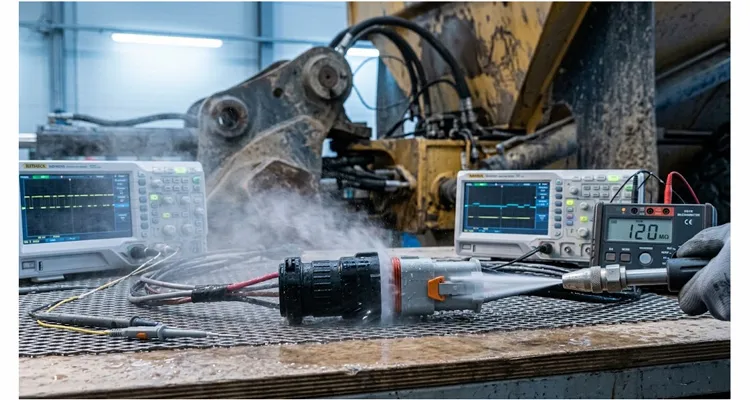
Let me be clear. This was an in-house comparison, not a certified laboratory report. If you need formal IP69K validation for a machine, we can do that as part of a harness development program. But for this article, we ran a practical bench test that matches what happens on a wash pad.
Our test setup:
- Hot water pressure washer, 110 bar, 80 degrees Celsius
- 25-degree fan nozzle
- Distance: 300 mm from the connector
- Spray duration: 30 seconds from four angles: front, rear, left, right
- Mated connectors with no backshell and no protective boot
- Separate test with rear wire exits exposed to direct spray
- After each spray, we opened the connector and checked for water behind the face seal, inside the terminal cavity, and behind the rear wire seal
- We also measured contact resistance before and after using a four-wire milliohm meter
The results were closer than most people would expect.
| Test condition | Deutsch DT04-2P | Amphenol AT04-2P | Time to first water behind rear seal (rear spray, no backshell) |
| Mated, front spray, 110 bar, 80°C | No face seal ingress | No face seal ingress | Not applicable — face seal held on both |
| Mated, rear spray, no backshell | Water behind rear wire seal after 25 seconds | Water behind rear wire seal after 18 seconds | DT: 25 seconds / AT: 18 seconds |
| Mated, rear spray, with sealed backshell | No ingress | No ingress | No ingress after 30 seconds |
| Thermal shock -40°C to 125°C, 50 cycles, then rear spray | No face seal ingress; slight wire seal compression set | No face seal ingress; slightly more wire seal compression set | DT: 22 seconds / AT: 15 seconds after thermal cycling |
| Flex test, 50,000 cycles at 25 mm radius, then rear spray | No ingress | Minor ingress at one sample | DT: no ingress / AT: ingress in 1 of 20 samples after 27 seconds |
| Undersized cable OD, 1.7 mm wire in a seal rated for 2.0–2.5 mm | Ingress after 10 minutes | Ingress after 8 minutes | DT: 10 minutes / AT: 8 minutes |
The main finding was not that one brand failed and the other passed. The main finding was that the cable entry and strain relief determine survival. The connector brand matters less than the installation details.
There was one small difference we noticed. After the thermal shock test, the Deutsch DT wire seals returned to their original shape slightly faster than the Amphenol AT seals. That could matter on a machine that sits outside in cold weather and then gets washed with hot water. The thermal shock is real. We measured the surface temperature of an articulation joint on a cold morning. It was minus 8 degrees Celsius. Ten minutes later, the operator hit it with 80-degree wash water. That is a thermal swing of nearly 90 degrees in a few minutes. The seal material has to recover quickly.
Amphenol AT seals did eventually recover. But the DT seals recovered faster and with less permanent set. If you are specifying a harness for a machine that works in cold climates and gets hot pressure washed, that difference is worth considering.
Where the Differences Show Up in the Field
We also found that the terminal retention spring design differs slightly between the two brands. Both meet the usual retention specs. But after repeated mating cycles and vibration, the Deutsch DT terminals held a few newtons more force on average. The Amphenol AT terminals were still well above the minimum requirement. That is not a failure. It is just a difference.
The coupling ring on the Amphenol AT felt lighter when we hand-tightened it. Some technicians may stop tightening too early because the detent clicks feel softer. We recommend tightening until the ring stops moving. A partially tightened coupling ring leaves the face seal under less compression. Under a direct pressure washer jet, that can let water past the face seal.
We did not see face seal failure on either brand when the coupling ring was fully seated. But if a technician leaves the ring half a turn loose, the face seal will not hold. That is not a brand defect. That is an installation error.
On an articulation joint, vibration can also loosen a coupling ring over time. We recommend adding a visual mark or a small cable tie to show if the ring has rotated. Both brands benefit from that. It is a simple field check.
Specifying a Joint Connector That Survives Pressure Washing
The connector is only one part of the system. If you want a harness to survive pressure washing at an articulation joint, you need to think about the cable entry, the strain relief, the connector orientation, and the wash procedure itself.
Step 1: Choose the connector family based on service and compatibility
If the machine already uses Deutsch DT, staying with DT makes sense. If the harness drawing says Amphenol AT, use AT. Both are valid. Do not mix families on the same machine unless you have a clear reason. The terminals are not always interchangeable, even if the housings mate. We have seen tolerance stack-ups cause loose contacts when customers mixed brands on the same circuit.
Step 2: Check the wire seal ID against the actual cable jacket, not the nominal wire gauge
This is the most common mistake we see. The wire seal has a specific OD range. If your cable OD is 2.1 mm, do not use a seal rated for 3.0–3.6 mm. The seal will not compress enough around the insulation. We tested a 1.7 mm cable in a seal rated for 2.0–2.5 mm. Water wicked along the wire strands and reached the terminal cavity in 10 minutes on the Deutsch DT and 8 minutes on the Amphenol AT. Both failed. The seal must match the actual cable OD.
Step 3: Use a sealed backshell or boot at the rear of the connector
At an articulation joint, the rear of the connector is often exposed to direct spray. Neither Deutsch DT nor Amphenol AT is designed to be sprayed directly from the rear without additional protection. Our test showed water behind the rear wire seal in 25 seconds on the DT and 18 seconds on the AT when no backshell was used. A sealed backshell or an adhesive-lined heat-shrink boot is mandatory — the same principle we apply in harness protection strategies for forestry machines.
Step 4: Crimp correctly and verify pull force
A poor crimp creates air gaps inside the terminal barrel. Water can enter through the wire strands and follow those gaps into the connector. We crimp and then pull test every terminal. For a 20 AWG wire, our pull test is set to 80 newtons minimum. For 16 AWG, 110 newtons minimum. If it moves, it gets cut and re-crimped. We do this on every harness, not just samples.
Step 5: Orient the connector so water runs away from the rear
If the connector is mounted horizontally, water can pool at the rear. Mount it so the rear faces downward or use a drip loop in the harness. That prevents water from sitting at the wire entry. A drip loop costs nothing and can save a connector.
Step 6: Test the completed harness with low-pressure air before installation
We test every harness with 1 psi internal air pressure while the connector is submerged in water. If bubbles appear, the harness does not ship. This test caught two leaking connectors out of a batch of 200 for a North American mining truck customer. Those two were cut and re-terminated. The customer later reported zero harness-related failures after 100 hours of wash bay testing. That is what an outgoing air leak test does.
Five Field Mistakes That Void Your Sealing
- Using the wrong wire seal size. This is the number one issue. The connector can be perfect, but if the wire seal is loose around the cable, water will get in. We proved it with a 1.7 mm cable in a 2.0–2.5 mm seal: 10 minutes to ingress on the DT, 8 minutes on the AT.
- Directing the pressure washer at the connector rear. Operators do this without thinking. A 100 bar jet at 20 cm will push water past almost any rubber seal. Train operators to keep the nozzle at least 30 cm away from connectors and to avoid the rear of the connector.
- Skipping the backshell or boot. The rear wire seal is not designed to handle direct high-pressure spray. It needs mechanical protection. A backshell is not optional at an articulation joint. Our test showed both brands failed within 30 seconds without one.
- Mixing connector brands on the same circuit. Deutsch DT and Amphenol AT housings may mate, but the terminals and seals are not always guaranteed to be a full system match. If you mix brands, you create tolerance stack-ups that can leak. We have seen this in field returns.
- Using silicone grease or sealant as a fix. Some people try to fill the connector with dielectric grease or RTV to stop water. Grease can trap water and cause terminal fretting. RTV can outgas and attack the connector seal material. Fix the sealing system instead of adding goop.
How to Verify the Fix Before the Machine Leaves the Yard
The simplest test is a pressure washer retest. Spray the connector from all angles while the machine is running and the circuit is live. Watch for signal dropouts. If the signal remains stable, open the connector and look for water. You should see none.
A better test is a low-pressure air leak test. Plug one end of the harness, apply 2 psi air to the other end, and submerge the connector in a bucket of water. Look for bubbles. If you see any, you have an ingress path.
We also recommend a four-wire resistance measurement before and after the wash test. A shift of more than 2 milliohms across the connector suggests moisture or terminal movement.
On the machine, add a visible mark on the coupling ring and check it after the first wash. If the ring moved, it was not fully tightened. Retighten and repeat the test.
Related Harness and Connector Support
We build complete harnesses with Deutsch DT and Amphenol AT connectors for articulation joints, sensor circuits, solenoid valves, and communication lines. We do not sell loose connectors as a retail shop. We supply harness assemblies to machine builders, retrofit shops, and fleet maintenance teams. For OEM programs, we also build custom J1939 harnesses to drawing. When routing in tight pivot areas, we frequently use right-angle Deutsch DT breakout cables to keep the rear of the connector away from direct spray and reduce bend strain at the joint. This is the same thinking used in heavy-duty diagnostic cable design, where the rear entry has to survive grease, wash-down, and constant handling.
If you already have a harness drawing, send it to us. We will review the connector selection, wire seal sizes, crimp specifications, and wash-down protection. If you do not have a drawing, send us photos of the failed connector and the cable OD. We can reverse engineer the correct part numbers.
We have been building wire harnesses since 2003 under certified environmental management and automotive quality management systems, with an independently audited quality management system. Our outgoing inspection includes a visual check, continuity, dimensional verification, and a 1 psi air leak test on every harness. That last test is the one that catches most wash-down failures before they leave the floor.
For a specific connector question or a harness sample request, use our contact page to start a technical review. If you are on site and need a quick answer, message us on WhatsApp and send a photo of the washed connector. A picture of the failure saves more time than a written description.
FAQ: Field Questions We Actually Received
Can I use a 2.0–2.5 mm wire seal on a 1.7 mm cable and still pass a pressure wash test?
No. We tested exactly that combination. Water reached the terminal cavity in 10 minutes on the Deutsch DT and 8 minutes on the Amphenol AT. The seal must match the actual cable insulation OD.
What happens if a technician only tightens the coupling ring half a turn on an Amphenol AT?
The face seal will not be under full compression. A direct pressure washer jet can push water past it. We measured the Amphenol AT coupling ring at 0.5 newton-meters full stop versus 0.8 newton-meters on the Deutsch DT. The lighter torque makes it easier to leave the ring loose. Always tighten until the ring stops moving.
Do I need a backshell even if my connector is IP67 rated?
Yes, if the rear of the connector sees direct spray. IP67 is a static submersion rating. It does not test a 110 bar jet hitting the rear wire entry. Our test showed water behind the rear seal in 25 seconds on the DT and 18 seconds on the AT without a backshell. With a sealed backshell, both passed.
Which connector is better for high-pressure washing?
Both Deutsch DT and Amphenol AT passed front spray testing when the coupling ring was fully seated and the rear was protected. The difference showed up at the rear cable entry. Neither brand survives rear spray without a backshell or boot. The deciding factor was installation, not brand.
Why did my connector pass an IP67 test but fail in the wash bay?
Because pressure washing creates dynamic water jets, thermal shock, and detergent exposure. IP67 is a static submersion test. It does not test rear entry, multiple spray angles, or thermal cycling. We measured a thermal swing from minus 8 degrees Celsius to 80 degrees Celsius in ten minutes on a real machine. That is a 90-degree shock the IP67 test never sees.
Does your lab test include chemical wash?
We tested with a 3% agricultural wash detergent at 80 degrees Celsius. Detergent reduces surface tension and makes water penetrate smaller gaps. Both connectors showed increased rear wicking when the cable was undersized, but no face seal leakage when the coupling ring was fully seated.
Can I use Amphenol AT terminals inside Deutsch DT housings?
In some cases they fit, but we do not recommend it. The terminal retention spring design differs. Mixing terminals and housings creates a tolerance stack-up that can lead to loose contacts or water ingress. We have seen field returns from this exact mistake.
What cable OD range do the wire seals accept?
It depends on the seal part number. Common sizes cover ranges like 1.4–1.7 mm, 2.0–2.5 mm, 2.7–3.3 mm, and 3.5–4.0 mm. The seal must match the actual cable insulation OD, not the nominal wire size. Measure the cable jacket with calipers before ordering seals.
Can you build a complete harness with Deutsch DT on one end and Amphenol AT on the other?
Yes, we can build hybrid harnesses if the drawing requires it. But we recommend keeping one connector family per circuit to avoid tolerance issues. If you need a hybrid, we will review the terminal and seal compatibility before quoting.
What is the minimum order for a custom harness sample?
We do not have a fixed minimum for sample evaluation. The sample quantity depends on the harness complexity and connector inventory. Send us your drawing or a photo of the existing harness, and we will provide a sample plan and lead time.
Get Engineering Help Before You Spec the Next Harness
If you are designing a harness for an articulation joint, do not wait until the first field failure. The connector choice is important, but the cable entry, backshell, wire seal, and crimp quality decide whether the harness survives the wash bay.
Send us your harness drawing or a photo of the failed connector. We will help you choose the right Deutsch DT or Amphenol AT configuration, verify the wire seal against your cable OD, and build a sample that you can pressure wash the same day it arrives.
Use the contact page to start a technical review. If you need a fast answer from the floor, message us on WhatsApp. Send the photo. Tell us the cable OD. Tell us the wash pressure. We will take it from there.
