

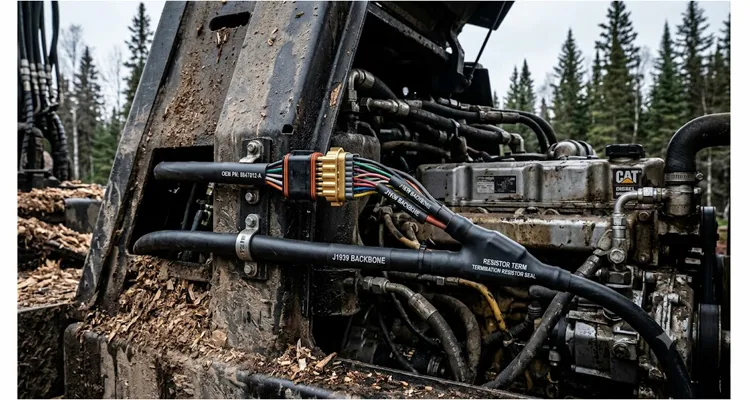
I used to carry a Fluke 1587 and a pocket full of Deutsch terminal picks every time I walked a harvester assembly line. The CAN bus troubles on those machines didn’t announce themselves with a warning lamp. They showed up as intermittent joystick dead zones, a head that wouldn’t tilt for three seconds, or a transmission controller dropping into neutral on a 20-degree slope. Most of those faults traced back to one class of component we all took for granted: the J1939 backbone harness.
After five years in procurement and supplier quality at a forestry equipment OEM, I learned something that doesn’t make it into many component catalogs. Most commercial-vehicle J1939 harnesses get sourced against an SAE J1939/15 physical layer checklist. That document assumes a maximum conductor temperature rise at rated current, not the combined effects of a hydraulic oil mist that softens PVC plasticizer over 1,800 hours. I started spotting the mismatch not in a DVP&R report, but by tracking the Shore A hardness of jacket samples cut from warranty returns. This isn’t a supplier quality problem. It’s a specification mismatch rooted in design assumptions that never left the highway, and it’s the reason more forestry equipment OEMs are walking away from generic harness catalogs and moving toward custom J1939 harness suppliers who understand the physical layer as well as the procurement side.
What I Saw on the Harvester Line
The first harvester I ever tore down for a warranty root-cause analysis had just under three thousand hours. The machine logged repeated “Engine CAN Timeout” faults, and the service tech had already swapped two ECUs before flagging it for engineering review. When we unspooled the main backbone harness, the failure was almost too simple. A J1939 twisted triplet running from the cab controller to the rear node had chafed through its PVC jacket at a frame pass-through. Water had wicked into the insulation, turning the dielectric constant of the cable into something the transceiver couldn’t drive. The termination resistor at the far end was no longer ninety-three ohms to ground—it was a few hundred kilo-ohms across a wet junction. This kind of termination resistance drift is something we later documented in detail when we analyzed J1939 termination resistance drift between hot and cold soak cycles, and it shows up far more often in forestry equipment than any datasheet would predict.Vibration-triggered harness opens at specific engine speeds are another hallmark of forestry CAN bus problems—our field guide to intermittent J1939 faults at 1800 RPM explains how to isolate these failures before they get misdiagnosed as ECU faults.
That harness came from a respected tier-one supplier. It carried all the usual markings: SAE J1939/15, CAN 250 kbps, PVC jacket. The problem wasn’t a manufacturing defect. The problem was that a harness designed around a set of assumptions from the commercial vehicle world had been dropped into an environment where wood chips, hydraulic oil mist, urea exposure, and -30°C cold starts were daily events. Forestry machines flex frames, run high vibration amplitudes in the 20–80 Hz range, and see maintenance intervals that are sometimes measured in rough hours, not calendar time. The electrical architecture—and every custom J1939 backbone harness in it—has to survive that.
Why “Automotive-Grade” Isn’t a Forestry Grade
A procurement team that buys J1939 harnesses the same way it buys truck parts will eventually pay for that shortcut with warranty claims. The term “automotive-grade” means the component meets a set of standards written for on-road platforms—ISO 16750 for environmental loads, typical SAE J1939/11 or /15 physical layer definitions. Those standards assume reasonable shock isolation, controlled routing, and a life target of maybe ten thousand hours in a cab-forward vehicle.
A wheeled harvester or a forwarder operates outside that envelope. Frame twist induces connector body flex that frets the tin-plated terminals. Cold-soak starts at -35°C stiffen a standard PVC jacket until it cracks at bend radii that looked generous on a CAD screen. Biodegradable hydraulic fluid, which many Scandinavian operators run, attacks common jacket compounds in ways that diesel fuel never did.
None of this is theoretical. I’ve had a connector pin microscope tell me the story: a Deutsch DT series contact with tin plating showing 40% exposed base metal after eighteen months. The micro-motion amplitude on that bulkhead connector was under 0.1 mm—completely invisible to the eye—but it was enough to scrub the plating away and create intermittent high-resistance paths. The CAN transceiver sees that as a burst of error frames, the controller increments its fault counter, and eventually the node goes bus-off. The operator sees a machine that “just stops working sometimes.” A custom J1939 harness designed for these vibration profiles would have specified gold-plated terminals from the start.We’ve catalogued the full spectrum of these environmental degradation mechanisms—from hydraulic oil attack to wood chip abrasion—in our guide to forestry J1939 harness protection strategies, which complements the custom harness design approach discussed here.
Procurement’s Blind Spot: The True Cost of a Twenty-Five-Dollar Harness
A standard J1939 backbone harness for a mid-size harvester might cost the OEM somewhere in the range of one hundred and twenty to two hundred dollars on a bill of materials. When it fails in the field, the direct cost story changes completely. I did the math on one campaign: a single unscheduled dealer visit in northern Alberta, factoring in a service truck roll, technician time, and machine downtime during logging season, ran the operator over three thousand seven hundred dollars. The OEM’s warranty exposure—parts, labor, freight on a replacement ECU that wasn’t actually defective—added another two thousand four hundred dollars. Multiply that across forty machines with the same routing defect, and you have a single harness-related issue costing the OEM over two hundred and forty thousand dollars in direct warranty cost, not counting the reputational damage when a contractor’s production stalls.
That’s the exact point where procurement teams stop bidding on unit cost and start writing performance specs. Instead of “What’s the unit price for a J1939 harness?” they ask “Can you build us a harness that will survive sixty-five hundred hours without a single bus fault?” The catalog distributor won’t return your call for a 65-hundred-hour bus-fault-free requirement. A custom J1939 harness manufacturer with in-house engineering will ask for your schematics and schedule a design review.
What a Proper Custom J1939 Harness Supplier Looks Like
After I moved to the supply side, I realized how many factories claim “custom cable assembly” capability but really mean they’ll change the length and put a different label on the bag. That’s not what a forestry OEM needs. What the OEM needs is a factory that can sit down with the machine’s electrical schematics, review connector pinouts against the DBC file, suggest alternative connector families for high-vibration nodes, and produce prototype custom J1939 harnesses within a working week.
The facility I work with now operates on a different model. It’s a direct factory with over twenty years of experience building specialized vehicle harnesses, not a trading company re-selling off-the-shelf assemblies. We don’t store raw cable stock in a general warehouse bay. The PP/PE compounding lines that extrude our forestry-grade jacket compounds feed directly into an environmentally controlled room kept at 22°C ±2°C. That number isn’t arbitrary. We traced a lot-to-lot variation in cold-bend performance back to a humidity swing in our old storage area—the polyurethane pellets had absorbed moisture before extrusion. The fix was capital-intensive, but it made the IATF 16949 process audit we passed a direct business result rather than a paperwork exercise. The shop floor runs under 5S discipline, and every custom J1939 harness goes through a four-step inspection sequence—continuity, hipot, dimensional check, and visual under magnification—but the one that catches forestry-specific latent defects is the hipot test run after the connector bodies have been thermal-shocked from -40°C to 85°C. We added that step three winters ago after a batch of DT-XT connectors passed room-temperature hipot but arced through a micro-crack in the interfacial seal when a harvester cold-soaked overnight in northern Sweden. This is what we mean when we say our harnesses meet ISO 9001, UL, CE, REACH, and RoHS compliance—and that our environmental management system is certified to ISO 14001—they are not badges, they are engineering outcomes.
More importantly for the engineering discussion, the factory has the equipment to test what it builds: programmable vibration shaker tables, thermal cycling chambers, salt fog cabinets. When a forestry OEM asks “Can this connectorized backbone survive our 3-axis vibration profile at -30°C?” the answer isn’t a guess. It’s a test report.
Customization Parameters That Actually Change Reliability
Matching AWG and Jacket Compound to Forestry Conditions
A seasoned engineer specifying a custom J1939 harness for a forwarder or a tracked feller buncher won’t ask for “better quality.” They’ll ask for specific things. The conductor AWG has to match the maximum current draw on the network, accounting for cold-crank voltage sag and connector contact resistance. The jacket compound matters more than the conductor gauge in most forestry applications: a polyurethane jacket with a Shore A hardness in the mid-80s will survive hydraulic oil immersion and abrasion against a steel frame rail, while a standard PVC jacket won’t last two thousand hours.
Advanced Connector Customization and Shield Strategy
Connector selection goes deeper than “Deutsch vs. Ampseal.” A custom J1939 harness supplier can key connectors uniquely so that a field technician cannot accidentally swap the front and rear chassis harness branches during a rushed repair. They can specify gold-plated terminals with a minimum 30 micro-inch plating thickness in the mating zone, which holds up under fretting conditions where tin would fail. They can integrate the 120-ohm termination resistor inside an overmolded connector body so it’s never exposed to moisture or physical damage. They can add a single-point shield drain strategy that avoids ground-loop noise, and they can laser-mark every branch with the OEM’s part number, revision, and a date code for full traceability.
All of this is customization that a catalog supplier simply won’t touch. And it’s available at a direct factory without markup from intermediary distributors.
A Harvester Migration in Six Steps: From V-CAN Faults to Zero Recurrence
Let me walk through an actual migration project, with the OEM’s name withheld but the technical details intact. The machine was a wheeled harvester operating in Finland and Sweden. The symptom: periodic “V-CAN Communication Error” codes logged by the central controller, causing the measuring system to freeze for two to four seconds before recovering. The recurring fix from field service had been to reseat connectors, but the faults returned within weeks.
Step 1 – Failure Analysis on Returned Harness
We found moisture ingress at the main bulkhead connector, corrosion on several J1939 high and low pins, and two spots where the PVC jacket had abraded through against a hydraulic hose clamp. The root cause wasn’t mysterious: moisture wicking plus mechanical abrasion.
Step 2 – Design Review Against Machine Routing
The engineering team proposed a bundle of changes: switch the jacket material from PVC to a cross-linked polyethylene compound with a co-extruded nylon overbraid for abrasion resistance; upgrade the bulkhead connector from a standard DT series to an environmentally sealed DT-XT with silicone interfacial seals; increase the wire gauge by one AWG step on the main backbone to reduce voltage drop during cold starts; and move the termination resistor into a sealed, overmolded splice body located on the engine-side branch rather than at the far end of the chassis harness, reducing its exposure.
Step 3 – Prototyping
The factory built six custom J1939 harnesses to the revised specification within four business days and shipped them directly to the OEM’s R&D center.
Step 4 – Validation
The OEM ran those harnesses through a combined vibration and thermal-humidity profile—two thousand hours of 3-axis random vibration at 2.5 Grms, alternating with hot-wet dwells at 65°C and 95% relative humidity. During and after the test, CAN bus error frame counts stayed below the threshold set in the validation plan.
Step 5 – Limited Field Release
A limited field release on ten machines operated by contractors who had reported the original problem most frequently. After one full logging season—roughly two thousand operational hours—none of the ten machines logged a single V-CAN communication fault. The previous twelve-month average for that fleet had been four to six occurrences per machine.
Step 6 – Full Production Cutover
The OEM replaced their generic J1939 backbone with the custom J1939 harness assembly and issued a service bulletin to retrofit earlier machines. Within the following year, warranty claims related to CAN communication on that model dropped to zero. The avoided warranty cost, calculated conservatively, saved the OEM over eight hundred thousand dollars.
Common Mistakes When Specifying J1939 Harnesses for Forestry Equipment
After auditing J1939 harness designs from a dozen different OEMs, I’ve catalogued a set of mistakes that appear repeatedly, even in teams with strong mechanical engineering backgrounds.
Mistake 1 – Ignoring the DBC Pinout
A J1939 harness is not just a cable—it’s part of a network topology. I’ve seen harnesses where the stub length to a display node exceeded one meter, violating the SAE J1939 recommended maximum, simply because the mechanical layout team didn’t coordinate with the controls group. The result was signal reflections that confused the CAN controller—a problem we unpack in our guide to calculating J1939 stub length and reflection timing, where even an extra fifteen centimeters of untwisted stub can corrupt an entire log cycle.
Mistake 2 – Dual-Ended Shield Grounding
On a machine with a steel frame acting as a ground reference, connecting the shield to chassis at both ends creates a ground loop. I once correlated intermittent CAN error spikes with the exact moment the operator engaged the electric-hydraulic grapple saw. The inverter’s PWM switching noise was coupling into the shield and, because both ends were tied to frame ground, the entire shield acted as a radiating antenna. In the CANoe trace, we saw a clean 250 kbps stream suddenly overrun with bit errors, repeating at the inverter’s 8 kHz switching frequency. A single-point ground at the controller end with a floating shield at the far end dropped the error frame count to zero in the same cutting cycle. This same floating-shield principle is what we apply when designing custom J1939 harnesses to avoid the common-mode voltage shifts we’ve measured on dozens of machines—see our guide to measuring and eliminating J1939 common-mode voltage shifts for the exact test setup.
Mistake 3 – Insufficient Connector Mating Cycle Rating
Forestry machines get serviced in the field, and connectors get plugged and unplugged during component replacement far more often than a design FMEA may assume. A connector rated for 50 cycles will degrade by the time a machine has had two hydraulic valve replacements and a cab tilt procedure. In a custom J1939 harness, we always spec connectors rated for at least 500 mating cycles on serviceable nodes.
Mistake 4 – Neglecting Cold-Bend Jacket Performance
A specification that reads “-40°C to 85°C” doesn’t guarantee the cable stays flexible at -40°C. I’ve seen a PVC-jacketed backbone snap its insulation like a twig when a technician tried to reposition it during a winter engine swap. For any forestry equipment wiring harness, the cold-bend test report matters more than the temperature range on the datasheet.
How to Confirm the Fix Actually Worked
A successful custom J1939 harness migration isn’t complete when the first article samples pass lab tests. It’s complete when the field data proves the bus is quiet. The way to confirm that is to instrument a few early-field machines with a CAN bus data logger that captures error frame counts over time, correlated with temperature and vibration exposure. Vector CANoe or a standalone CANalyst-II with a logging script works well. If the error frame count per hundred operating hours drops from double digits to essentially zero, the custom J1939 harness design is working. I’ve also seen OEMs run a simple end-of-line test on every machine: connect the completed vehicle to a diagnostic tool that sends a high-load CAN frame stream while the machine runs through a full hydraulic cycle. Any bus errors triggered during that 30-minute test flag the machine for harness re-inspection before shipment. For teams that want a more rigorous field diagnostic framework, our structured J1939 diagnostic workflow for fleet downtime reduction walks through exactly how to isolate harness faults from calibration or ECU faults without shotgunning parts.
Frequently Asked Questions from Forestry OEM Procurement Teams
What’s the minimum order quantity for a custom J1939 harness?
It depends on the complexity and the engineering time required, but the factory can handle prototyping runs as small as five to ten harnesses. For full production, the line can scale into the thousands per month. Low-volume needs don’t get pushed to the back of the queue.
Can you match existing OEM part numbers and form factors for a custom J1939 harness?
We’ve done this for an OEM whose tier-one supplier discontinued a 16-pin bulkhead connector on a 10-year-old harvester. We pulled the last sample, 3D-scanned the cavity, and matched a current-production Amphenol AT series shell with a modified keying rib. The critical step was verifying the interfacial seal compression against used connectors pulled from trade-in machines. It took seven days from receiving the sample to shipping a drop-in replacement that matched the original form, fit, and function.
What connector families do you support for custom J1939 harness applications?
Deutsch DT, DTM, DTP, and DT-XT series, Amphenol AT and ATP, TE Connectivity AMPSEAL and Superseal, M12 circular connectors with CAN pin arrangements, and others. If the connector has a published datasheet, we can integrate it.
How do you handle shielding for J1939 cables in a forestry environment?
We typically recommend a single-point chassis ground at the controller end with a floating shield at the other nodes. For machines with high electromagnetic interference—like those with inverter-driven electric saw heads—we can specify a foil-plus-braid double shield with a dedicated drain wire and sealed termination. On one forwarder, this eliminated CAN dropouts that occurred every time the saw motor ramped up. The same shielding principles appear in our case study on PTO interference and a fifty-dollar shield fix on a logging fleet.
Do you provide mating connector kits or just the custom J1939 harness?
We can supply fully assembled harnesses with all mating connectors, terminals, seals, and cavity plugs included, bagged and labeled for the assembly line. If you need partial kits, we’ll configure the bill of materials accordingly.
What electrical testing is performed on every custom J1939 harness before shipment?
Every harness we build is 100% tested on an automated test fixture that checks continuity, absence of shorts, and hipot withstand voltage between conductors and to the shield. We can also verify termination resistance and impedance characteristics on request. No sample-based inspection; every single harness gets tested.
How do you support urgent custom J1939 harness prototype requests?
The engineering team can turn a 2D drawing into a sample build within three to five business days, provided the connectors and cable stock are in our climate-controlled warehouse. For long-lead connector series, we carry safety stock of common forestry connectors. Direct WhatsApp communication with the engineering contact helps cut the review time significantly.
Are your custom J1939 harnesses certified for REACH, RoHS, and CE?
All materials we use meet REACH and RoHS requirements. The full-plastic connector designs eliminate heavy-metal risks. Our factory holds UL certification for cable assemblies and complies with CE requirements for products entering the European market.
Can you do custom overmolding and strain relief on a J1939 backbone harness?
Yes. Overmolding is one of our core in-house processes. We can overmold connectors, Y-splices, and terminator housings with polyurethane or thermoplastic elastomer compounds that bond to the jacket and create an IP67 or IP69K-rated seal. This is a common upgrade for forestry harnesses that see high-pressure washdowns.
How do I initiate a design review for a custom J1939 harness and get engineering support?
The most direct path is to send your schematic, a rough 3D routing layout, and any known failure history to our engineering group. You can reach us through the Contact Page on our website, or send a message directly via WhatsApp for a faster initial response. We’ll review your requirements, propose connector and cable alternatives, and if needed, build a proof-of-concept sample before committing to tooling.
If your forestry platform is wrestling with intermittent CAN bus faults that keep pointing back to harness integrity, the fix is rarely a “better” version of what you already have. It’s usually a different specification altogether, one that starts with the machine’s real environment and works backward to the conductor, the jacket, the connector, and the termination. That’s what a custom J1939 harness supplier does—and from a procurement perspective, the numbers on the warranty ledger will tell you whether it’s working long before the operators stop complaining.
You’re welcome to start that conversation without a commitment. A schematic review and a technical discussion don’t cost anything, and they often surface design constraints the spec sheet never mentioned. Reach our engineering team through the Contact Page or send a direct message on WhatsApp—we’ll pick up the thread and take it from the engineering side, not the sales counter.
