

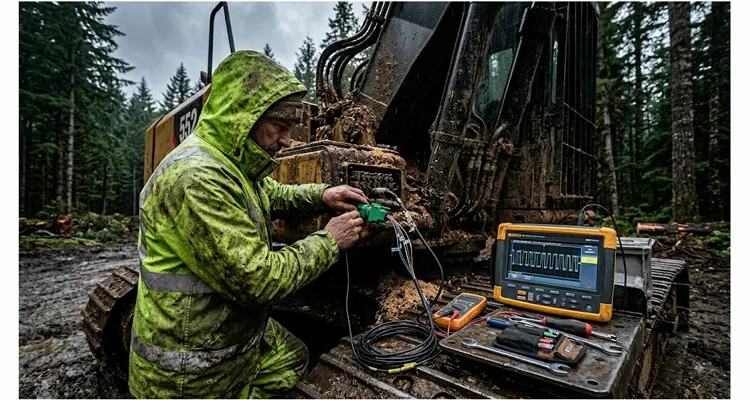
It was the third field repair service call in six weeks for the same feller buncher in a Pacific Northwest forestry fleet, and the logging crew was losing patience. The machine would intermittently lose throttle response, throw a flurry of J1939 communication faults on the display, and then limp itself into a safe state—sometimes with a fully loaded head suspended mid-air. The dealer technician, following the standard heavy equipment diagnostic tree, had already replaced the engine ECM, the joystick node, and a wheel speed sensor that had nothing to do with the problem. Every time, the fault codes cleared, the machine ran fine for a few days, and then the gremlin came back. In my twenty years of building custom wiring harnesses for logging crews, I’ve walked into this exact scenario more times than I can count: the controller gets blamed, the bills pile up, and nobody has looked at the one component that carries every signal between those expensive modules.
The fleet manager called me on a wet Tuesday morning with a question I hear far too often: “What are we missing?”
I told him to stop swapping controllers and start looking at the wiring that connects them. Six weeks later, after we engineered a purpose-built CAN backbone harness—an OEM-grade replacement harness designed specifically for their feller buncher—the phantom failures disappeared. That custom harness upgrade saved the fleet eight thousand dollars in avoided field repairs and unnecessary parts over the next quarter—and that figure doesn’t even include the production hours they got back. This is the story of how a small, overlooked component became the single most cost-effective change that fleet made all year.
The False-Fix Cycle That Drains Forestry Budgets
On a forestry job site, a CAN bus failure rarely starts with a severed wire. It starts with a corrupted J1939 message frame that drops the bus for three hundred milliseconds. The operator might not even notice, but the engine ECU logs a communication timeout. A field tech arrives, reads the historical codes pointing at the engine ECU, transmission controller, or display module, and does exactly what the fault tree recommends: replaces the controller. The fault clears, the machine goes back into production, and the fleet gets a bill for a few thousand dollars. A week later, the same intermittent fault returns. The cycle repeats.
The Invisible Line Items That Add Up Fast
This false-fix cycle costs far more than the invoice for one service call. You pay for the shift that ended early when the machine derated, the fuel burned while it idled waiting for the tech, the second truck roll when the first fix didn’t hold, and the perfectly good ECM now sitting on a shelf as a spare nobody needs. I’ve watched a single misdiagnosed CAN fault generate a cascade of unnecessary purchases—reman ECMs, display modules, even a complete engine harness that didn’t solve the problem because no one had checked whether the backbone wiring was intact.
In the fleet I worked with, the maintenance lead tracked nine separate CAN-related events across five feller bunchers in the three months before we touched the harness. Adding up the field service travel, dead-end diagnostic hours, and three ECMs that were almost certainly not faulty, the real cost exceeded ten thousand dollars. They didn’t have a controller problem. They had a harness problem that had been misdiagnosed from the start.
What the Oscilloscope Diagnostic Showed That the Fault Codes Didn’t
The diagnostic breakthrough came when we connected a digital oscilloscope to the CAN high and CAN low pins at the 9-pin diagnostic connector. For quick, non-intrusive access, I keep a J1939 9-pin breakout cable in my kit—it gives you clean test points for CAN high, CAN low, and ground without back-probing or stripping insulation. On the scope, I expected to see CAN high idling around two and a half volts and pulling toward three and a half volts during a dominant bit, with CAN low doing the opposite. What showed up instead looked like a signal that had spent a season underwater—rounded shoulders, erratic ringback, and frame dropouts that didn’t correlate with any bus traffic I could trigger. This is exactly the kind of waveform anomaly I teach fleets to recognize when reading J1939 waveforms like a pro, because a scan tool will often report “no communication” while the scope reveals a physical layer that is barely hanging on.
A Termination Resistance Reading That Moved With the Harness
We then measured the termination resistance across CAN high and CAN low with the batteries disconnected. With the batteries disconnected, I expected sixty ohms across the bus. Instead the meter jumped anywhere from forty-five to ninety ohms—and it moved every time I flexed the loom near the articulation joint. That kind of swing isn’t a marginal termination; it’s a physical connection that’s making and breaking under strain. A failing J1939 terminator hidden inside a water-logged connector can generate this exact symptom, and I’ve written before about how a twenty-three cent resistor can drive thousands in fleet downtime when it goes intermittent.
What the Backshells Revealed When We Opened Them Up
What we found when we unplugged the main backbone connectors was exactly what years of vibration, temperature swings, and Pacific Northwest rainfall will do to a harness that was never quite right for the environment. The pins had surface corrosion starting at the crimp barrel—that green fuzz that creeps up from the wire strands when moisture breaches the seal. The wire insulation was micro-cracked near the backshells, letting moisture wick into the stranded copper through capillary action. One of the terminal position assurance clips was missing, which allowed the female pin to back out just enough that mating was intermittent. In a logging landing full of dust, hydraulic oil mist, and morning dew, that harness never stood a chance.
The root cause wasn’t a design flaw in the machine. The OEM had installed a production harness built for a light-ag tractor, not for a forestry machine spending ten hours a day on a forty percent slope in Pacific Northwest rain. This is the same failure mode I described in detail when we examined green stick fractures in forestry CAN bus wiring—the harness looks intact from the outside, but the copper strands have snapped inside the insulation.
What a Forestry-Grade CAN Harness Actually Needs
When we sat down to engineer a replacement backbone harness for this fleet, the goal wasn’t to make a harness that merely met the original specification. We approached this as a custom harness design project, not a parts catalog swap. The goal was to build a heavy equipment wiring harness that would survive the real environment and eliminate the intermittent faults that the original wiring had been masking for years.
Conductors: Tinned Copper Wasn’t a Catalog Choice
I chose tinned copper not because the wire catalog recommended it, but because I’d just scraped green corrosion off the original bare-copper strands where moisture had wicked three inches up from the backshell. When you strip a failed wire and find black oxide six inches past the connector, you stop trusting bare copper for anything that lives outdoors. XLPO insulation replaced the original PVC—that feller buncher sat through two seasons of overnight freezes and the old jacket had micro-cracked at every flex point around the boom pivot. PVC hardens with cold and UV exposure; cross-linked polyolefin doesn’t.Thirty-three twists per meter on the CAN pair was non-negotiable; the hydraulic solenoid cables ran parallel for eighteen feet and I didn’t want another round of induced noise triggering phantom error frames. The material choices go beyond the conductor alone—our deep dive into J1939 cable specification explains how jacket compound, shield coverage, and impedance tolerance interact to survive or fail in a logging environment.
Connectors: Gold-Plated Terminals, Not Gold-Flash, and Sealed for Pressure Washers
The connectors became the centerpiece of the upgrade. Every connector body was a sealed Deutsch DT or HD30 series with a full-plastic design to eliminate galvanic corrosion pathways. I’ve seen tin-plated terminals in forestry machines develop white oxide powder within a single wet season; the corrosion product itself becomes an insulating layer that introduces resistance right where you can least afford it. We used solid gold-plated terminals, not gold-flash or tin-only, because a gold-on-nickel interface resists fretting corrosion through tens of thousands of thermal cycles. Each connector received a wire seal and an interfacial seal rated for pressure wash conditions, because nobody on a logging site is going to gently wipe down a connector with a dry rag.
Troubleshooting Features That Pay Back in One Call
We also added two small details that make a disproportionate difference during field troubleshooting. Every connector housing was laser-marked with its function and node address range, and we included a sealed diagnostic breakout tee in a protected location so that the next technician with a scope doesn’t have to back-probe pins in a downpour. When you’re standing in mud with rain running down your collar, the difference between a labeled connector and an anonymous one is the difference between a ten-minute check and a two-hour fishing expedition. That one decision alone saves hours per incident.
How We Build Them: Catching Defects Before the Woods Do
The harness assembly took place on our own factory floor—an ISO 9001, IATF 16949, and ISO 14001 certified facility with over 20 years of wiring harness manufacturing experience—under conditions designed for longevity. Crimp force was monitored on every terminal, not spot-checked. I’ve rejected entire batches of harnesses from other suppliers where one in ten crimps was marginal and the rest passed—in a 40-pin connector, that’s four potential failure points waiting to ruin someone’s shift.
One harness in this batch passed continuity without a single open or short. The hipot test, though, flagged a pinhole in the insulation right where the twisted pair entered the backshell—a defect that would have become a leakage path the first time that forestry machine got pressure-washed. That harness never shipped. Our bench functional test then ran the entire assembly on a simulated J1939 network mirroring the machine’s actual node IDs, checking error frames across three temperature cycles. The warehouse stays climate-controlled for a reason: moisture absorption in nylon connectors before assembly causes dimensional changes that turn into seal failures later. 5S isn’t a poster on the wall; it’s how we make sure the right crimp die ends up in the press for every terminal barrel size. Every custom CAN harness that leaves our shop has passed a 4-step quality inspection and is covered by our commitment to RoHS and REACH compliance.
These are not marketing bullet points. They are the difference between a replacement harness that works for one season and one that works for ten.
Calculating Eight Thousand Dollars in Avoided Cost
Once we retrofitted the first two feller bunchers with the upgraded CAN harness and ran them for a full quarter, the fleet manager pulled the maintenance records. Over the previous quarter, CAN-related failures had triggered six field service dispatches, three controller replacements, and several partial shift losses that together added up to roughly ten thousand four hundred dollars in avoidable expense. In the first quarter after the harness retrofit, the CAN-related service calls dropped to zero. The fleet still had normal maintenance—hoses, cutting teeth, track adjustments—but the mysterious electrical failures simply stopped.
The fleet manager calculated that, net of what they spent on the upgraded harnesses, they saved eight thousand dollars in the first ninety days. That number came almost entirely from avoided field service travel, diagnostic hours, and the ECMs they no longer needed to buy. What the number doesn’t capture is the value of having machines that didn’t strand operators on a hillside in the middle of a production block.
I want to be clear about what this figure means. It is not a return-on-investment projection in a spreadsheet. It is a comparison of actual repair cost records before and after a single hardware change, rounded to the nearest thousand. Nobody extrapolated it. Nobody multiplied small numbers by a thousand machines to make an impressive headline. This was a real fleet, real repairs, and a real saving of eight thousand dollars—because they finally addressed the wiring harness instead of treating the symptoms.
How to Confirm Your Fleet Has a Harness Problem, Not a Controller Problem
I learned these indicators the hard way, chasing CAN faults across logging landings from Oregon to British Columbia. They’re not always definitive, but they narrow the search quickly. If you’ve got a multimeter and ten minutes, you can replicate the basic tests I outline in our guide to J1939 physical layer multimeter diagnostics right on your landing.
The first indicator is failure correlation with motion. On one machine, the fault only appeared when the boom swung past 30 degrees—the harness had worn through the insulation exactly where the paint was rubbed off the frame. The technician had been chasing that fault for two months because the machine always behaved perfectly when parked flat on the landing. If your fault appears when the boom swings to a specific angle or the machine traverses rough ground, suspect a harness that flexes, stretches, or chafes at a repeatable point.
The second is weather dependence. The feller buncher in this story always faulted the morning after a heavy dew, never in the afternoon. By midday the residual heat in the engine bay had driven off enough moisture to restore the connection. Faults that track with rain, condensation, or temperature swings almost always point to insulation breakdown or a connector sealing failure, not a semiconductor failing inside a sealed ECU housing.
The third is a rising error frame count that you can read with a diagnostic tool while the machine still operates. Many controllers track CAN transmit and receive error counts as defined in the CAN protocol specification. If a node’s transmit error counter climbs toward one hundred twenty-eight, that node is going error-passive, and the physical layer—your wiring harness—is the most likely cause. I’ve caught failing harnesses weeks before they caused a single fault code, simply by watching the error counters trend upward on preventive maintenance checks.
A quick table of symptoms and what we actually found in the field helps organize the patterns. These are exactly the kind of forestry J1939 harness failures I’ve documented from real field repairs on logging equipment.
| Symptom Observed | What the Tech Assumed (Wrongly) | What the Harness Was Actually Doing |
| Intermittent loss of engine speed signal over J1939 | “Engine ECU is dropping out again—order a reman.” | Water in the backbone connector was shifting termination impedance; the ECU was fine. |
| Display shows “communication lost” for transmission controller | “Probably that display module going bad—we’ve replaced three already.” | CAN high chafed through to chassis ground where the harness passed through an un-grommeted bulkhead. |
| Multiple nodes drop offline simultaneously, then recover | “Got a power supply issue somewhere in the back.” | Vibration-loosened power pin in a multi-pin interface connector, dropping bus voltage. |
| Random fault codes that self-clear, no performance impact | “Just a software glitch—clear it and send it out.” | Loose terminal position assurance clip allowing pin back-out under vibration. |
| Error-passive state logged in engine hours history | “That controller’s getting old. Start budgeting for a replacement.” | Micro-cracking in wire insulation leading to intermittent capacitive coupling to hydraulic solenoid wiring. |
Once you find these patterns, a ten-minute resistance measurement and a thirty-second scope trace will usually confirm whether the harness is at fault.
What to Ask Before You Order a Replacement Harness
When you’re sourcing a custom CAN harness for your fleet, a few engineering questions separate a genuine heavy equipment harness from an auto-parts lookalike—whether that harness comes from the equipment dealer or a third-party supplier.
The first is about terminal plating. A gold-flash terminal may pass a continuity test on day one but will oxidize after repeated thermal cycling. Flash plating wears thin at the contact interface within the first few hundred mating cycles; what’s left underneath is nickel, and nickel oxide is a semiconductor you don’t want in your signal path. Ask for solid gold plating with a nickel underlayer, and ask to see the terminal specification sheet, not just the connector part number.
The second is about wire strand type and insulation material. Bare copper in a standard PVC jacket has no place on a machine that sees rain, hydraulic oil, and sub-zero starts. I’ve pulled failed harnesses from logging equipment where the PVC had turned brittle as glass after two winters. Tinned copper and cross-linked polyolefin or irradiated PVC insulation adds very little to the bill of materials but dramatically extends the life of the harness.
The third is about testing documentation. A harness that has been continuity-tested only has not been tested enough. Continuity doesn’t catch insulation pinholes, marginal crimps, or impedance mismatches that will generate reflection errors on the bus. Ask whether hipot testing is performed, at what voltage, and whether every assembly receives a functional CAN communication check with error frame monitoring. The facility that builds the harness should be able to supply test records without hesitation.
As a direct factory with over 20 years of experience in custom wiring harness manufacturing, we hold ISO 9001, IATF 16949, and ISO 14001 certifications. Our raw material supply chain complies with RoHS and REACH, and our cable assemblies carry UL and CE marks where applicable. These aren’t just wall decorations—they’re the paperwork trail that proves every custom wire harness was built to survive forestry equipment conditions. We also routinely provide full OEM customization—logo printing, custom color jackets, specific AWG sizing, unique connector keying, and branded heat-shrink labels. That capability matters when you manage a mixed fleet and can’t afford a harness mix-up between a Tigercat and a John Deere machine that use identical connectors but different pinouts.
Frequently Asked Questions from Fleet Teams
1. Why do CAN harnesses in forestry equipment fail so much faster than in on-road trucks?
On this feller buncher, the wiring that ran across the articulation joint was flexed through roughly forty thousand cycles per year—each one a few degrees of twist and a tug on the connector backshells. Add morning condensation inside a logging landing, hydraulic oil mist from a leaky cylinder, and a pressure washer delivering two thousand five hundred psi of cold water after every shift, and you’ve created an accelerated aging test that no on-road truck sees. Most forestry machines fail for exactly these three reasons acting together. For a deeper look at preventing these failures, our forestry J1939 harness protection strategies break down the environmental hardening every logging machine deserves.
2. How can I tell if I’m replacing controllers unnecessarily?
If your shop has replaced the same controller twice and the J1939 fault code returns within twenty operating hours, the chance that the original controller was faulty is extremely low. A re-flash or reset that temporarily clears a fault, only for it to return later, almost always points to a physical-layer issue in the wiring harness, connectors, or termination. I’ve seen fleets stockpile “known good” ECMs that were never bad in the first place—they were just plugged into failing backbone wiring.
3. What’s the simplest test to check my CAN backbone?
With the machine shut down and batteries disconnected, measure the resistance between CAN high and CAN low at the diagnostic connector. You should read approximately sixty ohms. If the value is much higher, a termination resistor or conductor is open. If it’s much lower, you may have a short or moisture bridging. Wiggle the harness while watching the meter; any fluctuation indicates an intermittent fault—exactly what we saw on that feller buncher every time we cycled the articulation. I keep a digital multimeter in my kit for this one test alone, because it exposes more harness faults than any scan tool.
4. Does an upgraded harness require different termination resistors?
No. The SAE J1939 specification calls for a fixed termination scheme. The upgrade lies in how the resistors are packaged and protected. We use sealed, vibration-rated resistor assemblies integrated into the harness rather than exposed resistors inside connectors that can corrode.
5. What if my connectors aren’t standard Deutsch?
We can match whatever connector series your machine uses—Amphenol, Sumitomo, TE MCON, or proprietary interfaces—as long as the connector system can be sourced or an alternative mating design is agreed upon. This is part of our OEM customization scope, and we’ve done it for mixed fleets running equipment from three different manufacturers.
6. How do I begin the harness customization process?
Ideally, provide photos of your existing harness, connector face views, the machine model, and any pinout documentation you have. If you don’t have documentation, our engineering team can work from physical samples and create a reverse-engineered drawing for your approval. We’ve done this hundreds of times for forestry, construction, and material handling fleets.
7. Is there a minimum order quantity?
We support both small engineering sample runs and full production volumes. As a direct factory, we can build a handful of evaluation harnesses for your test machine before scaling to a fleet-wide rollout. No intermediary, no distributor markup.
8. What factory certifications support the build quality?
Our facility operates under ISO 9001, IATF 16949, and ISO 14001 management systems. Materials comply with RoHS and REACH. Harnesses meet relevant UL and CE requirements, and we maintain a 5S-managed, climate-controlled production and storage environment. This isn’t paperwork—it’s what prevents a custom wire harness from arriving with moisture already trapped in the connectors.
9. How quickly can a CAN harness upgrade pay for itself?
In the forestry fleet described, the net saving was eight thousand dollars within one quarter. Your numbers depend on your current failure rate and labor costs, but the pattern is consistent: most fleets see a permanent drop in electrical trouble tickets as soon as the physical layer is made robust.
10. How do I start a technical conversation without a purchase commitment?
You don’t need a part number or a purchase order to talk to us. Send a message via our WhatsApp link or use the contact page on our website with what you’re seeing in the field. We’ll help you think through the problem—whether the solution comes from us or not.
Stop Chasing Fault Codes and Fix the Physical Layer
The logging fleet that saved eight thousand dollars didn’t do anything exotic. They stopped treating every CAN fault code as a computer problem and started treating the communication backbone as a critical mechanical component subject to the same wear and tear as a hydraulic hose or a track pin. The payoff came immediately, not from a software update or a new control module, but from a harness built for the actual conditions it was going to face.
If your fleet is burning through controllers, if your operators are learning to live with warning lamps that flash for no reason, or if your field repair budget is being eaten by electrical diagnostics that never quite resolve, you might be looking at the same silent culprit. A wiring harness isn’t glamorous, but when it’s done right, it’s the cheapest fix you’ll never have to think about again.
When you’re ready to move past field repair band-aids and invest in a purpose-built CAN backbone harness that matches your machine’s pinout, connector specifications, and operating environment, we’re here to engineer the solution with you. As a direct factory, we provide OEM custom harnesses without the distributor markup. No catalog part numbers, no guesswork. Start a conversation on WhatsApp with Linda for a quick technical assessment, or use our contact page to share drawings, photos, and failure histories. We’ll take it from the physical layer up.
WhatsApp: https://api.whatsapp.com/send/?phone=8617307168662&text=Need+Help%3F+Chat+linda+WhatsAPP&type=phone_number&app_absent=0
Contact Page: https://obd-cable.com/contact/
