

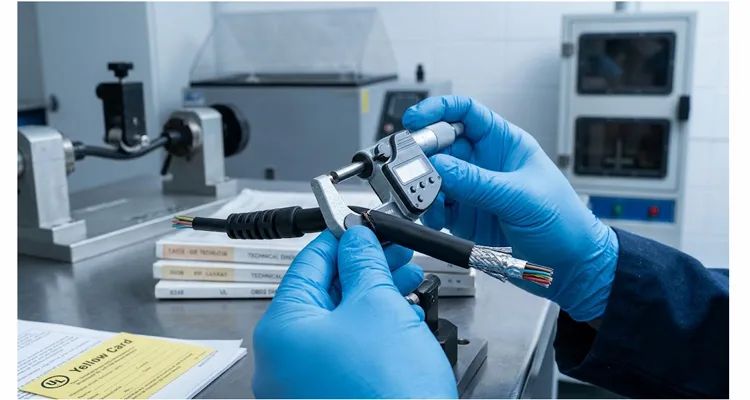
A European diagnostic tool OEM sent us three failed OBD2 extension cables from a production lot marked UL 94 V-0. The returns came from service bays after eight to twelve months. The jacket had cracked 18 to 22 millimeters behind the strain relief. Cross-sections measured 0.94 millimeters at the thin point. The UL Yellow Card for that compound listed V-0 at a minimum thickness of 1.0 millimeter.
That single mismatch explains more than most datasheets admit.
UL 94 V-0 appears on nearly every flame-retardant jacket datasheet. But the rating belongs to a plaque, at a thickness, in a lab. It does not belong to your finished cable. The gap between those two things is where field failures start.
This article is not a materials science introduction. It is what I have learned from returned cable samples, cross-sections, FTIR analysis, flex testing, salt spray testing, and PPAP documentation reviews. If you specify OBD2 cables, J1939 adapter cables, or custom diagnostic harnesses, the details below will tell you where to look before a warranty claim reaches your desk.
What UL 94 V-0 actually certifies — and what it does not
The UL 94 V-0 vertical burn test uses five conditioned specimens. A flame is applied twice for ten seconds. After-flame time, afterglow, burning drips, and cotton ignition are recorded. To pass V-0, the material must self-extinguish within ten seconds after each flame application, with total after-flame across all five specimens not exceeding fifty seconds. No specimen can burn to the clamp. No burning drips can ignite the cotton below.
Those numbers are the pass criteria. They are also where most datasheet readers stop. UL Solutions has published its own explanation of what the UL 94 rating covers and what it explicitly does not cover. The short version: it is a small-scale, material-level test under controlled laboratory conditions. It is not a cable test.
The V-0 rating is assigned at a specific thickness. Look at a UL Yellow Card and you will see language like “V-0 at minimum thickness of 0.062 inches” or “V-0 at 1.5 millimeters to 6.0 millimeters.” That thickness range is a condition of the certification. The material passed at that thickness. It did not pass at every thickness. It did not pass after being bent, stretched, aged, or exposed to plasticizer migration from an overmold.
The UL 94 V-0 test is a material-level test. It is not a cable-level test. It is not a finished assembly test. It is not a service-life test.
This distinction is where most V-0 jacket failures begin. The supplier has a valid certificate. The certificate is for the compound. The finished cable is a different object.
Where the rating stops and your cable starts
The table below shows where a material datasheet stops and a finished diagnostic cable begins.
| Check | Material datasheet | Finished cable |
| V-0 rating | Yes, at a certified thickness | Must be verified at minimum wall thickness |
| Flex performance | Not tested | Must be tested after bend cycles |
| Plasticizer migration | Not tested | Must be checked with overmold and housing materials |
| Salt spray | Not tested | ASTM B117 plus post-exposure flame test |
| PPAP | Not included | Full package required for OEM programs |
| Lot traceability | Usually not linked to cable | Must link compound batch, extrusion lot, and test records |
A V-0 certificate tells you what the compound can do in a lab. It does not tell you what the extruder did with the compound, what the jacket wall thickness is at the thin point, or what happens after ten thousand insertion cycles.
Why OBD2 diagnostic cables expose this gap faster than power cables
An OBD2 cable in a busy workshop sees eight to fifteen insertion cycles per day. Each insertion bends the jacket near the strain relief. The cable is coiled for storage and uncoiled for use. Floor temperature can reach 45 to 55 degrees Celsius in summer. A winter service bay can drop to minus 20 degrees Celsius. A cable routed near a transmission tunnel after a road test can see 70 degrees Celsius.
None of that is in the UL 94 test.
Now add flame-retardant chemistry. To reach V-0, a halogen-free jacket compound often needs thirty to sixty percent by weight of flame-retardant additives. Those additives change the base polymer. They can increase stiffness, reduce elongation at break, and create stress concentrations at the boundaries between additive particles and the polymer matrix. A low-smoke zero halogen compound, for example, typically relies on a high loading of aluminium trihydrate filler — roughly sixty percent by weight — to suppress combustion, which directly affects the mechanical properties of the base polymer.
A neat TPU compound might show 550 percent elongation at break. The same TPU loaded with enough flame retardant to hit V-0 may drop to 320 percent elongation at 55 percent additive loading. The jacket passes the flame test in the lab. It fails the bend test in the field.
I have seen this pattern repeat across suppliers. The datasheet shows V-0. The finished cable fails in six to twelve months. The supplier blames the application. The customer blames the material. Both miss the real issue: the finished jacket was never verified against the conditions that caused the failure.
Three variables that decide whether a V-0 jacket survives
UL 94 V-0 thickness requirement at the thin points
The V-0 rating applies at a specific thickness. On a round diagnostic cable, jacket wall thickness varies around the circumference. At the point where the cable is most compressed during extrusion, the wall may be ten to fifteen percent thinner than nominal. If the UL Yellow Card says V-0 at 1.0 millimeter and your finished cable has a 0.85 millimeter thin spot, that thin spot is outside the certification.
This is why our production floor verifies jacket wall thickness at six points around the circumference. We use a laser micrometer that samples continuously as the cable exits the extruder. When the minimum wall thickness drops below the certified threshold, the line stops.
Flex history before the UL 94 V-0 flame test
The UL 94 test is conducted on as-conditioned specimens. It does not simulate what happens after ten thousand bend cycles. A jacket that passed V-0 in its virgin state may fail V-0 after the polymer chains have been mechanically degraded by flex fatigue. Cracks form. Those cracks create pathways for oxygen ingress and flame propagation.
If your diagnostic cable sees repeated bending in service, and every OBD2 cable does, a material-level V-0 rating is not enough evidence that the finished jacket will remain flame retardant after the bend cycles. This is the same pattern we document in ECU bench flashing cable spec gaps, where a cable that passes a continuity check fails once it becomes an active circuit element under load. Applications that route the cable through a tight 90-degree turn behind a dashboard or within an engine panel are the ones that expose this gap fastest. A 90-degree right-angle J1939 cable for tight spaces exists for exactly that reason: the connector geometry prevents the jacket from being forced into a bend radius it was never validated for.
Plasticizer migration and UL 94 V-0 additive leaching
Many flame-retardant systems rely on additives physically dispersed in the polymer matrix, not chemically bonded to it. Over time, those additives can migrate. Plasticizers from the connector overmold can migrate into the jacket. Heat accelerates the process. Humidity accelerates it. Flexing accelerates it.
I have tested jacket samples from returned cables where the flame-retardant concentration at the outer surface had dropped measurably compared to the as-manufactured compound. The bulk material still passed V-0. The outer surface, the part that actually sees the flame in a real fire, did not. This is a close cousin of the combined vibration and chemical degradation we see in off-highway harnesses, where two stressors acting together reach failure far sooner than either one alone.
Case file: 0.94 millimeter wall, 20 percent surface depletion, 8,000-cycle crack
About three years ago, we received samples from a US-based diagnostic tool manufacturer. Their previous cable supplier had shipped OBD2 extension cables with a jacket marked UL 94 V-0. The cables were failing in the field after eight to twelve months. The failure mode was consistent: jacket cracking near the strain relief, followed by conductor exposure. That failure mode is not limited to one product family. Any diagnostic cable that sees repeated insertion cycles near a connector will eventually show the same pattern if the jacket wall thickness at the bend point falls below the certified threshold.
We cut cross-sections. The nominal wall thickness was specified as 1.2 millimeters. At the thinnest point, we measured 0.94 millimeters. The UL Yellow Card for that compound said V-0 at a minimum thickness of 1.0 millimeter. The thin spot was below the certified thickness.
We then flex-tested samples of the returned cable. At five thousand cycles, the jacket showed microcracks. At eight thousand cycles, the cracks reached the conductor. The as-manufactured cable passed the same flex test out to twelve thousand cycles. Something had changed between the factory and the field.
We sent samples for FTIR analysis. The outer surface of the returned jacket showed a different spectrum than the inner surface. The flame-retardant concentration at the outer surface was approximately twenty percent lower than the bulk material. The jacket had been formulated correctly. The processing had created a skin layer depleted of flame retardant. Over time, that skin layer cracked. Once cracked, the flame-retardant depletion at the crack tip made the failure self-propagating.
The previous supplier had a valid UL Yellow Card for the compound. They had a certificate of compliance. They had test reports showing V-0. What they did not have was a process control system that verified flame-retardant distribution in the finished jacket, not just in the incoming compound.
What we changed in our process after that case
That case reshaped how we approach flame-retardant jackets for diagnostic cables. The methodology matters more than the certificate.
Incoming compound verification for UL 94 V-0 jackets
Every batch of flame-retardant compound receives a coupon test before release to production. We mold a plaque at the certified thickness and run a simplified vertical burn test in-house. It is not a substitute for UL certification, but it catches batch-to-batch variation before the compound reaches the extruder.
Extrusion process control for flame-retardant compounds
We monitor melt temperature, screw speed, and die pressure continuously. Flame-retardant compounds are sensitive to thermal history. A melt temperature spike can degrade the flame-retardant chemistry or cause phase separation in the compound. Our operators have authority to stop the line if any parameter drifts outside the qualified window.
Wall thickness verification at the thinnest point
We sample wall thickness at six circumferential positions. The specification is written against the minimum measured thickness, not the nominal. If the minimum drops below the certified threshold, the cable is rejected.
Post-extrusion flex conditioning and flame test
For diagnostic cables that will see repeated bending, we run a sample from each production lot through a flex test at the application bend radius. After the flex cycles, we perform a flame test on the flexed section. This is not a UL test. It is an internal test that tells us whether the finished jacket still behaves like V-0 after the mechanical abuse it will actually see. For cables designed to reach a port behind a firewall or beneath a dash, the OBD2 extension cable construction matters as much as the protocol it carries. The jacket formulation, strain relief geometry, and temperature rating all influence whether the cable survives the same insertion cycles that a shorter cable would never see.
Salt spray and environmental conditioning per ASTM B117
Diagnostic cables used in mobile service trucks or outdoor diagnostic stations see salt spray and UV exposure. We run salt spray testing per ASTM B117 on jacket samples from each lot. Flame-retardant additives can leach under salt spray exposure. If the post-salt-spray flame test shows degradation, the lot does not ship. The same exposure path can also drive moisture ingress and pin-to-pin leakage current at connector interfaces.
PPAP documentation for diagnostic cable programs
We maintain PPAP documentation for every diagnostic cable program we support. The package includes material certifications, process flow diagrams, PFMEA, control plans, and dimensional results. For OEM customers who need to qualify a supplier, that package gives you an evidence trail that a certificate alone does not provide.
Our factory has more than twenty-one years of direct manufacturing experience. We operate under ISO 9001, ISO 14001, and IATF16949. Products comply with RoHS, CE, UL, and REACH requirements. We use a four-step quality inspection process, 5S management, and a climate-controlled warehouse. Diagnostic cable assemblies are full-plastic design where required and 100 percent tested before shipment.
✅ ISO 9001, ISO 14001, IATF16949, RoHS, CE, UL, REACH
✅ 21+ years factory experience, direct factory
✅ OEM customization: Logo, brand, length, color, AWG
✅ 4-step quality inspection
✅ 5S management + climate-controlled warehouse
✅ RoHS standard, full-plastic design, 100% tested
Five failure signatures I look for in returned V-0 jackets
- Failure signature one: the material rating is treated as the cable rating. The UL Yellow Card is for the compound, at a thickness, in a lab. Your finished cable is a different object. Verify thickness at the thin points. Verify flame performance after the cable is made, not just on the incoming material.
- Failure signature two: the thickness qualifier on the UL Yellow Card is ignored. “V-0 at 1.5 millimeters to 6.0 millimeters” is not the same as “V-0.” If your jacket wall is thinner than the lower bound, the certification does not cover your cable. Ask for the specific thickness range. Measure the actual minimum wall. Compare them.
- Failure signature three: flame-retardant performance is assumed to survive flexing. The UL 94 test does not flex the specimen. Your cable will flex. If the application involves repeated bending, the flame performance after bending is the relevant number, not the as-received performance.
- Failure signature four: a certificate is accepted without a process audit. A certificate of compliance tells you what the material is supposed to be. It does not tell you what the extruder actually did with it. Ask your supplier how they verify flame-retardant distribution in the finished jacket. If the answer is “we buy certified compound,” you have found the gap.
- Failure signature five: plasticizer migration from the connector is overlooked. The overmold or connector housing may contain plasticizers that migrate into the jacket over time. This is especially common with PVC jackets and PVC-based overmolds. The migration changes the jacket’s mechanical and flame properties. If your cable assembly uses different materials for the jacket and the overmold, ask about compatibility testing after thermal aging.
How to confirm a V-0 jacket fix actually worked
I do not trust a single flame test to confirm that a V-0 jacket problem is solved. The test that matters is the one that replicates the failure mode you observed in the field.
- Step one: characterize the failure. Cut a failed jacket. Measure the wall thickness at the failure location. Compare it to the UL Yellow Card minimum. If the wall is thin, you have a processing problem, not a material problem.
- Step two: replicate the flex history. Take a new cable from the fixed production lot. Flex it at the application bend radius for the number of cycles your field data suggests is relevant. Then perform a vertical burn test on the flexed section. If it still self-extinguishes within ten seconds with no dripping, you have evidence that the fix addresses the mechanical aspect of the failure.
- Step three: condition for environmental exposure. If the field failures involved heat, humidity, or salt spray, condition the flexed samples under those conditions before the flame test. A jacket that passes V-0 at room temperature after flexing may fail after thermal cycling or ASTM B117 salt spray exposure.
- Step four: verify the thickness distribution. Take cross-sections at multiple points along the cable length, not just at one location. Verify that the minimum wall thickness across the entire production lot meets the certified threshold. A single thick section does not prove the whole cable is compliant.
- Step five: document the process controls. Ask your supplier for the process control data from the production lot. Melt temperature record. Line speed record. Wall thickness measurement record. If the supplier cannot provide this data, the fix is not verifiable.
Questions to ask before you approve a diagnostic cable jacket
If you are specifying an OBD2 cable for a diagnostic tool platform, or qualifying a new supplier, these supplier qualification questions separate a certified supplier from a compliant one.
- Does your UL Yellow Card specify a minimum thickness for the V-0 rating? What is that thickness?
- How do you verify flame-retardant distribution in the finished jacket, not just in the incoming compound?
- What is your minimum measured wall thickness specification, and how do you measure it?
- Do you perform flame testing after flex conditioning for cables that see repeated bending in service?
- What is your process for detecting plasticizer migration between the jacket and the overmold?
- Can you provide salt spray test data per ASTM B117 on the finished jacket material?
- What PPAP documentation do you maintain for diagnostic cable programs?
- Can you trace a finished cable lot back to the compound batch, extrusion run, and test records?
A V-0 marking on a jacket is a starting point. It is not a finish line.
Failure modes and risk: what happens when the jacket cracks
A diagnostic cable jacket is not just a cosmetic cover. It is the physical barrier between a live electrical conductor and the environment. In a diagnostic port, the conductor carries twelve volts and communicates with the vehicle’s ECU. If the jacket fails and the conductor contacts a grounded metal surface, the best case is a blown fuse and a lost diagnostic session. The worst case is a short circuit in a confined space near flammable materials.
The UL 94 V-0 rating exists because that worst case is real. The test was designed to identify materials that will not sustain combustion and will not drip flaming particles onto materials below. A V-0 jacket that actually performs as V-0 in service is a meaningful safety feature. A V-0 jacket that only performs as V-0 in a laboratory is a liability.
The difference between those two outcomes is not the certificate. It is the engineering discipline behind the certificate: the process controls, the verification testing, and the understanding that a material property is not the same thing as a finished product property.
Related diagnostic cable products and OEM support
If you are working on a diagnostic cable platform and need to specify a jacket that actually performs, we manufacture OBD2 extension cables, J1939 adapter cables, and custom diagnostic harnesses with flame-retardant jacket options. Every diagnostic cable we ship undergoes incoming compound verification, in-process wall thickness monitoring, and post-production flame testing. For OEM programs, we provide full PPAP documentation and can run salt spray testing per ASTM B117 on finished cable samples.
We can customize jacket material, wall thickness, color, cable length, AWG, connector overmold, logo, and brand. Our engineering team can review your application requirements and recommend a jacket construction that meets both the flame rating and the mechanical durability requirements of your specific use case.
If you have a failed V-0 jacket on your bench, send a 30 millimeter section with the connector. We will cross-section it, measure the wall at the thin point, and compare it to the UL Yellow Card minimum. If the compound has a skin-layer depletion issue, we will tell you what to look for in your next supplier audit.
Contact page: https://obd-cable.com/contact/
You can use the contact page to send drawings, specifications, or failure samples. We respond to technical inquiries within one business day. OEM customization and engineering support are available from prototype through production.
FAQ
Q1: Does a UL 94 V-0 marking on the jacket guarantee that the cable will not propagate fire in a vehicle?
No. UL 94 V-0 is a material-level test on a conditioned specimen at a specific thickness. It does not test the finished cable assembly, does not simulate flexing or aging, and does not account for plasticizer migration or additive leaching. A V-0 jacket that has been mechanically degraded or chemically altered may not perform as V-0 in service.
Q2: What is the minimum jacket wall thickness for a V-0 rating?
It depends on the specific compound and the UL Yellow Card. A common flame-retardant TPU may be V-0 at 1.2 millimeters. Another may be V-0 at 0.75 millimeters. Some are certified only at 1.5 millimeters and above. If your extrusion die lands a 0.9 millimeter thin spot, that spot is outside a 1.0 millimeter certification. We measure at six points around the circumference and write the specification against the minimum, not the nominal.
Q3: Why do V-0 jackets fail after flexing when they pass the UL 94 test?
The UL 94 test does not flex the specimen. Flexing creates microcracks in the polymer matrix. Those cracks expose fresh surfaces and create pathways for flame propagation. If the jacket compound has a high flame-retardant loading, the material may be more brittle and more prone to flex cracking. In one returned lot, we saw microcracks at five thousand cycles and conductor exposure at eight thousand cycles, while the as-manufactured cable passed twelve thousand cycles.
Q4: What is plasticizer migration and how does it affect flame retardancy?
Plasticizers are additives that increase flexibility. They are often present in PVC overmolds and connector housings. Over time, plasticizers can migrate from the overmold into the cable jacket. This changes the jacket’s mechanical properties and can dilute the flame-retardant system. A jacket that was V-0 at the time of manufacture may not be V-0 after twelve months of plasticizer migration.
Q5: Can a supplier provide a V-0 certificate without actually achieving V-0 in the finished cable?
Yes. The supplier may have a valid certificate for the incoming compound. The compound may pass V-0 at the certified thickness. But if the extrusion process creates a skin layer depleted of flame retardant, or if the wall thickness at the thin point falls below the certified threshold, the finished cable does not meet the V-0 standard even though the supplier holds a certificate.
Q6: What is a UL Yellow Card and how do I read it?
A UL Yellow Card is the official certification document for a material. It lists the material’s flammability rating, the thickness range at which that rating was achieved, and other relevant properties. When you see “V-0 at 1.5 millimeters to 6.0 millimeters,” that means the material achieved V-0 when tested at thicknesses between 1.5 and 6.0 millimeters. It does not mean the material is V-0 at 0.8 millimeters.
Q7: Does salt spray exposure affect flame-retardant performance in cable jackets?
It can. Salt spray can leach certain flame-retardant additives from the jacket surface. Halogen-free systems that rely on metal hydroxide fillers may be particularly susceptible because the fillers can react with salt solutions. We run ASTM B117 salt spray testing on jacket samples from each production lot and perform post-exposure flame testing to verify that the jacket still meets its rated performance.
Q8: What is PPAP and why does it matter for diagnostic cable jackets?
PPAP stands for Production Part Approval Process. It is a standardized documentation package used in automotive and industrial supply chains to demonstrate that a manufacturing process can consistently produce parts that meet specifications. For diagnostic cable jackets, a PPAP package includes material certifications, process flow diagrams, PFMEA, control plans, and dimensional results. It gives OEM customers an evidence trail that a certificate alone does not provide.
Q9: How can I test a V-0 jacket to verify it will perform in my application?
Flex the cable at the application bend radius for a number of cycles representative of your field conditions. Then perform a vertical burn test on the flexed section. If your application involves heat, humidity, or salt spray, condition the samples under those conditions before the flame test. This gives you a more realistic assessment than a standard UL 94 test on an as-received specimen.
Q10: What should I ask a supplier to prove their V-0 jacket will survive in the field?
Ask for the specific thickness range on the UL Yellow Card. Ask how they verify flame-retardant distribution in the finished jacket. Ask for wall thickness measurement data at the thin points. Ask about flex testing followed by flame testing. Ask about plasticizer migration testing if the overmold and jacket use different materials. Ask for ASTM B117 salt spray test data. Ask for PPAP documentation. A supplier who can answer these questions has the process controls in place. A supplier who cannot is selling certificates, not jackets.
Q11: Does UL 94 V-0 mean the jacket is fireproof?
No. V-0 means the material self-extinguishes within a specified time after the flame is removed and does not drip flaming particles that ignite cotton below the specimen. It does not mean the material will not burn. It does not mean the material will not melt. It means the material will not sustain combustion under the specific test conditions. A V-0 jacket exposed to a sustained external flame will still degrade.
