

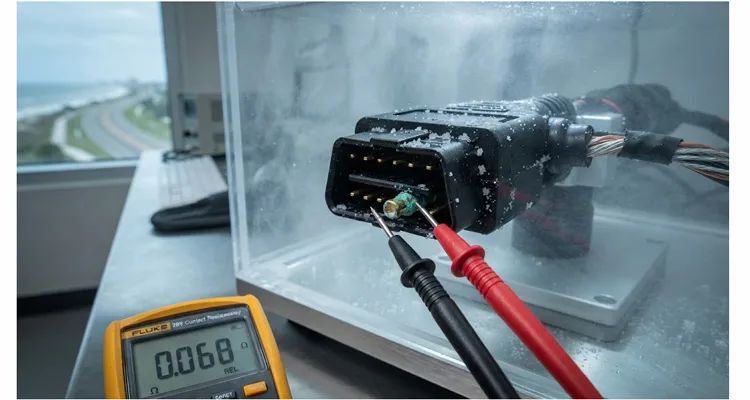
Short answer from our lab: 48-hour salt spray testing is a process control check, not a coastal service-life prediction. For coastal fleet OBD harnesses, specify at least 240 hours neutral salt spray or 15–20 cycles of IEC 60068-2-52 Test Kb, plus post-test contact resistance limits and material traceability. According to the Wikipedia entry on salt spray testing, there is only a weak correlation between salt spray duration and expected service life, especially where drying cycles are important for durability. That is exactly the gap we see in coastal fleet returns.
Our Q2 2025 warranty log contains an anonymized return that shows how far a lab pass can sit from a coastal warranty. A Tampa last-mile fleet returned 63 OBD-II extension harnesses. The vehicles were parked outdoors within 1.2 km of the Gulf. Service time was 14 months. Pins 4 and 5 had risen from 6.8 milliohms to 47 milliohms. The shell showed white zinc corrosion products. The original datasheet listed “48 h salt spray per ASTM B117.” This was the third coastal fleet in 18 months with the same failure signature. The lab work below explains why.
Why 48-Hour Salt Spray Testing Fails Coastal OBD Harnesses
ISO 9227 and ASTM B117 specify a 5% NaCl fog at 35°C. That apparatus standard covers the chamber, the procedure, and the conditions required to create and maintain the salt spray environment. It does not prescribe exposure periods or interpret results for a specific product. On our harness production line, we treat that test as a plating-bath health check. It catches gross plating defects, porosity, and surface treatment gaps. If a connector shell coating is three microns thick instead of five, 48 hours will usually expose it.
The Limits of Continuous Fog Testing
What 48 hours does not do is simulate coastal service life. There is no acceleration factor. A 48-hour pass does not tell you how many years the part will last. The chamber is built to attack the base metal, not to reproduce the wet-dry cycling that actually drives corrosion on a coastal vehicle.
Wet-Dry Cycling vs. Static Chamber Conditions
A connector that passes 48 hours in continuous fog may see almost no salt exposure in a real coastal vehicle during a dry week. The same connector may fail in eight weeks in a Florida parking lot where morning dew deposits salt and afternoon sun bakes it dry. Repeat that cycle three hundred times, and the chloride concentration inside the mated connector can exceed what the static chamber produces.
What 48-Hour Salt Spray Actually Tells You
In our lab, a 48-hour ASTM B117 pass tells us the plating bath is not grossly out of control. It does not tell us whether the connector will survive 18 months near the coast. For coastal validation, we run IEC 60068-2-52 Test Kb, severity 3, and measure contact resistance every two cycles. That is the difference between a process control check and a service-life screen. The IEC standard specifically addresses components designed to withstand a salt-laden atmosphere, which is the environment our coastal fleet customers actually operate in.
The Three Corrosion Mechanisms That 48 Hours Misses
Corrosion in coastal OBD harness applications is not one process. It is at least three simultaneous mechanisms.
Galvanic corrosion. OBD connector pins are often brass or phosphor bronze with tin or gold plating. The shell may be aluminum or zinc alloy. When an electrolyte bridges dissimilar metals, a galvanic cell forms. A 48-hour fog test may show slight discoloration. The galvanic potential difference does not fully express itself until repeated wet-dry cycles concentrate chlorides at the junction points.
Chloride concentration cycles. Salt spray from breaking waves does not deposit once and stop. It deposits, water evaporates, chlorides concentrate, and the cycle repeats. Over weeks, the chloride concentration inside a mated connector can reach ten to twenty times the 5% solution used in the chamber. Continuous fog cannot replicate that concentration mechanism.
Capillary action and creep. We have seen harnesses where salt-mist was drawn into connector pins through capillary action, pulling brine past the seal interface. Once inside, sodium chloride creates a conductive bridge. The 48-hour test does not exercise the thermal cycling that opens and closes those capillary pathways. For a deeper look at how moisture moves through mated connectors, see our notes on moisture ingress and pin-to-pin leakage current.
Lab Comparison: 48 Hours vs. 96 Hours vs. Cyclic Salt Spray
We built a controlled set of OBD-II harnesses with standard construction: PVC jacket, tin-plated brass pins, PA66 connector housing. Sample size was 30 per protocol. The chamber was calibrated before the run. Plating thickness was verified by XRF at 3.1 microns tin over brass. The same wire lot and plating lot were used across all three protocols.
Test Conditions and Sample Size
- Test A: 48 h continuous NSS, ISO 9227
- Test B: 96 h continuous NSS, ISO 9227
- Test C: IEC 60068-2-52 Test Kb, 10 cycles
Test C used two hours spray, four hours humid storage at 40°C and 95% RH, and eighteen hours dry at 60°C. Ten cycles took ten days. The real fleet vehicle experienced something closer to that in four months of coastal operation.
Results and Interpretation
| Protocol | Test condition | Result | Contact resistance change | Visible condition | CAN signal |
| Test A | 48 h continuous NSS, ISO 9227 | Pass | Less than 5% | No visible corrosion | Stable |
| Test B | 96 h continuous NSS, ISO 9227 | Marginal pass | 18% | Slight discoloration at pin-to-shell interface | Stable but marginal |
| Test C | IEC 60068-2-52 Test Kb, 10 cycles | Fail at cycle 8 | 340% | Black oxidation on pins 4, 5, 6 | Intermittent ECM communication from cycle 6 |
The difference between Test A and Test C is not just duration. It is the dry-wet cycling. The dry phase concentrates chlorides and allows oxidation to establish. The wet phase re-wets the surface and drives the electrochemical reaction further. Continuous fog keeps everything wet but does not concentrate anything.
What Field Returns Show
Across 42 anonymized coastal fleet returns in 2024, 71% of failures occurred at the pin-to-housing interface. Mean time to failure was 11.3 months. The common factor was a 48-hour B117 test report and tin-plated brass pins. The second most common failure point was the wire-to-terminal crimp, where salt wicked into the stranded conductor. We have also seen ground-shift errors trace back to shared return paths, which is why we document separated Pin 4 and Pin 5 OBD harness behavior in fleet telematics installs.
Failure Location and Mean Time to Failure
These were not extreme cases. The fleets operated within five miles of a coastline: the Florida Keys, the Texas Gulf Coast, Southern California, the Pacific Northwest, and the Eastern Seaboard. In each case, the original datasheet claimed salt spray testing. In each case, the test duration was too short and the post-test electrical measurements were missing.
Supplier Evaluation Checklist for Coastal OBD Harnesses
When you specify OBD harnesses for a coastal fleet, a standard test report is not enough. Use a weighted scorecard. The thresholds below are the ones we use for coastal-grade diagnostic harnesses.
| Criterion | Weight | Pass threshold | Evidence required |
| Salt spray duration | 25% | At least 240 h NSS or at least 15 Kb cycles | Test report with post-test resistance |
| Plating thickness | 20% | At least 5 microns tin, or 0.2 microns Au over 1.5 microns Ni | XRF certificate |
| Seal integrity | 15% | IP67 mated | IEC 60529 report |
| Batch traceability | 20% | Wire lot, plating lot, assembly date | PPAP Level 3 |
| Factory audit | 20% | IATF 16949, ISO 9001, ISO 14001 | Current certificates |
Step 1: Ask for the Test Standard and Duration
A 48-hour ASTM B117 test is not the same as a 48-hour cyclic test under IEC 60068-2-52. The B117 apparatus standard does not prescribe the exposure period for a specific product, nor does it interpret the results. That is your job as the specifier. For coastal applications, specify one of the following:
- Minimum 240 hours neutral salt spray per ASTM B117 or ISO 9227.
- 15 to 20 cycles of cyclic salt spray per IEC 60068-2-52, Test Kb, severity level 3 or higher.
- An OEM-specific standard such as Ford CETP, GM GMW 3172, or VW PV1210 with extended duration.
For reference, SAE J1455 specifies 96 hours for heavy-duty commercial vehicle applications. Marine-grade connectors often require five hundred or more hours. The automotive underbody standard is 336 hours.
Step 2: Require Post-Test Electrical Measurements
Visual inspection after salt spray is almost worthless for OBD connectors. Contact resistance is the acceptance criterion. Ask your supplier for contact resistance before and after test. A part that doubles its resistance after salt spray is a failed part. Our acceptance limit is no more than 1.5 times the initial resistance, not simply “passes at 50 milliohms.”
Also require insulation resistance above 100 megohms after exposure. We use 500 VDC insulation resistance testing as part of our post-test sequence. For CAN bus circuits, verify that differential signal amplitude remains within specification after the test. A connector can look clean and still kill the bus. Ground offset is another silent killer, which is why we also track the 10 mV rule for ECU ground offset and document OBD2 splitter ground shift DTC storms when shared returns are involved.
Step 3: Verify the Material Stack
Harness construction determines corrosion performance more than test duration alone. For coastal applications, we specify the following.
| Component | Standard construction | Coastal-grade construction |
| Pin plating | Tin over brass | Gold flash over nickel over brass, or thick tin at 5 microns or more |
| Housing material | PA66 | PA66-GF30 or PBT with UV stabilizer |
| Seal material | EPDM or silicone | Silicone with low compression set |
| Jacket | PVC | TPE or PUR with halogen-free flame retardant |
| Overmold | None or basic | Fully overmolded with IP67-rated seal |
Full-plastic connector designs eliminate the metal-to-metal galvanic couple at the shell interface. In our internal comparison, changing pin plating from 3 microns tin to 0.2 microns Au over 1.5 microns Ni changed 480-hour Kb contact resistance from 4.2 milliohms to 5.1 milliohms. The tin-plated control changed from 4.5 milliohms to 38 milliohms. For sealed network applications, our IP67 connectors for CAN networks use the same sealing logic we apply to coastal OBD assemblies.
Step 4: Request PPAP Documentation and Factory Audit
Any supplier can send a sample to a third-party lab and get a pass report. That is not the same as controlling the process. Ask for PPAP Level 3 documentation with dimensional results, material certifications, and process capability data. Ask for in-house salt spray capability with calibration records. A factory that runs its own chambers has immediate feedback on process drift.
Ask for IATF 16949 certification. If the supplier does not have it, they are not serious about automotive-grade quality. Ask for batch traceability back to the wire extrusion lot and the plating lot. We run our own salt spray chambers alongside production. Our climate-controlled warehouse and 5S management system let us trace a failed harness back to the specific plating bath that processed the terminals three months earlier. That traceability is built on the same system we describe in IATF 16949 cable assembly traceability.
What Passing Actually Means After Extended Salt Spray
The measurement session matters more than the visual inspection. After a cyclic salt spray test, we remove the sample from the chamber, rinse it gently in running water, and let it stabilize at room temperature for two hours. Then we measure four things.
Measurement Sequence After Cyclic Salt Spray
First, contact resistance on every pin, not just a sample. A single pin with elevated resistance can kill the CAN bus. Second, insulation resistance between adjacent pins at 500 VDC. Third, withdrawal force on the connector. Salt can deposit inside the housing and change the mechanical fit. Fourth, visual inspection under 10x magnification, specifically looking for corrosion products on pin surfaces and at the seal interface.
Coastal Acceptance Limits
A harness passes our coastal specification if contact resistance changes by less than 25% and no pin exceeds 10 milliohms absolute. That is tighter than most OEM standards. Coastal fleets need tighter margins because the field environment is more aggressive than the lab.
How We Test and Trace Coastal-Grade OBD Harnesses
We do not run salt spray tests only because a customer asks for a report. We run them because field failures create fleet downtime, diagnostic headaches, and warranty claims. Our environmental test lab runs cyclic salt spray alongside continuous NSS. We measure contact resistance on every production lot, not just first articles. We trace every harness back to the wire extrusion lot and the plating bath.
Factory Evidence and Traceability
Our factory has more than twenty years of harness manufacturing experience. We are a direct factory with ISO 9001, ISO 14001, and IATF 16949 certification. Our IATF 16949 milestone is documented in our automotive quality certification page, and our environmental management system is covered under ISO 14001. Products meet RoHS, CE, UL, and REACH requirements. We offer OEM customization for logo, brand, length, color, and AWG. Our four-step quality inspection covers incoming wire, crimp geometry, assembly, and final electrical test. We use 5S management and a climate-controlled warehouse to protect plating and seal materials before shipment.
Engineering Review for Coastal Applications
When a customer tells us they operate in a coastal environment, we do not pull a standard test report from the file. We ask about distance from the coast, annual rainfall, road salt usage, and vehicle duty cycle. Then we recommend a test duration and material stack that match the application.
FAQ: Salt Spray and OBD Harness Selection for Coastal Fleets
Q1: Is 48 hours of salt spray enough for coastal OBD harnesses?
No. For coastal fleet use, our minimum is 240 hours NSS plus 20 cycles of IEC 60068-2-52 Test Kb. In our lab, 48-hour B117 samples failed at cycle 8 of Kb with a 340% contact resistance increase.
Q2: How long should OBD harness salt spray testing last?
For coastal applications, specify at least 240 hours continuous NSS, or 15 to 20 cycles of cyclic salt spray per IEC 60068-2-52. For tropical coastal environments with year-round salt exposure, 720 hours is not unreasonable.
Q3: What is IEC 60068-2-52 Test Kb?
It is a cyclic salt spray test with alternating salt spray, humid storage, and dry storage phases. The cyclic test is more representative of real coastal environments because it exercises the wet-dry cycles that drive chloride concentration and corrosion propagation.
Q4: What plating is best for coastal OBD connectors?
Gold flash over nickel over brass is effective when the gold layer is thick enough and pore-free. Thick tin at 5 microns or more is a lower-cost alternative. Bare gold over brass can accelerate corrosion at pore sites because the small anode-to-cathode ratio drives localized attack.
Q5: What is the contact resistance limit after salt spray?
Our coastal acceptance limit is less than 25% change from initial resistance, with no pin exceeding 10 milliohms absolute. A part that doubles its resistance after salt spray should be treated as failed, even if it still passes a basic continuity check.
Q6: Can dielectric grease prevent OBD connector corrosion?
Dielectric grease helps, but it is not a substitute for proper construction. Grease can be displaced during mating and unmating, and it does not prevent galvanic corrosion at the pin-to-shell interface. It is a supplementary measure, not a primary protection strategy.
Q7: What PPAP documents should I request for coastal OBD harnesses?
At minimum: dimensional results, material certifications with mill lot traceability, process capability studies for critical dimensions, salt spray test reports with post-test electrical data, and a control plan that identifies plating thickness and seal integrity as critical control points.
Q8: How does temperature cycling affect salt spray performance?
Temperature cycling accelerates corrosion by opening and closing capillary pathways. Each thermal cycle can pump electrolyte deeper into the connector. A harness that passes 240 hours of static salt spray may fail 240 hours of salt spray combined with thermal cycling.
Q9: What is the most common failure point on coastal OBD harnesses?
The pin-to-housing interface at the OBD connector. That is where dissimilar metals are closest, electrolyte is most likely to collect, and capillary action is strongest. The second most common failure point is the wire-to-terminal crimp, where salt can wick into the stranded conductor.
Q10: How do I audit a supplier’s salt spray testing capability?
Ask for the chamber model, calibration records, test frequency per production lot, sample size per lot, and post-test acceptance criteria. Then ask to see the chamber during a factory audit. If the supplier cannot show you the equipment and the records, the test report is not a controlled process document.
Engineering Support for Coastal Fleet OBD Harness Projects
If you are specifying OBD harnesses for a coastal fleet and you are not sure whether your current supplier’s test data is adequate, send us the specification. Our engineering team will review it against your distance from the coast, annual rainfall, road salt usage, and duty cycle. We will tell you honestly whether 48 hours is enough for your application. If it is not, we will recommend the exact duration and test method.
OEM Customization and Engineering Support
We support OEM customization for logo, brand, length, color, and AWG. We can provide PPAP documentation, salt spray test reports, and material traceability from wire extrusion to plating bath. For a technical review of your OBD-II harness assemblies, visit our product page at https://obd-cable.com/product/ or send your application details through our contact page at https://obd-cable.com/contact/.
For direct engineering support, use WhatsApp: https://api.whatsapp.com/send/?phone=8617307168662&text=Need+Help%3F+Chat+linda+WhatsAPP&type=phone_number&app_absent=0
WhatsApp: Need help? Chat with Linda on WhatsApp — she can connect you directly with our engineering team for a technical review of your harness specification.
Contact Page: Request an Engineering Consultation — send us your application details, and we will respond with a specification recommendation and a factory capability summary.
