

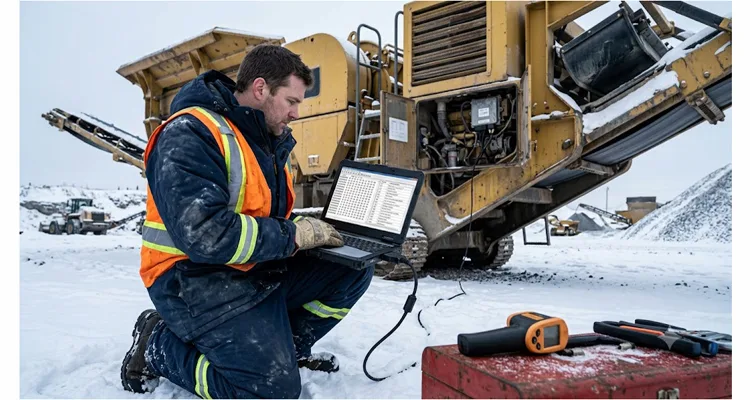
The first time I burned an entire shift on a dictionary mismatch, I was wedged between a generator enclosure and a frozen mud wall in northern Alberta, trying to figure out why a perfectly good thermocouple kept triggering a derate. Eighteen years later, that same knot still tightens in my gut whenever I see two ECUs agree on voltage but go to war over what 0x1A 0x3F actually means. This is the Dictionary War, and if you have ever stared at a raw hexadecimal log and realized your engine controller and your aftertreatment controller are speaking slightly different dialects of J1939, you know exactly what I mean.
This article is not a generic introduction to SAE J1939. There are already a hundred of those online. This is for the engineer who already has a CAN trace, who already knows the PGN and the suspect SPN, and who just realized that the scaling in their .dbc file gives a coolant temperature of 328°C on a cold-soaked engine. Something is off, and you need to cross-reference SPN tables the hard way—when two documents, two ECUs, or two versions of the truth refuse to agree.
When Two ECUs Speak Different Dialects
Last winter I was called out to a mobile rock crusher in northern Alberta. The machine used a Tier 4 Final engine from one manufacturer and a separate aftertreatment control module from another. The dashboard displayed exhaust gas temperature correctly. But the engine ECU‘s broadcast of EGT—SPN 1180—showed a value that fluctuated wildly, triggering a false high-temperature derate every few hours. The site technician had already replaced the thermocouple twice.
What took six hours to uncover was deceptively simple. The dashboard gauge used its own dedicated analog input from the thermocouple—it never touched the CAN bus. The aftertreatment module, however, only knew what the engine ECU told it over the wire. The engine ECU’s internal SPN table defined SPN 1180 with a resolution of 0.03125°C per bit and an offset of -273°C, while the aftertreatment module’s version used 1°C per bit with a 0°C offset. Both were technically “valid” interpretations from different editions of a manufacturer-specific layer on top of J1939-71. Neither device was faulty. The problem was a dictionary mismatch no automatic decoder had flagged.
This is the reality of working with SAE J1939 in complex machinery. SPN definitions are not set in stone. The official SAE J1939-71 document assigns ranges of SPNs and standard definitions, but manufacturers can—and do—create their own within reserved blocks. An SPN like 3350 might be “Aftertreatment Diesel Particulate Filter Soot Load” according to the 2013 standard but could carry a completely different meaning in a proprietary body controller from a different supplier. When you integrate components from separate engineering teams, you inherit their dictionaries. And dictionaries drift over time.
The battle is not really between two ECUs on the wire. It is between two paper trails—two engineering documents, two calibration files, two mental models of what the bits should mean. Your job is to untangle them without corrupting your own sanity.
The Root Cause: Why Dictionaries Diverge
I’ve sketched the J1939 stack on whiteboards so many times I could draw it blindfolded. Physical layer at the bottom. Transport protocol. Parameter groups bundling SPNs. And right at the top—where the real fights break out—are the SPN definitions themselves, scattered across SAE J1939-71 and manufacturer supplements that rarely sit in the same revision. The reasons they drift apart are rarely malicious, but they are consistent.
Edition Gaps: When an SPN Changes Its Meaning
A year earlier, I’d seen an older transit bus where SPN 5215 was happily broadcasting soot load until someone plugged in a 2018 diagnostic tool that insisted SPN 5215 was now reserved. The bus wasn’t broken. The diagnostic laptop was reading from a dictionary that had moved on without informing the ECU. This is the edition gap trap. SAE revises J1939-71 periodically, and an SPN that was “Reserved” in 2007 might get assigned a new meaning in 2016. If an older ECU was calibrated with a 2007-based dictionary and a newer module speaks 2016, you get a collision. The collision is silent—no bus error—just nonsense data.
OEM Proprietary Overlays: The Same SPN, Two Different Lives
Then there are OEM proprietary overlays. A truck OEM may take an SPN that SAE defines for “Transmission Output Shaft Speed” and, inside their own body controller, reuse that same SPN number for “Air Suspension Bag Pressure.” As long as the message lives on a proprietary PGN, SAE rules are not violated. But the moment someone hands you a generic .dbc file that cross-links both PGNs, you have two contradictory definitions sitting side by side in your analysis tool.
Encoding and Slot Drift: When Resolution and Byte Order Collide
Encoding and slot drift introduces a quieter kind of chaos. Even when SPN number and name match, the Data Transfer Function can differ. One ECU might assume 2-byte Motorola encoding with a 0.125 rpm/bit resolution, while another uses 1-byte Intel encoding with 1 rpm/bit. The numbers look plausible in the middle of the range, but at the edges they diverge, and your diagnosis unravels.
Multiplexed SPNs: The Hidden War Inside a Single Message
I once debugged a marine engine where the multiplexor byte lived at position zero but the second supplier’s integration document placed it at byte two. The disagreement only surfaced above 1800 RPM—a classic intermittent J1939 fault that hides below a specific engine speed. Below that threshold, both modes decoded identically. Tracing that took two days and a very patient captain. Multiplexed SPNs reuse the same byte position for different parameters depending on a control byte elsewhere in the packet. If two source documents interpret the multiplexor differently, you get a dictionary war that only appears under specific operating modes.
In the rock crusher case, the root cause was a 2018 service bulletin from the engine manufacturer that adjusted the temperature SPN scaling to improve low-range accuracy. The bulletin was never applied to the aftertreatment ECU‘s reference material because the two components were documented by separate departments. No one had compared the two scaling formulas side by side until we did, manually, in a spreadsheet.
Step-by-Step: Cross-Referencing When Nothing Agrees
When I face a dictionary conflict that automated tools cannot resolve, I follow a process that has proven itself on everything from marine propulsion engines to underground mining loaders. I have written before about how J1939 calibration faults can quietly burn through diagnostic hours—the six-hour rock crusher case in this article is exactly the kind of math you want to avoid. If you want the full framework beyond just dictionary conflicts, I have published a structured J1939 diagnostic workflow that walks through the same methodical approach for any CAN bus fault. It is not glamorous. It involves staring at hexadecimal digits and flipping through PDFs. But it works.
- Step 1: Grab the raw hex and lock it down. Log a clean CAN trace that captures the disputed PGN multiple times. Record the raw hex payload, the source address, and the timestamp. I normally capture at least 60 seconds of CAN bus data spanning cold start, warm-up, and steady state to establish a solid baseline. This is your ground truth. Without it you are arguing about ghosts. A proper J1939 breakout kit lets you see what your scan tool cannot, which matters when the dictionary error you are hunting only appears under specific conditions.
- Step 2: Verify what you’re actually looking at. Strip away the CAN identifier and protocol framing to isolate the data payload. Verify the PGN number from the identifier. Check if the message is a single frame, a transport protocol sequence (BAM/CMDT), or a periodic broadcast. Misidentified multi-frame messages cause dictionary errors that look like SPN conflicts but are actually reassembly bugs. I have seen a BAM/CMDT mismatch masquerade as a calibration fault more than once—the symptom looks like a dictionary problem, but the root cause sits one layer down in the transport protocol.
- Step 3: Round up every suspect document. Pull together every source that claims to define this SPN: the official SAE J1939-71 version you have access to, the engine manufacturer’s supplementary document, the vehicle OEM’s integration manual, and any .dbc or .odx files floating around your network. Label them Document A, B, C. Do not trust any single source yet.
- Step 4: Run the numbers with each candidate. Take the same raw hexadecimal bytes and apply each candidate’s slot definition—resolution, offset, byte length, byte order. Write down the resulting physical values. For SPN 1180 from our rock crusher, Document A gave 685°C, Document B gave 328°C, Document C gave 362°C at the same moment. One of these matched the known ambient temperature plus a reasonable exhaust delta. The others were physically impossible.
- Step 5: Get off the laptop and go touch the machine. This is the step many people skip because it requires leaving the desk. Use an infrared thermometer, a handheld pyrometer, a mechanical gauge—whatever you can safely position near the component—and measure the actual physical condition. Compare it against each decoded value. The definition that produces the closest match within sensor accuracy is your winner. If none match, you have a sensor fault or a wiring issue, not a dictionary war.
- Step 6: Write your own amendment and share it. Once you identify the correct dictionary, create a single source-of-truth spreadsheet that lists the disputed SPN, its proper scaling, and a comment referencing the document that validated it. Share this with every technician and engineer who will ever touch that machine. This spreadsheet becomes your team’s personal “J1939-71 amendment.”
Here is a simplified version of the reconciliation table we used on the crusher:
| SPN | PGN | Byte Position | Candidate A Resolution/Offset | Candidate B Resolution/Offset | Physical Measurement | Correct Definition |
| 1180 | 64973 | Bytes 3-4 | 0.03125 / -273 | 1 / 0 | 362°C (IR gun) | Candidate A (0.03125, -273) |
| 110 | 65262 | Byte 1 | 1 / -40 | 0.5 / -40 | 87°C (coolant temp gauge) | Candidate A |
The table is not beautiful, but it settles arguments.
Five Mistakes That Turn a Dictionary War Into a Losing Battle
Over the years I have watched good people burn whole shifts chasing phantom SPN problems because they fell into one of these traps. I have made every single one of these mistakes myself.
The .dbc Gospel Error
I once spent an afternoon staring at an engine speed reading of 11,265 RPM at idle. The problem wasn’t the sensor, wasn’t the ECU. A .dbc file I’d trusted for two years had a resolution mismatch buried in a comment field—SPN 190 was stated as 0.125 rpm/bit in the comments but actually defined as 1 rpm/bit in the encoding section. A .dbc is a snapshot of someone’s understanding at a single point in time. It may have been reverse-engineered, stripped from a calibration tool, or handed down through three engineering generations with no change log. Treat it as a hypothesis, not a standard.
The Intel-or-Motorola Oversight
J1939 predominantly uses Intel (little-endian) byte ordering, but not always. I’ve seen raw bytes 0x01 0x2C interpreted as 11265 in Intel and 300 in Motorola. That’s the difference between idle and redline on some engines. When in doubt, pull the slot definition from the official spec and verify the byte order manually before you trust a tool’s auto-detection. A solid grasp of endianness helps here; it’s one of those fundamentals that quietly determines whether your decoded value is sensible or nonsense.
The Offset Blind Spot: A Common J1939 Dictionary Mismatch Trap
Many temperature SPNs use an offset of -40°C to cover a wider range with unsigned integers. Forget to apply it and your decoded value is off by exactly 40 degrees. This is so common that when I see a temperature that is exactly 40°C warmer than expected, I immediately check the offset in the definition. I once wasted a morning chasing a coolant temperature reading that turned out to be perfectly normal—after you subtracted 40.
The PGN Assumption Trap
The same SPN number can appear in different PGNs with different lengths. SPN 110 (Engine Coolant Temperature) is defined in the standard EEC1 message as 1 byte. But a manufacturer might also broadcast it in a proprietary 2-byte form for higher resolution. Your candidate definitions might both be right—for different PGNs. Before you blame the dictionary, confirm which PGN you’re actually decoding.
The Latest-Is-Greatest Fallacy
Sometimes the correct definition for a ten-year-old ECU is a ten-year-old version of the standard. A newer document may have reassigned an SPN that the old ECU still uses in its original context. When an engine controller was flashed in 2014 and never updated, the dictionary that governs it is also frozen in 2014. Match your reference to the ECU’s calibration date, not the current year.
How to Confirm You Have Won
A dictionary war ends not when you find the paper definition, but when the data makes sense in the physical world and stays consistent over time.
The first sign of victory is that a known-good physical measurement aligns with your decoded CAN data. On the rock crusher, after we applied the correct scaling for SPN 1180, the exhaust temperature readout matched the IR gun within 3°C across the full operating range. The false derate vanished.
The second sign is that other dependent diagnostics begin to work. If your DPF load calculation uses the corrected SPN, the regeneration triggers should behave predictably. If your dashboard gauge was previously showing nonsense, it now tracks like a normal instrument.
I usually let the machine run through several thermal cycles and log everything again. If the decoded data stays plausible across cold starts, full-load operation, and shutdown, you have solved the conflict.
Then I update every copy of the .dbc file I control, write a short engineering note explaining the change and the physical validation, and store it in a shared location that does not require a password to access. A solved dictionary war should never have to be fought twice.
Tools That Help (and One You Cannot Do Without for ECU SPN Conflict Resolution)
Diagnostic software like PEAK-System’s PCAN-Explorer or Vector’s CANalyzer gives you the raw view you need. A good spreadsheet—Excel or LibreOffice—is where the actual cross-referencing happens. A handheld temperature gun or multimeter provides the physical anchor.
But there is another variable that can ruin all of this work: the physical connection. When you are chasing a dictionary conflict, you are already questioning the data. The last thing you need is a questionable cable adding intermittent frame errors, ground offsets, or signal reflections on the CAN bus. I learned long ago to begin every diagnosis with a known-good J1939 interface cable—one that is properly shielded, 100% continuity tested, and built with the correct termination characteristics. When you need to probe signals directly without disrupting the network, a J1939 9-pin pigtail breakout cable gives you clean access points for your scope or CAN interface. This takes the physical layer off the suspect list immediately.
The One Variable You Must Eliminate: Your Diagnostic Cable
I’ve walked the production floor where our diagnostic cables are built. It’s not glamorous—just rows of test fixtures and a quality team that pulls samples every hour. The facility is ISO 9001 and IATF 16949 certified, but what actually matters to me is that every single assembly passes four inline checks before it reaches the shipping bay. Full-plastic overmold, RoHS and REACH compliant materials, climate-controlled storage that keeps the copper from oxidizing in the monsoon season—these are the things that prevent a cable from ever becoming a variable in your diagnosis. A cable manufactured in January behaves the same as one manufactured in July, and that kind of consistency is non-negotiable when you’re eliminating variables.
If you are working on an OEM integration, a custom diagnostic harness, or a fleet-wide telemetry rollout, and you need a cable that meets a specific pinout, length, branding, or color requirement, that is exactly the sort of project the engineering team handles routinely. We have been doing this for over twenty years as a direct factory, and we have seen nearly every J1939 connector configuration on the market.
Frequently Asked Questions
What exactly is an SPN in J1939?
SPN stands for Suspect Parameter Number, but I think of it as a parameter’s social security number on the bus. In the rock crusher case, SPN 1180 was exhaust gas temperature—a simple value that two ECUs interpreted in radically different ways. It identifies a particular parameter—temperature, pressure, speed, state—within a CAN message. Each SPN is assigned a unique number by SAE, but manufacturers can also define their own within reserved ranges.
Why would two ECUs define the same SPN differently?
Often because the engineering teams that calibrated each ECU used different editions of a manufacturer’s spec. In Alberta, a 2018 service bulletin updated the scaling for the engine controller, but nobody carried that change over to the aftertreatment module’s documentation. Two dictionaries, one SPN, hours of confusion. Other times the SPN was reassigned in a newer standard release, or a proprietary body controller reused an SPN number for an internal function.
Can I rely on a standard .dbc file for all my decoding?
Only after you’ve validated one known parameter against a physical measurement. I treat every .dbc as a working hypothesis. The rock crusher’s file would have sent us in circles forever if we’d trusted it without an IR gun. If the validated parameter checks out, the rest of the file is likely trustworthy. If not, you have work to do.
How do I find the authoritative SPN definition for an older engine?
Go back to the calibration documentation issued when that ECU was flashed. On the rock crusher, the correct definition was hiding in a 2018 service bulletin that had never been cross-applied to the aftertreatment reference materials. If you don’t have the original doc, contact the manufacturer’s application engineering group with the ECU part number and software version. The current production documentation may have moved on.
What is the difference between Intel and Motorola byte order in J1939?
Intel (little-endian) places the least significant byte at the lower address. Motorola (big-endian) places the most significant byte at the lower address. I saw this mistake cost someone a day when bytes 0x01 0x2C were read in Motorola as 300 RPM—perfectly idle—but the tool assumed Intel and reported 11,265 RPM. SAE J1939 prescribes Intel ordering for most standard SPNs, but always check the slot definition.
Can an SPN appear in more than one PGN?
Yes. The same SPN number can be broadcast in multiple PGNs, sometimes with different scaling or length. In the five common mistakes section I mentioned SPN 110 showing up as a 1-byte value in EEC1 and a 2-byte value in a proprietary message. Make sure you are decoding the correct PGN before blaming a dictionary mismatch.
How do I handle an SPN that uses multiplexing?
Multiplexed SPNs depend on a “multiplexor” byte in the same message. I once debugged a marine engine where the multiplexor position differed between two integration documents—the error only appeared above 1800 RPM. You must first decode that multiplexor byte to know which SPN definition applies. Validate the mode with physical observations whenever possible.
What if both candidate definitions look plausible?
Go to the machine and force the parameter to an extreme. Open a valve, disconnect a sensor, redline the engine momentarily. An incorrect definition will usually fall apart at the edges of the range. This is exactly how we caught the 0.03125 versus 1 resolution mismatch on the rock crusher—at cold soak, the bad definition returned physically impossible values.
Should I always use the latest version of SAE J1939-71?
Use the version that matches the production date of your ECUs. For diagnostics, the latest version is informative, but the ECU behaves according to the standard that was current when it was programmed. I’ve seen a 2018 diagnostic tool incorrectly flag an older bus because its SPN list had been updated without backward compatibility notes. The SAE J1939 Digital Annex is a valuable cross-reference tool if you have access to it.
When should I give up and call the manufacturer?
When you have exhausted the physical measurement cross-check and still get nonsensical data, or when the SPN appears to involve safety-critical functions—steering, braking—where a wrong interpretation could cause harm. Swallow your pride and make the call. No one wants to be the engineer who guessed wrong on a brake controller dictionary.
When the Dictionaries Finally Agree
Resolving a dictionary war is one of the most quietly satisfying moments in this line of work. The dashboard gauge settles. The fault lamp stays off. Your decoded log lines up with the physical world. The two ECUs were never really arguing with each other; they were just following different orders. Your job was to translate between them.
If you’re wrestling with a dictionary conflict right now—especially one where a false derate is costing production hours—reach out. We solve these, and we build the cables that won’t add another variable to your CAN trace. Our engineering team is here for technical discussion, custom project consultation, or even just to hear your own Dictionary War story. When you reach out, you talk to people who understand the difference between SPN 110 and SPN 110 misinterpreted.
For technical discussion, custom project consultation, or to share your own dictionary war story:
Chat on WhatsApp: https://api.whatsapp.com/send/?phone=8617307168662&text=Need+Help%3F+Chat+linda+WhatsAPP&type=phone_number&app_absent=0 or send a message through our contact page: https://obd-cable.com/contact/ . No pricing talk, no stock checks—just engineering support and tailored OEM solutions backed by a factory that has been building reliable diagnostic connections for more than two decades.
