

I got the call at 3:14 in the morning. A fleet manager in Ohio, voice cracked from exhaustion, told me three of his seven trucks were dead. Not coughing, not limping—completely unresponsive. Engine control modules wouldn’t wake up. Dashboards lit up like pinball machines and then went dark. The fault codes told a fragmented story: J1939 communication timeouts, ABS node missing, transmission ECU offline, engine ECU silent. His mechanics had been chasing the problem for two days. They’d already swapped an engine ECM, a complete dash cluster, and half a chassis harness. When I asked the single question I ask every time—“What’s the resistance between CAN-H and CAN-L at the diagnostic connector?”—there was a long pause. They hadn’t measured it.
That silence carries a steep price. Here, the tab came to an entire week of lost uptime, more than forty-seven thousand dollars in direct and indirect costs, and a fault repaired with a component worth twenty-three cents at volume: a J1939 terminating resistor.
J1939 Missing Terminator Symptoms: What the Ohio Trucks Taught Us
On the morning the three trucks died, the drivers described something no scan tool recorded. The dash gauges swept, froze for three seconds, then swept again—like a computer repeatedly rebooting. The engine would catch, run cleanly for maybe forty-five seconds, and then cut out as if the key had been turned off. No ECM DTC accompanied the stall because the ECM itself was dropping off the bus before it could log a fault. One technician spent four hours swapping ECMs between trucks, only to watch the “new” ECM exhibit identical J1939 missing terminator symptoms in the suspect chassis and the “suspect” ECM fire up perfectly in a donor truck.
To a technician who hasn’t spent time staring at a CAN scope trace, this mimics a bad ground or a chafed wire. It’s neither. The physical layer degrades in ways that seem almost designed to mislead if you’re not watching the differential waveform. After a battery reset, the CAN bus would sometimes stay quiet long enough for the engine to start, then fill with error frames and force every ECU into bus-off within thirty seconds. That’s the signature of a J1939 backbone missing a J1939 terminator: traffic-dependent collapse, not a hard short. If you’ve been around heavy-duty wiring long enough, you know this script by heart. But if you’re under pressure to return a revenue vehicle to service, the temptation to load the parts cannon is real. That cannon is expensive.
The Measurement That Should Have Been Step One
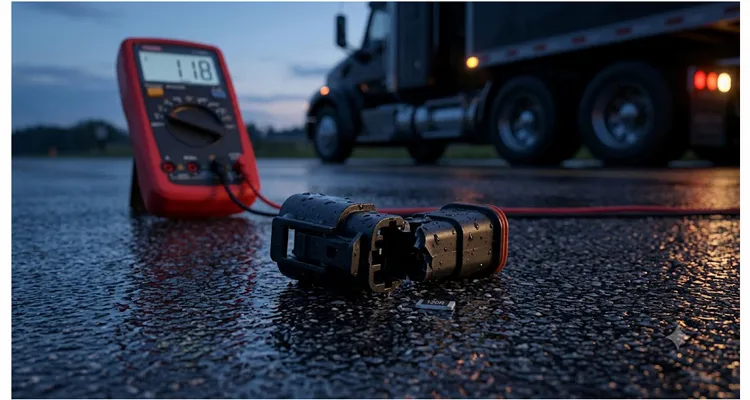
When the Ohio technician finally set his meter to ohms and probed pins C and D of the 9-pin diagnostic connector, the display settled at 118—not the 60 ohms a healthy J1939 backbone should show. That single number told me more than twenty pages of fault codes. With the batteries disconnected, a correctly terminated J1939-11 or J1939-15 pair settles at 60 Ω because the two 120-ohm resistors at the far ends of the bus sit electrically in parallel. One J1939 terminator was clearly still in place, because its 120 Ω mate would have produced a reading near 60 Ω if both were present. The math told me the cab-end J1939 terminating resistor was either absent or so far gone that the network saw an open circuit. Every subsequent measurement confirmed it.
Here is the pin reference for the standard heavy-duty diagnostic connector they were probing, with what we actually found in Ohio added so you can see how the data lined up with the symptom:
| Pin | Signal | Typical Wire Color | Function | Ohio Observation |
| A | Ground | Black | Chassis / battery negative | Clean, low resistance to chassis |
| B | Unswitched | Red | Battery positive (12V/24V) | Stable at 12.6 V |
| C | CAN_H | Yellow | J1939 data link high | Intact, but chafed inside the bellhousing pass-through—not the root cause, found during inspection |
| D | CAN_L | Green | J1939 data link low | Continuity good. DC voltage at rest floated to 0.8 V, indicating a missing termination on one end |
| E | J1708 (+) | – | Legacy data link (if present) | Not used in this chassis |
| F | – | – | OEM-specific | – |
| G | – | – | OEM-specific | – |
| H | J1708 (-) | – | Legacy data link (if present) | Not used |
If you memorize nothing else, remember pins C and D and the number 60 ohms. It takes thirty seconds with a basic multimeter. This one measurement, done before any parts swapping, would have saved that fleet thirty-seven thousand dollars in parts and substitute rental trucks alone. For the full voltage and resistance baselines every technician should keep in their notebook, see our J1939 physical layer multimeter diagnostics guide.
J1939 Physics: Why One Missing Resistor Breaks Everything
Think of the CAN backbone as a rail line. The terminator resistors are the buffers at the end of the track. When the transmission ECU shouts a wheel-speed message onto the bus, that electrical pulse travels the full length of the twisted pair. If it reaches an open end with no J1939 terminator, it turns around and crashes head-on into the next message. The engine ECM, listening for clean data, gets nothing but noise. It shuts its transceiver down to protect itself—a bus-off state. That’s exactly what happened under the cab of those Ohio trucks: with the cab-end J1939 terminating resistor missing, the ABS ECU’s 10 ms broadcasts ricocheted off the open stub and collided with the engine’s torque request. One collision was enough to silence the engine.
A single missing terminator doesn’t just raise the DC resistance from 60 ohms to 120 ohms. It also shifts the recessive DC bias and distorts the AC waveform enough that even a well-designed transceiver can’t recover the bitstream when bus traffic increases. That’s why the problem might hide at key-on with low traffic and then explode the moment the ABS ECU starts broadcasting wheel speed messages. If you want to understand why a single 60-ohm resistor in the middle isn’t a fix and how stub placement dictates reflection timing, read our J1939 split termination vs. 120-ohm guide.
This is not a “maybe” scenario. I once stood on a logging spur in British Columbia and watched a loaded forwarder lose throttle on a 12% grade because of a corroded terminating resistor that had drifted from 120 ohms to 4.7 kiloohms. The driver pulled over, heart racing. The fault codes pointed to a fuel pressure deviation, but the actual culprit was a J1939 terminator with green fuzz inside a cab-mount connector. That resistor, by the way, cost the logging company one full production day, roughly six thousand eight hundred dollars in lost revenue for that single truck. The hardware fix cost cents.
Tracing the Missing Twenty-Three Cent Terminator
Back to the Ohio fleet. Once the resistance measurement confirmed a missing J1939 terminating resistor, we traced the J1939 backbone topology. The trucks were late-model Class 8 tractors with the following logical segment order:
Engine ECM → firewall bulkhead connector → cab harness junction → instrument cluster → chassis harness connector → ABS ECU → transmission ECU → tail-lamp node with an integral terminator
The cab junction had a three-way tee. One leg went to the instrument cluster node. Another leg ran rearward to the chassis. The third leg should have held a 120-ohm resistor molded inside a sealed Delphi-style connector body—the cab-side J1939 terminator. When I asked the technician to inspect that tee, he sent me a photo: the locking tab on the terminator connector was broken. The resistor assembly was simply gone. It had likely been disconnected during a transmission overhaul six months earlier and never reinstalled. Vibration finished the job.
A twenty-three cent metal-film resistor, encapsulated in plastic, had dropped off the truck somewhere on Interstate 70. The electrical ghost it left behind stalled three tractors for five working days.
What the Fleet Had Already Spent Before Finding the Resistor
I asked the fleet manager to tally the costs they’d incurred before I arrived. He sent me the list:
- Remanufactured engine ECM (one unit): two thousand one hundred dollars
- Instrument cluster, new OEM: nine hundred fifty dollars
- Replacement chassis wiring overlay harness: one thousand three hundred dollars
- After-hours diagnostic labor, three technicians at two shifts each: two thousand eight hundred eighty dollars
- Substitute rental trucks to cover haulage contracts, five days: nine thousand six hundred dollars
- Towing and yard shuffling: eight hundred fifty dollars
That subtotal is seventeen thousand eight hundred eighty dollars, and it doesn’t include the lost business from contracts they couldn’t cover, the missed maintenance windows on the remaining trucks, or the overtime paid to office staff who rescheduled loads by hand. The fleet manager estimated the true economic impact exceeded forty-seven thousand dollars. The root cause was a missing twenty-three cent J1939 terminator that nobody measured for.
I have tallied the same grim arithmetic on iron-ore haulers in Western Australia, transit buses in Houston, and workboat gensets in Rotterdam. The hardware cost is always negligible. Discipline with a multimeter is the irreplaceable asset.
Common Traps Even Experienced Technicians Fall Int
Five Diagnostic Mistakes on the J1939 Backbone
Before I explain exactly how to diagnose and verify a J1939 terminator issue, it’s worth listing the wrong turns I keep seeing in service bays and field repair vans:
- Assuming the terminators are inside the modules. On some engines or ABS units, there is an internal J1939 terminator that can be switched on or off by a parameter. If you replace a module and don’t set the terminator configuration correctly, you can accidentally create a double-terminated or zero-terminated segment. This is especially common on agricultural and construction equipment where the same ECU is used in multiple machine platforms. If you’ve already swapped a module and now see a phantom 40-ohm or open-circuit reading, work through our J1939 double termination and switched terminator diagnostic guide to verify the configuration.
- Using a 60-ohm aftermarket resistor “to make it right.” A single 60-ohm part between CAN_H and CAN_L does not replace two 120-ohm resistors. It puts the DC load in the wrong location, unbalances the recessive common-mode voltage, and still leaves one physical end of the J1939 backbone unterminated from an AC perspective. You create a standing wave that might pass a key-on test but fail under vibration or temperature cycles.
- Measuring resistance with the battery connected. CAN transceivers have leakage paths to VCC and ground. If the network is powered, you are measuring the parallel resistance of the transceiver input impedance, not the terminators alone. Always disconnect the batteries and wait for capacitive bleed-off before probing.
- Ignoring connector body integrity. The J1939 terminator resistor almost always lives inside a plastic connector shell with weather sealing. If the shell is cracked, water and salt creep in, driving the resistor value up slowly over months. The bus doesn’t fail abruptly—it degrades, causing intermittent errors that get blamed on “glitchy software.”
- Pin drag and spread terminals. The small female terminals that receive the terminator’s male blades can relax over time. I’ve seen cases where the resistor measured 120 ohms in free air but made only a few hundred milliohms of contact once mated. The resulting intermittent open circuit mimics a missing J1939 terminator perfectly. Always check terminal retention with a drag test pin before declaring a resistor dead.
How We Build Components That Don’t Invite This Kind of Failure
The Four-Step Quality Gate That Caught a Near-Miss
Two years ago, a batch of 120-ohm metal-film chips from a long-trusted wafer supplier passed our automated incoming resistance probe with flying colors—120.2 Ω, 119.8 Ω, all well within our 1% gate. But during the connector latch cycling test, one J1939 termination assembly failed after just 18 mate/unmate cycles. The overmold hadn’t bonded cleanly to the connector shell, so the retaining clip snapped under stress. That failure mode—a connector that measures perfectly on the bench but dies a month into service—was exactly what stranded the Ohio fleet. We pulled the entire batch, traced the molding parameter drift to a barrel temperature sensor, and recalibrated the press.
That is how our four-step quality inspection operates as a set of tripwires, not a brochure bullet. The automated 100% resistance verification catches deviations before overmolding. The connector locking-latch cycle test would have caught the broken tab that dropped the Ohio J1939 terminator onto the highway. Pressure-decay testing on the connector body validates the IP67 seal even after thermal shock cycling, so road salt and DEF mist don’t silently corrode the resistor element. And before any assembly leaves our bench, it gets plugged into a golden J1939 backbone and subjected to a 500 kbps traffic load while we monitor error frames with a Vector analyzer. A twenty-three cent component treated as an afterthought will become a forty-thousand-dollar problem on a jobsite. It is precisely because the part is cheap that the manufacturing discipline cannot be cheap.
OEM Customization Beyond the Catalog
Our facility holds IATF 16949, ISO 9001, and ISO 14001 certifications, which means every one of those tripwire events gets documented, root-caused, and locked out of the process. Material traceability goes back to the resistor element lot, and we store raw components in a climate-controlled, 5S-managed warehouse because resistors drift with humidity if you’re careless before overmolding. The J1939 terminator body is full-plastic overmolded, RoHS compliant, with no exposed metal other than the terminals. The material is selected for UV stability and chemical resistance, since these parts can end up inches from diesel exhaust fluid lines or battery acid vents.
We offer full OEM customization on every J1939 terminator assembly we build—connector brand, wire pigtail length, AWG, overmold color and shape, laser-marked logos. Whether you need a Y-terminator for a mining truck or a right-angle low-profile design for a transit bus engine bay, we engineer it. Our engineering team does the thermal derating calculations, the vibration profile analysis, and the connector pinout validation before we cut the first steel for the mold. That is not marketing language. That is how you make sure a twenty-three cent J1939 terminating resistor never again costs anyone forty-seven thousand dollars.
Step-by-Step: How to Diagnose a Missing or Degraded J1939 Terminator
If you’re standing next to a dead vehicle and suspect a bus termination fault, here is the exact protocol I used on the Ohio tractors. It takes about fifteen minutes with the right adapter cables.
Phase 1: Resistance and Topology Check
- Kill all power. Disconnect the battery negative terminals. Wait 60 seconds. Measure voltage across CAN_H and CAN_L to confirm zero before proceeding.
- Measure DC resistance at the 9-pin diagnostic port. Use a Fluke 87V or equivalent meter with decent low-ohm accuracy. Normal: 60 Ω ± 5%. If you see 120 Ω, one J1939 terminator is missing. If you see an open circuit (greater than 3 kΩ), both are gone or the J1939 backbone has a physical break. In Ohio, we saw 118 Ω—close enough to 120 to declare one end open.
- Locate the known terminator. Find the one that’s present—it’s typically at the end of the backbone opposite the engine ECM. Unplug it and confirm it reads 120 Ω across its pins in free air. Reinstall it.
- Temporarily plug a known-good 120-Ω terminator into the exposed backbone end where you suspect the missing J1939 terminator belongs. Re-measure at the 9-pin connector. If the reading drops to 60 Ω, you’ve found the location. The bus should recover immediately. This is a definitive test, and the moment we did it in the Ohio shop, the dash stabilized and the engine fired.
Phase 2: Load Validation and Terminal Inspection
5. If the bus remains at 120 Ω after adding a terminator, you have a backbone break. Isolate segments by splitting connectors and measuring resistance in each direction. I’ve found breaks inside unwrapped tape splices, corroded bulkhead pass-throughs, and even inside a frame rail that chafed through overnight.
Validate under load. With the J1939 terminator reinstalled, connect a CAN monitor tool and start generating traffic. Watch for error frames. A clean bus with proper termination will have zero error frames in a 60-second window even at full rated busload. On the Ohio trucks, we still saw occasional errors after replacing the terminator—those traced back to pin drag on the female terminals inside the cab junction connector that had relaxed after months of vibration with the locking tab broken. We cleaned and replaced the terminals before the bus finally ran clean.
Frequently Asked Questions from Fleets and Manufacturers
1. Why did three trucks in Ohio go dead from a single missing J1939 terminator?
The missing cab-end resistor left that end of the J1939 backbone unterminated. Every time the ABS ECU broadcast wheel-speed messages, the signal reflected off the open stub and collided with the engine ECM’s torque request. The resulting bit errors forced the engine ECM into bus-off, shutting down fueling. Three trucks shared the same chassis harness design, so the missing J1939 terminator—lost after a transmission overhaul—paralyzed all three the same way.
2. The fleet measured 118 ohms at the diagnostic port. Why didn’t that immediately point to a missing J1939 terminator?
Because the crew never measured resistance before swapping parts. A healthy bus sits at 60 Ω. When they finally probed, 118 Ω told me one 120-ohm J1939 terminating resistor was present and the other was open. But without a baseline, many technicians assume a non-zero reading means “wiring is okay.” It doesn’t. You need 60 Ω. Anything else demands a topology trace.
3. After we replaced the terminator, we still saw intermittent errors. What else could have been wrong?
In the Ohio case, the broken locking tab on the original J1939 terminator had allowed moisture and vibration to reach the female terminals inside the cab junction tee. The terminals relaxed over time, causing high contact resistance that mimicked an intermittent open. We found it with a drag test pin. Always check terminal retention before declaring the repair complete.
4. Can a single missing J1939 terminator really cause a no-start?
Absolutely. The Ohio trucks wouldn’t even crank until we plugged a temporary J1939 terminator into the cab tee. The engine ECM’s safety logic required a heartbeat from the transmission and aftertreatment controllers over the CAN bus. Without complete termination, that heartbeat never arrived, and the ECM refused to authorize fueling.
5. Is it safe to drive with only one J1939 terminator if the truck seems to run?
No. Even if the engine starts, the missing terminator creates standing waves that can corrupt safety-critical messages like brake demand or steering angle. The first time you demand full torque with an unstable ABS signal, the outcome can be dangerous. The logging truck I mentioned earlier lost throttle on a grade because of a corroded, high-resistance J1939 terminator—it still read as “present” but was electrically useless.
6. How can I tell the difference between a missing J1939 terminator and a shorted CAN bus?
A short between CAN_H and CAN_L reads near 0 ohms, not 120 ohms. A short to ground or battery will pull one line’s DC voltage to that rail. With the network powered, CAN_H and CAN_L should sit around 2.5 V to 3.5 V relative to ground. If you see 0 V or 12 V, you have a short, not a terminator issue. Always measure voltage first, then resistance with power off.
7. Why do I need two 120-ohm resistors instead of one 60-ohm resistor in the middle?
Impedance termination in a transmission line must occur at the ends, not at a single lumped point. Placing 60 ohms in the middle creates two unterminated stubs that reflect energy. The Ohio trucks had a three-way tee—if someone had tried to cheat with a single 60-ohm part at the junction, the stubs to the instrument cluster and rear chassis would have still reflected, causing the same bus-off under traffic. For a complete breakdown of stub-length math and reflection timing, see our J1939 stub length and reflection timing guide.
8. Do different J1939 speeds require different terminators?
The characteristic impedance of the cable is essentially the same, so the same 120-ohm terminator works for both 250 kbps and 500 kbps. The topology rules change—500 kbps allows a longer backbone and shorter stubs—but the termination requirement does not change. The twenty-three cent J1939 terminator doesn’t care about baud rate.
9. Can I build a field-expedient J1939 terminator to get home?
In an emergency, a 120-ohm, 0.25 W metal-film resistor with short leads inserted into the mating connector can get a vehicle off the road. Solder the leads and cover the assembly with heat-shrink tubing. But this is a limp-home fix. It will not survive vibration or moisture. The Ohio fleet now keeps a proper sealed J1939 terminator assembly in the glovebox of every truck.
10. How does your factory ensure a J1939 terminator won’t fail like the Ohio one
We test every batch for connector latch integrity, environmental seal, and network performance under full busload before shipping. Our IATF 16949, ISO 9001, and ISO 14001 certifications mean that any failure we catch gets root-caused and locked out of the process permanently. We maintain full material traceability back to the resistor lot, and every J1939 terminator is 100% tested—no sampling. If a connector locking tab even thinks about fracturing, our cycling test catches it before it leaves the factory.
The Twenty-Three Cent Guardian
That three-truck fleet in Ohio eventually ran flawlessly once the missing J1939 terminator was replaced, the terminal drag issue resolved, and the connection point secured with a fresh weather seal. The manager told me later that he now keeps a 120-ohm terminator in his glovebox, along with a printout of the resistance chart taped to the inside of his multimeter case. I call that a cheap education—just not as cheap as it should have been.
The twenty-three cent J1939 terminating resistor is, ironically, the only component on the entire data backbone that exists solely to maintain signal integrity. Every other ECU on that network costs hundreds or thousands of dollars and depends on that resistor to function. It is the cheapest, most overlooked, and most devastating single-point failure in the entire vehicle electrical architecture.
If you are commissioning new equipment, designing a wiring harness, or just trying to keep a fleet running, I’ll leave you with this rule: before you order a replacement module, before you call a tow truck, before you spend one dollar swapping parts—measure the resistance between pins C and D. That single number will tell you more about the health of your network than an hour of fault code analysis. For a structured diagnostic workflow that has saved fleets thousands in downtime, read our structured J1939 diagnostic workflow guide.
Engineering Support, Not Sales Scripts
The Ohio fleet manager still has my direct number. Last month he needed a right-angle J1939 terminator that wouldn’t foul a new DEF tank bracket—something no catalog offered. We pulled a 3D model from our library, adjusted the overmold profile, and had five pre-production samples in his hands within seven working days. That’s the relationship our factory is built around: you describe the mechanical envelope and the connector platform, we do the thermal and vibration homework, and the parts show up with full material certs.
When you run into a J1939 issue that doesn’t match the textbook, or when you need a J1939 terminator or harness designed to survive your specific environment rather than a generic catalog part, my engineering colleagues and I are reachable directly. We don’t route you through call-center scripts. We look at your pinouts, your installation constraints, and your existing supply chain, and we build exactly what you need—whether that’s a five-hundred-piece custom J1939 cable assembly with overmolding or a handful of trial terminators for a new prototype machine.
- For direct engineering conversations, message us on WhatsApp: Start a conversation
- For detailed technical inquiries, drawings, and RFQs, use our contact page: https://obd-cable.com/contact/
We build in a factory that has lived and breathed vehicle data link hardware for two decades, under certifications that OEMs trust. That includes custom logo and branding, color matching, length and AWG specification, and packaging engineered for your production line. The difference between a twenty-three cent J1939 terminator that holds up and one that costs a fleet its entire weekly uptime is exactly the difference between an afterthought and a properly engineered component. We focus on the latter.
