

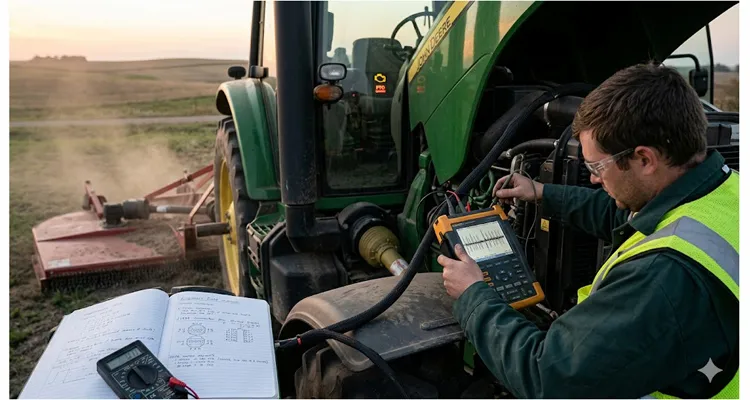
Late one October evening, a silage contractor working the Nebraska-Kansas line phoned me with a problem that had already eaten two full days of his harvest window. His self-propelled forage harvester had developed a ghost inside the J1939 backbone. The instant the PTO stub shaft engaged, nodes would vanish — fifty healthy CAN messages per second collapsing into a blizzard of error frames with no warning, no gradual fade, just a network falling off a cliff. Three days on that machine taught me what a power take-off-induced interference event really looks like when it’s allowed to chew through a CAN network unchecked.
What you’re about to read is not a sanitized white paper. These are field notes — the kind you scratch into a pocket notebook while wiping chaff and hydraulic oil off your hands. If you’ve ever watched a machine derate because the transmission ECU lost communication during PTO operation, you already understand this isn’t about theoretical noise margins. This is about a piece of equipment that refuses to deliver torque exactly when the operator needs every last foot-pound.
Where You Encounter It: The Patterns We See in the Field
In all the years I’ve spent chasing CAN bus gremlins across three continents, I’ve never once watched a PTO-induced J1939 fault reproduce itself on a clean lab bench. These failures surface on machines that have absorbed a decade of dust, vibration, and improvised field-side repairs. My service notebook logs this interference pattern across three distinct equipment categories:
- Agricultural tractors pulling large rotary cutters or round balers. The PTO clutch packs are typically electro-hydraulic and pull serious current. When the coil de-energizes, the flyback pulse isn’t always clamped cleanly by the internal suppression diode — if one was even installed. On a row-crop tractor near Lincoln, we measured a forty-two-volt inductive kick riding the chassis ground reference while the cutter spun up to rated speed.
- Construction telehandlers equipped with a rear-facing auxiliary PTO. Here the culprit was mechanical rather than electrical: a dry spline coupling that, under torque load, generated micro-arcing across the ground path. That arcing sprayed broadband hash from three hundred kilohertz to well above two megahertz — precisely the spectrum where CAN transceivers are supposed to reject common-mode noise, except rejection fails the moment the ground plane starts shifting.
- Marine auxiliary drive on a commercial trawler. The PTO shaft fed a hydraulic pump positioned six meters aft of the engine ECU. The J1939 backbone ran parallel to unshielded pump solenoid wiring for nearly four meters of that span. Proximity alone was sufficient to flip bits at random intervals.
The common thread weaving through all three cases? Every single one involved high-current switched inductive loads sharing a machine ground with a J1939 network that some designer had declared “differential and therefore immune.” Differential signaling helps, but calling it a forcefield is wishful thinking. Anyone wanting a formal primer on the SAE J1939 protocol and its physical layer can consult the Wikipedia entry — though the standard won’t tell you what a dry PTO clutch does to your ground plane at four hundred amps.
What’s Actually Happening Inside the Bus
Whenever I train a new technician on CAN diagnostics, I start by handing them a terminated stub and a digital multimeter. Measure across CAN_H and CAN_L with the bus powered down. You want to see sixty ohms end-to-end because two 120-ohm resistors sit in parallel — one inside the engine ECU housing, the other buried behind the cab’s instrument panel. The transceiver chip reads the voltage difference between the two signal wires; that’s the elegant part of the design. But once you’ve watched the common-mode swing on a TJA1051 climb past twelve volts during a PTO clutch dump, you stop believing differential signaling makes you bulletproof. I’ve documented this measurement technique in detail previously — here’s a closer examination of J1939 common-mode voltage shift measurement using an oscilloscope.
We consistently uncover three physical mechanisms during root cause investigations, and I’ve learned to identify each one by the specific machine that revealed it.
Mechanism 1: Ground-potential bounce – Three Volts Engine-to-Cab
On a forage harvester, I fabricated a 10-AWG bonding jumper from the ECU ground stud directly to the battery negative post. The PTO-induced error frames vanished. That result told me the factory chassis return path could not simultaneously handle a 400-amp starter inrush and a solenoid flyback transient without lifting the ground reference voltage. The PTO solenoid return current was traveling through the same chassis steel that the J1939 shield relied upon, and those few milliohms of steel resistance transformed into a voltage step that the CAN receivers interpreted as a common-mode voltage shift. This is fundamentally a ground loop triggered by a high-current transient — the classic mixed-signal installation headache where power and signal return currents share a conductor never sized for the task. I later measured a 0.3V ground offset on a J1939 backbone and traced it straight back to this identical shared-return configuration — if you’re wondering what a fraction of a volt costs a fleet in unscheduled downtime, I’ve itemized it here.
Mechanism 2: Magnetic coupling – Parallel-Path Coupling Inside a Mesh Loom
A baler harness had the CAN backbone and the PTO clutch power wire zip-tied together inside the same split loom for a full two meters. My near-field probe displayed fifty-millivolt peaks on CAN_H that locked step with the twenty-kilohertz chopper frequency of the PWM valve. That’s near-field magnetic coupling — the twist pair geometry cancels far-field interference beautifully, but bring a fifty-amp pulsed DC conductor within thirty centimeters of the CAN pair and the differential lines pick up a spike that perfectly mimics a dominant bit. Relocating the CAN cable into a separate steel conduit dropped the coupled noise below ten millivolts.
Mechanism 3: Radiated electric field – Clutch-Plate Arcing Visible on a Spectrum Analyzer
When a dry clutch engages, it produces a rapid sequence of arc strikes across the mating plate surfaces. Each microsecond-duration arc functions as a broadband transmitter. We captured this with a handheld Aaronia Spectran. PTO engaged, slip phase: the noise floor surged from negative eighty-five dBm to negative forty-two dBm centered at 1.2 megahertz — aligned squarely with the CAN bit timing harmonics. A nearby unshielded CAN stub acts as an unintentional tuned antenna in this scenario.
The table below summarizes these J1939 noise coupling mechanisms and their field-proven countermeasures:
| Noise Mechanism | Typical Source | Frequency Range | Primary Fix |
| Ground-potential bounce | PTO solenoid return current sharing chassis with shield | DC to low kHz | Dedicated ground strap, star washers |
| Magnetic coupling | PTO power cable routed parallel to CAN backbone | kHz to low MHz (matches PWM) | Physical separation (>200 mm), steel conduit |
| Radiated electric field | Dry clutch plate arcing | Broadband up to 1 GHz | Shielded CAN cable with 360° termination, ferrites |
Diagnosis on the Machine: Where to Start Without a Lab
Isolating PTO interference does not require a five thousand dollar oscilloscope. I’ve performed successful diagnostics armed with only a digital multimeter and a handful of DB9 breakout connectors. Below is the sequence I follow once the obvious checks are cleared — termination resistance, stable power supply voltage, and absence of pin-to-pin shorts. For the complete diagnostic workflow I teach our OEM clients during on-site training sessions, I’ve prepared a dedicated guide on J1939 physical layer troubleshooting with a 60-ohm waveform check.
Step 1: Map the Fault to PTO State
With the engine off but ignition powered, monitor J1939 message traffic using any basic diagnostic scan tool. Actuate the PTO switch — if the system permits engagement with the engine stationary — and listen carefully for the solenoid click. Communication dropping at the precise instant of engagement provides a strong directional clue. Better still: if the fault manifests exclusively when the PTO is under mechanical load, you are likely dealing with either clutch-arcing noise or a high-current ground shift under torque.
Step 2: Disconnect the Solenoid Circuit
Unplug the PTO solenoid directly at the coil terminals. Start the engine and engage the PTO output mechanically if the machine provides a separate manual lever for the shaft. A CAN bus that stays clean under these conditions confirms the interference source is the solenoid circuit or its associated wiring — not shaft rotation or mechanical arcing at the clutch pack. This single isolation step has solved more mysteries than any other diagnostic technique I know.
Step 3: Differential Voltage Sniffing with a Multimeter
Configure a digital multimeter for AC millivolts and probe between CAN_H and CAN_L at the most accessible network node with the engine running and PTO disengaged. Expect less than one hundred millivolts of AC ripple. Now engage the PTO under load. An AC reading that jumps above five hundred millivolts and fluctuates indicates a differential noise injection problem — genuine J1939 interference, not merely a common-mode disturbance the transceiver should tolerate.
Step 4: Check Shield Continuity Under Load
I repeatedly encounter brand-new harness assemblies with shields left floating at one end because the installer applied an obsolete RS-485 wiring practice. The J1939 specification requires the shield to be connected to ground at every node, ideally through a low-impedance path to the chassis. While the PTO is loading the ground plane, measure the resistance from the shield drain wire at the farthest ECU back to the battery negative terminal. Any reading above one ohm is contributing to your problem. Flex the harness thoroughly during the measurement; I’ve discovered fractures inside overmolded strain reliefs that only reveal themselves when the loom bends under torque vibration. This is precisely why I developed a formal wiggle test protocol for J1939 harness opens — it exposes intermittent shield discontinuities that a static continuity test will miss every time.
A Layered Fix: Shielding and Filtering That Survives the Field
After confirming PTO-driven noise, resist the temptation to clip on a ferrite and declare victory. I address the problem in ordered layers, progressing from passive shielding improvements to active filtering as severity demands.
Layer 1: Shielding the CAN Backbone Properly
I section sample segments from every reel of shielded CAN cable our factory qualifies. A ten-power jeweler’s loupe reveals more than any datasheet ever will. If I can visually identify gaps in the braid wider than the individual strand diameter, I know the “85% optical coverage” claim printed in the catalog is marketing fiction. Last winter, we traced a combine harvester’s intermittent PTO errors to a production batch where our microscope measurement returned sixty-three percent coverage. The cable manufacturer insisted it met specification. A single month installed on a silage cutter proved otherwise. For harnesses leaving our own facility, we cross-check optical coverage with a digital microscope before a single connector body is molded onto the cable. A proper dual-shield design — aluminum-mylar foil paired with an overall tinned copper braid — assigns each layer its role: the foil blocks high-frequency electric fields, while the braid suppresses magnetic and low-frequency impedance. Terminate that shield 360 degrees at every connector in the backbone. Never attach a pigtail drain wire to a pin; that construction creates a stub inductor precisely where you need a low-impedance path. Use a metal connector shell, such as a Deutsch DT or Amphenol AHD, that clamps the shield circumferentially around its full diameter. In our harness production, we injection-mold the connector body directly over the circumferentially clamped shield — a process that eliminates the micro-corrosion junction I’ve seen generate a two-ohm ground path after just six months of exposure in a fertilizer spreader environment.
Layer 2: Clamp the Transient at the Source
Solder a bidirectional TVS diode directly across the PTO solenoid coil terminals — a component like the 1.5KE33CA works reliably. Select a standoff voltage just above nominal system voltage so the device remains non-conducting during normal operation. This arrangement snubs the flyback spike before it ever reaches the chassis ground network. On one tractor retrofit, this single modification reduced AC ripple on the CAN bus from one point two volts to under eighty millivolts — a fifteen-to-one improvement.
Layer 3: Common-Mode Choke on the CAN Lines
When shielding improvements alone prove insufficient, install a common-mode choke on the CAN_H and CAN_L pair adjacent to the node entering error-passive mode. A component such as the ACT45B-510-2P-TL003 delivers several hundred ohms of common-mode impedance across the noise frequencies we encounter in the field while adding negligible differential impedance. I keep a small inventory of these chokes in the service van; their installation count across rescued CAN networks now exceeds what I can easily tally.
Layer 4: Isolate the Ground Reference
For extreme cases — typically installations where the PTO-driven implement carries its own ECU powered from a separate battery — deploy an isolated J1939 repeater. These devices employ galvanic isolation to sever ground loops entirely. I’ve installed them on silage trucks whose trailer-mounted unloading auger motor maintained a floating ground that could not be bonded to the tractor chassis due to electrolysis concerns with the silage acids present in the operating environment.
Five Mistakes That Will Make the Problem Worse
- Floating the shield at the dashboard. I once removed a belly-pan from a scraper tractor and discovered a carefully heat-shrunk CAN backbone whose shield drain wire had been snipped clean at the instrument cluster bulkhead connector. “The radio was making noise,” the owner explained. That three-meter un-terminated shield functioned as a textbook loop antenna. Reconnecting the drain to the cluster’s ground pin reduced the error frame rate from roughly one thousand per hour to two. Grounding the shield solely at the ECU end creates an efficient radiator at the opposite end; the floating shield then capacitively couples noise into the CAN pair with no available path to dissipate the energy.
- The capacitor trick that kills the bus. A repair shop installed a 0.1 µF ceramic capacitor between CAN_L and chassis ground, intending to shunt PTO noise to the frame. The dominant-edge transitions collapsed into a sawtooth waveform. The bus became incapable of acknowledging even a single claim frame. We desoldered the capacitor, inserted a common-mode choke in its place, and the network recovered immediately. I keep that capacitor taped to the wall above my service bench as a cautionary exhibit. Adding capacitance from either CAN_H or CAN_L to ground unbalances the line impedance, introduces signal reflections, and slows edge rates until the recessive-to-dominant transition violates the bit timing specification.
- Routing the J1939 backbone inside the same convoluted tubing as the PTO solenoid power leads. Proximity guarantees magnetic coupling. Maintain at least two hundred millimeters of separation. Where cables must cross, do so at a right angle.
- Using un-terminated stub cables longer than one meter. At two hundred fifty kilobits per second, a stub exceeding one meter begins to behave as an unterminated transmission line stub, generating reflections that arrive coincident with noise-induced glitches. I’ve diagnosed a PTO fault that was, at its root, a reflection artifact amplified by the noise source — not direct bit corruption from the interference itself. The interplay between J1939 termination, stub length, and phantom fault cost deserves every fleet manager’s attention: a three-dollar termination resistor omitted from a stub can ignite a diagnostic cascade that accumulates four-figure expenses before the true cause is identified.
- Assuming a new electronic PTO doesn’t need suppression. Modern PWM-controlled proportional PTO valves can prove more troublesome than traditional on/off solenoids because their switching frequency harmonics fall directly within the CAN baud rate’s bandwidth. When the valve drive operates at a chopping frequency near twenty kilohertz, its harmonics can beat against the CAN bit timing and produce sporadic frame errors that surface only during extended field operation — the most difficult pattern to capture.
How to Confirm You’ve Fixed It — Not Just Masked It
A quiet CAN bus can lull even experienced technicians into a false sense of confidence. I apply three validation checks following every shielding or filtering modification.
- Error counter reset and observation. Clear the Transmit Error Counter (TEC) and Receive Error Counter (REC) in every ECU on the network using a diagnostic tool. Operate the machine through a minimum of ten complete PTO duty cycles — engage under load, maintain rated speed for thirty seconds, disengage. If any node increments its error counter beyond single digits, the remediation is incomplete.
- Oscilloscope capture at two points. Simultaneously probe the differential and common-mode signals at the node located farthest from the termination resistors. The differential waveform must remain cleanly bounded between negative one and positive one volts during the recessive state, and exceed two point five volts positive or negative during dominant. Common-mode voltage must remain inside the transceiver’s specified input range with a margin of at least three volts under the worst-case PTO transient you can provoke. For those new to interpreting CAN physical-layer waveforms, I’ve assembled a practical introduction on J1939 waveform analysis with a 200-dollar USB scope — the guide illustrates exactly how edge rates and ringing appear on a healthy bus compared to one suffering from a ground offset.
- Load dump simulation. On a machine where the alternator is accessible, momentarily apply a heavy electrical load while the PTO is operating. This stress test evaluates the bus’s immunity to a broader power transient beyond the PTO circuit alone. I use a carbon pile tester connected across the battery terminals. A bus that remains healthy through this abuse has been hardened properly.
Cables and Components That Hold Up When the Dust Settles
When reworking grounds cannot salvage an existing harness, I specify a replacement J1939 backbone cable engineered explicitly for high-noise operating environments. A properly constructed J1939 cable for these applications delivers four characteristics: uniform conductor twist geometry maintained along the entire length, dual-layer shielding, environmentally sealed connectors with integral shield termination, and an outer jacket compound that neither wicks diesel fuel nor degrades under prolonged UV exposure and mechanical chaffing.
Our production line undergoes twice-annual audits by a German off-highway OEM whose engineering team arrives carrying their own calibrated torque tables and a Rohde & Schwarz vector network analyzer. That level of scrutiny exceeds any third-party certification audit — but when the paperwork is required, our facility holds IATF 16949 certification alongside ISO 9001 and ISO 14001 — all three certificates are current and renewed on their standard cycles. Every reel of raw cable is traceable to its production batch, and our REACH declarations account for every plasticizer and flame retardant compound present in the jacket formulation. For customers confronting PTO interference directly, we frequently recommend a custom cable assembly: overmolded Deutsch DT connectors with a tinned copper braid shield that is molecularly bonded to the connector body during the injection-molding cycle. That bond does not degrade under vibration — I’ve validated it on a shaker table running a continuous one-hundred-hour profile without a measurable increase in bond resistance.
OEM customization is fundamental to how we operate. We replicate your existing connector pinout, trim cable length to the exact centimeter, and silk-screen your part number and brand logo directly onto the jacket. The finished harness fits like original equipment while resolving the J1939 interference problem the original design never anticipated.
Frequently Asked Questions
Can a PTO shaft itself generate electromagnetic noise even without electrical components?
Without question. A dry mechanical PTO under heavy load produces micro-arcing at the spline interface, particularly when metallic wear debris accumulates between the mating surfaces. I’ve aimed a handheld spectrum analyzer at a worn PTO housing on a manure spreader and observed the noise floor climb across the entire RF spectrum — that broadband energy couples directly into any unshielded CAN wiring routed within the near field.
I swapped in a shielded cable and still have PTO dropouts. What now?
I hear this story three times a month. Shielded cable addresses one half of the problem; the other half concerns where the shield current ultimately flows. On a telehandler, I had to install a dedicated 8-AWG bonding strap from the transmission ECU’s shield terminal directly to the battery negative post. The factory harness returned shield current through a painted mounting bracket — six ohms of resistance measured across that paint layer. Once the bracket was ground to bare metal and secured with a star washer, the bus error counters stayed at zero through repeated PTO cycles. When the interference mechanism is predominantly common-mode ground bounce, a shielded cable alone cannot correct the root cause. This is the exact failure mode I addressed in my guide on how to diagnose a J1939 ground offset — a painted bracket beneath a ground lug can convincingly mimic a dozen unrelated faults.
What resistance should I measure between shield and chassis ground?
Under static conditions, target less than zero point five ohms. During dynamic PTO loading, the resistance must not fluctuate beyond point two ohms if the connection is mechanically sound. Use a four-wire milliohm meter whenever possible; a standard two-wire multimeter frequently misleads due to the contribution of test lead and probe contact resistance.
Can I use an aluminum foil tape wrapped around the harness as a temporary shield?
No. Foil tape possesses uncontrolled impedance, provides no continuous drain path, and typically fractures at the first flexure. I’ve measured ten-ohm paths through improvised foil wraps after a single day of machine vibration. The practice invites unreliable operation and wastes diagnostic time chasing phantom faults.
Does a terminated stub that’s unpowered still affect the bus?
Yes. An ECU that is powered down but still connected presents an unterminated stub if its internal termination is switched or absent. That stub behaves as a capacitive load and a reflection point. When the stub length exceeds one meter, the resulting reflections can corrupt bit timing — especially when combined with the additional noise energy from PTO arcing.
My diagnostic tool shows no fault codes but the engine derates intermittently. Could this still be PTO noise?
Absolutely. Noise-corrupted bit errors frequently fail to generate persistent DTCs because the malformed messages are discarded by the receiving ECU before a time-based fault confirmation counter can increment. What you observe instead are communication loss events that trigger an immediate derate command without storing a corresponding diagnostic code. Examine the ECU’s bus-off counter and error counters directly — do not rely exclusively on the stored fault log.
Is there a quick test to see if noise is entering through the power supply or the CAN lines?
Disconnect the suspect ECU’s CAN connector while leaving its power supply connected. Monitor the network’s bus traffic. If the bus stabilizes, the noise ingress path traveled through that node’s CAN transceiver — potentially via its power supply pins coupling noise into the transceiver’s internal circuitry. If the bus remains noisy with that node’s CAN port physically disconnected, the noise is coupling directly into the cable harness itself.
How do you choose a TVS diode for the solenoid without affecting normal operation?
Select a standoff voltage approximately twenty percent above the maximum system voltage, accounting for alternator charging output. For a nominal twelve-volt system that reaches fourteen point four volts during charging, a TVS diode with an eighteen-volt standoff rating will remain non-conducting under all normal operating conditions while clamping the flyback spike aggressively the moment voltage exceeds threshold. Always locate the TVS as physically close to the coil terminals as the installation permits.
Will these fixes work for other CAN-based networks, like NMEA 2000 or ISO 11783?
The identical physical-layer principles govern any two-wire CAN bus implementation. NMEA 2000 and ISO 11783 (ISOBUS) share the same fundamental electrical layer as J1939. The primary differences involve connector sealing specifications and termination resistor placement conventions, but the shielding and filtering methodologies transfer without modification. We’ve successfully applied these same techniques to marine NMEA 2000 networks experiencing interference from generator PTO drives.
How can I get a cable assembly built to my exact machine’s routing and connector pinout?
That describes the core of our daily work. Provide your connector part numbers, overall routing length, AWG preference, and any special jacket requirements, and we’ll produce a custom J1939 harness that follows your machine’s exact layout. Our engineering team has delivered solutions spanning from four-node agricultural backbone harnesses to eighteen-node forestry machine networks. We maintain no minimum order quantity for prototype evaluation sets.
Let’s Talk About Your Machine’s Specific Problem
PTO interference never reads the textbook. Every machine possesses its own grounding idiosyncrasies, its own characteristic noise signature, and its own tolerance threshold for error frames before the operator perceives a problem. If you’ve been fighting intermittent J1939 faults that synchronize with PTO engagement — and off-the-shelf replacement cables or a software reflash failed to cure the condition — you almost certainly need a wiring solution engineered specifically for your operating environment. I’ve documented how J1939 ground offset problems impact fleet operating cost across successive machine generations: what begins as a nuisance derate on a single tractor transforms into a budget line item that propagates to every unit in the fleet when the root cause remains unaddressed in the harness design.
I’m Linda. I manage technical support and custom cable engineering at our factory. Send me a WhatsApp message with a rough dimensional sketch, several photographs of your current harness routing, and a description of the fault pattern as you observe it. No sales presentation, no obligation — simply a technical conversation between people who share the understanding that downtime costs more than a properly engineered cable assembly ever will.
Prefer email? Use our contact page. We’ll get back to you within one business day, usually faster.
Chat with Linda on WhatsApp
We manufacture to IATF 16949, ISO 9001, ISO 14001. Products are RoHS and REACH compliant. OEM customization includes logo, branding, cable length, color, AWG, and connector type. Every assembly undergoes four-stage quality inspection and is 100% tested before shipping.
