

Three years ago I stood in a fleet bay in Ohio watching a technician chase an intermittent no-start on a Cummins ISX. He had swapped the cam sensor, the crank sensor, and the engine harness connector — twice. The scan tool showed no fault codes. Live data looked clean. The truck would fire up perfectly for two days, then strand the driver at a loading dock three hundred miles away. After the third tow bill, the fleet manager asked me, “Should I just buy a scope?”
I told him to hold off. Not because a scope wouldn’t have helped — it would have — but because a tool is only as useful as the system around it. That conversation turned into a cost-benefit analysis I’ve repeated in different forms for dozens of mixed fleets since. If you run a fleet shop and you’re staring at a quote for a lab-grade oscilloscope, let’s walk through the real numbers, the physics you’re actually chasing, and the fork in the road where a scope either pays for itself in six weeks or gathers dust until the next shop manager inherits it.
What a Scope Sees That a Scan Tool Won’t — The Four Signals a Fleet PM Never Sees
A scan tool reads interpreted data — a module has already converted an analog signal into a digital parameter. If the module’s conversion is flawed, or if the signal is degraded in a way that still crosses a logic threshold, the scan tool shows you a lie that looks like truth.
An oscilloscope shows you the raw voltage over time. In a modern commercial vehicle, that matters for four specific kinds of trouble — what I’ve come to think of as “the four signals a fleet PM never sees.”
Physical-Layer Network Rot: J1939 Backbone Faults Your Multimeter Misses
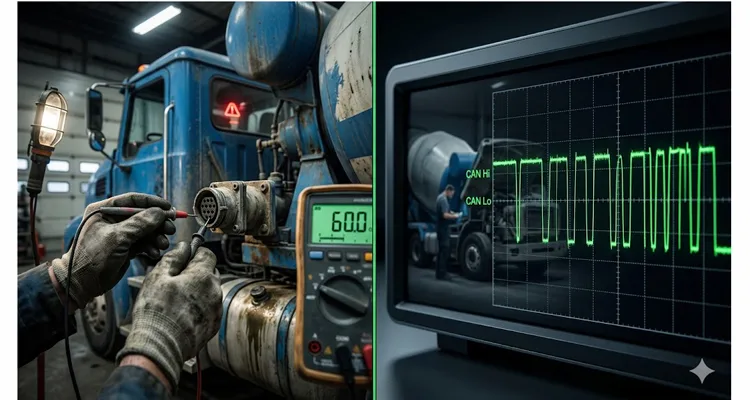
A J1939 backbone on a concrete mixer measured a perfect 60 Ω end-to-end, yet the dash lit up with random “No Comm” entries every third load. The multimeter said everything was fine. A scope in differential mode across CAN Hi and CAN Lo showed the culprit: a half-moon cut in the harness jacket let moisture wick between the twisted pair, creating a capacitive bridge that swallowed entire message frames. The steps you look for on a healthy CAN differential trace were there, but they had recessed edges — a tell a multimeter is blind to. This is the kind of fault that J1939 physical layer troubleshooting with a 60-ohm waveform catches in under twenty minutes when a resistance check says everything is fine. The underlying physics — how a chafed twisted pair creates a capacitive bridge that distorts the differential signal — is consistent with the transmission line behavior described in the CAN bus standard, where impedance discontinuities along the backbone cause reflections that eat message frames long before a multimeter registers any change in DC resistance.But here’s what a scope won’t tell you: once you’ve identified that the bus is sick, you still need to track down whether the root cause is a corroded termination, a noise source coupling onto the backbone, or a connector that’s wicking moisture. That’s a physical inspection and elimination process — and it’s where a scope hands off to a systematic field approach for diagnosing J1939 noise and termination problems on the truck side.
Microsecond Phase Shifts: Cam-Crank Correlation and Timing Faults
A Detroit DD15 would start and idle like a sewing machine, then break up under load. The crank and cam correlation codes refused to set. A scope on both sensors during a snap-throttle event showed the cam signal drifting eight degrees relative to the crank. The tone ring had walked on its press fit — a mechanical fault that existed purely in the time domain. No scan tool PID measures angular displacement between two raw AC signals.
Current Signatures: Detecting Dead Commutator Segments with a Current Clamp
I once condemned three 6.7L Powerstroke high-pressure fuel pumps before a current clamp taught me humility. Voltage to the pump looked textbook. The scan tool‘s fuel pressure PID never wavered from requested. But a current clamp on the pump feed captured a commutator ripple that decayed after three lobes instead of six. Two commutator segments had fractured, and the pump was dragging a dead winding past the brushes on every revolution. The engine derated intermittently, and not a single DTC ever fired for that pump.
Intermittent Dropouts Below the DTC Trigger Threshold
A wheel speed sensor on a refuse truck would vanish for eight milliseconds on a stretch of corrugated gravel road behind the landfill. The ABS module’s fault logic demanded a missing signal for at least fifty milliseconds before it would light the lamp — the equivalent of a “minor glitch” the engineer decided wasn’t worth a code. The scope, set to trigger on a pulse-width dropout shorter than ten milliseconds, caught it on the first test drive. We found a wire with one strand still connected inside the insulation.
If the majority of your fleet faults sit squarely outside these four buckets, you can probably stop reading and keep your money.
The Real Cost of Owning a Scope (It’s Not the Purchase Price)
Let’s talk numbers — written out so they land properly.
A reputable automotive oscilloscope with four channels, a set of high-voltage probes, a current clamp, and a pressure transducer kit will set a shop back somewhere between four thousand and seven thousand dollars. A PicoScope 4425A kit lands near the middle of that band. Add a dedicated laptop hardened for shop use: another twelve hundred to two thousand dollars. Already you’re at the equivalent of a year’s worth of premium scan tool subscription renewals for a ten-bay shop.
But that is not the real cost. The real costs are:
Training Investment for Oscilloscope Diagnostics
A tech who can read a scan tool competently cannot automatically read a secondary ignition waveform or a LIN bus eye pattern. Figure forty to eighty hours of structured learning before the tool becomes a diagnostic asset rather than a guessing machine. For a shop billing at one hundred thirty dollars an hour, that’s between five thousand and ten thousand dollars in labor that won’t appear on any invoice while the tech climbs the learning curve. I’ve seen fleets cut that time in half by putting their lead diagnostic tech through a forty-hour NVH and network diagnostics block aligned with TMC’s recommended skills ladder, then having that tech mentor the rest of the crew for thirty minutes every Friday on a single waveform. The mentoring model tends to stick. The payoff? A tech who can run a J1939 waveform analysis on a 200-dollar USB scope and extract actionable data is worth three who can only click through scan tool menus.
Usage Velocity: The Hidden Friction of Infrequent Scope Use
At a nine-bay refuse fleet I audited, the scope came out roughly once every five weeks. Each time, the tech spent twenty-seven minutes — I timed it — re-finding the right trigger mode and re-zeroing the current probe. Multiply across three techs over a year, and you’ve burned three billed hours just remembering how the tool works. That’s almost enough to buy another current clamp. If the scope doesn’t get used at least biweekly, the friction of re-learning eats any diagnostic savings.
Misdiagnosis Cost: When a Scope Leads You Astray
I’ve seen a scope lead a tech astray more times than I’ve seen a lack of one. A “noisy” cam sensor waveform gets condemned, the sensor is replaced, and the root cause was an alternator diode spilling AC onto the sensor ground — something a basic ripple test with a multimeter would have found in ninety seconds. The scope added a five hundred dollar part and two hours of labor to a problem that needed a two hundred dollar alternator rebuild. This is not the tool’s fault, but it is the fleet’s ledger entry.
Where a Scope Pays Back Faster Than Anything Else
There are fleet profiles where the return on investment is brutal and immediate:
There are fleet profiles where the return on investment is brutal and immediate:
Once you’ve got a hybrid battery pack showing an isolation fault, a scan tool gives you a code and a guess. A scope with two channels looking at voltage and current on the high-voltage bus lets you see the isolation resistance degrade in real time under load. I’ve pinpointed a chafed AC compressor cable inside a hybrid Escape that three dealerships missed. The scope paid for itself on the second repair — literally a one-day ROI if you count avoided battery pack replacement.
Fleet Profile B: Vocational Severe-Service Fleet Diagnostics (Concrete Mixers, Refuse Trucks, Dump Trucks)
These vehicles live in a constant vibration bath. Intermittent CAN bus faults are their native language. A scope used once a quarter for a network health audit catches backbone degradation before a truck derates on a job site. One avoided mobile service call covers the annual amortization. Fleets that adopt this practice routinely see J1939 physical layer ROI from basic tools cut downtime by seventy percent, because the scope finds the degradation when it’s still a nuisance, not a no-start.
Fleet Profile C: Multi-Brand Fleet Maintenance with Different OEM Engines
A single OEM scan tool will never cover all variants well. A scope is vendor-agnostic. If you maintain Cummins, Detroit, Volvo, and a couple of Hino light-duty trucks, the scope becomes the one diagnostic constant.
For a fleet doing primarily scheduled preventive maintenance and swap-out repairs on a single brand of trucks with a factory diagnostic laptop, the math flips the other way — often hard.
The “Buy a Scope to Save the Fleet” Trap
Here is the pattern I see repeatedly: a fleet has one elusive fault that costs them twenty thousand dollars in downtime and a service truck roll in a year. They buy a scope to solve that fault. The fault is eventually traced to a wire harness pinch that a careful visual inspection could have found if someone had spent three hours tracing the routing diagram. The scope sits. Five years later the shop has a six thousand dollar artifact and nobody remembers how to trigger on a missing pulse.
Before you buy, run this diagnostic escalation filter:
| Symptom | First-line tool | If unresolved, escalate to | Fleet-sized reason |
| Active DTC with freeze frame | Factory scan tool | Scope only if sensor signal integrity is suspect | A false sensor reading can strand a loaded mixer on an 8% grade; verify the signal, not just the code. |
| No-start with no codes | Known-good swap of critical sensors, fuel pressure gauge, compression test | Scope for crank/cam correlation and injector signal | |
| Network “no communication” | Multimeter (resistance, short-to-ground, short-to-battery) | Scope for signal quality and reflection analysis | A CAN frame that gets eaten by moisture wicking costs the same as a broken backbone in downtime, but looks perfect on a meter. |
| Intermittent drivability, no codes | Graphing scan tool data logging over a long drive cycle | Scope with triggered single-shot capture on suspect circuits | An eight-millisecond dropout on a wheel-speed sensor won’t light the ABS lamp — but it will fire the stability control when the driver hits a pothole at sixty miles an hour. |
| EV/HEV isolation fault | Insulation tester (megger) | Scope with differential HV probe and current clamp | An isolation fault that appears only under load can thermal-cycle into a full pack shutdown on a hot afternoon — the megger won’t see it, but the scope will. |
Every one of these paths acknowledges that a scope is an escalation, not a starting point. The question is how often your fleet genuinely needs the escalation tier.
When a “Good Enough” Scope Is Enough
If your analysis lands on “we need a scope but not a four-channel lab unit,” there is a credible middle tier. Handheld scopes designed for field diagnostics — the ones built into certain high-end scan tools or standalone units with a rechargeable battery — now deliver two hundred megahertz bandwidth and enough triggering logic to capture the events that matter. They typically run between one thousand and two thousand dollars, and the barrier to entry is far lower because the interface is purpose-built for common automotive tests.
A USB-based scope paired with a shop laptop can also work, but beware the noise floor on cheaper units. A scope with eight-bit vertical resolution gives you two hundred fifty-six discrete voltage levels. That’s fine for digital logic but woeful for analyzing a primary ignition waveform where you need to see the slope of the coil’s rise time. Twelve-bit is the minimum I’d trust for anything involving inductive kick. Fourteen-bit or better if you’re chasing subtle fuel injector current ramps. When I’m scoping a J1939 backbone on a refuse truck that’s been in service for eight years, I want to see J1939 scope bench edge rates, ringing, and differential voltage clearly — and a noisy front end on a cheap scope turns that measurement into guesswork.
One thing to remember: the cable between your scope and the vehicle is not a passive accessory. A poorly shielded BNC-to-banana or BNC-to-OBD adapter introduces capacitance that can round off the square edges of a CAN signal, making a healthy bus look pathological. If you’re building your own breakouts, use cables with known impedance and proper shielding. We routinely supply fleet shops with custom OBD interface cables that are twisted-pair, 120 Ω characteristic impedance, and individually shielded — tested at one hundred percent — because even a thirty-centimeter test lead can distort a signal enough to mislead a junior tech. When you’re chasing an intermittent fault that only appears after two hours of runtime, the last thing you need is the cable lying to the scope. For shops that need to tap into a 9-pin diagnostic connector without disturbing the backbone, a J1939 9-pin pigtail breakout cable gives you clean access to CAN Hi, CAN Lo, and power right at the connector — no backprobing required.
A Decision Framework in Four Questions
Before you open a purchase requisition, sit down with the senior diagnostic tech and ask:
- How many unsolved intermittent faults did we have in the last twelve months where the scan tool and multimeter failed to isolate the cause? If the answer is fewer than four, a scope will likely gather dust.
- Do we have at least one technician who can already interpret a scope waveform without a cheat sheet, or are we willing to dedicate real training time? If no, the scope will become a source of incorrect diagnoses.
- Are we seeing a shift toward EVs, hybrids, or complex body control networks that demand physical-layer analysis? If yes, a scope stops being optional — it becomes a safety and diagnostic necessity.
- Do we have the discipline to perform periodic network health audits, or will the scope only come out during catastrophe? Reactive-only usage never justifies the cost. Proactive usage — monthly bus health checks on a rotating basis across the fleet — generates the yield.
If questions one and two are “no” but three and four are “yes,” you have your answer. If only one of the four is “yes,” put the money into a top-tier scan tool with a built-in graphing meter and a set of current clamps.
FAQ: Six Questions Fleet Technicians Actually Ask
Q: Can an oscilloscope replace my scan tool?
I’ve never seen a Paccar MX-13 run a forced DPF regen through a PicoScope. The scope is the camera; the scan tool is the remote control. You need both. If your budget forces a choice, buy the scan tool first — every time.
How do the noise floor specs of a four thousand dollar USB scope compare to a twelve hundred dollar handheld when chasing a 50 mV CAN frame on a refuse truck?
At 50 mV per division, a quality USB scope with 12-bit resolution will show the quiet third-harmonic ripple that tells you the termination is healthy. Most handheld units at that price point have a noise floor that obscures detail below about 20 mV. For a healthy CAN bus swinging three volts peak-to-peak, that’s irrelevant. For a degraded bus where the recessive level is only 1.2 volts and the differential amplitude is collapsing, the USB scope‘s cleaner front end can separate a soft termination from a wiring fault. The handheld will show you “something wrong” — the USB scope will tell you exactly which end of the backbone has the bad termination. I’ve covered this in more detail in a dedicated piece on J1939 oscilloscope waveform diagnostics, because the difference between a four-thousand-dollar scope and a twelve-hundred-dollar handheld shows up most clearly when you’re measuring differential signal quality on a degraded bus.
Q: What’s the minimum bandwidth I need for automotive diagnostics?
For standard CAN (up to 1 Mbps) and most sensor signals, a 20 MHz scope is adequate. For FlexRay or high-speed ECU clock lines, you want 100 MHz or more. Two-channel minimum; four-channel is strongly preferred for crank/cam correlation with injector timing simultaneously. On a fleet that runs mostly heavy-duty diesels with J1939 at 250 kbps, even a 10 MHz scope will cover 99% of the use cases — but if you also maintain light-duty gasoline hybrids with LIN subnets that run at 19.2 kbps, you need a scope that can zoom in on the slow stuff without losing the sample rate on the fast stuff. Memory depth starts to matter more than bandwidth once you pass 20 MHz.
Q: How do I avoid damaging my scope with high voltages?
Use differential probes rated for the voltage you’re measuring — never float a scope by defeating the ground pin. A COP probe rated for 20 kV is mandatory for secondary ignition. For EV work, a CAT III or CAT IV rated differential HV probe is not optional; it’s a life-safety decision. Many fleet shops keep one scope for general diagnostics and a separate isolated unit for HV traction systems. The cost of one mistake on a 400-volt bus makes the second scope look cheap.
Q: How much training do my techs realistically need?
A basic competence course runs about forty hours of structured, hands-on training. Without it, the scope will be used like a very expensive multimeter — voltage and time only, no triggering intelligence. I suggest sending one senior tech for formal training and having them mentor the rest of the crew with thirty-minute Friday sessions focused on a single waveform per week. That model tends to stick, and the cost is measured in lost coffee time rather than lost billable hours.
Q: What’s the most overlooked scope accessory that pays for itself?
A high-quality current clamp. Voltage tells you what the circuit is trying to do; current tells you what the component actually does. I’ve solved more fleet faults with a current clamp connected to a scope than with all other probes combined. A fuel pump that spins and makes pressure can still have a dead commutator segment; a current waveform will show the gap. A glow plug module that clicks on and off on scan tool data can still deliver half the rated current to the plugs — a current clamp on the supply feed will show you exactly how many plugs are actually heating.
Where OBD Cables Enter the Equation
It’s easy to spend six thousand dollars on a scope and then plug it in with a five dollar backprobe lead that introduces a ground loop. The diagnostic chain is only as strong as its weakest physical link. If your fleet is building a dedicated diagnostic cart — scope, laptop, battery support, and interface breakout — the OBD cable assembly that ties into the vehicle is a component you want to spec, not just grab off the shelf.
We’ve manufactured OBD cables and diagnostic harnesses for fleets, OE tool builders, and engineering houses for over twenty years. Every cable that leaves our floor carries a four-stage inspection card — continuity and hipot first, then a 200-cycle insertion test on the J1962 connector, a visual under 3x magnification, and a final continuity check. We learned that lesson the hard way in 2011 when a single cold solder joint on a CAN Hi pin cost a fleet three days of downtime. That connector now gets a 100% pull-force test. It’s the only way to stay within the IATF 16949 process control we’re audited against every year, and it’s why the same production line ships to tier-one OEMs and fleet diagnostic carts alike.
The facility runs under ISO 9001 and ISO 14001, and every raw material — PVC compound, solder alloy, copper conductor — gets quarterly GC-MS testing in our lab to verify RoHS and REACH compliance. UL and CE certification is a matter of record, but we prove the standards in the process, not on a wall plaque. Climate-controlled warehousing and a 5S shop-floor discipline keep oxidation and contamination out of the equation before a cable ever reaches the assembly bench. In a diagnostic environment where a few ohms of contact resistance can turn a healthy CAN trace into a ghost, storage conditions are part of the specification.
The detail that matters most for scope work: we build cables with the AWG and shielding you actually need. Want a 24 AWG twisted pair with drain wire and an aluminum-Mylar shield, terminated in a J1962 connector that won’t loosen after two hundred mating cycles? We can run it. Need custom lengths because your diagnostic cart sits farther from the truck than standard cables allow? That’s a standard order, not a special request. OEM customization — logo embossing, brand-specific overmold colors, custom pinouts for proprietary breakout boxes — all comes from the same production line that supplies Tier-1 contracts.
If you’re integrating a scope into your fleet’s diagnostic process and you need the physical layer to be as reliable as your measurement instrument, our engineering team can spec the connection solution with you directly.
The Honest End-of-Analysis
For most mixed fleets running late-model diesel trucks and a sprinkling of gasoline service vehicles, a professional-grade oscilloscope is a tool you borrow for six months before buying. If after six months of borrowed or rented use — with proper training — you’ve got a list of ten faults the scope caught that your current tools missed, then you have a business case. If that list has three items on it, you probably don’t.
The fleets that extract the most value treat the scope as a preventive diagnostics instrument, not a reactive firefighting tool. That mental shift is harder to install than any piece of equipment, and it won’t come in the box.
If you’re at the point where the analysis points toward a purchase, or if you’re trying to design a diagnostic setup that won’t let the cables be the weak link, we’re here for the engineering conversation — not the sales pitch.
WhatsApp: Chat with our engineering support
Contact Page: Direct inquiry for OEM cable specification
