

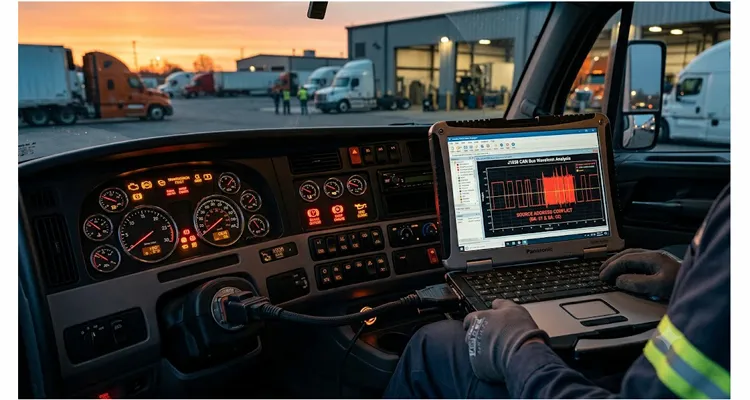
The first thing I noticed on the J1939 log was the arbitration ID 0x0CF00400 appearing twice — once from the replacement ECM, and once from a PTO controller that had no legitimate reason to occupy Source Address 0. The CAN bus had been silently at war with itself for eleven days. The fleet hadn’t found it because the engine started clean every time. That arbitration ID conflict pattern is etched into memory from repower rescue calls across six states — each one a preventable system integration failure.
That job was a fifty-three-unit engine repower in Texas, Cummins ISX12s coming out, reman X15s going in — on paper, a routine fleet retrofit. Late-model Peterbilts, factory-built after 2017. The engines were from a reputable reman supplier. The wiring harnesses were new, the ECUs flashed by the engine distributor. By Thursday, forty-one trucks had rolled out of the bay. By Friday, twelve sat dead on the shoulder of I-10.
By Monday morning we were standing in a Houston fleet yard, connected to the first downed truck. What we found wasn’t a parts failure. Nobody had dropped a liner. No one had mis-torqued a cylinder head. The failure lived in a protocol layer that got zero attention before the swap — inside the J1939 data link, where source addresses were colliding and SPN ambiguity was silently corrupting torque commands. The engine would start, idle, and rev clean. Put it under load in tenth gear and the transmission would hunt between gears, then command a failsafe downshift that cascaded into a full instrument cluster fault display — torque derate, ABS warning, and transmission MIL all active simultaneously. The root cause? Nobody had audited the J1939 calibration against the chassis before dropping in the engine.
That single week burned through just north of four hundred eighty-three thousand dollars in downtime, diagnostics, rework, and freight penalties. Not because the repower was a bad idea — it was actually a sound financial decision on paper — but because no one treated the CAN bus as a system that needs to be verified, not assumed.
The network-layer failure nobody budgets for
When a freshly repowered truck strands on the shoulder, every mechanic looks straight at the engine — it’s the new component, the variable that changed. In heavy-fleet diagnostics, that reflex eats days. In the Texas case, the fleet had already swapped three ECMs, two engine wiring harnesses, and a complete aftertreatment control module by the time we arrived. They were firing the parts cannon with both barrels.
I plugged a CAN logger into the nine-pin Deutsch diagnostic connector and captured thirty seconds of bus traffic at key-on, engine off. On a properly configured J1939 backbone, you expect a clean address claim sequence followed by a steady cadence of cyclic messages — TSC1 from the transmission ECU, EEC1 from the engine ECM, CCVS from the ABS controller — each occupying a unique source address and arbitration ID. What I saw instead were duplicate source addresses. The replacement ECM was broadcasting on Source Address 0, standard for an engine controller. The chassis still had a legacy PTO controller — installed three years earlier as part of a hydraulic pump retrofit — that also claimed Source Address 0. Neither controller executed a proper address claim procedure as defined in the J1939-81 standard. It specifies that when two ECUs contend for the same address, the one with the lower NAME value wins the arbitration. Both devices carried poorly configured NAME fields, so neither yielded. The bus was effectively arbitration-locked anytime the PTO controller woke up.
That’s not an engine defect. That’s a system integration failure waiting to happen on any fleet that treats an engine repower as a purely mechanical swap.
The fix was simple once diagnosed: reflash the PTO controller with a unique source address and correct its NAME to reflect its secondary role. Total time to resolve: fourteen minutes, plus the validation drive. Total time the fleet lost before we got there: nearly eleven days. A proper J1939 calibration audit would have caught this mismatch before the first truck ever left the bay. Instead, a fourteen-minute reflash turned into an eleven-day outage.
Why J1939 is not plug-and-play
I’ve collected enough “J1939 is just J1587 with a faster baud rate” comments from shop foremen to paper a maintenance office wall. That mindset — treating a CAN 2.0B multi-master network like a simple serial link — has drained more fleet budgets than any single component failure. J1587 is a master-slave serial bus where one module polls and others answer. J1939 runs a full CAN 2.0B network where every ECU must independently claim a unique address, announce its parameter groups, and meet strict cyclic timing deadlines. Miss any of those, and the bus can silently corrupt data without illuminating a single fault lamp.
When you swap an engine, you’re not just changing a mechanical power source. You’re introducing a new network node that brings its own PGN definitions, its own SPN scaling tables, its own transmit cycle requirements, and its own set of supported parameters. The chassis doesn’t auto-negotiate these differences; it assumes everything still matches. The transmission doesn’t automatically know that the new engine sends torque data at a different update rate, or that the new EEC1 message drops a few bits the old one carried. These mismatches rarely surface at idle in the bay — they manifest under load.
Across more than sixty field audits, we’ve documented the same four failure patterns. Source address collisions — exactly like the Texas PTO conflict — show up most often in vocational chassis where body builders added controllers years ago and nobody documented the address map. PGN incompatibility follows: the new ECM broadcasts parameters the gateway was never programmed to forward, and the torque command evaporates mid-shift. Then there’s SPN scaling drift, which tricks the transmission controller into reacting to phantom temperatures. Finally, cycle-time mismatch: TSC1 arriving at twice the expected rate, filling the transmit buffer until DM1 messages drop out. None of these will be caught by a generic OBD-II scan tool, because those tools only query DM1/DM2 diagnostic messages. That’s why we recommend a J1939 breakout kit for any pre-repower audit — it exposes the live broadcast traffic a scan tool cannot see. A full audit also requires a known-good DBC file for both the engine and the chassis.
The business case, stated plainly
Fleet managers talk about downtime in dollars per hour, but until you itemize a network-layer failure, the numbers stay abstract. In Texas, the hourly rate became painfully concrete. The fleet was losing roughly one thousand eight hundred forty dollars per truck per day in lost revenue and re-rental costs. Multiplied across twelve deadlined trucks over eleven days, that’s two hundred forty-two thousand eight hundred eighty dollars in direct operational loss. The rest of the four hundred eighty-three thousand came from emergency diagnostics, air freight for parts, technician overtime, and a penalty clause with their largest refrigerated freight customer.
Had the fleet invested in a pre-repower J1939 calibration audit, each truck would have required roughly three hours of a technician’s time — a fully loaded cost of about three hundred forty dollars per truck. For fifty-three trucks, that’s eighteen thousand twenty dollars — roughly four percent of the total loss they ended up absorbing. The audit would have paid for itself even if it prevented only a single-digit number of failures.
| Cost Breakdown for Texas Fleet Repower | Amount |
| Total financial loss (downtime, diagnostics, rework, penalties) | four hundred eighty-three thousand dollars |
| Direct operational loss (12 trucks × 11 days) | two hundred forty-two thousand eight hundred eighty dollars |
| J1939 audit cost per truck (3 hours) | three hundred forty dollars |
| Total J1939 audit cost for 53 trucks | eighteen thousand twenty dollars |
| Audit cost as percentage of total loss | approximately 4% |
This isn’t a doomsday scenario. It’s the math I run every time a fleet asks whether a network audit is worth the upfront hours. The network layer remains the most underpriced risk in any retrofit project, and the phantom cost of network calibration faults keeps showing up in P&L statements long after the wrenches are put away.
What a J1939 calibration audit actually looks like
This is not a “check engine light scan.” It’s a methodical, documented verification of every ECU on the CAN bus. Here’s exactly how we run it, and how any competent fleet maintenance group or engineering partner can replicate it.
Step 1: Pre-audit documentation — not the service manual
Before a single wrench turns, you need two things most shops overlook:
- A full list of all ECUs on the chassis CAN bus, including source addresses, NAME values, and PGN support. This comes from the chassis OEM’s engineering documentation — not the service manual, which rarely publishes CAN address maps. If you can’t obtain it, build it by logging a known-good truck of the same specification.
- The engine supplier’s DBC file or equivalent CAN matrix for the replacement ECM. If the reman shop can’t provide it, treat that as a stop-work red flag.
We maintain a library of J1939 databases going back to model year 2005. For customers executing large-scale repowers, we often build a custom reference document that maps every SPN and PGN between old and new configurations. This is not a product we sell in a shopping cart — it’s engineering work tailored to the fleet’s exact chassis and engine combination.
Step 2: Baseline recording
With a known-good truck (ideally the first unit to be repowered), we connect a Vector VN1610 or similar CAN interface and log thirty minutes of continuous bus traffic at:
- Key-on, engine off
- Idle, cold start
- Idle, hot, all accessories on
- Road test: low-speed maneuvering, highway cruise, loaded pull
This captures address claims, cyclic message timing, transport protocol sessions, and any fault-confirmed DTCs. The log is saved as a reference baseline. Every subsequent truck gets compared against it.
Step 3: DBC-anchored comparison
The baseline log is loaded into analysis software (we use Vector CANalyzer, but BUSMASTER or SavvyCAN can work for smaller fleets) along with the DBC file. We verify:
- All expected source addresses are present and not duplicated
- Transmit cycle times fall within J1939 tolerances (±10% for most cyclic messages)
- SPN scaling matches the chassis specification for critical parameters (engine speed, driver demand torque, actual engine torque, coolant temp, oil pressure, aftertreatment temperatures)
- Multi-packet messages reassemble correctly; no dropped segments
- Diagnostic messages (DM1, DM2) are responding within timeout windows
If anything deviates, we document it, assign severity, and decide whether a reflash or harness modification is needed.
Step 4: Stress the network
This step is often skipped; I consider it essential. We inject a controlled additional bus load — about fifteen percent — using a scripted node that simulates a moderately chatty telematics device. The network should remain stable. If messages start dropping or error frames increment, the bus margin is too thin, and adding a GPS tracker or dashcam later will push it over the edge. I learned this lesson after a fleet added trackers to freshly repowered trucks and started losing CAN communication within a week.
Step 5: Validate and document
Every truck that passes gets a signed audit report with the VIN, engine serial, ECM part number and calibration ID, CAN log file hash, and a list of verified parameters. This report is your leverage if a downstream dispute arises with the engine supplier or the truck OEM. It also becomes the new baseline for any future diagnostics.
Common mistakes I’ve seen (and made myself)
Treating the reman ECM as a drop-in module. Reman suppliers flash the ECM with a calibration tuned for a specific hardware configuration. If your chassis runs an additional PTO controller, a body builder module, or an aftermarket idle management system, that calibration can conflict silently. Always request the calibration release notes before installation.
Validating only with a generic scan tool. Generic tools read SPNs through the diagnostic request interface (DM1/DM2). They don’t monitor the live broadcast bus. A source address conflict will not necessarily set a fault code visible on a handheld scanner.
Ignoring gateway routing. On newer chassis (2016+), the J1939 backbone is often segmented behind a gateway that filters and translates messages. If the replacement ECM sends PGNs the gateway doesn’t recognize, those messages vanish silently. The dash displays normal values because it reads a translated signal. Meanwhile, the transmission controller — on a different segment — is starved of torque data. We learned this painfully on a Freightliner Cascadia during a Detroit to Cummins repower.
Skipping the loaded road test. Idle validation catches maybe forty percent of problems. The rest only surface when the engine produces real torque and the transmission demands shifts under load.
Verifying the fix is permanent
After the reflash or harness correction, we repeat the baseline comparison. If every cyclic message returns within its specified window and no new source address conflicts appear, the truck is cleared for service. I also recommend a seven-day telematics monitoring window — most modern fleets have some form of remote engine data. Watch for any sporadic fault codes related to network timeout, torque signal unavailable, or accelerator pedal plausibility. If those surface, bring the truck back for a deeper inspection.
The best fleet managers I know now include a twelve-minute “J1939 health check” in every preventive maintenance schedule. It catches creeping issues — a chafed harness, a corroded terminating resistor, a telematics device going rogue — before any of them become a roadside emergency.
Why your diagnostic cables can make or break an audit
The cables, connectors, and diagnostic interfaces you use during an audit are not interchangeable. I’ve used cables that fell apart after two weeks on a shop floor, and I’ve used cables that outlasted the trucks they serviced. There is a measurable difference.
For field audits, we frequently equip fleets with a dedicated J1939 9-pin pigtail breakout cable that provides a clean tap into the bus while preserving the link to the scan tool — no piercing of wire insulation, no intermittent opens introduced into the network. Choosing a supplier for this hardware deserves the same rigor as the audit itself; we’ve laid out the full evaluation framework in our J1939 cable supplier audit guide. Our cable assemblies are built in an IATF 16949-certified facility — the same quality framework expected by Tier-1 automotive suppliers — and every unit passes a four-step inspection: continuity, hipot, J1939 signal integrity measurement on a network analyzer, and a pull-test to 150 newtons. We hold ISO 14001 for environmental management, and all materials meet RoHS and REACH requirements. That’s the difference between a breakout harness that holds a clean eye diagram at 500 kbit/s and one that drops frames whenever the shop bay temperature swings. We build to your specification: logo, branding, length, color, AWG. If you’re repowering a fleet and need a custom breakout harness to accelerate audits, that’s what we do — not off a shelf, engineered from your requirements.
When you’re chasing an intermittent fault on a CAN bus, the last thing you need is your test equipment introducing variables. That’s a conversation better had over a direct line.
FAQ: J1939 Calibration Audits for Engine Repowers
1. What exactly is a J1939 calibration audit?
After a repower on a concrete mixer, we had a PTO engagement delay that wasn’t present before the swap. The dash voltage looked fine. A J1939 audit revealed the body controller was retransmitting EEC1 data with a scaling offset from the old engine calibration, causing the PTO controller to wait for a torque confirmation that never matched its threshold. The audit is the process of finding that mismatch before the truck enters service — verifying that every controller on the CAN bus is reading and sending data using the same dictionary.
2. Who needs a J1939 calibration audit?
Any fleet performing engine repowers, but especially vocational trucks with multiple add-on controllers. I think of a refuse fleet we worked with — each truck had a chassis ECM, engine ECM, transmission ECU, ABS, and three body builder modules for the compactor, lift arm, and onboard scale. When they repowered thirty-two trucks, five different network conflict patterns emerged. Medium-duty and heavy-duty trucks built after 2010 are most susceptible because the network complexity jumps significantly in that era.
3. Can’t my engine distributor handle this?
Engine distributors typically flash the ECM and provide a basic operational check. They rarely audit the full chassis network. Their scope ends at the engine bellhousing. In one case, a distributor delivered fifty reman engines with a calibration that worked perfectly on their dyno but conflicted with a chassis telematics gateway on the fleet’s actual trucks. The distributor wasn’t at fault — they had no visibility into the chassis side. The problems I’m describing live on the other side of the firewall.
4. How long does an audit take?
For a single truck with good documentation, about two to three hours including the road test. The first truck in a series takes longer — about five to six hours — because you’re building the baseline database. On a recent project with a mixed fleet of four different sleeper cab configurations, the baselining phase took a full two days, but after that the per-truck audits dropped to under three hours.
5. Do I need special tools?
Yes. A J1939-capable CAN interface (Vector, Kvaser, PEAK, or similar) and analysis software that can load a DBC file. Beyond the interface, knowing how to read J1939 waveforms will help you spot reflection issues or common-mode voltage shifts that a DBC comparison alone won’t flag. I once watched a fleet try to validate a repower using a consumer-grade Bluetooth OBD-II dongle. It showed no fault codes for three weeks while a source address conflict was silently corrupting transmission shift requests on half the fleet. A generic dongle cannot see the live broadcast bus traffic that reveals these problems.
6. What is a DBC file and why do I need it?
A DBC file is a database that translates raw CAN IDs and data bytes into human-readable parameters and scaling. Without it, you’re looking at a hexadecimal stream and guessing whether 0x0CF00400 means engine torque or a PTO request. The engine reman supplier should provide this file. If they can’t, you have to reverse-engineer the mapping from a known-good capture, which triples the time required.
7. Can a pre-repower audit prevent all issues?
No. It prevents the majority of network-layer failures that cause downtime. On a recent Detroit to Cummins repower, the audit caught a PGN routing mismatch that would have starved the transmission of torque data. What it didn’t catch was a mechanical oil cooler leak that developed three months later. An audit is one essential layer of a comprehensive quality process, not a replacement for mechanical installation diligence.
8. How do I handle a mixed fleet with different chassis models?
You create a baseline for each unique chassis configuration. One audit process does not fit all. A nationwide refrigerated carrier we supported had four distinct chassis variants across two hundred trucks — different sleeper options, different PTO arrangements, different gateway firmware revisions. We built a matrix of baseline logs for each variant, then templated the audit so technicians could apply the right reference based on the VIN prefix. That upfront engineering support turned what could have been chaos into a repeatable workflow.
9. What certifications should I look for in a diagnostic cable supplier for this work?
Look for IATF 16949 (automotive quality management), ISO 9001, and product-specific certifications like RoHS, CE, UL, and REACH. These aren’t just paperwork. A cable that isn’t built to IATF 16949 standards might pass continuity on the bench but introduce intermittent CAN errors when the shop temperature swings or when a technician bends the cable at a tight angle near the diagnostic connector. Signal integrity problems in your test equipment will send you chasing ghosts that don’t exist in the truck.
10. How do I get engineering support for a fleet repower audit?
Reach out to a team that does this work daily. Not a call center — actual engineers who can read a DBC file and have been on the shop floor. We’ve had fleet managers send us a single CAN log and a description of symptoms, and within a few hours we identified a misconfigured NAME field in a replacement ECM that had already cost them a week of downtime. You can contact us directly through our website or via WhatsApp for a no-obligation technical discussion about your project.
A final thought, engineer to engineer
Two decades ago, I was crimping Deutsch connectors on a workbench and genuinely believed J1939 was just J1708 with a higher clock speed. Jobs like the Texas repower cure you of that misconception permanently. The one thing that still catches fleets off guard is the assumption that a repower is a mechanical job with some electrical connections on the side. It’s the other way around. The engine is a torque-producing node on a distributed control network, and without a verified J1939 calibration audit, you’re trusting that every ECU interprets torque, speed, and temperature identically. That trust is expensive.
A J1939 calibration audit is insurance. Not the kind you buy and file away. The kind that pays out before the truck leaves the bay. If your fleet is looking at a repower program, let’s talk before the wrenches turn — not after the tow trucks roll.
Engineering support for fleet repowers, custom J1939 harnesses, and OEM diagnostic cable solutions:
- WhatsApp: Chat with Linda on WhatsApp
- Contact Page: obd-cable.com/contact/
We provide OEM customization, direct factory engineering support, and project-based J1939 audit assistance — built on twenty-plus years of factory experience and internationally certified manufacturing.
