

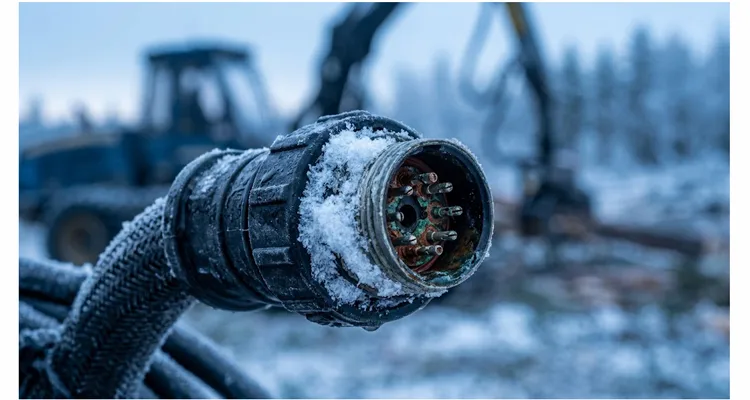
The first cold snap on a northern logging block usually finds the weak harness.
A forwarder or harvester will drop a node from the J1939 network for a few seconds, store a communication timeout in the ECU, and then run normally for another two days. The fault never appears on a warm shop floor. By the time someone back-probes the network at 4:00 a.m. with frozen gloves, the problem has already cost a shift.
This is rarely a controller problem. It is almost always a J1939 physical layer problem: a terminal fretting under vibration, an insulation crack that has allowed water to reach the twisted pair, or a shield drain tied to the wrong point. The harness is the last component people replace, but it is the first place these failures begin. As we have documented in our forestry J1939 harness field repairs post, these failures tend to resurface at the worst possible time.
For a forestry OEM, the minimum supplier demand should not stop at a certificate. It should include:
- PPAP Level 3 documentation before production release
- Crimp validation for the exact terminal, wire, seal, and tool combination
- Forestry-specific environmental testing, not just automotive temperature cycles
- 100% final electrical test data on every harness
- A factory floor you can audit, not a certificate wall
The failure sequence that starts in the harness
Most forestry J1939 faults are intermittent because the CAN physical layer has a slow-moving impedance problem, a terminal fretting problem, or an insulation breakdown. The diagnostic codes are rarely helpful. A typical fault might be a timeout for the engine controller, or a J1939 communication loss stored in the transmission ECU, which often shows up as SPN 639 FMI 9 on the service tool.
J1939 is a differential bus. It tolerates noise only if the differential impedance stays close to 120 ohms and the termination resistance is where the standard says it should be. A small change in capacitance from water ingress, or added resistance at a terminal, is often enough to erode the recessive signal margin. The node times out, the controller stores a fault, and then the condition disappears when the harness dries or the terminal temporarily re-seats.
I have seen a forwarder in western Canada drop the entire implement bus after twenty minutes of working in deep snow. The electronics bench-tested fine. The wiring looked fine. The failure was a splice in the J1939 backbone where water had wicked under the heat shrink and turned the splice into a capacitor. In the shop, the splice was dry and the network measured 60 ohms. In the field, the same splice became a capacitive path between CAN high and chassis ground when snow melt hit it. The recessive signal margin collapsed, and the bus dropped nodes until the splice dried out again.
That is the pattern with forestry J1939 failures. The harness does not fail outright. It degrades until the bus becomes unreliable, and then it recovers just long enough to make troubleshooting miserable.
Forestry is harder on wire than a truck or an assembly line
Forestry equipment combines the worst conditions of off-highway, construction, and cold-climate operation. A harness that survives years under a truck cab can fail in one season on a feller buncher.
| Field condition | What it does to the harness | What to specify |
| Vibration from saw units, booms, tracks | Fretting corrosion on terminal contact, connector latch wear | Selective gold terminals, validated crimp retention, secondary latch connectors, strain relief |
| Thermal cycling from -40°C to +120°C near engine and hydraulics | Insulation cracking, seal compression set | XLPE or ETFE insulation, silicone seals, thermal shock testing |
| Snow, ice, meltwater, pressure washing | Water wicking into connectors and splices | Sealed connectors rated IP67/IP69K, adhesive-lined dual-wall heat shrink, cavity plugs |
| Hydraulic oil, chain oil, diesel, wood resin | Jacket softening or embrittlement | PA12 or TPU jacket, fluid compatibility data |
| Branch intrusion, chafing on steel edges | Insulation wear, short-to-chassis | Braided sleeving, spiral wrap, routing clips, abrasion testing |
| Electrical noise from solenoids, pumps, weld repairs | CAN frame errors, marginal recessive signals | Twisted pair, single-point shield drain, correct 120 ohm termination, proper ground return sizing |
A truck harness can use PVC insulation and tin terminals in many locations. A forestry wiring harness cannot, and the difference shows up in field life, not in a catalog. We have also seen insulation failures that look like a green stick fracture in CAN bus wiring—the conductor survives, but the jacket cracks long before anyone notices.
Why IATF 16949 alone does not prevent these failures
IATF 16949 does not test a harness for 2,000 hours on a forwarder. That is not what the standard is for. It is a process standard. It forces the supplier to run a control plan, keep PPAP records, and maintain traceability. But the standard only works if the control plan writer knows what a feller buncher does to a wire bundle.
I have seen a certified supplier ship a J1939 backbone with PVC insulation because the customer drawing only called out AWG and nothing else. The control plan said “inspect wire insulation.” Nobody checked cold-flex. That harness failed in one season. The certificate was not the problem. The missing engineering input was the problem.
A plant can hang a certificate in the lobby and still run a crimp station without a force monitor. I have walked into shops like that. When I audit a harness shop, I do not ask for the certificate first. I ask to see the PPAP file for the last forestry build, the crimp height SPC chart, and the quarantine cage where nonconforming parts sit. If the quality manager cannot show me a cross-section from last week’s terminal change, the certificate does not matter.
I also want to see the RoHS and REACH declarations tied to the actual wire lot, not a generic PDF on a server that covers everything and nothing. ISO 14001 tells me the site controls waste and raw material handling. It does not tell me the harness will survive a harvester saw unit. The engineering evidence is what keeps your machine running. This is exactly why we wrote about the limits of a certificate in our post on Shenzhen Carsun achieving IATF 16949—the paper is real, but the crimp data is what matters.
What to demand before a drawing is released
Before a single drawing revision is signed, have the supplier walk you through seven items. If they cannot answer in detail, keep looking.
J1939 Network Topology and Termination Map
The supplier should review the complete machine-level J1939 network, not just a harness sketch. They should identify where the 120 ohm termination resistors live, how many nodes are on the backbone, and whether any J1939 stub length exceeds the recommended limit.
At 250 kbit/s, a J1939 stub should stay under one meter. I have seen longer stubs work on a bench but fail on a machine. Longer stubs create reflections that eat into signal margin. If the supplier does not ask about stub length, that is a warning sign. The reflection timing math behind this is covered in our J1939 stub length and reflection timing guide, but the practical takeaway is simple: keep the stub as short as possible.
Wire and Insulation Selection for Forestry Harness
The drawing should call out more than AWG. It should specify insulation material, temperature rating, cold-flex performance, and chemical resistance.
For forestry, XLPE or ETFE insulation is the baseline. PVC is not acceptable for cold-climate machine wiring because it turns brittle. A supplier should be able to explain why the selected insulation will not crack at -40°C.
Connector and Terminal Metallurgy for J1939 Harness
Sealed connectors with a full-plastic body and secondary latch are preferred for forestry. Plated metal shells look strong on a render, but they introduce another corrosion interface in the field. If the supplier wants to use metal, ask for salt spray and galvanic compatibility data.
Terminal plating is even more important. Gold or selective gold terminals resist fretting in vibration. Tin terminals do not hold up well in high-vibration connector pairs, especially when mated with gold headers.
Crimp Validation for J1939 Terminal-Wire Combinations
Every terminal, wire, seal, and crimp tool combination should be validated by cross-section analysis and pull force testing. Crimp height and width should be tracked with statistical process control during production.
This is not a one-time test. It must be repeated when the tool changes, the terminal changes, or the wire supplier changes. I have seen crimp height drift after a tool rebuild that nobody thought to re-validate.
Splice Policy for Forestry J1939 Backbone
Splices in a J1939 backbone should be minimized. If a splice is unavoidable, it should be sealed with adhesive-lined dual-wall heat shrink and placed in an accessible service loop. A splice hidden inside a sealed connector becomes a field diagnostic nightmare that usually ends with a connector replacement.
Labeling and OEM Customization Requirements
Customization is not just logo and brand. It is engineering control over length, color, AWG, connector orientation, branch breakouts, and print legend. If the supplier cannot map each wire code to a specific AWG and insulation color on the drawing, field service becomes guesswork.
For forestry OEMs, wire color codes should match the machine service documentation. The harness print should include connector face views and cavity assignments. A supplier that treats labels as an afterthought will create harnesses that take twice as long to troubleshoot.
Change Management for Forestry Harness Production
The supplier should operate a controlled ECR/ECN process. Any change in wire, terminal, connector, seal, or manufacturing process should require a new PPAP submission. Uncontrolled substitutions are one of the most common root causes of field failures in low-volume off-highway builds. I have seen a harness batch go out with a different terminal because the buyer found a cheaper one.
A factory audit checklist that separates a real harness builder from a reseller
I do not ask to see the certificate first. I ask to see the crimp force monitor data and the quarantine cage. Those two things tell me more than a wall of framed certificates.
Our crimp station has force monitoring on every cycle, not a pass/fail light. That means we see a crimp going bad before it produces a bad harness. That did not happen because of an ISO auditor. It happened after a batch of forwarder harnesses came back with intermittent CAN faults, and we traced it to a crimp tool that had drifted two hundredths of a millimeter. That kind of drift does not show up on a pass/fail light. Now the tool validation log is reviewed every shift, and the quarantine cage sits next to the crimp bench, not in a back room where problems get forgotten. Incoming wire is cross-sectioned before it reaches the rack.
The floor should look like 5S: a place for everything, tool calibration labels current, wire spools returned to racks after each shift. A climate-controlled warehouse matters because terminal oxidation, mixed wire spools, and condensation are three root causes of field failures that nobody sees until the harness is in a machine. A factory that keeps a FIFO wire rack and a clean crimp area has fewer unplanned substitutions.
Final test should be 100% tested, not lot sampling. If a supplier wants to sample, that is a sign they do not trust their own process. For every harness, the supplier should test continuity, shorts, insulation resistance, and where applicable, hipot. For CAN harnesses, some manufacturers also measure end-to-end impedance or termination resistance. That is a good sign. It means they understand the network, not just the wire. A test sticker is not enough; the test data should be retained and traceable to the harness serial number.
Material compliance documentation should include RoHS and REACH declarations tied to the actual build, with CE and UL where applicable. A binder full of generic declarations is not the same thing. A full-plastic connector design can reduce corrosion paths and simplify compliance. If the supplier uses plated metal shells, ask for salt spray data. Most forestry environments will find the weak point in a metal shell within a season.
ISO 9001 and ISO 14001 are baseline expectations for the site. The IATF standard is the one that forces PPAP and control plans. Our IATF 16949 certification is one part of that; the daily force-monitor data on the crimp bench is the other. None of them should replace a walk through the floor, because a certificate cannot smell a bad crimp.
Common mistakes that keep showing up in field returns
These are the issues I see repeatedly on forestry harnesses, each tied to a field symptom:
- Calling out only wire gauge and not insulation material. “18 AWG” is not enough. I have seen a forwarder run for six months before the jacket cracked at the boom pivot. The wire was still conducting; the insulation was gone. The insulation determines cold-flex life, not the copper.
- Mixing tin-plated and gold-plated terminals in the same connector pair. This is common when a harness is repaired in the field with whatever terminal is in the toolbox. It accelerates fretting corrosion and creates a fault that disappears when the connector is re-seated.
- Placing the 120 ohm termination resistor in the middle of the network. It belongs at the ends of the backbone. A mid-span termination creates two unterminated stubs, and the reflection pattern can produce intermittent bus-off events under load.
- Hiding a splice inside a sealed connector instead of in an accessible service loop. I have had to cut open a connector to find a corroded splice that the OEM never knew existed.
- Using split loom without sealed splices or adhesive-lined heat shrink. Water follows the loom into the connector. I have seen a connector fill with water over a winter because the loom acted as a channel.
- Using PVC jacket in cold-climate forestry. It becomes brittle below -20°C. I have seen PVC harnesses on skidders crack within two seasons. The insulation fails before the copper does.
- Missing cavity plugs in unpopulated connector positions. Water and dirt enter through open cavities. This is one of the cheapest failures to prevent and one of the most common.
- Grounding the shield at both ends or tying it to a noisy chassis point. This creates ground loop current. The resulting noise can mimic a failing controller, but the problem is in the shield drain.
- Running J1939 along hydraulic lines without abrasion standoffs. Vibration and branch contact wear through the jacket. I have seen a CAN high wire short to a hydraulic tube and take down the entire implement bus.
- Changing terminal supplier without repeating crimp validation. Different terminal plating or material changes the crimp interface. The crimp height that worked for one supplier can be wrong for another.
Each of these is preventable at the drawing and PPAP stage. None of them requires exotic technology. For a deeper look at how to protect forestry harnesses from these issues, see our forestry J1939 harness protection strategies.
How to confirm the fix actually holds
A supplier can claim a harness is forest-ready. You should confirm it with test data before production, and with field validation after.
| Validation stage | What to log or measure | Pass criteria |
| Bench thermal shock plus vibration | CAN error frames, terminal resistance | Zero bus-off events, terminal resistance change below 0.5 milliohms |
| Bench humidity and water spray | Insulation resistance, connector leakage | No water ingress, insulation resistance above 100 megohms |
| Field test on two machines for 500 hours | J1939 error logs, connector inspection | No communication dropouts, no fretting, no water ingress |
| Teardown after field test | Wire cross-sections, terminal cross-sections | No insulation cracks, no terminal plating wear |
The bench test should use a real CAN data logger connected through a J1939 9-pin breakout cable, not a simple continuity tester. A continuity tester will tell you the wire is connected. It will not tell you the network is stable. You want to capture error frames during vibration and thermal cycling. A harness can pass continuity and still produce intermittent network errors under load.
After field validation, cut the harness apart. Look for insulation cracks at tight bends, terminal fretting inside connectors, and water tracks inside splices. This teardown is the only way to see what the field test missed. If the harness survives the teardown, it has a reasonable chance of surviving production volumes.
The teardown is where most so-called forest-ready harnesses fail, and it is rarely the copper that gives up first. On one teardown, I found the XLPE jacket had started to cold-flow inside a P-clip because the installer torqued the clamp to the same value as a steel hydraulic line. The wire was still passing continuity, but the insulation was permanently deformed. The next revision added a standoff and a torque limit on the clip. That is the kind of thing a bench test does not show.
Questions forestry OEMs ask us most often
1. Is IATF 16949 mandatory for a forestry J1939 harness?
Not by law, but it should be by customer requirement. The standard forces the supplier to maintain PPAP, control plans, FMEA, and traceability. Without it, you are relying on the supplier’s goodwill. I have seen too many low-volume builds skip PPAP because nobody asked.
2. What is the difference between J1939/11 and J1939/15?
J1939/11 typically refers to the shielded twisted-pair physical layer used in heavy-duty vehicles and off-highway equipment. J1939/15 is an unshielded variant used in some applications. Forestry equipment generally should stay with shielded twisted pair because of electrical noise from solenoids and pumps. I have never seen a forestry machine where unshielded was the right call.
3. What AWG should a forestry J1939 backbone use?
It depends on length and load, but many forestry backbones use 18 or 20 AWG twisted pair. The critical specification is insulation material and twisted-pair geometry, not just AWG. A proper supplier will calculate or verify the impedance. I have seen 22 AWG backbones work on short runs, but the moment you route them along a boom, the voltage drop becomes a problem.
4. How long can a J1939 stub be at 250 kbit/s?
Keep stubs under one meter. Shorter is better. I have seen a two-meter stub work on a bench for a year and then fail on a harvester when the saw motor PWM noise lined up with the recessive bit. If a stub must be longer, move the node or add a junction box, but do not just accept it.
5. Can PVC wire be used in forestry?
Avoid PVC for cold-climate forestry. It becomes brittle and cracks. XLPE, ETFE, or equivalent low-temperature insulation should be specified. I have seen PVC harnesses on skidders fail within two seasons. The insulation fails before the copper does.
6. What connector rating should we specify?
Sealed connectors rated IP67 or better are typical. IP69K is worth considering because forestry equipment gets pressure washed. The connector body should resist diesel, hydraulic oil, and chain oil. I have seen a standard IP67 connector survive water spray but then swell and crack after repeated contact with chain oil.
7. What does 100% tested actually mean?
It means every harness is electrically tested, not sampled. The test should include continuity, shorts, insulation resistance, and optionally hipot. The data should be traceable to the harness serial number. A test sticker is not enough; you need the record.
8. How often should crimp tooling be validated?
Crimp tooling should be validated at initial setup and after any significant tool maintenance or change. Production should include periodic pull testing and crimp height monitoring. A supplier should show SPC data, not just a calibration sticker. I have seen a crimp tool drift out of tolerance after a week of heavy use on a long run.
9. Should the shield be grounded at both ends?
In most cases, no. The shield drain should be grounded at a single point to avoid ground loop current. There are exceptions, but both-end grounding in a noisy forestry environment often creates more problems than it solves. I have seen a both-end-grounded shield pick up hydraulic solenoid noise and inject it directly into the CAN reference.
10. Can a supplier support low-volume forestry builds with custom colors and labels?
Yes, if the supplier is a direct factory. Low-volume OEM builds need custom lengths, colors, AWG, branding, and pinouts without the overhead of an automotive volume program. The supplier should handle this as engineering work, not as a sales option.
11. What certifications should a forestry J1939 harness supplier hold?
Look for ISO 9001 and the IATF standard at the manufacturing site. ISO 14001, RoHS, REACH, CE, and UL should be available as material and product compliance documentation. Certifications alone do not prove the harness will survive, but they show the process is controlled. Our certifications are documented here if you want to verify the paper trail.
Next step
Send your harness drawing, pinout, or field failure photos through WhatsApp. The link opens a chat with our engineering contact:
Or use the contact page if you prefer to send a package or schedule a technical review:
We do not start with a quote. We start with the application, because a harness that is not engineered for the machine will fail no matter what the price is. Forestry OEMs should expect that. If you need a harness with your logo, your wire color code, your AWG callouts, and your specific branch lengths, that should be handled as engineering work before the drawing is released. Our factory floor is open to audit, and the crimp force monitor runs whether or not anyone is watching.
