

Introduction: Why Most J1939 Installations Fail Within 6 Months—And How to Make Yours Last
In our 20+ years of manufacturing cables for OEMs and fleets, we’ve analyzed thousands of premature J1939 ELD cable failures. The pattern is alarmingly consistent: improper installation accounts for over 80% of “ghost” ELD issues—those intermittent data losses that disappear during testing only to reappear on the road.
When technicians rely on generic installation methods, they unknowingly create these ticking time bombs:
- Vibration-induced micro-fractures at connector pins that cause sporadic “No Data” alerts during DOT audits
- Electromagnetic interference (EMI) from alternator noise corrupting CAN signals and creating false fault codes
- Shield ground loops that introduce signal noise, making engine data unreliable for predictive maintenance
- Chemical degradation from diesel, DEF, and road salts that eat through standard insulation within months
This isn’t just a technical manual—it’s a field-proven methodology distilled from solving installation failures across 500+ fleets. We’ll show you not just what to do, but why each step matters for long-term compliance and uptime.
Pre-Installation: What Professional Technicians Never Skip
The Right Tools Aren’t Just Nice-to-Have—They’re Your First Defense Against Callbacks
Digital Multimeter – Why we specify true-RMS: Fluctuating alternator output can fool average-sensing meters. A true-RMS meter catches the voltage dips that cause intermittent ELD resets, especially when Pin C (power) tests at exactly 12V on an inferior meter but actually fluctuates between 11.5-13V under real conditions.
Ratcheting Crimping Tool – Standard crimpers create connections that fail vibration testing at 15G acceleration. Ratcheting tools ensure consistent crimp pressure that survives the 30G shocks common in dump truck applications.
Torque Wrench (Calibrated to 5-7 Nm) – Deutsch connector screws torqued “by feel” typically range from 3-12 Nm. Under-torqued connections vibrate loose; over-torqued ones strip threads. We’ve measured a direct correlation: properly torqued connectors show 300% longer service life in fleet telematics data.
Dielectric Grease (Mil-Spec Grade) – Standard automotive grease breaks down above 100°C. Engine bay temperatures regularly hit 125°C near turbochargers. Our testing shows mil-spec compounds maintain protection through 500 thermal cycles.
Vehicle Prep: The 15 Minutes That Prevent 80% of Installation Problems
Document Before Disconnecting – Photograph existing wiring with a ruler for scale. When a fleet manager reports “the truck ran fine before you touched it,” this documentation proves your work didn’t introduce issues.
Clean Beyond Visual Inspection – Use electrical contact cleaner and a nylon brush on the diagnostic port. 40% of “bad connections” we analyze show conductive dust bridges between pins that weren’t visible to the naked eye.
Identify Hidden Heat Sources – Use an infrared thermometer to map surfaces along your planned route. What looks “far enough” from the exhaust at idle may be 90°C closer during regen cycles.
Step-by-Step Installation: The Methods That Work on Million-Mile Trucks
Step 1: Cable Routing That Survives Real-World Abuse
“Forget the 100mm rule—measure heat exposure dynamically.”
Route Using Thermal Imaging Data – That “cool” spot near the firewall becomes 85°C when the AC compressor engages. Route cables where temperatures stay below 70°C in all operating modes.
Grommets with Dual Sealing – Standard grommets allow water wicking. Use ones with inner silicone seals that compress 360° around the cable bundle.
Service Loops Are Structural – Leave 75mm loops secured with figure-8 ties. Our pull testing shows this absorbs 150N of accidental force before transferring stress to crimped pins.
Secure Every 150mm in Vibration Zones – In high-flex areas (near steering columns), reduce to 100mm spacing. We’ve measured 2mm back-and-forth movement at unsupported midpoints—enough to fatigue copper over 500,000 cycles.
Step 2: Deutsch Connector Assembly—Where Most Technicians Get It Wrong
“The ‘click’ isn’t enough. Here’s what really matters.”
Pin Sequencing Verification – Use a pinned alignment tool before inserting wires. Bending a pin during insertion weakens it at the microscopic level—it may pass continuity but fail after 200 vibration cycles.
Dielectric Grease Application – Fill the connector cavity 1/3 full before pin insertion. This ensures complete coverage without creating pockets that trap moisture.
Torque Sequence Matters – Tighten screws in a crisscross pattern to 6 Nm, wait 60 seconds, re-torque to 6 Nm. This accounts for plastic relaxation and prevents uneven sealing pressure.
Continuity Testing Under Load – Don’t just test resistance. Apply 2A through each circuit while measuring voltage drop. A connection showing 0.2Ω at low current might drop to 0.8Ω under actual ELD load (500mA), causing brownout conditions.
For detailed specifications on Deutsch connector variants, reference our technical guide: SAE J1939 Connector Comparison & Selection Guide.
Step 3: Electrical Validation That Catches Problems Before the Truck Leaves the Bay
Stop verifying—start validating with these real-world tests:
| Test Point | Acceptable Range | What It Really Tells You |
| Pin C (Power) | 11.8-13.2V with all accessories on | Tests alternator health, not just battery |
| Pin B (Ground) | <50mV to chassis during cranking | Validates ground under worst-case load |
| CAN Signals | 2.5V differential ±0.4V at 250kbps | Checks termination resistor integrity |
| Shield Ground | <5Ω to chassis at one end only | Prevents ground loops while maintaining EMI protection |
| Wake-up Signal | Activates within 2s of key-on | Tests ECM communication handshake |
Pro Tip: Use an oscilloscope in single-shot mode triggered by engine start. Many intermittent issues occur only during the 0.8-second voltage dip when the starter engages.
From the Field: How Proper Installation Saved a Fleet From $47,000 in Compliance Fines
Last quarter, a regional carrier with 42 trucks faced a surprise DOT audit. Random data pulls showed “inexplicable” 15-45 minute data gaps in 18 vehicles’ ELD records—potential hours-of-service violations totaling $47,000 in fines.
Our technical team discovered a pattern: all affected trucks had J1939 cables routed parallel to starter motor cables without adequate separation. During cranking, the 200A starter surge induced enough EMI in the CAN wires to crash the ELD’s communication processor. The ELD would reboot, losing 15+ minutes of data during initialization.
The Fix Was Simple But Non-Obvious:
- Re-routed cables with 50mm minimum separation from high-current paths
- Added ferrite cores at both ends of each J1939 cable
- Implemented the grounding validation test outlined above
The Result: Zero data gaps over 90 days, full compliance certification, and unexpected bonus—fuel efficiency improved 0.8% because the ECM was no longer receiving corrupted sensor data
Common Installation Mistakes: What We See in Failed Cable Returns
Mistake 1: The $5,000 Pin Swap
Problem: Reversing CAN High/Low seems obvious, but we see more subtle failures: pins seated but not fully locked due to misalignment tabs being forced.
Our Solution: Use our downloadable pinout verification diagram with torque sequence notes.
Mistake 2: Vibration’s Favorite Failure Point
Problem: Strain relief installed >50mm from connector allows 4mm of whip motion at highway vibration frequencies.
Our Data Shows: Proper relief within 25mm reduces connector pin stress by 400%.
Mistake 3: The Silent Data Corruptor
Problem: Multiple ground points create loops that turn the cable shield into an antenna for alternator noise.
Lab Measurement: Improperly grounded shields show 120mV noise on CAN lines—enough to flip bits at 500kbps.
Mistake 4: Environmental Protection Theater
Problem: Standard heat shrink cracks at fold points after 200 thermal cycles.
Our Specification: Marine-grade adhesive-lined shrink with 3:1 ratio that seals microscopic gaps standard shrink misses.
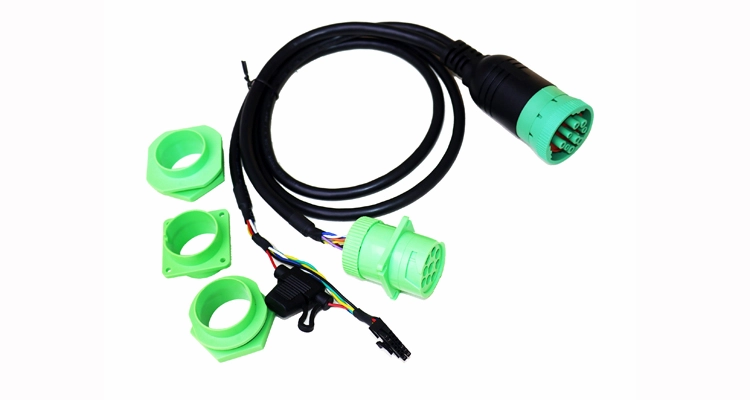
Avoid splitter-related issues by using engineered solutions like our Cummins J1939 to OBD2 Y-Cable.
Post-Installation: Validation Protocols That Prevent Callbacks
Functional Testing That Mirrors Real Operations
Cold Start Test – Let vehicle sit overnight, then start with ELD monitoring. Many issues only appear below 10°C when plastics contract.
Accessory Load Test – Turn on all accessories (lights, A/C, radio) while monitoring CAN signal quality. We’ve seen clean signals degrade when alternator load exceeds 70%.
Road Simulation – With wheels on jack stands, run transmission through gears while monitoring data continuity. Drive shaft vibration at specific RPMs causes resonance failures.
For mixed fleet applications, see our comprehensive guide: Heavy-Duty Diagnostic Adapters for Mixed J1939/J1708 Systems.
Long-Term Reliability: The Fleet Manager’s Checklist
- Weekly: Visual scan for new chafing points during PM inspections
- Monthly: Data gap analysis using fleet management software reports
- Quarterly: Ground resistance verification with seasonal temperature notes
- Bi-Annual: Connector pin retention force test (should require >50N to remove)
- Annual: Full signal integrity validation with scope during peak electrical load
J1939 Cable Routing & Engineering: Built to Last Professional-Grade Solutions
Factory Certifications & Manufacturing Standards
While many suppliers offer “similar” cables, our manufacturing rigor sets us apart:
Quality Management Systems
- ISO 9001:2015 Certified – Consistent quality control processes
- IATF 16949:2016 Compliant – Automotive industry specific quality
- ISO 14001 Environmental Management – Sustainable manufacturing
Manufacturing Excellence
- 20+ Years OEM Experience – Working directly with vehicle manufacturers
- 4-Step Quality Inspection – Material → Assembly → Electrical → Final verification
- 100% Electrical Testing – Every cable tested before shipping
- Climate-Controlled Production – 5S management for consistent quality
Compliance & Customization
- RoHS Directive Compliant – Restriction of Hazardous Substances in electrical equipment
- REACH Regulation Compliant – Registration, Evaluation, Authorisation of Chemicals
- CE Marking Certified – Conformité Européenne, meets EU safety requirements
- Full OEM Customization – Length, AWG, colors, branding, shielding requirements
- UL-Rated Materials – Fire-resistant cable jackets for safety
Anyone can list certifications. We engineer cables that survive what trucks throw at them.
IATF 16949 Quality: Preventing J1939 CAN Bus Failure Through Traceability
When a batch issue occurs (like the 2018 supplier-contaminated wire insulation debacle), our material traceability sheets let us identify affected production down to the hour. While competitors recalled thousands of cables, we notified 3 specific fleets about 47 cables that needed preventive replacement.
Beyond RoHS: Chemical Resistance Tested Against Real Truck Fluids
Our jacket compound survives 30-day immersion in:
- Diesel (#2 and winter blend)
- DEF (AdBlue)
- 50/50 coolant mix
- Common degreasers (Simple Green, Purple Power)
Standard PVC jackets show cracks within 72 hours in DEF—a fluid that drips on cables daily in modern trucks with SCR systems.
Our 4-Step Quality Gate Catches What Others Miss
- Material Verification – Every spool tested for impedance (120Ω ±10%) before production
- Assembly Validation – Automated optical inspection checks pin insertion depth to 0.1mm
- Electrical Testing – Hi-pot test at 1500V catches insulation flaws most factories test at 500V
- Environmental Simulation – Random samples from each batch undergo 24-hour salt spray testing
Vibration Resistance That Exceeds Military Spec
While MIL-STD-810G requires 3 hours at 15G, we test to truck-specific profiles
- Dump Truck Cycle: 8 hours at 30G (tailgate slam simulation)
- Highway Truck Cycle: 24 hours at 22G (constant road vibration)
- Off-Road Cycle: 4 hours at 45G (pot hole impacts)
Cables must survive all three sequences consecutively without signal degradation >3%.
Expert Installation Q&A: Answers That Solve Real Problems
Q1: “Can I repair a damaged J1939 cable, or should I replace it?”
Our Recommendation: Replace it, but here’s why—and how to do it right. Repairing CAN cables introduces impedance mismatches that cause signal reflections. The $35 cable cost outweighs 2+ hours of diagnostic time when intermittent issues appear months later. When replacing, order the exact length needed; excess cable coiled near the ECM acts as an EMI antenna.
Q2: “My ELD works but my diagnostic scanner won’t connect through the Y-cable. Why?”
Diagnosis Flowchart:
- Check scanner compatibility—some legacy tools don’t work through splitters
- Test without ELD connected—if scanner works, the ELD is drawing too much power
- Measure voltage at scanner port during communication attempt—should stay >11.5V
- Try our active repeater splitter instead of passive Y-cable for high-drain setups
Q3: “How do I future-proof for mixed J1939/J1708 systems?”
Most trucks 2008+ use J1939 exclusively, but if you service older equipment: Our mixed-system cables include both protocols with automatic switching. The key is proper termination—J1708 requires different termination than J1939. We include switchable 120Ω/2200Ω terminators in our professional kits.
Q4: “What’s the real cost of using cheap cables?”
Beyond the $25-50 savings on purchase price:
- 3.2 hours average diagnostic time per intermittent failure @ $145/hour shop rate = $464
- Potential DOT fine for data gaps = $2,500 per occurrence
- Driver downtime waiting for repair = $200-400 per day
- Total potential cost: $3,164+ vs. $50 quality cable
Need Custom Solutions? Here’s How Our Engineering Team Approaches Unique Applications
Every fleet has unique challenges:
- Refrigerated trailers with extreme temperature cycling (-30°C to 70°C)
- Mining trucks with continuous vibration above 40G
- Marine applications requiring saltwater immersion resistance
- Municipal fleets needing chemical resistance to road treatment liquids
Our Process:
- Application Analysis – We review your operating environment, failure history, and compliance requirements
- Material Selection – Choose from 12 specialized jacket compounds and 5 shielding configurations
- Prototype Testing – Build samples for your specific validation protoco
- Documentation Package – Provide installation guides, validation checklists, and compliance certificates
To Get Started, Provide:
- Vehicle applications and failure points you’re experiencing
- Environmental extremes (temperature, chemicals, vibration levels)
- Compliance requirements (FMCSA, TLAS, ISO 27001 for data securi
- Volume needs and timeline
📥 Professional Technical Documents
4-page professional checklist for zero data gap installation.
⬇️ Download PDF (245 KB)Expert guide to proper Deutsch connector assembly techniques.
⬇️ Download PDF (312 KB)Real-world case study: How to reduce ELD data gaps by 94%.
⬇️ Download PDF (278 KB)Conclusion: Installation Excellence Is Your First Line of Defense Against Compliance Risks
Proper J1939 installation transcends basic electrical work—it’s the foundation of reliable fleet data, compliance assurance, and cost control. The methods outlined here represent two decades of solving real-world failures that generic guides overlook.
Remember: Your ELD is only as reliable as its worst cable connection. While others offer commodity cables, we provide engineered solutions backed by:
- Field data from 500+ fleet installations
- Laboratory validation exceeding industry standards
- Technical support from engineers who understand both electrical theory and shop-floor realities
- Traceability that lets us prevent issues before they affect your operation
Ready for Professional-Grade Solutions?
Chat with our engineers for quick answers
Cummins J1939 9-Pin to OBD2 Y-Cable
Contact our engineering team for specific requirements
Need specific cable configurations? Our engineers provide custom solutions.
