

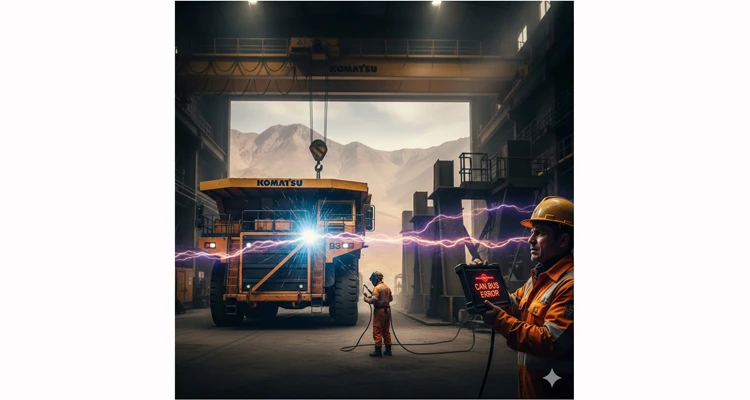
The 06:42 shift report logged a Komatsu 930E with sudden throttle drop and an illuminated check engine light. By 08:15, three additional haul trucks had returned from the pit displaying identical combinations of SPN 91 and SPN 639 errors. None of the vehicles had been operating near one another. The single common factor: all four had passed through Bay 4 for routine oil sampling the previous afternoon, while a fitment crew was welding new conveyor supports approximately 15 meters away.
The initial diagnosis suggested catastrophic ECU failure. However, in an environment where one truck’s downtime costs more than most annual salaries, replacing $10,000 computers without evidence is not defensible. You locate the physical evidence first. This narrative documents how we found that cause—positioned directly adjacent to a welding ground clamp. This represents a documented mining case study J1939 cable failure investigation with verified field data. Understanding how to systematically diagnose such intermittent issues is critical, as we’ve outlined in our guide to diagnosing intermittent CAN bus failures.
The Scene: A Maintenance Bay, an Arc Welder, and a Silent CAN Bus
The maintenance bay sits 200 meters downwind from the primary crusher. Airborne dust in this zone carries silicate particles abrasive enough to etch glass—we have documented headlight covers fogging permanently within 18 months of equipment deployment. Electrically, the bay sits between high-voltage tray lines feeding the conveyor drives and a VFD bank switching 600 amps daily. When the welding crew arrives, they introduce a 400-amp arc source using grounding methods unchanged since the 1970s. This environment demands the robust construction found in a J1939 cable durability agriculture engineering guide, which addresses similar harsh conditions.
The four affected trucks had entered the bay for scheduled oil sampling and filter changes. During their parking interval, a fitment crew was installing new structural supports for the bay, operating a 400-amp arc welder positioned less than 15 meters from the line of parked equipment.
The detail overlooked by site electricians: the welder’s ground clamp attached to the building’s steel frame, but the return path passed directly beneath the trucks’ parking positions. This configuration generated a large-amplitude, fluctuating magnetic field directly under the vehicles. This scenario represented a classic welding interference solution case awaiting identification.
Within 24 hours of returning to production, the trucks began reporting the following error suite:
| SPN Code | Component | Observed Behavior |
| SPN 91 | Accelerator Pedal Position | Erratic, out-of-range signal voltages |
| SPN 84 | Wheel Speed Sensor | Data validity errors, intermittent dropouts |
| SPN 639 | J1939 Network | logged |
The maintenance team replaced sensors. They re-flashed ECUs. Neither action resolved the condition. The fault pattern appeared, disappeared, and migrated to different trucks without explanation.
The Deeper Dive: Why Standard Cables Became Antennas
When our team arrived on-site, we began with data acquisition rather than component replacement. We extracted proprietary diagnostic logs from the engine ECUs and the truck’s VIMS (Vital Information Management System). The pattern was unequivocal: the logged faults were not component failures. They were communication failures.
The J1939 protocol is inherently robust, relying on differential signaling—the voltage difference between CAN High and CAN Low. This protocol family is maintained by the Society of Automotive Engineers as the standard for heavy-duty vehicle networks. The fundamental principles of this robust communication are detailed in the CAN bus Wikipedia entry on the physical layer, which explains how differential signals and proper termination provide noise immunity. Electromagnetic interference (EMI) from the welding arc induced common-mode current into the unshielded twisted pair cables routed along the truck’s chassis. For a deeper understanding of how to protect against this, refer to our field guide to CAN bus EMI shielding.
Here is what the oscilloscope revealed: the unshielded twisted pair running along the frame rails was not filtering noise—it was capturing it. The steel chassis combined with the cable run length created a loop antenna geometry. As detailed in technical literature on CAN physical layer design, twisted-pair wiring helps cancel common-mode interference, but in high-energy events like welding arcs, the induced voltage can overwhelm the transceiver’s common-mode rejection capabilities. When the welder struck an arc 15 meters distant, that loop captured sufficient energy to momentarily exceed the CAN transceiver’s input protection circuitry. The ECUs did not fail; they lost the ability to hear the network through the noise floor.
The Result:
The CAN controller enters a protective “bus-off” state, freezing all network communication. The truck becomes a 500-ton static sculpture—visually impressive, operationally useless to the load-out target.
This was not a sensor problem. It was a cabling infrastructure vulnerability that manifested only under the extreme electromagnetic stress of an external welding arc. This observation confirms why any rigorous mining case study J1939 cable analysis must prioritize the physical layer before investigating electronics. The principles of sound connection design, whether crimp vs solder for vibration reliability, are fundamental here.
Step-by-Step: The Shielded J1939 Cable Retrofit
The mine could not relocate the maintenance bay. The welding schedule could not be halted. The solution required isolating the trucks’ electronic nervous systems. We executed a full retrofit of the diagnostic backbone cables using a shielded, heavy-duty variant designed for mining environments.
The procedure followed methodical steps with the same rigor applied to major component rebuilds:
1. Baseline Measurement
We connected a digital oscilloscope to capture the CAN bus waveform on a known-good truck. We then reproduced the welding conditions (with the truck powered down) to measure induced noise on the existing unshielded cables. The noise spikes exceeded +40V, far beyond the CAN transceiver’s absolute maximum tolerance.
2. Cable Selection
We specified cable meeting the J1939/11 physical layer specification for shielded twisted pair (120-ohm characteristic impedance). The critical specifications included:
- Tinned Copper Braid Shield: Minimum 85% optical coverage. This provides a low-impedance path to ground for induced noise currents.
- Heavy-Duty Jacket: Polyurethane (PUR) instead of standard PVC. Required to resist continuous abrasion from Atacama silicate dust.
- Drain Wire: Tinned copper drain wire in continuous contact with the shield for reliable field termination to chassis ground.
3. Grounding Strategy (The Critical Part)
Installing shielded cable without proper grounding guarantees failure. A poorly terminated shield performs worse than no shield at all. Understanding the true cost of custom cable engineering helps justify the investment in doing it right.
- We established single-point, low-impedance grounds for each cable segment, typically at the ECU or fuse panel end. Industry guidance from semiconductor manufacturers and system designers consistently recommends grounding shielding at a single point to prevent ground loops that can inject noise into the signal path.
- We used 360-degree termination through Deutsch HD series connectors, ensuring the shield made continuous contact with the connector shell, which then grounded to the chassis. No “pigtail” grounds were permitted—these represent a common, fatal installation error.
4. Installation and Re-routing
During installation, we re-routed the new cables to separate them from high-current DC lines. We maintained a minimum separation of 300mm from all potential noise sources, securing cables with dedicated p-clips on clean frame rails.
The “Quick Fix” That Fails: 5 Common Mistakes
These errors appear consistently in field installations. They distinguish a permanent solution from a recurring operational headache. If you are researching a welding interference solution case, eliminate these practices from consideration. Many of these mistakes are also covered in our analysis of OBD2 splitter cable problems and fixes, which addresses similar signal integrity issues.
1. Why a Twisted Braid Becomes a Choke at Welding Frequencies
Field technicians often take the shield braid, twist it into a wire pigtail, and crimp it into a ring terminal. At the frequencies present in welding noise, this pigtail acts as a high-impedance choke. The induced noise cannot drain to ground and remains coupled into the signal conductors.
2. The Ground Loop That Turned a Shield Into an Antenna
Grounding the shield at both ends creates a ground loop. Current flows through the shield itself, inductively coupling noise into the very conductors the shield is intended to protect.
3. 120-Ohm Impedance: Why GPT Wire Reflects Signals
Automotive primary wire (standard GPT or TXL constructions) does not maintain controlled impedance. When used for J1939 networks, impedance mismatches cause signal reflections, data corruption, and communication errors independent of external interference. As the Wikipedia article on 120-ohm termination resistors explains, proper termination is critical to prevent signal reflections on transmission lines. Proper termination requires 120-ohm resistors at both ends of the bus segment.
4. The Missing Resistor That Left the Bus Unstable
During maintenance, someone may disconnect a component containing an integral terminating resistor. The bus becomes unterminated, highly susceptible to reflections and noise, producing intermittent communication failures. Proper bus design, as discussed in our J1939 cable ELD compliance audit failure analysis, always accounts for this.
5. Foil-Only Imports: What We Found in the “New” Stock
Assuming new components are correctly engineered is unsafe. We tested the “new” cables the mine held in inventory. They were low-cost imports with foil shielding only and no drain wire. Foil provides some RFI attenuation but is ineffective against the low-frequency magnetic fields generated by welding equipment. Effective shielding requires braid.
How We Confirmed the Fix (Beyond Just “It Works”)
We did not close the access panels and wait for the next failure report. We reproduced the welding conditions with the oscilloscope still connected and observed the waveform in real time. This level of validation is part of the IATF 16949 PPAP zero-defect cable process we adhere to.
1. Post-Installation Waveform Capture
We reconnected the oscilloscope and repeated the welding test with the trucks powered on. The previously observed 40V noise spikes were eliminated, reduced to a barely measurable ripple of under 1V. The recessive bus voltage remained stable at 2.5V throughout welding operations.
2. Controlled CAN Bus Traffic Analysis
We used a Dearborn Group (or equivalent) J1939 protocol analyzer to monitor the bus for error frames. Before the retrofit, error frames saturated the bus during welding. After installation, the bus traffic remained clean with zero error frames detected.
3. Operational Verification
The trucks returned to the pit. Check engine lights remained off. Throttle response returned to normal. Fleet availability returned to pre-failure levels.
Zero operational downtime was incurred during the diagnostic and repair process.
The Cable That Made the Difference
The cable used in this solution was not a special prototype or custom engineering sample. It is a standard product within our heavy-duty range, though its construction specifications exceed industry typical. It represents the type of component that remains invisible when functioning correctly—which is precisely the objective. Our manufacturing facilities are certified under ISO 9001, ISO 14001, and IATF 16949, ensuring this level of quality.
Cable Construction Details:
- Core: 18 AWG (0.82 mm²) tinned copper stranded conductors for flexibility and corrosion resistance.
- Insulation: Polyethylene (foam-skin dielectric) to maintain the precise 120-ohm characteristic impedance required by the J1939 specification.
- Shielding: Combined aluminum foil and tinned copper braid. The foil addresses high-frequency RFI; the braid handles low-frequency magnetic interference from sources including welders and alternators.
- Jacket: Polyurethane (as specified above), color-coded blue for immediate identification as diagnostic cabling.
This cable functions as physical layer insurance. The most sophisticated ECUs and sensors cannot compensate for a wiring harness that fails to deliver intact data. A million-dollar machine becomes an expensive stationary object when its data link fails. This understanding derives from over 20 years of observing field failures traceable to physical layer vulnerabilities. For applications with extreme vibration, consider our J1939 ArmorLink vibration-validated cable assembly.
Frequently Asked Questions from the Field
Q: Will this cable fix my existing communication errors?
A: It depends on the error mechanism. If your errors are mechanical (broken conductors, corroded pins, damaged connectors), those must be repaired first. If your errors are intermittent and correlate with high engine load, alternator electrical noise, or nearby welding operations, then shielding addresses the root cause—electrical interference coupled into the signal path.
Q: The welding is completed. Why do I need shielded cable now?
A: The next source of EMI may be a new VFD installation, a lightning strike near the site, or a high-power radio transmitter. Once the dielectric materials in low-quality cable are degraded by overvoltage events, the damage is permanent. Shielding provides permanent, proactive defense against future interference sources.
Q: Will this work with the ECUs already installed in our fleet, or do we need adapters?
A: This cable adheres to the SAE J1939/11 physical layer standard. It is compatible with any ECU, display, or telematics device communicating via J1939, including Cummins, Caterpillar, Komatsu, and other major manufacturers. No adapters are required.
Q: What about moisture ingress in underground or wet mining conditions?
A: The polyurethane jacket provides high resistance to water, oil, and hydraulic fluids commonly encountered in mining environments. For connector interfaces, we recommend dielectric grease and proper sealing of Deutsch or equivalent connectors to prevent moisture entry.
Q: Can you customize cable lengths and apply our fleet branding?
A: Yes, daily. We can imprint cables with your fleet asset numbers or logo, cut to exact lengths to eliminate coiled excess, and color-code jackets for different applications (diagnostic backbone, implement control, telematics, etc.).
Q: How does shielded copper compare to fiber optic cabling for mining equipment?
A: Fiber optics offer complete EMI immunity but present practical limitations. Fiber is mechanically fragile and difficult to terminate in field conditions. Shielded copper remains the industry standard for mobile equipment because it is mechanically robust, field-serviceable with standard tools, and provides power to network nodes where required.
Q: Which manufacturing standards apply to your cable materials and assembly processes?
A: Our facility operates under ISO 9001:2015 and IATF 16949 (automotive) quality management systems. Materials comply with RoHS and REACH requirements. Every meter of cable undergoes testing for impedance, continuity, and high-voltage dielectric withstand before shipment.
Q: What is the typical lead time for a custom order of this cable type?
A: For fleet quantities similar to this mining operation, we typically ship custom-engineered cables within 5-7 business days. We maintain substantial raw material inventory in climate-controlled storage specifically to support rapid response for mining and heavy equipment customers.
Need to Discuss a Similar Application?
The Atacama case represents one example among many. We observe identical failure patterns in underground mines, surface mines, construction sites, and agricultural operations. If your equipment experiences intermittent faults, phantom diagnostic codes, or unexplained communication losses, a conversation costs less than pulling a transmission for a problem that does not exist mechanically.
If your fleet logs SPN 639 errors or diagnostic tools freeze during welding operations, send me the details. I can review photographs of your cable routing, examine shield termination points, and provide an assessment distinguishing component issues from physical layer problems. This is the welding interference solution case we are prepared to solve for your operation. For more background, read our analysis of cold weld and vibration arbitration.
The most direct path to a technical discussion is via WhatsApp. I can review installation photographs, discuss your cable specifications, and help scope an appropriate solution.
Chat with our Engineering Support on WhatsApp
For detailed project requirements—such as OEM customization, specific cable lengths, or fleet-wide branding—you can submit specifications through our contact page.
Go to the Contact Page for OEM & Engineering Inquiries
We supply cables. More importantly, we provide engineering support to ensure your million-dollar assets remain online and communicating clearly.
