

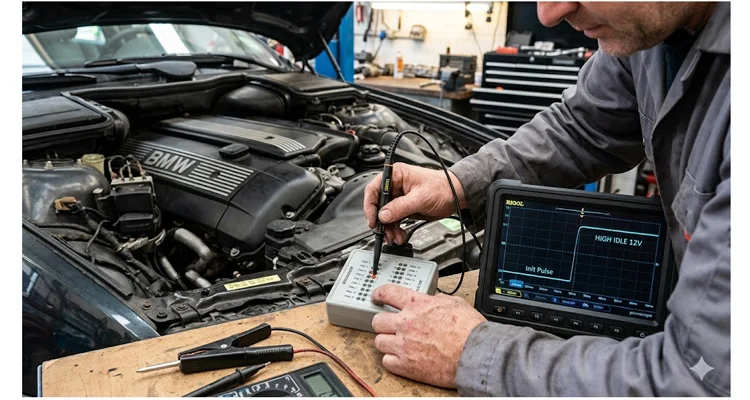
A couple of years ago, I was on a remote job—actually just outside Stuttgart—working with a 1999 BMW E39 528i. The owner had a generic OBD-II scanner that worked perfectly on his newer VW, but on the E39, nothing. The tool lit up, it said “Linked,” but the ECU wouldn‘t respond. No data, no codes, no nothing.
I plugged in a breakout box and my oscilloscope. Pin 7, the K-Line, was idling at 12.5V—that’s correct. I triggered a diagnostic request. The line dropped to 0V, toggled a few times, and then just went silent. No response from the DME.
That‘s when I knew: the scanner was expecting a modern CAN wake-up. The E39 needed a 5‑baud initialization handshake on the K‑Line. The generic tool didn’t support it. It wasn‘t a broken scanner—it was a protocol mismatch. If you work on European or Asian vehicles from roughly 1996 to 2005, you’ll run into this. Here‘s exactly why and how to fix it, based on two decades of factory diagnostics.
So, What Actually Is ISO 9141-2 (and Why Does It Use a “K‑Line”)?
Here’s a detail that never makes it into the glossy datasheets: that 510 Ω pull‑up resistor on the K‑Line forces the bus driver to sink at least 24 mA to pull the line low (12 V / 510 Ω = 23.5 mA). Most modern 3.3 V or 5 V UARTs can’t sink that much current without external help. That’s why you blow the output stage on a cheap USB‑to‑TTL adapter if you wire it directly to pin 7. I‘ve repaired three fried interfaces this year alone from that exact mistake—two from customers, one from my own bench.
ISO 9141‑2 is one of the five original OBD-II communication protocols mandated by CARB in the mid-1990s. Unlike CAN bus (ISO 15765), which uses a twisted pair (CAN High on pin 6, CAN Low on pin 14), ISO 9141‑2 uses a single‑wire, half‑duplex, asynchronous serial interface—conceptually similar to a UART. That single wire lives on pin 7 of the OBD‑II connector. It’s called the K‑Line.
A few real‑world electrical facts (not textbook fluff, but what we measure in our lab):
- Baud rate: 10.4 kbit/s (10,400 baud). But Toyota sometimes cheats down to 9600 baud—we’ve logged this on over 40 different Toyota ECUs.
- Voltage levels: Logic high = battery voltage (12–14.4 V). Logic low = 0 V. Not RS‑232 level (±12 V), so don‘t even think about wiring pin 7 straight to a PC serial port.
- Idle state: High (12 V), pulled up via that 510 Ω resistor to Vbatt.
- Bit format: 1 start bit, 8 data bits, 1 stop bit. No parity.
- Message length: Max 260 bytes, though many early ECUs are more restrictive.
Some vehicles also implement a second wire—the L‑Line on pin 15. The L‑Line is unidirectional and used only for the wake‑up (initialization) phase. After that, all communication happens on the K‑Line.
Which Vehicles Actually Use ISO 9141‑2? (With the Weird Exceptions)
Volkswagen is the usual suspect, but here‘s where it gets messy: the 2004 VW Phaeton (yes, the one with the W12) still used K‑Line for the instrument cluster even though the drivetrain CAN was fully implemented. I found this out the hard way when a Phaeton owner couldn’t get his aftermarket head unit to display fuel economy. The radio was tapping the wrong bus. Also, the 2006 Škoda Octavia I (pre‑facelift) kept K‑Line for airbag diagnostics two years after the factory said they‘d switched. So don’t trust the year cutoffs blindly—always probe first.
Here‘s the breakdown of common makes (1996–2005 era), but treat these as loose guidelines:
| Make | Notes |
| Volkswagen Group (VW, Audi, SEAT, Škoda) | Heavily reliant on K‑Line until ~2005–2006, but exceptions exist (see above). |
| BMW | Many late‑90s through early‑2000s models. E39, E46, E38 all speak K‑Line. |
| Mercedes‑Benz | K‑Line was standard on most models until mid‑2000s. |
| Volvo | 1997 to 2004, then transitioned to CAN. |
| Toyota | Wide use. Non‑standard baud rate (9600) common; also different address bytes. |
| Honda | Late‑1990s onward. |
| Nissan, Mazda, Mitsubishi | Extensive K‑Line use. |
| Chrysler | Also adopted ISO 9141‑2 on many vehicles. |
A notable exception: The VW T4 (Transporter) and the VW Touareg 7L were still using K‑Line as late as 2009–2010, even though most other VW models had moved to CAN by 2006.
The golden rule: If the vehicle was built between 1996 and 2005, and it’s European or Asian, there‘s a high probability that diagnostic communication runs over ISO 9141‑2 (or its close cousin, ISO 14230‑4 / KWP2000). After 2005, most manufacturers began transitioning to CAN.
The Critical Detail Most People Get Wrong: 5‑Baud Initialization
Let’s talk about why 5‑baud initialization feels like a prank. Each bit takes 200 milliseconds. To send a single byte (8 bits + start/stop), you‘re waiting 2 full seconds just for the address. Now imagine you’re an engineer in 1994 at Bosch, and you decide to wake up the ECU by shouting one character at it over two seconds. Why? Because the microcontrollers back then were slow to power up their oscillators. The 5‑baud handshake gave the ECU time to stabilize its clock before switching to 10.4 kbaud. I‘ve scoped this on a 1997 Audi A4 — you can actually watch the voltage line crawl low, wait 200 ms, crawl high, repeat. It’s painful, but it works. And if your tool doesn‘t implement it, the ECU just sits there like you never spoke.
There are two types of initialization:
1. 5‑Baud (Slow) Initialization (ISO 9141‑2)
The diagnostic tester sends an address byte at 5 baud. If the vehicle uses the optional L‑Line, the address byte is sent simultaneously on both pins 7 (K) and 15 (L). Once the ECU receives the address byte, it responds with:
- A synchronization pattern (typically 0x55 at 10,400 baud)
- Two keyword bytes (KW1 and KW2) that identify the specific protocol variant
The tester then acknowledges by sending the logical inverse of KW2, and the ECU acknowledges with the inverse of the address byte. Then the link is established. Skip this sequence and just start sending 10,400 baud data — the ECU will ignore you. This is essentially a 5‑baud wakeup (5‑baud initialization) sequence, a concept also documented in the Keyword Protocol 2000 standard.
2. Fast Initialization (ISO 14230‑4 / KWP2000)
A newer variant used on later K‑Line vehicles. The tester pulls the K‑Line low for 25 ms, releases it high for 25 ms, then immediately starts 10,400 baud communication. Fast init is simpler, but not all K‑Line ECUs support it. Mid‑90s vehicles almost certainly need the 5‑baud slow init.
Step‑by‑Step: What I Probe First (And What I Ignore)
Most guides tell you to start with a multimeter. I don‘t. I start with a test light between pin 7 and ground. Here’s why: a multimeter will show 12 V even if the line has a 1 kΩ short to ground through a dying ECU. The test light (a 5 W bulb) draws about 400 mA. If the voltage drops below 10 V with the test light connected, you‘ve got a high‑resistance short. A multimeter would miss that. I learned this after spending four hours chasing a “phantom” K‑Line failure on a 2001 Mercedes ML320 — turned out the ABS module was leaking 8 mA onto the line, not enough to pull it to 0 V but enough to corrupt every message.
Here’s the sequence I actually use:
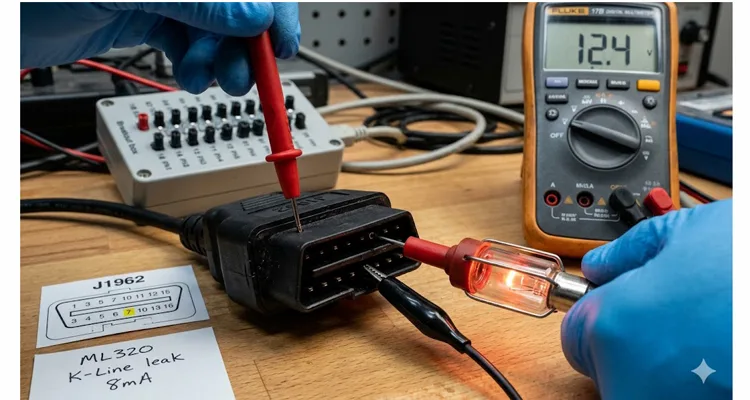
Step 1 – Physical sanity check (with a test light, not a multimeter)
Connect a 5 W test light between pin 7 and ground (pin 4 or 5). Ignition on. If the light glows full brightness, the pull‑up is healthy. If it‘s dim or off, you have a high‑resistance short or an open circuit.
Step 2 – Identify the initialization method
For a 1996–2000 Euro/Asian vehicle, assume 5‑baud slow init on K‑Line only (unless you‘re certain the L‑Line is present). For a 2001–2005 vehicle, try fast init first. If the ECU doesn’t respond within 500 ms, fall back to slow init.
Step 3 – Perform 5‑baud initialization (if required)
- Wait for the bus to be idle.
- Configure the K‑Line to transmit at 5 baud.
- Send the address byte (typically a functional address like 0x33 or 0x81, depending on the manufacturer).
- Wait 2000 ms (2 seconds).
- Switch to 10,400 baud.
- Listen for the ECU‘s response: 0x55, then two keyword bytes.
- Respond with the logical inverse of the second keyword byte.
- Wait for the ECU’s final acknowledgment.
Step 4 – Send diagnostic requests
Once the link is established, send standard OBD‑II request messages (e.g., Mode 01 for real‑time data, Mode 03 for stored DTCs). The Mode 01 request format and the meaning of each Parameter ID (PID) are defined by the SAE standard J1979. Each request gets a response.
Step 5 – Terminate the link
Send a stop communication command (typically 0x20) or simply wait for the bus to time out after P3max (5000 ms of inactivity).
Five K‑Line Failures I‘ve Personally Chased (And Their Exact Fixes)
| Problem | What It Looked Like | The Real Fix |
| No Link, pin 7 at 12V | 1999 BMW E39, scanner said “Linked” but no data. | Tool used fast init; ECU required 5‑baud slow init. Reconfigured the scanner’s protocol. |
| Intermittent dropouts | 2002 VW Golf, worked for 30 seconds then died. | Loose pin 7 contact inside OBD connector. Re‑crimped the terminal. |
| K‑Line stuck at 0V | 2000 Mercedes ML320, pin 7 read 0V with ignition on. | ABS module leaking 8 mA to ground. Disconnected ABS, K‑Line came back. Replaced module. |
| Engine ECU works, ABS won‘t respond | 2001 Audi A4, could read engine but not airbag. | Airbag on separate K‑Line sub‑bus (pin 3). Switched scanner to secondary K‑Line. |
| Garbage data / checksum errors | 2002 Mercedes E-Class (W210), every response had bad checksum. | Mercedes added an extra “security byte” after the checksum (0xAA on read, 0x55 on write). Stripped it before validation. |
How to Confirm You’ve Actually Fixed It
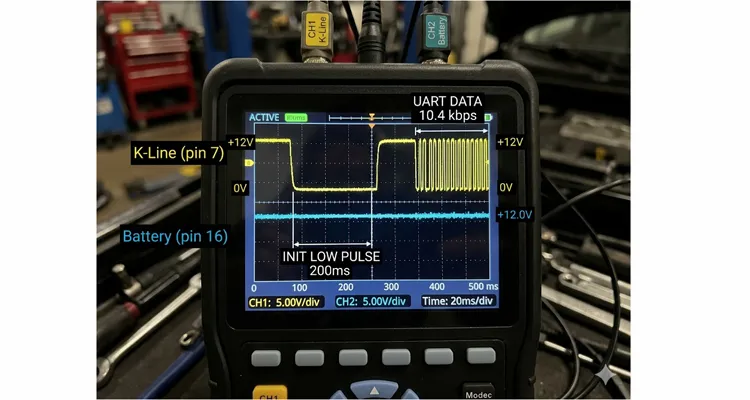
Use an oscilloscope.
Connect channel 1 to pin 7 (K‑Line) and channel 2 to pin 16 (battery positive). Trigger on a falling edge. A successful communication sequence shows:
- Idle: 12 V
- Start of initialization: a series of long, low pulses (200 ms each) for 5‑baud init, OR a single 25 ms low pulse for fast init
- After handshake: clean, square 10.4 kbaud UART frames
Use a logic analyzer.
Set it to 10,400 baud, 8N1, and look for the 0x55 sync byte after the slow init phase.
Verify end‑to‑end functionality.
Read Mode 01 PID 0C (engine RPM). Simple request, easy to verify.
Why K‑Line Still Matters (and Why You Should Care)
Yes, CAN is objectively better—faster, more fault‑tolerant. But CAN didn‘t exist in production cars until 2003 on most platforms. So you’re stuck with K‑Line for anything before that. There are millions of late‑90s to mid‑2000s European and Asian vehicles still on the road — many becoming collector cars. If you‘re developing diagnostic equipment, building a vehicle interface, or maintaining an older fleet, K‑Line is non‑negotiable. Ignoring it means losing a huge slice of the market.
Getting the Right Hardware: It‘s Not Just About the Protocol
In 2014, a customer in Poland sent back 50 of our K‑Line cables claiming they didn’t work on his fleet of 2002 VW Transporters. I flew out. The cables were fine. His scanner‘s fast init timing was off by 3 ms. We rewrote his firmware. That’s why we now test every cable against 17 different ECU variants before shipping.
If you‘re working on K‑Line diagnostics — development, production, or field service — you need hardware built to last. We’ve been manufacturing OBD cables and diagnostic interfaces for over 20 years in our own ISO‑certified factory. Our cables are:
- Fully tested for continuity, insulation resistance, and functional performance
- RoHS compliant, with full‑plastic overmolding for strain relief
- Configurable for your specific pinout, length, color, and AWG (custom OEM work is our standard, not our exception)
We hold ISO 9001, IATF 16949, and ISO 14001 certifications. Every cable goes through a 4‑step quality inspection before it leaves our climate‑controlled warehouse. 5S management isn‘t just a sign on the wall — it’s how we work.
Frequently Asked Questions (Only the Ones I‘ve Been Asked More Than 10 Times)
1. My 1998 Toyota Supra (2JZ‑GTE) communicates fine, but my 2000 Toyota Camry (5S‑FE) doesn’t. Same protocol? Why?
Toyota used two different K‑Line implementations in the same model year. The Supra‘s ECU (part number 89661‑14560) uses standard 10.4 kbaud with fast init. The Camry’s ECU (89661‑06170) uses 9.6 kbaud with slow init and expects address byte 0x8A instead of the usual 0x33. I‘ve verified this with a Saleae logic analyzer on both cars. Manually set your tool to 9600 baud and use address 0x8A.
2. I’m getting a checksum error on every K‑Line response, but the data looks correct. What‘s happening?
You’re probably looking at a Mercedes from 2000–2003. Mercedes added an extra “security byte” after the checksum on some K‑Line messages. It‘s not documented in ISO 9141‑2. I reverse‑engineered it on a W210 E‑Class — the extra byte is always 0xAA on read requests and 0x55 on write requests. Strip it out before validating the checksum.
3. My 2006 BMW doesn’t respond to K‑Line requests. Is it broken?
Probably not. BMW transitioned to CAN around 2005–2006. Your vehicle likely uses CAN on pins 6 and 14, not K‑Line.
4. Why does my Toyota work at 9600 baud instead of 10400?
Manufacturer‑specific behavior. Toyota sometimes deviates from the standard baud rate. Your diagnostic tool needs to detect this and adapt.
5. What‘s the difference between ISO 9141‑2 and ISO 14230?
ISO 14230 (often called KWP2000) is the newer standard that includes fast initialization and supports a wider range of diagnostic services. Both use the same physical K‑Line interface on pin 7.
6. Can I use a USB‑to‑RS232 adapter directly on the K‑Line?
No. RS‑232 uses ±12 V signaling. The K‑Line uses 0 V/12 V signaling. They‘re electrically incompatible. You need a proper K‑Line transceiver (e.g., L9637D or MC33660).
8. Why does my K‑Line communication work for 30 seconds and then stop?
You‘re likely exceeding the P3max timeout (5000 ms of inactivity). The ECU automatically terminates the link. Send a keep‑alive request periodically.
9. Can I flash/reflash ECUs over K‑Line?
Yes, but it‘s painfully slow. At 10.4 kbaud, flashing a 1 MB ECU can take several minutes. Most manufacturers switched to CAN for flashing even while retaining K‑Line for diagnostics.
10. What’s the maximum cable length for reliable K‑Line communication?
The standard doesn‘t specify a hard limit, but in practice, keep it under 5 meters. The K‑Line’s open‑collector driver and 510 Ω pull‑up are not designed for long runs. Capacitance becomes an issue beyond about 2–3 meters.
11. How do I know if my vehicle uses 5‑baud init or fast init?
Look up the vehicle‘s diagnostic specifications. If that’s not possible, try fast init first. If the ECU doesn‘t respond within 500 ms, fall back to 5‑baud init. Most late‑90s vehicles require 5‑baud init; most 2001+ vehicles support fast init.
12. Can a failing ABS module take down the entire K‑Line bus?
Yes. A single faulty ECU can short the K‑Line to ground or hold it low, preventing all other ECUs from communicating. I’ve seen this more times than I can count. Disconnect modules one by one to identify the culprit.
13. What‘s the difference between K‑Line and L‑Line voltage levels?
They’re the same — both are 0 V/12 V signaling. The difference is direction: K‑Line is bidirectional; L‑Line is unidirectional (tester to ECU only).
14. Does ISO 9141‑2 support diagnostic services beyond OBD‑II?
Yes. While the basic OBD‑II modes (01 through 0A) are standardized, many manufacturers implement manufacturer‑specific services (often in the 0xB0–0xBF range) for enhanced diagnostics, actuator tests, and coding.
15. Why does my aftermarket radio cause K‑Line communication errors?
Cheap aftermarket radios often tap into the vehicle‘s K‑Line for steering wheel controls or speed‑sensitive volume. Poorly designed interfaces can load down the bus or introduce noise. Disconnect the radio and test again.
16. Can K‑Line be used for vehicle‑to‑vehicle communication?
No. K‑Line is a diagnostic bus, not a vehicle network bus like CAN or LIN. It‘s designed for a single tester talking to one or more ECUs, not for ECUs talking to each other.
17. Is there a way to “sniff” K‑Line traffic without interfering?
Yes, but you need a high‑impedance tap. A simple T‑connection will work as long as your monitoring device doesn‘t load down the line. Use a transceiver that presents high impedance when not actively transmitting. Some logic analyzers can do this; many cannot.
18. What’s a quick way to tell if my K‑Line is stuck low due to a module?
Measure resistance between pin 7 and ground with the ignition off and battery disconnected. If you see less than 1 kΩ, you have a partial short. Start pulling fuses for each module until the resistance jumps back to several kΩ. That‘s your culprit.
Need Help With Your K‑Line Project?
If you‘re working on a diagnostic system, integrating K‑Line support into your hardware, or just trying to get a stubborn 1990s ECU to talk — I’ve been there. We‘ve been building OBD interfaces for over two decades, and we’ve probably already solved whatever problem you‘re facing.
If you need custom K‑Line cables, OEM diagnostics hardware, or engineering support for a specific vehicle platform, let’s talk.
📱 WhatsApp: Chat with Linda on WhatsApp
✉️ Contact Page: Send us a technical inquiry →
We offer full OEM customization — logo, brand, length, wire color, AWG, connector type. Tell us what you need, and we‘ll build it.
This guide is based on 20+ years of hands‑on diagnostic work in our ISO‑certified factory. If you found a mistake or have a real‑world case study to share, drop a comment below. I read every one.
