

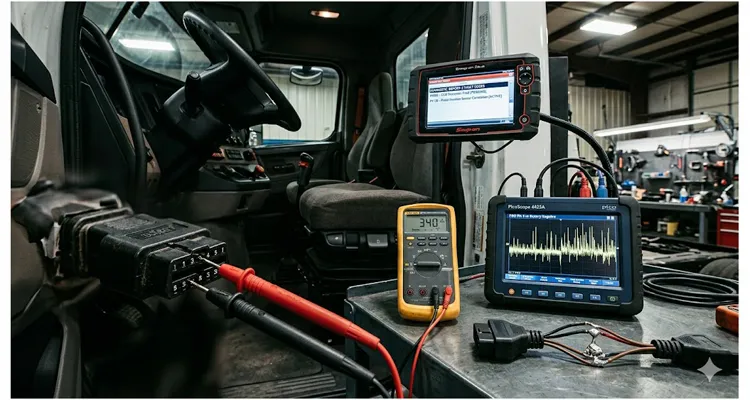
Last winter I took a call from a fleet maintenance supervisor who had a Freightliner Cascadia with a Cummins ISX12 sitting dead in the yard, a stack of repair orders already totaling over two thousand dollars, and a dealership insisting the only path forward was a second engine ECU. A month earlier, their first ECU replacement had been diagnosed based on a handful of fault codes: an internal ROM checksum error, sporadic accelerator pedal correlation faults, and phantom CAN bus timeouts. The dealer’s remedy was predictable — swap the ECU. The bill came to roughly two thousand five hundred dollars for the module, programming, and labor. Seventy-two hours later, the truck rolled back in with the same codes. The dealer’s next recommendation: replace the ECU again, blaming a “defective” replacement unit.
It wasn’t the ECU. It was a ground offset of less than four-tenths of a volt.
That’s the subject of this article: a silent, measurement-induced fault that tricks experienced technicians into condemning perfectly healthy control modules. I’m writing this because my team has debugged this exact ground offset scenario more times than I can count, and because most factory diagnostic flowcharts and wiring diagrams never mention the one variable that corrupts the entire measurement chain — the ground reference your scan tool trusts.
The Physics of Ground Offset in Automotive Diagnostics
A handheld multimeter measures whatever voltage appears between its test leads with no fixed anchor. An engine ECU can’t operate that way — every millivolt its microcontroller reads must be referenced to a real, physical sensor ground plane. Inside the module, that plane is a dedicated copper pour on the PCB, bonded to the ECU housing to reject chassis noise by design. Sensors like accelerator pedal position transducers, throttle position sensors, rail pressure sensors, and exhaust gas temperature probes all run on a five-volt reference supplied by the ECU, and their return signal sits between zero and five volts measured exclusively against that same ECU sensor ground.
The OBD-II diagnostic connector gives you two ground paths: pin four (chassis ground) and pin five (signal ground). On paper, a schematic shows pin four, pin five, and the battery negative terminal all at the same potential — within a handful of millivolts. On a truck that has survived five winters of road salt while a PWM cooling fan pulls forty amps, a voltage difference of two hundred to five hundred millivolts appears routinely between those points. That potential gap is the ground offset. On heavy‑duty J1939 networks, the same phenomenon causes ghost faults that nobody traces back to the physical layer — we’ve dissected the exact mechanism in our J1939 ground offset voltage diagnosis guide.
When a scan tool or a data-logging breakout box samples a sensor voltage through the OBD port, it grounds itself through whatever path the diagnostic cable provides. If that cable has pin four and pin five soldered together inside the overmold, or if it forces the tool’s ground onto pin four through a corroded contact, the scan tool’s ground reference floats away by whatever noise or ground loop current is riding on the chassis. The scan tool then paints a picture of sensor voltages that the ECU never generated. The diagnostic software, seeing nonsensical data, triggers internal ECU failures, five-volt reference short-circuit faults, or sensor correlation errors.
This is not an edge case you’ll find in a typical training seminar; it’s the kind of real‑world fault we’ve spent two decades tracing on the factory floor. I have seen it on heavy-duty diesel trucks, light-duty gasoline pickups, mining equipment, and agricultural machinery. The one component that was never at fault? The ECU. The common denominator was always the ground integrity of the diagnostic signal chain.
The Real-World Case That Cost Two Thousand Five Hundred Dollars (and Solved with a Fifty-Cent Fix)
Let me walk through that Freightliner in detail, because it’s the clearest example in my notes.
The truck exhibited an intermittent loss of throttle response and lit the MIL. The stored fault codes were:
- P2138 – Accelerator Pedal Position Sensor 1-2 Correlation
- P0606 – ECM/PCM Processor Fault
- U0100 – Lost Communication with ECM/PCM (ghost, historical)
The dealership technician followed the factory diagnostic tree. He checked the accelerator pedal sensor wiring, found no opens or shorts to ground, observed a clean five-volt reference, and saw plausible pedal voltages on a breakout box at idle. Because P0606 was present, the service manual instructed him to verify ECM grounds and power feeds, then replace the ECM if those checked out. The ECM was swapped, programmed, and the truck passed a road test.
When the codes returned, I was called in for a second look. I brought a four-channel oscilloscope and high-impedance differential probes. I back-probed the accelerator pedal signal and sensor ground directly at the ECM connector, while simultaneously capturing pin five (signal ground) at the OBD-II connector through the diagnostic port. The scope told the story immediately.
With the engine running and the alternator charging, the ECM’s sensor ground at the ECU connector housing sat within twelve millivolts of battery negative — quiet and stable. Pin five at the OBD connector, however, was riding on a noisy offset that swung between one hundred eighty and three hundred forty millivolts above battery negative, synchronous with the alternator’s PWM field control and the electric fan’s PWM drive. The scan tool’s ground path picked up that entire offset, causing it to report pedal voltages that drifted in and out of the fault threshold. The ECU itself never saw those corrupted voltages. The ECU was perfectly healthy. The P0606 was triggered by the ECU’s own diagnostic routine, which detected a discrepancy between its internal sensor ground and the data reaching the pedal sensor — a discrepancy created by the corrupted ground reference traveling through the diagnostic tool’s ground path while the tool was connected.
The root cause was twofold: the fleet’s generic OBD breakout harness had pin four and pin five soldered together inside the molded connector, and the truck’s chassis ground path had developed higher resistance at a corroded frame connection. Together, they formed a small but destructive ground loop through the diagnostic cable every time a scan tool was plugged in. The truck drove perfectly until someone connected a diagnostic interface. The entire two-thousand-five-hundred-dollar repair was chasing a measurement artifact.
We cleaned the chassis ground bonding point, replaced the breakout harness with a properly engineered diagnostic cable that keeps signal ground and chassis ground electrically separate, and the “faulty” ECU is still in that truck today, running without a hiccup.
A Step-by-Step Method to Detect and Confirm Ground Offset
If you’re chasing an intermittent sensor correlation fault, a five-volt reference integrity code, or a phantom ECM internal failure, add these measurements to your routine before you condemn a module. You will need a digital multimeter with a millivolt range and, ideally, a two-channel oscilloscope. (We’ve compared the diagnostic yield of a 200‑dollar USB scope against a bench unit for J1939 waveform work — you don’t need a laboratory‑grade instrument to see the telltale signatures, but bandwidth matters as we outline in this 50 MHz vs 100 MHz scope bandwidth comparison for CAN bus glitches.)
Step 1: Measure the vehicle’s internal ground offset.
With the ignition on and engine off, connect the black meter lead to the battery negative post (not the clamp, the post). Probe OBD pin four (chassis ground) with the red lead. Record the reading. A healthy system stays under fifty millivolts. Start the engine and switch on all high-current loads — headlights, blower motor, heated seats, auxiliary PTO if equipped. Repeat. On that Freightliner, this measurement climbed past three hundred millivolts with the fan and alternator loaded.
Step 2: Measure the difference between pin four and pin five.
With the engine running and loads on, measure between OBD pin four and OBD pin five. Anything above thirty millivolts tells you chassis ground and signal ground are not at the same potential. Some ECUs float the signal ground through an internal isolation barrier by design, but for most heavy-duty and light-duty applications, this gap points to a grounding issue.
Step 3: Back-probe the ECU sensor ground directly.
Locate the ECU sensor ground pin (a wiring diagram is essential here). Back-probe it and compare its potential to battery negative. If the ECU sensor ground is clean while OBD pin five shows an offset, your diagnostic interface or the vehicle’s DLC wiring is introducing the error. If both the ECU sensor ground and OBD pin five show the offset, the problem lives in the vehicle’s main ground path — not in the ECU and not in your cable.
Step 4: Substitute a known-good, properly grounded diagnostic cable.
Disconnect your current scan tool interface or breakout cable. Install a diagnostic cable you trust — one with independent signal ground and chassis ground conductors, a defined shield termination, and measured contact resistance under five milliohms per pin. Re-measure pin five. If the offset disappears, your original cable was the culprit.
Step 5: Scope the sensor signal and ground simultaneously.
Set up one channel on the suspect sensor’s signal wire (e.g., accelerator pedal position one) and a second channel across OBD pin five to battery negative. Use differential mode if available. You will immediately see if the ground reference is moving in time with electrical loads. A stable sensor signal riding on a wandering ground reference is a guaranteed recipe for phantom fault codes.
Keep the following limit table handy during diagnosis:
| Measurement Point | Engine Off (Key On) | Engine Running (Loaded) | Action If Exceeded |
| Battery Negative to OBD Pin 4 (Chassis Ground) | Less than 50 mV | Less than 100 mV | Inspect main chassis ground connections for corrosion or looseness |
| Battery Negative to OBD Pin 5 (Signal Ground) | Less than 50 mV | Less than 50 mV | Check diagnostic cable and DLC wiring for ground loop |
| OBD Pin 4 to OBD Pin 5 | Less than 30 mV | Less than 30 mV | Suspect internal ECU ground float or cable short between pin 4 and 5 |
The Cable Factor: Why a Ten-Dollar Harness Can Cost You Thousands
What a Failed OBD Cable Looks Like Inside
We’ve torn down failed cables that somehow passed dealership procurement and ended up in tool cribs. One breakout harness, labeled “heavy-duty” on the packaging, had pin four and pin five bridged with a blob of solder inside the DLC overmold — no insulation, no separation. The signal ground conductor was bare copper turned green under the jacket, and the shield was drain-wired to both connector shells, creating a textbook ground loop antenna. Under a thermal camera at three amps, the contact interface hit ninety degrees Celsius after just twelve insertion cycles. That’s not a cable — it’s a diagnostic liability.
A diagnostic cable built like this becomes an antenna for alternator ripple, PWM noise, and voltage drops across the chassis. The scan tool cannot tell the difference between a real sensor error and a ground shift the cable itself injects. The technician sees “ECM internal fault” and follows the service flow chart straight to an unnecessary module replacement. The ECU was never the problem.
How We Engineer Ground Offset Out of the Cable
On the product engineering side, we treat diagnostic cable design with the same discipline as an ECU wiring harness. We never bridge pin four and pin five inside the vehicle connector. If a scan tool’s architecture forces a common ground, that tie happens only at the tool-side plug, through a controlled impedance path. On the last harness we built for an agricultural OEM, the signal ground traveled as a dedicated twisted pair inside an overall braid, with the shield terminated at the scan tool end only. That single-ended shield termination erased a fifty-millivolt loop that had scrambled their end-of-line tester for six months. Before that cable shipped, it was cycled twelve thousand times on a servo-driven mating fixture while we logged contact resistance every five hundred cycles. Had it drifted past five milliohms, it would have been scrapped before it left the factory. Even subtle cable asymmetry can generate common-mode noise that mimics an offset — we once documented a twelve‑percent geometric mismatch that corrupted differential signals on a J1939 backbone despite perfect shielding. The overmolding is a full-plastic, sealed design with no exposed metal, eliminating secondary corrosion paths. Every assembly passes a four-step inspection: automated continuity and insulation resistance, physical pin retention force verification, ground-loop offset measurement under load, and a final visual and dimensional check inside our climate-controlled, 5S-managed warehouse.
The same design rules apply across connector families. For J1939 diagnostic work, our J1939 9-pin pigtail breakout cable keeps signal ground and chassis ground electrically independent — the identical philosophy we use on every OBD harness we build, just in a Deutsch form factor.
These aren’t marketing claims we wrote for a brochure. They are the engineering guardrails that separate a diagnostic measurement you can trust from a measurement that leads to a two-thousand-five-hundred-dollar mistake.
When OEM Customization Makes the Difference
Every conversation we’ve had with Tier-1 suppliers and OEM test system builders starts with the same frustration: off-the-shelf cables are never exactly right. A diagnostic interface for a production end-of-line tester might need a specific length to reach a test rack, a particular color code to match plant floor SOPs, a non-standard AWG to handle a four-amp current surge during ECU flashing, or a custom overmold carrying the equipment builder’s logo.
From a Single Crimping Machine to IATF 16949 Certified Custom Harnesses
Twenty-three years ago this factory began with one terminal crimping machine and a single customer who needed a Deutz diagnostic adapter that wouldn’t fall apart after three firmware flashes. Today, when a Tier-1 client asks for a harness that holds a maximum ground offset of fifteen millivolts under one ampere of chassis current at eighty-five degrees Celsius, we don’t outsource the molding or the testing. The overmold compound is mixed in-house, the crimp height is verified to plus or minus zero point zero five millimeters, and every assembly runs through the same four-stage inspection that caught a two-milliohm contact drift in a batch of five hundred cables last quarter. Certifications — IATF 16949, ISO 14001, RoHS, CE, UL, REACH — aren’t framed posters on a wall. They’re the reason we can ship a custom-colored, custom-length, logo-branded diagnostic harness to a German OEM in under eight weeks, with an individual test report in the box.
A recent example: a German Tier-1 supplier needed two hundred OBD interface cables for an automated engine ECU flashing station. The specification demanded a two-meter length, eighteen AWG power conductors, a violet overmold with their corporate logo, and a verified maximum ground offset of fifteen millivolts under one ampere of chassis current. We delivered a first-article sample in three weeks and the full production run in eight weeks. Every single cable shipped with its own ground-offset measurement report.
If your diagnostic environment — a mobile field service laptop, a dynamometer cell, or an assembly-line tester — depends on accurate ground-referenced measurements, a cable designed for your specific constraints isn’t a luxury. It’s the baseline.
Common Mistakes That Lead to Unnecessary ECU Replacement
Over the years I’ve compiled a short list of patterns that surface again and again. If any of these sound familiar in your workshop or test bench, you may be one ground offset away from condemning a good module.
- Treating pin four and pin five as interchangeable. They are not. Signal ground is the reference for sensor readings. Chassis ground carries power return and shielding currents. Tying them together at the DLC injects noise directly into your measurement.
- Using a single-ended multimeter and trusting the number. A digital multimeter averages voltage over its sampling window. It can completely mask a three-hundred-millivolt ripple that a scope would reveal instantly.
- Failing to load the system during measurement. Ground offsets usually appear only when current flows through the chassis — alternator charging, HVAC blower, PWM-controlled fans. Measure with everything off and you will see a clean signal and assume everything is fine.
- Replacing an ECU based on fault codes alone, without an independent measurement. A stored P0606 means the ECU self-test flagged an anomaly. It does not automatically mean the ECU is defective. The self-test can trip from a ground disturbance injected through the diagnostic bus when a scan tool is connected.
- Ignoring the diagnostic cable as a test instrument. You would not trust a pressure transducer you dropped on the shop floor every day. Yet technicians routinely expose OBD cables to oil, coolant, dirt, and creeper wheels, and rarely verify their electrical integrity.
How to Confirm the Repair and Close the Case
After you have corrected a ground offset — whether by cleaning vehicle ground points, replacing a diagnostic harness, or both — use this disciplined sequence to confirm the fix is real and not a coincidence.
- Re-measure the offset. You should now read less than fifty millivolts between battery negative and OBD pin five with all loads active. On a scope, the waveform should be a nearly flat line.
- Clear all fault codes and perform a drive cycle. Monitor the suspect sensor data on your scan tool. The signal must be stable and match a back-probed measurement within the sensor’s accuracy specification.
- Run the ECU internal self-test, if available. Many modern ECUs support bidirectional tests for RAM, ROM, and watchdog circuits. Passing this test with the corrected ground confirms the ECU was never damaged.
- Document the before-and-after measurements. Attach a screenshot of the offset waveform and the final clean measurement to the work order. This protects you and the customer if similar codes reappear from a different cause.
- Label or retire the defective diagnostic cable. If a breakout harness caused the problem, do not put it back on the tool crib shelf for the next technician to unknowingly use. Tag it, cut it, or return it to the supplier with measurement data.
Frequently Asked Questions
1. What exactly is a ground offset in automotive diagnostics?
In the Freightliner we worked on, the scan tool’s ground reference (pin five at the OBD port) sat three hundred forty millivolts above the ECU’s internal sensor ground. That’s a ground offset: a voltage drop between where the measurement tool thinks “zero volts” is and where the ECU actually measures zero. At a five-volt sensor scale, three hundred forty millivolts represents a nearly seven percent error. For a throttle position sensor, that’s enough to make the diagnostic software believe the ECU is returning implausible data, even though the ECU itself reads the sensor perfectly. On heavy-duty backbones, a seemingly trivial 0.3‑volt offset can cascade into fleet‑wide downtime — we’ve quantified the cost of a 0.3V ground offset on a J1939 backbone in a separate field study.
2. How can a ground offset make an ECU look faulty?
When the scan tool reads sensor voltages that are shifted or noisy due to a ground offset, the diagnostic software may interpret the data as an internal ECU failure, a corrupted calibration, or a five-volt reference fault. The ECU may also log internal errors if the diagnostic session disturbs its ground reference. On that Cascadia, the P0606 appeared only when the scan tool was connected through the defective breakout harness — the ECU was never actually defective.
3. What voltage difference is considered a ground offset problem?
In a properly functioning system, the offset should be under fifty millivolts, measured between battery negative and OBD pin five with the engine running and electrical loads on. Consistent readings above one hundred millivolts warrant investigation. In the Cascadia case, the offset reached three hundred forty millivolts under load — well into the region that generates false ECU fault codes.
4. What are the most common symptoms?
Intermittent throttle response issues, pedal correlation faults, random five-volt reference codes, phantom CAN communication losses, and ECU internal checksum or watchdog faults — especially if they appear only when a scan tool is connected. On that Cascadia, the only driveability clue was an intermittent dead pedal that occurred exactly when the electric fan ramped up.
5. How do I measure ground offset with a multimeter?
Set the meter to the millivolt DC range. Connect the black lead to the battery negative post. Probe OBD pin four and note the value. Then probe OBD pin five. Run the engine and turn on high-current loads. Repeat the measurements. For a more complete picture, also measure between pin four and pin five.
6. Can a poor-quality OBD cable cause a ground offset?
Absolutely. The generic breakout harness we removed from the Cascadia had pin four and pin five soldered together internally — we later confirmed it induced the entire ground offset by creating a ground loop that superimposed vehicle electrical noise onto the signal ground.
7. Why do some vehicles seem more prone to this issue than others?
Vehicles with PWM-controlled alternators, electric cooling fans, or aftermarket electrical accessories tend to generate more chassis ground noise. Older vehicles with frame corrosion are particularly susceptible because the chassis ground path resistance increases with age. The Cascadia had both: a noisy PWM fan drive and a corroded frame ground that raised the path resistance just enough to create a destructive ground offset.
8. Is ground offset the same as a ground loop?
A ground loop is one of the mechanisms that produces a ground offset. When a diagnostic cable creates multiple paths to ground with different potentials — exactly what happened with that soldered-together pin four/pin five harness — current flows through the cable’s ground conductor and a voltage drop appears. That voltage drop is the ground offset you measure.
9. After fixing the ground, how do I know the ECU is really okay?
If the fault codes no longer return after a complete drive cycle, the ECU passes its available bidirectional self-tests, and the sensor data matches a back-probed measurement, the ECU can be considered healthy. In every case I have investigated, including the Cascadia, I have yet to see an ECU that was permanently damaged by a transient ground offset during diagnosis.
10. When should I consider a custom diagnostic cable instead of a generic one?
If your diagnostic workflow involves automated test benches, end-of-line programming stations, or frequent connection to heavy equipment with known noisy electrical systems, a custom diagnostic harness built with your specific grounding scheme, AWG, length, and connector type removes the most common source of measurement error before it causes a misdiagnosis. The agricultural OEM we worked with learned this the hard way — their fifty-millivolt loop vanished the moment we delivered a harness with a single-ended shield termination and dedicated signal ground pair.
The Takeaway
Ground offset is an invisible measurement error that has cost fleets, independent shops, and OEMs millions in unnecessary module replacements, warranty claims, and lost uptime. The fix is almost never an ECU. It is understanding what your scan tool actually references when it displays a voltage, and having the discipline to verify that ground reference before you condemn a module.
If the idea of spending two thousand five hundred dollars to replace a good ECU because of a fifty-cent ground problem bothers you as much as it bothers us, let’s fix the measurement chain first. We’ll engineer a diagnostic harness that isolates signal ground from chassis ground, size the conductors for the flashing current your modules actually draw, and ship you a cable with its own ground-offset measurement report — so the next time your scan tool says “ECM internal fault,” you’ll know whether to trust it. Chat with Linda on WhatsApp or visit the contact page. Describe your vehicle, your scan tool, and the fault codes you’re chasing. We’ve been doing this from the same factory floor for over twenty years, and we’d rather prevent one unnecessary ECU replacement than sell a thousand cables to people who never needed them.
The next time a scan tool says “replace ECU,” take thirty minutes to check the ground. It might just save you two thousand five hundred dollars.
Need engineering support or a custom diagnostic harness? Chat with Linda on WhatsApp or visit our Contact page. Tell us about your setup and the problem you’re chasing. We’ll help you find the ground offset before it finds your wallet.
