
By the CARSUN Engineering Team
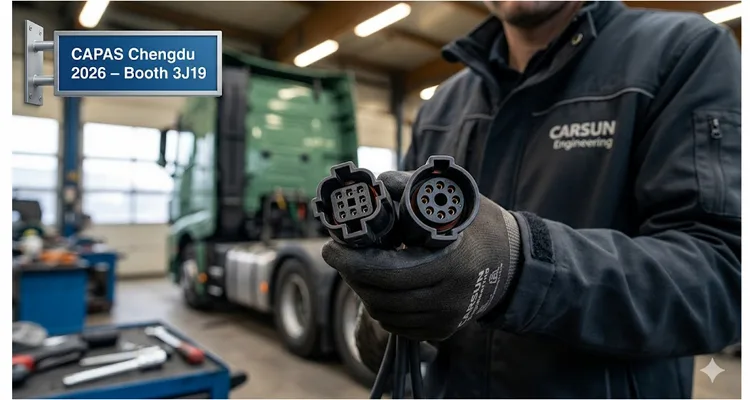
May 21–23, 2026 | Chengdu Century City New International Exhibition & Convention Center
Booth 3J19
Introduction
A few years back, I took a call from a fleet maintenance supervisor in Chongqing. His telematics vendor had shipped a batch of J1939 Y-cables for a mixed fleet of Sinotruk HOWOs and Dongfeng Tianlongs. Every single cable had the same pinout — and the vendor couldn‘t tell him why. Some trucks ran fine. Others threw SPN 639 FMI 14 before the key even finished cycling.
That’s the kind of problem you won‘t find in a datasheet. It surfaces in a repair bay at 2 AM, when the truck is supposed to be loaded and gone by 5.
If you’ve ever been handed something like this, you already know the real bottleneck isn‘t the protocol — it’s the physical layer. And the physical layer starts with the harness in your hand.
We exhibit at CAPAS Chengdu 2026 because this is exactly where those conversations need to happen. Southwest China isn‘t a single fleet profile. The mix here — domestic heavy trucks, joint-venture light commercial vehicles, CNG buses, electric last-mile vans — creates wiring requirements that off-the-shelf catalogs simply walk past. If your supplier can’t tell you the difference between a J1939-09 (Type 1 Deutsch) and a J1939-13 (Type 2 Deutsch) diagnostic connector — a distinction we break down in our J1939 Type 1 vs Type 2 guide — you‘re already solving the wrong problem.
A Brief Reality Check About Your Current Supplier
If your supplier has never put these five questions to you, they’re guessing:
- What is the exact SAE standard revision your vehicle ECU was programmed to — J1939-73 (2016) or earlier?
- Do your installers have access to the vehicle‘s CAN backbone, or are they tapping the diagnostic port only?
- Are your trucks 12V or 24V system voltage? (We’ve seen 12V cables land in 24V fleets more than once.)
- Does your application require CAN Hi/Lo termination inside the harness, or is termination handled upstream?
- What AWG is your installer actually comfortable terminating in the field?
If the answer to all five is “never been asked,” find us at Booth 3J19.
For 20 years, our factory floor has been dedicated to one discipline: building automotive-grade diagnostic harnesses and heavy-duty cabling. We aren‘t a trading house that forwards RFQs to the lowest bidder. We’re the hands-on manufacturer that opens the molds, sets the crimp forces, and pushes every single harness through a full pin-by-pin electrical test before it leaves the floor. When a fleet engineer calls us with a SPN 639 intermittent fault and asks, “Should I spec 120-ohm termination in the Y-splitter, or does the backbone handle it?” — we answer from the bench, drawing on the same logic we shared in our J1939 termination stub length phantom fault guide, not from a spec sheet we Googled.
Why CAPAS Chengdu Matters (Even If You’ve Never Exhibited in Southwest China Before)
CAPAS 2026 expects 53,000 square metres this year. For us, that translates into three days on concrete, talking to fleet managers who‘ve spent more time under a truck than behind a desk. The halls will be packed with commercial-vehicle and new-energy exhibitors — truck builders, EV component suppliers — which lines up exactly with the hardware our factory has been shipping since 2005: J1939 harnesses, OBD2 breakout cables, urea-pump looms, ELD integration kits, and EV wiring that doesn’t quit after the first monsoon season.
The Chengdu-Chongqing zone has grown into China‘s third-largest automotive production cluster, and its fleet profiles — heavy trucks climbing mountain grades, refrigerated trailers on long hauls, electric last-mile vans in dense city grids — beat up commercial vehicle wiring harder than any lab shaker table can simulate. Vibration, temperature swing, moisture ingress, and field-termination errors stack up in ways that lab testing often misses.
If you’re specifying harnesses for fleets running between Kunming and Chongqing, you need a supplier who knows what a seven-day condensation cycle does to an unsealed Deutsch DT connector. That‘s not a white-paper assumption — we’ve run that exact soak test, logged contact resistance every 12 hours, and engineered our seals around the data. This is the same practical mindset behind our 9-pin Deutsch connector diagnostic fix article, where we tackled field corrosion head-on.
At our 9 m² booth (3J19), we‘ll have a projector running real factory floor footage — not stock video. You’ll see our own crimping stations, custom wire harness assembly lines, and climate-controlled quality control stations under 5S management, held at 23°C and 45% RH year-round. We’re bringing a full wall of sample boards so you can physically inspect connector fit, insertion force, sealing-ring tolerances, and cable jacket quality. Put a J1939 9-pin Deutsch connector in your hand and feel whether the latch engages with a solid click — a datasheet won‘t tell you that.
What We’re Bringing (And What We Won‘t Just Hand You a Catalog For)
The Physical Samples Wall — Inspect Our OBD2 Diagnostic Connectors and Heavy-Duty Harnesses Yourself
Handle a MAN 12-pin diagnostic adapter. Check the pin alignment on a Mazda 17-pin to OBD2 conversion cable. Feel the insertion force of our J1962 16-pin connector against whatever you’re currently sourcing. We‘ll have un-terminated connector housings and fully assembled automotive wire harnesses side by side, so you can see exactly what the mold cavity finish and terminal crimp look like under the insulation jacket.
This matters because connector pin retention isn’t just a QC box to tick — it‘s the difference between a telematics device that stays locked in for 400,000 km and one that drops connection every time the driver hits a pothole in the Liangshan mountains.
Factory-Floor Footage — See Our 100% Electrical Testing and IATF 16949 Wire Harness Production
The projector will show our actual production environment. No staged shots, no stock footage. You’ll see the real workflow: incoming material verification, in-process checks at each crimp station, then every harness landing on a custom test fixture — not a multimeter and crossed fingers. The fixture scans every pin: continuity, short-to-adjacent, and high-pot on any power line. We log the pass/fail record against the lot number.
We don„t just print ISO 9001 on a brochure. Our entire build process follows IATF 16949-aligned discipline because a Tier-1 ECU customer once asked us to run a full PFMEA on a high-voltage interlock harness. That forced us to map every possible failure at every crimp and moulding station, and we kept the habit because it stops the kind of intermittent fault that dead-lines a truck at a weigh station. You can read about our certification journey in our Shenzhen Carsun Electronic Technology Achieves IATF 16949:2016 Certification article.
5S management isn’t a poster here — you‘ll see organized workstations, tool shadow boards, and raw cable stock stored at a steady 23°C, not sweating through a Shenzhen summer.
Engineering Conversations — Your Custom Wire Harness and OEM Diagnostic Cable Specifications, Not Sales Pitches
This is the booth’s real job. If you‘re:
- A fleet telematics integrator trying to standardize J1939 Y-cables across a mixed fleet of Jiefang, Dongfeng, and Sinotruk trucks;
- An OBD2 tool manufacturer who needs custom J1962 OBDII 16-pin molded connectors with specific pinout assignments and color-coding for your diagnostic scan tool;
- A heavy equipment distributor sourcing ELD-compliant harnesses that bridge J1939 and J1708 on the same diagnostic port;
- A new energy vehicle BMS supplier needing high-voltage interlock harnesses with specific AWG and shielding requirements;
…then bring your pinout drawings, your failed samples, your vehicle-year-model list, and your installers’ feedback. We‘ll talk engineering, not pricing. We don’t publish prices at the booth or on our site, and we don‘t run “buy now” buttons — because every custom automotive harness we ship is configured to your application, not pulled from a warehouse shelf. If your project needs a direct PC interface, we also build specialized links like our OEM Heavy-Duty Deutsch J1939 to RJ45 Cable for ruggedized ECU communication.
What We Actually Manufacture (And What You’ll Actually See at Booth 3J19)
On the sample wall at Booth 3J19, you won‘t find a product catalog printed on foam board. You’ll find hardware that solved real field problems.
There‘s the J1939 9-pin Y-cable we built for a telematics integrator whose previous harness supplier kept crossing CAN Hi and CAN Lo on Type-1 Deutsch connectors — a mistake that triggered intermittent SPN 639 faults on Sinotruk HOWOs. We re-pinned the connector, embedded a 120-ohm terminating resistor inside the splitter body for the vehicles that needed it, and shipped evaluation samples in 10 days. This is the kind of fix we detail in our J1939 physical layer troubleshooting guide, and you’ll find the same design discipline in our standard J1939 9-pin Pigtail Breakout Cable for prototyping and field service.
We’re bringing the RP1226 14-pin adapter that let a European fleet manager unify ELD connections across MAN and DAF trucks without splicing the factory harness — a solution we‘ve seen reduce downtime dramatically, similar to the cases we discuss in our Freightliner RP1226 cable failure downtime article. And the urea-pump harness that went through three rounds of connector-keying revisions before a Chinese SCR system manufacturer finally got clean CAN communication between the dosing unit and the ECU.
You’ll also see OBD2 splitter Y-cables for over 30 vehicle brands, J1962 connectors you can physically compare to what you‘re buying now, MAN 12-pin adapters, and a selection of J1708 6-pin ELD cables. If you need something that isn’t on the wall — a specific Toyota 17-pin OBD1 cable, a Deutsch DT-series weatherproof overmold, a custom BMS harness for your EV project — ask. We maintain a physical connector library covering over 30 vehicle brands, and if a mold doesn‘t exist yet, we’ll cut a new one.
Quick Product Overview at Booth 3J19
For a snapshot of the automotive diagnostic cable assemblies and heavy-duty wiring harnesses you can handle in person, see the table below.
| Product Category | Representative Samples on Display |
| Heavy-Duty Diagnostic Cables | J1939 9-pin ELD Y-cables, J1708 6-pin ELD cables, MAN 12-pin adapters |
| OBD2 Diagnostic Cables & Connectors | J1962 16-pin connectors, OBD2 splitter Y-cables, OBD2 extension cables, OBD2 pass-through cables |
| Brand-Specific Adapters | BMW 20-pin, Mercedes-Benz 38-pin, Toyota 17-pin OBD1, Honda 3-pin adapters |
| Emission & Urea Pump Harnesses | Urea pump connector plugs, refrigerated transport harnesses, Carrier trailer harnesses |
| Telematics & Fleet Integration | RP1226 14-pin adapters, OBD2 GPS tracking cables, J1939/J1708 adapter HD series |
| Custom OEM Wire Harnesses | Custom logo, pinout, AWG, color, overmold, 100% tested assemblies |
A Quick Engineering Note on J1939 Diagnostic Port Types — Don’t Mix Up J1939-09 and J1939-13
At least once a month, someone emails us asking for “a J1939 diagnostic cable” — with no further spec. That‘s like asking for “a tire” for a truck. Here’s the minimum you need to pin down before you specify anything, and for a deeper dive, you can read our J1939 Type 1 vs Type 2 adapter buyer‘s guide:
- SAE J1939-09 (Type 1 Deutsch) — 9-pin Deutsch HD connector. This is the vehicle-side diagnostic port, typically near the driver’s kick panel. Pins A through J carry CAN Hi/Lo, power, ground, and manufacturer-reserved signal lines.
- SAE J1939-13 (Type 2 Deutsch) — Also a 9-pin Deutsch, but this is the off-board tool interface standard. The keying is different, the pin assignments shift. Force a Type 1 connector into a Type 2 port and you‘ll fold pins.
- SAE J1939-11 — The CAN physical layer spec (shielded twisted pair, 250 kbps default), as defined in the overarching SAE J1939 standard family, that both connector types implement.
This isn’t a workmanship issue — it‘s a specification compliance issue. We mold and stock both types, clearly labelled. If you’re unsure which one your fleet has, bring a photo of the diagnostic port to Booth 3J19 and we‘ll identify it in under ten seconds.
We know these distinctions cold because we’ve reverse-engineered dealer-level diagnostic connectors for over 30 vehicle brands — OBD1 Honda 3-pin DLCs, Mercedes-Benz 38-pin rounds, all the way to current J1939-13 tool interfaces. Every pinout we document gets physically verified on a real connector, with a multimeter, not pulled from a forum post.
Why “Quality First” Is a Verb, Not a Slogan
Not a single harness leaves our floor without cycling through a custom test fixture. The fixture cycles through all pins sequentially: continuity, then short-to-adjacent, then high-pot on any power line. That result gets logged against the production lot number.
Three months ago, we caught a batch of 16-pin J1962 connectors where a single female terminal measured 4 N retention force instead of the spec’d 6 N. The parts looked perfect under 10x magnification. They passed the continuity test. But the pull test exposed a terminal that would have gone intermittent after about 200 plug cycles. That batch never left the dispatch cage. We pulled the golden sample, re-verified the crimp tool calibration, and ran the lot again. If you want to see your lot‘s test records, we’ll show you the raw pass/fail logs — not a certificate, the actual data.
We store raw cable stock at 23°C and 45% RH year-round and monitor it 24/7 because PVC and TPU jacket compounds age very differently in Chengdu„s summer (35°C, 80% RH) than in a dry air-conditioned warehouse. A jacket that survived a Shenzhen dry-season test can fail prematurely through a Yunnan rainy season under a truck. If your fleet works high-humidity mountain routes, we spec the automotive-grade jacket accordingly.
Our quality management follows IATF 16949-aligned processes, including FMEA-based process design and full batch traceability. We didn’t adopt this framework to hang another certificate on the wall. A Tier-1 ECU supplier asked us to run a PFMEA on a high-voltage interlock harness destined for an electric bus. That exercise forced us to detail every potential failure at every crimp and moulding station, and we kept the discipline because it works — and because we‘ve traced too many field failures back to a step someone dismissed as “minor” on a Friday afternoon. Our environmental commitment runs alongside quality; we also hold ISO 14001:2015 certification for sustainable manufacturing.
What We Can Customize (And Why It’s Faster Than You Think)
We‘re a custom wire harness builder that owns every mold it runs. When you ask for a custom pinout, a specific jacket color, or your logo moulded into the connector shell, you’re talking to the people who will actually dial in the machine — not a project manager juggling three subcontractors.
We can laser-engrave your brand on the housing, overmould the connector in TPU grey if your installers hate orange, spec 18 AWG power conductors alongside 24 AWG signal twisted-pair in the same breakout, and deliver lengths anywhere from a 15 cm jumper to a 10 m garage cable. Need a pinout that doesn‘t exist in any published catalog? Bring us your vehicle-year-model list, or send us the original connector, and we’ll physically benchmark it.
Last year, a European telematics company needed an RP1226 14-pin Y-splitter cable with a pinout their existing supplier claimed was impossible below 5,000 units. We modified the mold, produced 200 evaluation units with the exact pinout they sketched on a napkin, and shipped them in 18 days. They‘re now a repeat production customer. That’s the difference between a trading company that forwards your RFQ and a direct factory supplier that opens the tooling drawer and gets to work.
If You‘re Reading This Before the Show
Send us your problem.
Not your PO — your problem. The intermittent connection that only shows up on rough roads. The connector that won’t stay seated. The harness supplier who keeps reversing CAN Hi and CAN Lo on the J1939-09 pinout. The urea pump adapter that communicates fine for two weeks and then throws a comm fault. The OBD2 extension that‘s 5 cm too short for your scanner’s mounting position.
Reach us on WhatsApp at +86 17307168662 (ask for Linda) or through our contact page at https://obd-cable.com/contact/. Send photos of your existing harness, your vehicle-side connector, your failed unit — whatever you‘ve got. We’ll review it before the show and tell you whether we can have a working sample waiting at Booth 3J19.
If your application is brand new — not a replacement, but a ground-up design — send us your draft pinout. We‘ll review it for specification conflicts (we’ve caught more than a few J1939/J1708 pin-assignment mismatches that would have caused field failures) and arrive ready for a prototype discussion when you walk up to the booth.
No minimum order quantity commitment required to start that conversation. We‘re a custom cable assembly factory — we understand that engineering validation comes before volume.
FAQ for Engineers and Buyers Planning to Visit
Q1: Do you manufacture in-house, or are you a trading company?
We are a direct OBD2 cable and diagnostic harness factory established in 2005, originally as Shenzhen Lianchuan Electronics. We run our own injection molding machines, crimping stations, and test lines in Shenzhen. You’ll see them running in the booth video.
Q2: What quality certifications do you hold?
ISO 9001, RoHS, CE, UL, and REACH compliance. Our production processes follow IATF 16949-aligned quality management — not for the plaque, but because a Tier-1 customer required a full PFMEA on an EV harness and we‘ve kept the discipline ever since. We also operate under 5S workplace management with climate-controlled raw material and finished goods storage. Our environmental stewardship is backed by our ISO 14001:2015 certification, ensuring we meet high sustainability standards.
Q3: Can you do pinout verification for a vehicle you haven’t worked with before?
Yes. We maintain a physical connector library covering over 30 vehicle brands, including many domestic Chinese commercial vehicle models. If we don‘t have the vehicle’s connector in our reference set, we‘ll ask you to send the original plug or let us benchmark a sample vehicle, and we’ll do the physical verification.
Q4: What’s your typical MOQ for custom OEM orders?
It comes down to complexity — re-pinning an existing connector shell carries a low MOQ and fast turnaround; cutting a completely new mold requires a higher MOQ and longer lead time. We‘ve done evaluation runs as small as 50–100 units for engineering validation. Discuss your requirements at the booth and we’ll give you a real production number, not a sales target.
Q5: How do you ensure batch-to-batch consistency?
We don‘t sample lots — we power up and verify every OBD2 cable and wire harness individually on a dedicated test station. We maintain golden samples for every active SKU. Crimp tooling is calibrated per production lot. Raw materials are stored in climate-controlled conditions at 23°C and 45% RH to prevent pre-production degradation.
Q6: Can you handle mixed-AWG assemblies?
Yes. Power conductors can be spec’d at 18 AWG while signal lines run at 22–24 AWG, all within the same custom harness assembly. We build these regularly for telematics power-plus-data cables.
Q7: What‘s the difference between your J1962 connectors and a generic off-the-shelf connector?
Fit, retention, and raw material. Our J1962 OBD2 connectors use RoHS-compliant full-plastic housing designs — not recycled-grade ABS that turns brittle after 6 months of UV exposure. Terminal retention force is verified per production lot. We’ve had customers replace competitors‘ connectors specifically because of intermittent contact at the female terminal — which almost always comes down to a terminal tension issue, not a “cable problem.”
Q8: Do you do connector overmolding for environmental sealing?
Yes. We overmold connectors with TPU or PVC for strain relief and IP-rated protection against moisture and dust ingress. This matters especially in heavy-duty truck applications where the diagnostic port is mounted externally or sits in a high-splash zone.
Q9: I have a mixed fleet — domestic Chinese trucks and imported European models. Can you do a unified harness solution?
Possibly. Bring your fleet list (make, model, year, engine variant) to the booth. We’ve designed unified telematics harness kits that cover mixed fleets before. Some combinations will still need separate harness SKUs per vehicle family — we‘ll tell you honestly which route works and which doesn’t.
Q10: Do you support RP1226 and ELD mandate compliance harnesses?
Yes. We manufacture RP1226 14-pin adapters and Y-splitter cables, J1939 9-pin ELD cables with mounting brackets, and J1708 6-pin ELD cables. If you‘re integrating telematics devices that need to read engine data without disturbing the vehicle’s existing diagnostics, we„ll help you select the right pass-through or Y-splitter configuration. For more on RP1226, see our case study on RP1226 Freightliner Cascadia telematics integration.
Q11: Will you have all products physically on display?
We’ll have a curated working-sample wall — heavy-duty diagnostic cables, OBD2 connectors, brand-specific adapters, urea pump harnesses, and telematics integration cables. This isn’t a catalog reprint. If you need something not on the wall, we can pull up our full product database and discuss custom requirements on the spot.
Q12: How do I find Booth 3J19 in the venue?
Chengdu Century City New International Exhibition & Convention Center. Booth 3J19 is located in Hall 3. The hall layout will be available via the official CAPAS show app and on-site signage. If you get turned around, WhatsApp us at +86 17307168662 and we’ll guide you in.
What to Bring to Booth 3J19
If you want to make the most of a 15-minute conversation, walk in with these:
- Your existing harness — especially if it‘s failing. We can inspect it on the spot.
- Vehicle list — make, model, year, engine variant. The more specific, the better.
- Pinout requirements — even a rough sketch on notebook paper is better than a verbal description.
- Photos of the diagnostic port location — clearance usually matters more than people assume.
- Your installer’s feedback — if they’re telling you “this connector is too hard to reach” or “this latch breaks after three insertions,” we need to hear it.
If you don‘t have all five, come anyway. Even a partial picture gets us further than no picture.
See You in Chengdu
Chengdu’s fleet mix — heavy domestic trucks grinding up out of the Sichuan Basin, CNG buses, electric last-mile vans — doesn‘t get solved by a catalog screenshot. If you’re sourcing diagnostic wiring harnesses for vehicles that actually work for a living, the conversation belongs at a booth where you can hold the OBD2 connector, check the latch, and talk directly to the engineer who designed the harness.
We‘ll be at Booth 3J19, Hall 3, with factory video running, a wall of samples you can handle, and an engineering team that answers questions directly — no script, no sales deck.
May 21–23, 2026
Chengdu Century City New International Exhibition & Convention Center
Booth 3J19
WhatsApp (pre-show inquiries): +86 17307168662 — ask for Linda
Contact Page: https://obd-cable.com/contact/
