

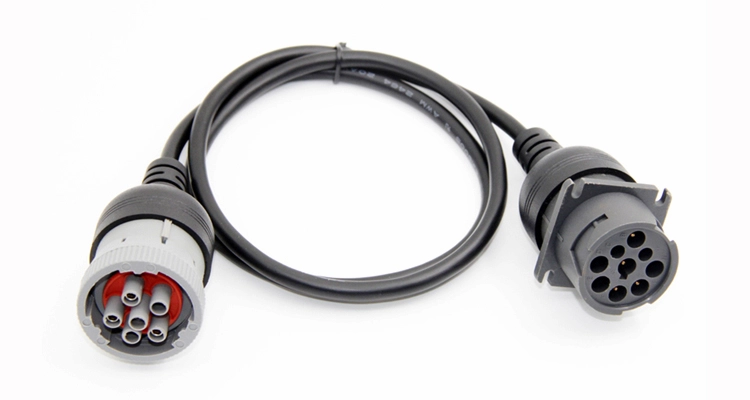
Introduction — Why Mixed-Protocol Diagnostics Are More Complicated Than They Look
In real workshop environments, heavy-duty vehicles rarely speak through one protocol at a time. Under the same connector, it’s common to find a modern J1939 CAN network operating together with a legacy J1708 serial channel.
This hybrid structure appears simple on paper—but creates enormous complexity for technicians, especially when adapters are chosen based only on what the connector looks like.
Many issues that mechanics face each day originate from the adapter itself, including:
- Missing or partially detected modules
- Intermittent communication or unstable refresh cycles
- ECU wake-up delays
- Tools like INSITE, JPRO, or TEXA identifying only half of the system
- Confusing “No Response” or “Data Timeout” messages
👉 This guide focuses not on definitions of J1939/J1708, but on real diagnostic behavior and adapter performance under mixed-protocol conditions.
This is an angle that traditional guides almost never address.
Why Mixed-Protocol Vehicles Need a Different Adapter Selection Strategy
Hybrid diagnostic environments are now the norm in:
- Long-haul fleet tractors
- Construction machinery
- Buses and large transport vehicles
- Power units, generators, and off-road equipment
In many of these platforms, a J1939 CAN backbone handles the core systems, while older subsystems—ABS, auxiliary modules, liftgate controllers—still communicate through J1708.
Technicians often experience situations like:
- CAN data appears instantly, but older J1708 modules never load
- ABS intermittently shows up depending on ignition cycles
- Only one data stream works at certain times
- The diagnostic tool connects but delivers incomplete results
These aren’t tool problems—they’re signal-handling problems caused by the adapter
Two Protocols, Two Electrical Behaviors
A high-quality diagnostic adapter must manage two very different signal types simultaneously
- High-speed differential CAN signaling (J1939)
- Low-speed asynchronous serial communication (J1708)
To perform correctly, an adapter must maintain:
- Clean grounding across both networks
- Correct pin isolation
- Consistent voltage behavior during ECU wake-up
- Noise suppression between legacy and modern channels
- Protection against timing interference
Even premium diagnostic software cannot compensate for an adapter that mishandles these behaviors.
The Hidden Reason Many Adapters Fail — Data Flow Priority Conflicts
In real shop conditions, older modules often respond before newer ones.
For example:
- A J1708 ABS module may send its handshake before J1939 wakes
- Small auxiliary systems react faster than the main ECU
- Non-OEM wiring modifications shift timing windows
If the adapter cannot manage these overlapping signals, one protocol may block the other entirely.
How a Properly Designed Adapter Solves This
A well-engineered adapter ensures that:
- Both data streams can operate without interfering
- Timing is synchronized rather than competing
- Legacy responses don’t suppress CAN initialization
- CAN remains protected from electrical noise generated by J1708
This is where most low-cost adapters fail—even if the connector shape looks identical.
A Practical Framework for Choosing the Right Heavy-Duty Adapter
Below is an actionable selection checklist built for real maintenance environments—not theoretical diagrams.
Step 1 — Map Your Diagnostic Environment (for Dual Protocol Diagnostic Cable selection)
Ask these questions:
- Do you need to read engine only, or all onboard modules?
- Is your workflow based on INSITE, JPRO, TEXA, or OTR?
- Is the vehicle’s wiring untouched or previously modified
- Are both J1939 and J1708 active under the same connector?
- Do you require simultaneous data streaming?
Your answers determine whether you need
- Supported single-protocol adapters
- Mixed-protocol dual-stream adapters
- Splitters
- Protocol bridging cables
Step 2 — Examine Internal Architecture, Not External Appearance
Two adapters can look identical but behave completely differently.
What truly matters:
- Signal-isolation routing
- Twisted-pair shielding quality
- Conductor gauge and material
- Noise-suppression layers
- ECU wake-up voltage stability
- Reinforced Deutsch locking geometry
- Durable strain-relief design
Poor internal design is the most common source of “unrecognized ECU” issues.
Step 3 — Assess Voltage Behavior Across Both Protocols
J1708 modules and J1939 ECUs react to wake-up voltage differently.
If an adapter introduces imbalance, you may see:
- Incomplete module lists
- Delayed handshake cycles
- Inconsistent data refresh
- Random communication drops
High-grade adapters keep voltage transitions stable even when the vehicle uses a mix of old and new modules.
The Best Use Cases for Dual-Protocol or Splitter Adapters
Dual-protocol adapters are ideal for:
- Mixed fleets with older and newer truc
- Workshops diagnosing ABS + engine in the same session
- Mechanics needing simultaneous data from both channels
- Vehicles undergoing aftermarket wiring modifications
Splitter adapters become essential when:
- You must monitor CAN and serial lines simultaneously
- OEM tools require isolated but parallel feeds
- Logging equipment must run alongside diagnostic software
Practical Scenario Examples (Real Workshop Insights)
These scenarios help technicians align their adapter choice with actual workflow needs.
Scenario 1 — Engine Reads, ABS Doesn’t
Cause: Legacy J1708 ABS sends its signal earlier than CAN.
Solution: A dual-stream adapter with synchronized timing protection.
Scenario 2 — Diagnostic Tool Connects but Shows Limited Data
Cause: Cross-protocol interference in low-quality adapters.
Solution: Use an adapter with internal shielding and isolated pin architecture.
Scenario 3 — Vehicle Has OEM Wiring Modifications
Cause: Non-standard pin assignments.
Solution: Use adapters engineered for stable grounding and pin mapping tolerance.
Industry Standards Compliance
Our manufacturing and testing processes adhere to international quality and safety standards, including:
- ISO 9001:2015 Quality Management Systems – Ensuring consistent manufacturing quality across all production batches
- IATF 16949:2016 Automotive Quality Management – Meeting automotive industry-specific requirements for reliability and traceability
- SAE J1939 and J1708 Standards – Following the official protocols established by the Society of Automotive Engineers for vehicle network communications
- RoHS/REACH Environmental Compliance – Adhering to European environmental directives for hazardous substance restrictions
Recommended J1939 J1708 Adapter Solutions for Mixed-Protocol Diagnostics
For technicians facing mixed-protocol challenges, we recommend:
- OBD2 to J1708 & J1939 Dual-Data-Stream Splitter Cable – Allows simultaneous communication with both protocols while maintaining signal integrity
- Cummins J1708 to J1939 Full-Compatibility Diagnostic Cable – Specifically engineered for Cummins engines with legacy J1708 and modern J1939 systems
- J1939 90-Degree Right Angle Cable for Tight Spaces – Ideal for confined installation environments where space is limited but signal quality cannot be compromised
Expert FAQ — Answers to Common Technician Questions
Q1: Why does my diagnostic tool connect to J1939 but completely ignore J1708 modules?
A: This is often a data flow priority conflict. Many adapters prioritize the faster CAN handshake, accidentally suppressing the slower J1708 response. A properly engineered dual-protocol adapter maintains balanced communication timing.
Q2: Can using a cheap adapter actually damage my vehicle’s ECU?
A: While rare, poor-quality adapters with incorrect grounding or voltage spikes can cause communication lockouts or temporary ECU confusion. Always choose adapters with proper surge protection and electrical isolation.
Q3: How do I know if I need a simple adapter vs. an active protocol converter?
A: If you’re working with mixed systems (both J1939 and J1708 active), you need a dual-protocol adapter. Only if you need to connect J1708 devices to a J1939-only tool (or vice versa) would you require an active converter.
Q4: Why does my ABS module show up sometimes but not always?
A: This indicates timing synchronization issues. Older J1708 modules often “wake up” at different intervals than CAN systems. A quality adapter synchronizes these timing windows for consistent detection.
Q5: What’s the difference between a splitter and a dual-protocol adapter?
A: A splitter divides one signal to multiple devices. A dual-protocol adapter handles two different protocols simultaneously. For mixed-system diagnostics, you often need both capabilities in one device.
Q6: How important is cable shielding for diagnostic accuracy?
A: Extremely important. Proper shielding (100% copper braid + foil) prevents electromagnetic interference that can corrupt CAN signals. Unshielded cables often cause intermittent communication failures.
Q7: Can I use the same adapter for different truck brands?
A: Yes, but ensure it follows OEM pin mapping standards. While J1939/J1708 are industry standards, different manufacturers may implement slight variations in pin assignments.
Q8: Why do some adapters work fine in the shop but fail in the field?
A: Field conditions introduce more vibration, temperature extremes, and electrical noise. Industrial-grade adapters with reinforced connectors and superior shielding perform consistently in both environments.
Q9: How long should a quality diagnostic adapter last?
A: With proper care, an OEM-grade adapter should last 3-5 years in daily professional use. Key indicators of quality include gold-plated contacts, strain relief design, and high-temperature insulation.
Q10: What certifications should I look for when choosing an adapter?
A: Prioritize IATF 16949 (automotive quality), ISO 9001 (quality management), and protocol-specific certifications like SAE J1939 compliance. These ensure the adapter meets industry standards for performance and reliability.
Looking Forward: The Evolution of Heavy-Duty Diagnostics
The diagnostic landscape continues to evolve. For insights into emerging technologies and future standards, explore our analysis: The Future of Automotive Diagnostics: Trends in OBD2 and J1939 Technology.
Get Expert Support for Your Specific Application
Every diagnostic scenario is unique—especially when dealing with mixed-protocol systems, custom vehicle configurations, or specialized fleet requirements.
Choose Your Preferred Consultation Method:
📩 Option 1: Detailed Technical Specification Form
Best for: Complex requirements, custom designs, OEM projects
- Submit complete technical details
- Receive engineered solution within 24 hours
- Ideal for fleet-scale requirements
💬 Option 2: Instant WhatsApp Technical Support
Best for: Urgent inquiries, quick questions, live troubleshooting
- Connect directly with our engineering team
- Get immediate answers to specific questions
- Perfect for workshop emergencies
What We’ll Need to Help:
- Vehicle make, model, and year range
- Current diagnostic challenges or limitations
- Specific protocols and data requirements
- Environmental operating conditions
- Quantity needs for fleet or workshop applications
Conclusion — Choose Adapters Based on Behavior, Not Appearance
The future of heavy-duty diagnostics revolves around mixed-protocol systems.
Choosing adapters by connector shape alone is no longer enough.
For accurate, stable, and complete diagnostics, technicians must consider:
- Signal behavior
- Timing synchronization
- Voltage stability
- Internal engineering
- Cross-protocol interference control
When your adapter handles both protocols intelligently, the diagnostic tool—and your workflow—performs at its best.
Ready to optimize your mixed-protocol diagnostics? Contact our team today to discuss your specific requirements and discover how our OEM-grade solutions can enhance your diagnostic capabilities.
