

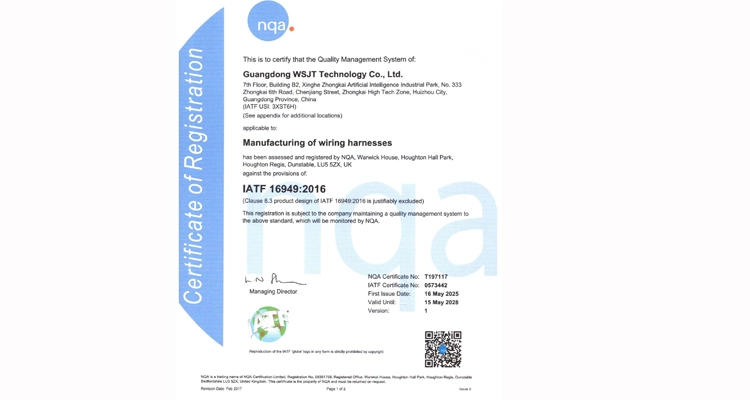
When a single faulty cable can halt an entire assembly line, “good enough” isn’t enough. For OEMs and tier-1 suppliers, the Production Part Approval Process (PPAP) isn’t just paperwork—it’s your guarantee against costly downtime and recalls. At CARSUN, we embed PPAP into our IATF 16949 system to deliver automotive cables with proven, documentable, and consistent reliability.
What is PPAP?
The Production Part Approval Process (PPAP) is a standardized quality validation system required by automotive OEMs to ensure production reliability. Operating within the IATF 16949 framework, PPAP confirms that every step—from tooling, assembly, to testing—consistently produces defect-free automotive cables.
For cable manufacturing, PPAP validates critical processes such as conductor preparation, insulation application, molding, and terminal assembly, ensuring compliance with electrical, mechanical, and dimensional requirements. This rigorous validation guarantees batch-to-batch consistency and full traceability.
Why PPAP Matters for Your Business
Even with precise customer-provided drawings, implementing PPAP is vital to:
- Eliminate Line-Down Incidents: Our PPAP-validated processes prevent diagnostic errors caused by signal instability in J1939 cables.
- Accelerate Your Time-to-Market: Streamlin
- Secure Your Supply Chain: Full traceability from raw materials to finished OBD2 cables mitigates risks and ensures consistent delivery.
Risk Without PPAP: Ignoring PPAP can result in downtime costs exceeding $50,000/hour, untraceable batch defects, and potential recall damage to your brand reputation. Our PPAP process shifts these risks away from you.
For OEM-grade J1939, OBD2, and custom wire harnesses, PPAP guarantees zero-defect manufacturing and adherence to OEM specifications.
The 18 Key Elements of a PPAP Package: Proof, Not Just a List
Instead of a simple checklist, we present how each element ensures quality and risk mitigation:
- Design Records & Engineering Changes – Ensure drawings and revisions are fully approved.
- Customer Engineering Approval – Formal acceptance from OEM engineers.
- Design FMEA (DFMEA) – Evaluate potential design failure modes.
- Process Flow Diagram – Map production steps for transpare
- Process FMEA (PFMEA) – Identify and prevent process failures.
- Control Plan – Define inspections, methods, and acceptance criteri
- Measurement System Analysis (Gage R&R) – Validate measurement reliabilit
- Material & Performance Test Results – Confirm conductor resistance, insulation, tensile strength, etc.
- Other PPAP Documents (9–18) – Include dimensional results, capability studies, packaging evaluation, and Part Submission Warrant (PSW)
Download Our Free PPAP Infographic to see how all 18 elements interact, forming a zero-defect assurance loop.
How Our Factory Implements PPAP
We integrate PPAP into daily operations with proven processes:
- Technical Drawing Review: Verify manufacturability and regulatory compliance.
- Prototype Production & Testing: Dimensional, electrical, and material validation.
- Comprehensive PPAP Documentation: Ensure smooth OEM approval.
- Full Batch Traceability: Every cable is logged and verified.
Case Study: For a leading European heavy-duty OEM, we reduced first-article inspection (FAI) approval time by 30% through our meticulously prepared PPAP package for a custom 16-pin diagnostic harness.
Our 100% electrical testing regimen results in a PPM (Parts Per Million) defect rate <50, trusted by global brands. All products are certified under ISO 9001, ISO 14001, IATF 16949, REACH, RoHS, CE, and UL, ensuring safe, reliable, and consistent shipments.
🧾 Sample PPAP Report – 16-Pin Diagnostic Cable
| Section | Description |
| Part Number & Revision | 16PIN-OBD2-2025-A |
| Material Compliance | RoHS / REACH Certified |
| Dimensional Inspection Results | Within ±0.05 mm tolerance |
| Electrical Test Results | Continuity, Insulation, Dielectric Strength – PASS |
| First Article Approval | Signed & Approved – 2025-11-01 |
| Process Flow Summary | Cutting → Crimping → Assembly → Molding → Testing |
📋 Traceable Batch Records / QC Example
| Batch No. | Production Date | Inspector | Pass/Fail | Notes |
| 001 | 2025-11-01 | Linda Liu | Pass | – |
| 002 | 2025-11-01 | May Yang | Pass | – |
| 003 | 2025-11-02 | Terry Luo | Pass | Minor Rework |
Includes: In-process checks & final audit core records
Traceability: Full traceability from raw material to finished cable.
📩 CTA: Download Full Batch Traceability & QC Report (PDF)
IATF 16949-Based Cable Manufacturing & PPAP Flow
Stage | Key Steps | Quality Control (QC)
| Stage | Key Steps | Quality Control (QC) |
| I. Material Preparation & Preprocessing | Raw material procurement → IQC → Cable cutting → Insulation stripping | IQC + In-Process Check |
| II. Terminal Connection & Initial Assembly | Welding & tinning → Connector assembly → Inner molding | 100% Electrical Testing |
| III. Outer Molding & Finishing | Outer molding → Electronic testing | Visual & Electrical Verification |
| IV. Final Inspection & Packaging | Final inspection → Rework → Assembly & Fixing → Packaging | Final Quality Control (FQC) |
Each stage is fully documented in PPAP reports, ensuring complete traceability and risk-free production.
Key Electrical Performance Tests
Critical tests include:
- Open & Short Circuit Test: Ensures continuity and no shorts.
- Miswiring Test: Confirms correct pin assignment
- Contact Resistance Test: Validates stable electrical conductivity
- Insulation Resistance Test: Checks insulation integrity.
- Dielectric Strength Test: Ensures high-voltage endurance without breakdow
Compliance & Quality Traceability
All batches are digitally traceable with inspection records kept for at least 10 years, fully compliant with IATF 16949, ensuring long-term reliability and transparent reporting for OEM customers.
Frequently Asked Questions (FAQ)
Q1
Do you hold quality management certifications?
A
Yes, we are certified under ISO 9001, ISO 14001, IATF 16949, REACH, RoHS, CE, and UL, guaranteeing global compliance.
Q2
Can you customize cables according to customer specifications?
A
A: Absolutely. We provide custom logos, AWG sizes, wire lengths, colors, and packaging under strict quality control.
🧾 Custom Cable Requirements Checklist (Quick Form)
| Item | Description / Example | Your Specification |
| Cable Type | OBD2, J1939, Wire Harness, etc. | |
| Connector Type | DB15, HDB26, Custom | |
| Wire Gauge (AWG) | e.g., 20AWG, 22AWG | |
| Length | meters / inches | |
| Color | Red, Black, Blue, etc. | |
| Quantity | pcs | |
| Logo | Yes / No | |
| Packaging | Bag, Box, Custom | |
| Special Instructions | e.g., PPAP required, custom molding |
📩 CTA:⬇️ Download Full Custom Cable Requirements Checklist (PDF)
(Fill this checklist to ensure all specs are captured before quotation.)
Q3
Are all products 100% tested?
A
Yes. Every cable undergoes continuity, insulation, voltage, and durability testing, with full test reports available.
Q4
Are materials compliant with environmental standards?
A
All materials meet RoHS and REACH standards.
Q5
Which testing standards are applied during production?
A
We follow IPC/WHMA-A-620 and IATF 16949, with complete PPAP documentation and control plans.
Q6
How is consistency ensured in mass production?
A
Through traceable batch records, in-process inspections, final audits, and full PPAP validation.
→ [Request a Sample PPAP Report] to see our quality documentation firsthand.
Ready to Get a PPAP-Compliant Quote?
Stop risking production with unverified suppliers. Send us your specs or drawings and get a PPAP-compliant quote within 24 hours.
For OEM & Tier-1 Suppliers: Send us your specs or drawings. We’ll review them against IATF 16949 and reply with a quote & quality plan in 24h.
Related Links
🔗 Standards & References
Below are the key international standards and certifications referenced throughout our PPAP and cable manufacturing process:
- 🌐 ISO – International Organization for Standardization
- Defines global standards for quality, safety, and efficiency across industries.
- 🚗 IATF 16949 – International Automotive Task Force
- The global automotive quality management standard ensuring consistent and defect-free production.
- ⚙️ SAE J1939 & J1708 – SAE International Standards
- CAN-based and serial communication protocols widely used in heavy-duty vehicle diagnostics.
- 🔌 IEC – International Electrotechnical Commission
- Global standards for electrical and electronic technologies, ensuring safety and compatibility.
- ✅ UL – Underwriters Laboratories Standards
- Safety and performance testing standards for electrical and electronic products.
- ♻️ RoHS Directive (EU)
- Restricts the use of hazardous substances in electrical and electronic equipment.
- REACH Regulation (EU)
- Ensures the safe use of chemicals and materials in manufacturing.
