
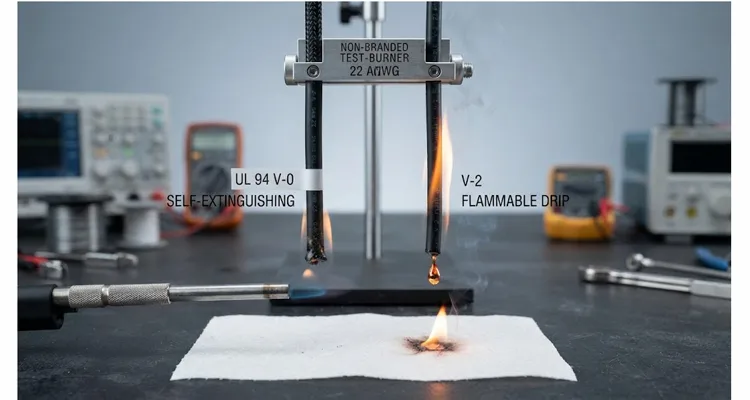
In 2019, we cut open a 22 AWG diagnostic harness from a supplier in Shenzhen. The jacket was marked “FR” on the print legend. It burned for 22 seconds and dripped flaming PVC onto the workbench. That was the day we stopped trusting the words “flame retardant” on a drawing.
The difference between a cable that melts away from the heat source and one that fuels it often comes down to a single, overlooked line on the datasheet: UL 94 V-0.
Most sourcing discussions focus on conductor gauge, capacitance, or shielding effectiveness. Those are electrical problems. The flame rating of the jacket is a physical safety problem. If you are sourcing diagnostic cables for medical devices, industrial control panels, or EV battery tooling, this is the spec that keeps your product off a recall list.
The Real Cost of a V-2 Rating (And Why It Fails Inspection)
UL 94 doesn’t measure how hard it is to start a fire—it measures what happens after you take the flame away. A V-2 material can self-extinguish in under 30 seconds and still fail a product audit because it dropped a burning ball of plastic onto the PCB below. V-0 closes that loophole: 10-second limit, zero flaming drips.
A standard PVC jacket might achieve V-2. That means it self-extinguishes within 30 seconds on a vertical specimen. That sounds okay on paper. The problem is the dripping. A V-2 material can produce flaming drips. Those drips fall onto the wiring harness below it, the PCB, or the patient table. You have not prevented the fire; you have just relocated it.
For a diagnostic cable that runs near an internal power supply or an oxygen line, that anti-drip property is the difference between a failed component and a catastrophic incident.
Where We See the Failure in the Field
I have been involved in cable assembly manufacturing for over two decades. Most of our work at the factory is OEM—we are not selling a finished retail product; we are building cables for clients who put them inside their machines.
Here is a recurring scene. A client sends us a sample harness from their previous supplier in Asia. The drawing says “flame retardant.” We cut a section, put it to the flame, and it burns like a candle. The issue is usually that the supplier substituted a reground PVC compound to save a few cents per meter.
Why does the “flame retardant” label fail? Because the cheap compound relies on a high concentration of plasticizer. When heat hits it, the plasticizer vaporizes, creating fuel. To meet V-0, you need a different chemistry—often a PVC compound with higher chlorine content or a shift to TPE/TPU formulations that char instead of burn. You cannot cheat this test with a coating; it is a property of the bulk material.
In March 2023, we had to reject a batch of cables destined for a diagnostic cart. The client’s spec said V-0, but the sample was V-2 at best. When we tested it, the flame went out, but a burning drop fell onto the lab bench. That single drop would have failed their end-product safety audit. The cost of re-terminating and remaking those cables was far less than the cost of a failed UL inspection on their final equipment.
The Engineering Trade-off: Flexibility vs. Flame Retardancy
You cannot simply demand V-0 and expect the cable to feel like silicone rubber. There is a physical compromise.
Halogenated compounds (like certain PVCs) are naturally fire-resistant. They release chlorine radicals that interrupt the combustion cycle. That is why they are common in building wire. But they are stiff.
Halogen-free compounds (used in medical or clean-room environments) often rely on mineral fillers—aluminum hydroxide or magnesium hydroxide—to achieve V-0. When heated, these fillers release water vapor, which cools the surface and dilutes the flammable gases. This works very well, but it reduces the elongation at break. The cable is less flexible.
The engineering decision is about where the cable lives.
- Diagnostic cables for bench equipment (OBD tools, oscilloscopes): These move constantly. You need flexibility. A soft V-0 TPU is often the right answer, but it costs more than PVC.
- Cables for fixed installations inside machinery: Here, you can tolerate a stiffer V-0 PVC. The safety requirement dominates because nobody is flexing it every day.
- EV battery diagnostic harnesses: This is a specific pain point. You have high current proximity, potential sparking, and the requirement for high voltage insulation. Here, a silicone or cross-linked jacket with V-0 rating is non-negotiable, even if it is expensive, because the alternative is thermal runaway.
Step-by-Step: How to Verify a V-0 Claim Before You Commit
You cannot rely on a supplier’s word. Here is the process I recommend to any sourcing engineer who needs to lock down this spec:
Step 1: Request the Physical UL Yellow Card
Ask for the UL file number for the specific cable assembly or the jacket compound. Do not accept a generic “company is UL certified” claim. You need the yellow card for the material. If they cannot provide it, the material is likely not registered.
Step 2: Perform the “Poor Man’s Burn Test” on a Sample
This is not a UL lab test, but it tells you a lot before you pay for certification. Take a 6-inch piece of cable. Hold it vertically. Apply a butane lighter flame to the bottom for 10 seconds, then remove the flame.
- If the flame travels up the cable and the jacket continues to burn after you remove the lighter, you’re not looking at V-0. We’ve measured samples that burned for 45 seconds after ignition.
- Place a dry paper towel underneath. If a burning drop falls and the towel ignites, you have a V-2 at best. This is the most common failure we see in cheap PVC.
- A true V-0 sample will snuff itself almost immediately—usually under 3 seconds—and the paper stays clean.
Step 3: Ask About the Regrind Policy
Ask the factory directly: “Do you use post-industrial regrind in the jacket compound?” If they say yes, ask what percentage. High percentages of regrind degrade the flame retardant performance. A responsible factory managing to ISO 9001 and IATF 16949 standards will control this. A factory cutting corners will lie or not know. This question alone often separates the real manufacturers from the trading companies.
Step 4: Match the AWG to the Jacket Thickness
A V-0 rating is meaningless if the jacket wall is too thin. For a 24 AWG diagnostic cable, you need a certain minimum wall thickness to meet the insulation requirements. If you ask for a custom color or logo, ensure that the color masterbatch added to the compound does not dilute the flame retardancy. Certain bright pigments (some reds and yellows) require higher loading to achieve color, which can push the material from V-0 back to V-1.
For a custom orange EV cable, we had to switch from a two percent masterbatch loading to a four percent loading of a brominated compound because the orange pigment suppressed the char formation. The final jacket passed V-0, but it cost about eighteen percent more in raw material. That’s the trade-off you need to know about before you commit to a bright color.
The Chemistry Behind the Firewall: Why Bromine vs. Phosphorus Matters
I do not want to overcomplicate this, but engineers ask why one V-0 material behaves differently from another. There are two primary mechanisms:
- Halogenated (Brominated/Chlorinated) Systems. These are very effective. They work in the gas phase. The issue is that when they burn, they produce dense smoke and acidic gases (hydrogen bromide, hydrogen chloride). For an industrial setting, that is a corrosion problem. For a hospital diagnostic device, it is a toxicity problem. This is why halogen-free is often mandated in medical specs, even if it is harder to achieve V-0.
- Halogen-Free (Phosphorus/Nitrogen/Mineral) Systems. These work by forming a char layer. The phosphorus reacts to create a glassy foam that insulates the polymer from the heat. This is cleaner smoke, but the mechanical properties (scratch resistance, flexibility) can suffer.
We ran a burn test on a halogen-free TPU cable last year. It charred beautifully—formed a black crust that stopped the flame. But the client rejected it because the surface was too rough after extrusion. The mineral fillers (aluminum hydroxide) had absorbed moisture in storage, causing surface porosity. That’s the hidden problem with halogen-free: it’s not just about flame chemistry, it’s about processing stability.
If you are sourcing diagnostic cables for a European medical device OEM, you are almost certainly dealing with the halogen-free requirement. You need a factory that understands how to extrude a halogen-free V-0 compound without creating surface defects. It is not a simple switch on the extrusion line; the temperature profiles and tooling are different.
A Note on Warehouse Conditions and Material Stability
You might not think about where the cable is stored, but it matters. A V-0 jacket that sits in a hot, humid warehouse without climate control will slowly absorb moisture. When you extrude it, you get surface porosity. That porosity changes the burn characteristics.
Our facility runs a climate-controlled warehouse under 5S management standards for this specific reason. If the raw resin absorbs moisture, you get “splaying” on the cable surface—a rough texture. That rough texture is where a flame can find a footing. When we ask clients to audit the factory, we often show them the material drying systems before we show them the extrusion line. A cable that passes the 10-second V-0 test requires a dry, consistent base material to begin with.
When You Need This Spec (And When You Don’t)
I want to be honest here. Not every diagnostic cable needs V-0. If you are making a low-power USB dongle for a car dashboard, the thermal mass is tiny; V-2 is usually acceptable, and V-0 adds cost and stiffness you do not need.
Ask yourself one question: if this cable catches fire, what is the first thing the flame touches?
If the answer is a sheet metal enclosure, a PCB, or a patient table, you need V-0. If the answer is open air and the total power is under five watts, you’re probably fine with V-2.
We’ve seen this play out in practice: a bench oscilloscope lead doesn’t need V-0. But a harness routed behind a four hundred volt power supply inside a diagnostic cart absolutely does. If the client sends you a spec with that line, you cannot argue with it. You just have to source it correctly.
Common Sourcing Mistakes: The “Copy-Paste” Datasheet
The most common mistake I see in RFQs is the copy-paste spec. An engineer writes down “UL 94 V-0” on a drawing because they saw it on another product. They attach it to a cable that runs at 20 AWG with a custom overmold.
The problem: The overmold material might not be V-0. The strain relief might be V-2. The label heat-shrink might burn.
When you source a diagnostic cable assembly, the V-0 requirement must apply to every component that touches the wire, not just the jacket. If you have a V-0 wire running into a V-2 connector backshell, you have a weak link. We often have to guide clients through this—they focus on the cable, but the connector housing is the failure point. A full-plastic design with RoHS compliance and a strict bill of materials (BOM) review is the only way to ensure the assembly is safe as a unit.
How to Fix a Specification Conflict: Flexibility vs. Safety
We have a client who builds portable diagnostic equipment for the mining industry. They wanted a very flexible, small-diameter cable (24 AWG) but also demanded V-0.
There is a conflict there. At 24 AWG, the wall thickness is thin. To pass V-0, the polymer needs enough mass to form a char layer. If it is too thin, it fails.
The solution involved moving from a standard PVC to a cross-linked polyethylene (XLPE) blend with a flame-retardant additive package. It was not as soft as silicone, but it passed the flex test for their application (they needed ten thousand cycles on a bend fixture) and maintained the V-0 rating. It cost roughly two times more per meter than the PVC alternative.
This is the kind of engineering trade-off that a generic “cable supplier” cannot help you with. You need a factory that can adjust the formulation and validate the result, not a company that just sells you stock cable from a catalog.
A Final Word on Quality Inspection (The 4-Step Process)
Here is what happens at our end before a V-0 cable leaves the dock. We run a 4-step quality inspection.
- Incoming Resin Check: We do not trust the resin supplier’s certificate of analysis. We run a melt flow index test and a small burn test on a pressed plaque of the raw material before it goes into the hopper.
- In-line Diameter Check: As the cable extrudes, we monitor the wall thickness continuously. If the wall dips below the tolerance band, that section is flagged. A thin wall is a fire risk.
- Bench Burn Test (Batch Sample): We pull a sample from the middle of every production run—not just the beginning. We run the butane test I described above. If it drips, the whole batch is quarantined.
- Final Continuity and Hip Test: This is standard, but it is the last gate. We test one hundred percent of the cables for electrical performance. The burn rating is about safety; the continuity test is about function. You need both.
Frequently Asked Questions (FAQ)
1. What exactly is UL 94 V-0?
UL 94 V-0 means a vertical plastic sample stops burning within ten seconds after flame removal and does not produce flaming drips.
2. Is V-0 the same as “flame retardant”?
No. “Flame retardant” is vague. V-0 is a specific, measurable performance class. V-2 is also “flame retardant” but allows dripping.
3. Can I get a V-0 cable with a custom color?
Usually, yes. But the pigment can affect the rating. You need to use a masterbatch compatible with the flame-retardant compound. A responsible factory will validate this.
4. What is the difference between halogenated and halogen-free V-0?
Halogenated cables (using bromine/chlorine) are often cheaper and easier to extrude, but release toxic, corrosive smoke. Halogen-free cables (using phosphorus/minerals) are cleaner but can be stiffer and more expensive.
5. Is V-0 required for all diagnostic cables?
No. It depends on the end-use environment. If the cable is near high energy or in a medical/industrial enclosure, it is often mandatory. For low-power accessories, V-2 might be sufficient.
6. Does the connector need to be V-0 too?
Yes, ideally. If the connector housing is V-2 and the wire is V-0, the assembly is only as safe as the weakest component.
7. Can a V-0 cable be flexible?
There is a trade-off. You can get flexible V-0 materials (like certain TPUs or special silicones), but they cost more than a rigid V-0 PVC.
8. How do I verify a supplier actually sent me V-0 material?
Request the UL yellow card for the compound and perform a simple vertical burn test with a butane lighter on a physical sample. Look for self-extinguishing behavior and, critically, no burning drips.
9. Does a V-0 cable last longer?
Not necessarily. The V-0 rating is about fire safety, not mechanical wear or electrical lifespan. Those are separate specs.
10. What if I need a custom length and logo on a V-0 cable?
That is not a problem if the factory does the customization in-house. The logo printing ink must also be flame-resistant, or it can provide a path for flame propagation along the surface.
Engineering Support for Your V-0 Specification
Most of our customers come to us after a previous supplier failed a burn test. We have built cables for diagnostic carts, EV battery test benches, and mining equipment. The common thread is that we don’t just extrude cable—we help you fix a spec that is physically impossible, like a 24 AWG V-0 cable that also needs to survive ten thousand flex cycles.
We operate as a direct factory with over twenty years of cable assembly experience. Our quality system covers ISO 9001, ISO 14001, and IATF 16949, and we build to RoHS, CE, UL, and REACH standards.We handle OEM custom orders—specific lengths, AWG sizes, colors, and branding.
If you want to discuss a technical spec or need a sample assessed, contact our engineering team via WhatsApp or the contact page. We can help you confirm whether your current supplier is actually meeting the V-0 standard or just printing it on the label.
WhatsApp: Chat with Linda on WhatsApp at https://api.whatsapp.com/send/?phone=8617307168662&text=Need+Help%3F+Chat+linda+WhatsAPP&type=phone_number&app_absent=0
Contact Page: https://obd-cable.com/contact/
