
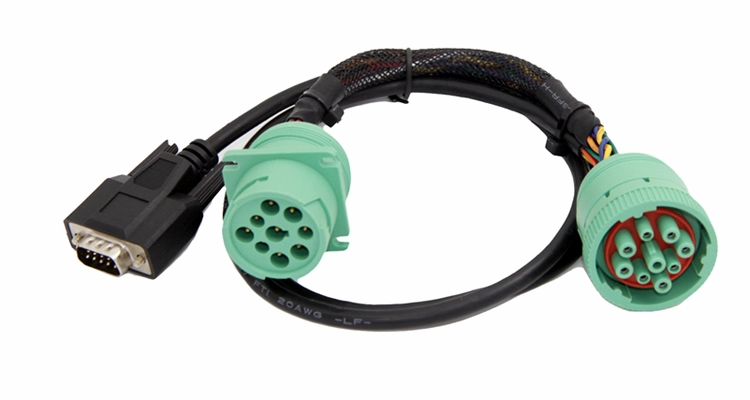
If you‘ve ever held two Deutsch DT connectors side-by-side, thinking they look “basically the same” only to find one won‘t mate, you‘re not alone. That frustration – wasted time, delayed projects, and unexpected costs – is the direct result of a critical, yet often overlooked, physical lockout between Type 1 and Type 2. This isn‘t about minor specs; it‘s about a fundamental design feature meant to protect multi-million dollar vehicle systems from catastrophic wiring errors. As a factory that has built thousands of custom harnesses for heavy-duty diagnostics and control systems, we‘ve seen this confusion turn into real-world delays. This guide cuts through the ambiguity with the clarity our engineering team uses on the production floor, showing you not just how to see the difference, but how to specify correctly from the start.
Understanding Type 1 vs Type 2 Deutsch Connector Mismating Problems
This confusion isn‘t theoretical. It manifests at critical, high-pressure points:
Type 1 vs Type 2 Deutsch Connector Mismatch on Assembly Line
A batch of newly delivered engine harnesses arrives. Technicians go to mate them to the ECU blocks and find a physical block – the connector aligns but refuses to click home. The line stops. We‘ve witnessed such mismatches halt a line for over 45 minutes, creating a production shortfall that triggered costly supplier penalty clauses.
Field Service Challenge: Identifying Correct Deutsch Connector Type
A fleet technician is tasked with upgrading the telematics unit on 50 trucks. The new module‘s cable has a subtly different Read about J1939 connection reliability that won‘t interface with the vehicle‘s existing port. The entire upgrade schedule is jeopardized.
Prototype Development Delay: Type 1 vs Type 2 Specification Error
An Learn the engineer’s framework for choosing adapters team finalizes a new control unit design. They source connectors based on a generic “View our J1939 breakout cable product 9-pin” spec from a supplier. When the first prototypes come back, they cannot connect to the mating harnesses supplied by their partner company. Weeks of development time are lost to re-spin the housing design
The Root Cause: More Than Just Polarization
The core issue is polarization for error-proofing, but its importance is often underestimated. Deutsch Engineering designed the DT series with these molded-in keyways not just to prevent mismating at installation, but to eliminate a specific failure mode: micro-motion wear. In heavy-duty vibration environments, a forced or imperfect mating—even if it makes electrical contact—can cause terminals to fret, leading to intermittent failures that are notoriously difficult to diagnose. This physical key is the most cost-effective field-reliability insurance an OEM can design in. Our analysis of field returns shows that the diagnostic labor cost to trace an intermittent fault often exceeds the replacement part cost by a factor of three or more.
Type 1 and Type 2 share the same robust shell, high-grade seals that achieve IP67 rating through precise silicone grommets (which we validate in our 48-hour salt spray tests), and the same reliable 15µin gold-plated contacts. The only difference is the strategic arrangement of these plastic keys and slots. Choosing the wrong type isn‘t a simple oversight; it‘s bypassing a critical safeguard.
Your 3-Step Visual Identification Protocol
Forget complex terminology. On the factory floor, we use this foolproof visual check. Grab a Explore our right-angle Deutsch DT cable solution and follow this:
Step 1: Orient the Connector
Hold the connector in front of you with the locking lever on top and facing upward. You are looking at the mating face (the side with the pins or sockets).
Step 2: Locate the Primary Polarization Rib
Ignore the small guide ribs for now. Find the largest, most prominent molded plastic rib on the inner rim of the connector housing.
Step 3: Type 1 vs Type 2 Deutsch Connector: The Clock Rule Identification Method
Visualize the connector face as a clock, with the 12 o‘clock position at the locking lever‘s pivot point.
- Type 1 (DT04 Series): The primary polarization rib is positioned at approximately the 2 o‘clock location. Its orientation is diagonal relative to the latch.
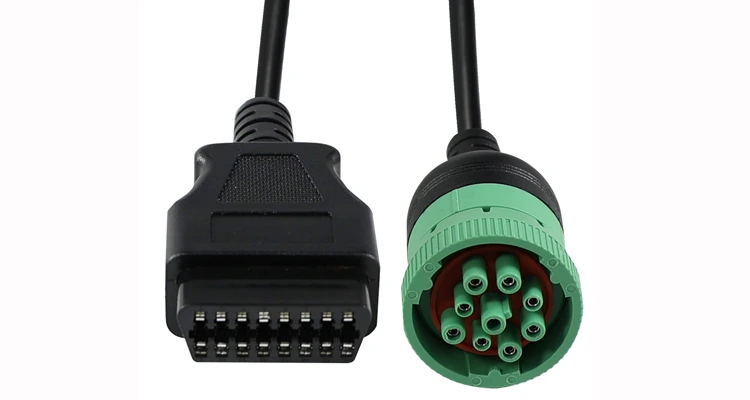
- Type 2 (DT06 Series): The primary polarization rib is positioned at the 3 o‘clock location. Its orientation is perpendicular (90 degrees) to the latch.
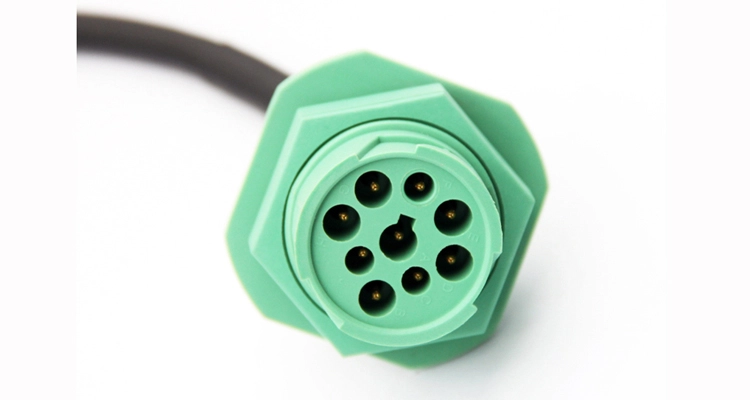
This is the non-negotiable difference. The table below is your quick-reference spec sheet:
| Feature | Deutsch DT Type 1 (DT04 Series) | Deutsch DT Type 2 (DT06 Series) |
| Visual Identifier (Clock Rule) | Primary rib at ~2 o‘clock (Diagonal) | Primary rib at 3 o‘clock (Perpendicular) |
| Common Industry Application | Found widely in general chassis wiring, older engine management systems, and traditional industrial controls. | Now prevalent in modern SAE J1939 vehicle networks, advanced telematics gateways, and new designs requiring distinct keying to prevent cross-connection. |
| Our OEM Advisory Note | Never assume based on application age. We’ve seen new designs specify Type 1 for backward compatibility. The drawing is law, but verification is critical. |
The Top 5 Specification & Procurement Mistakes We See (and Fix)
After twenty years in this business, we‘ve reviewed thousands of client drawings. These are the recurring errors that lead to the wrong connector type being ordered:
Mistake 1: Type 1 vs Type 2 Deutsch Connector: Avoiding Specification Ambiguity
This is the most common and costly error. It‘s like ordering “a car” without specifying the model. The purchase order must include the full series: DT04- (Type 1) or DT06- (Type 2).
Mistake 2: Unverified Legacy Design and Type 1 vs Type 2 Confusion
“We’ve always used this drawing” is dangerous. A previous engineer may have used a locally-sourced substitute. We once caught a client‘s 10-year-old drawing that labeled a Type 2 connector as “DT04-style,” which would have failed in their new production run.
Mistake 3: Mistaking the Mating Connector’s Type
It sounds obvious, but under time pressure, people guess. Always physically check the mating half using the Clock Rule. Don‘t assume the vehicle side is the “standard.”
Mistake 4: Overlooking Cavity Plug Compatibility
If your design requires blanking off unused cavities, the sealing plugs are also type-specific. Ordering Type 1 plugs for a Type 2 housing will compromise the environmental seal.
Mistake 5: Assuming Your Supplier “Knows What You Mean”
Never assume. Provide a clear photo with the keying rib circled, or the specific manufacturer part number (e.g., Deutsch 0-143-2023-1). Ambiguity in communication is the root cause of most component failures.
How to Validate Your Choice Before Cutting the First Wire
Engineering rigor means verifying before committing. Here‘s our factory‘s incoming quality check for this exact issue, an integral part of our IATF 16949:2016 certified 4-step quality inspection regime:
Validation Method 1: First-Article Sample Mating Test
Before approving production of 500 cables, we demand samples of the specified connectors. Our QC team physically mates them to a known-good counterpart. It must engage smoothly, with the distinct, positive click of the locking lever. Any resistance is a failed test.
Validation Method 2: Dimensional Verification with Calipers
We don‘t just look; we measure. Key rib location and housing dimensions are checked against the official Deutsch datasheet. This catches even subtle molding variations from non-OEM sources.
Validation Method 3: Application in a Test Harness
For critical projects, we‘ll build a single prototype cable, mate it, and subject it to a continuity and insulation resistance test. This is the final, definitive proof that the electrical and physical paths are correct.
We build this verification into the process because it‘s why clients trust us with their OEM customization.
Our Engineering Support for Deutsch Connector Applications
For us, this knowledge isn‘t academic; it‘s applied daily. When a client sends us a drawing for a J1939 diagnostic adapter or a custom sensor harness, the first thing our engineering team does is a connector audit. We look for the “DT04” or “DT06” callout. If it‘s ambiguous or missing, we flag it immediately—this single question has saved projects months of delay.
Our value is in execution. You provide the pinout, the performance requirement, and the application environment. We handle the rest: sourcing genuine, traceable components; crimping wires with tooling calibrated to MIL-DTL-22520 standards; applying overmolds that survive salt spray and thermal cycling; and delivering a cable that‘s been 100% tested for continuity and isolation. Whether you need a short-run prototype with specific logo branding and custom lengths or a full production batch, our climate-controlled warehouse and 5S-managed production cells are built for this precision. Our ISO 14001 certified environmental management system governs this responsible production.
To explore our full range of engineered solutions for heavy-duty vehicles, please browse our Browse all professional truck cables
Frequently Asked Questions (FAQ)
Q1: Can I just file down the keying rib on a Type 1 to make it fit a Type 2 port?
A: Under no circumstances. This will destroy the IP67 environmental seal, potentially damage internal terminal seals, and void all component certifications. In high-vibration applications, the filed material can create debris that causes short circuits. It instantly creates a major, unpredictable reliability failure point.
Q2: The contacts seem to slide into either housing. Are they interchangeable?
A: For a given cavity size, yes, the metal pin and socket contacts are often identical between See solutions for other connector access problems. This fact is why the housing mix-up is so common—the electrical parts fit, but the mechanical shell does not. The housing is the key.
Q3: Is one type more reliable or higher quality than the other?
A: No. Both Type 1 (DT04) and Type 2 (DT06) meet the same stringent Deutsch performance specifications for vibration, moisture, and chemical resistance. The choice is purely about polarization and system design, not quality hierarchy.
Q4: How can I be sure my drawing is correct before I send it to you for a quote?
A: Use the 3-Step Visual Identification Protocol above on your existing sample or mating component. Take a clear, well-lit photo of the mating face, and note the position of the locking lever. This visual reference is as valuable as the drawing itself for our engineering review.
Q5: Do you keep both Type 1 and Type 2 connectors in stock for prototypes?
A: We maintain an inventory of the most common Deutsch variants for prototyping and short-run production. This allows us to move quickly on engineering support requests. For high-volume needs, we source directly from certified distributors with full traceability.
Q6: We‘re designing a new system. Should we default to Type 2 because it‘s “newer”?
A: Not necessarily. The choice should be strategic. Use Type 2 if you need to ensure absolute incompatibility with older Type 1-based systems in your facility. If you‘re expanding an existing Type 1 infrastructure, maintain consistency. We can advise on the lifecycle and compatibility implications.
Q7: What’s the lead time for a custom cable assembly using these connectors?
A: For prototypes, we can often turn around samples in 1-2 weeks once the design is finalized. For production batches, lead time depends on component availability and complexity. We provide transparent timelines after our initial design review.
Q8: Can you handle the entire process from our rough sketch to a finished, tested cable?
A: Absolutely. This is our core OEM/ODM service. Send us a hand-drawn sketch, a sample, or a marked-up photo. Our engineers will translate it into a manufacturable drawing, suggest optimizations for durability and cost, and guide you through material choices (like AWG rating and jacket material) until we deliver a production-ready, fully tested product.
Professional Engineering Support & Customization
Specifying the correct Deutsch connector is a fundamental step. For engineers and procurement professionals managing heavy-duty vehicle projects, this precision defines success.
If your work involves custom diagnostic harnesses, telematics integrations, or specialized vehicle control systems, our engineering partnership exists to provide certainty. We combine deep component knowledge with 20+ years of direct factory experience in low-to-medium volume, high-complexity cable assembly.
Discuss your specific connector challenge and application needs directly with our engineering team: Contact us via WhatsApp.
Submit your drawings, sketches, or samples for a formal review and quotation: Use our Engineering Contact Form.
We are your partner for certified, reliable OEM customization. Let‘s build something robust.
