

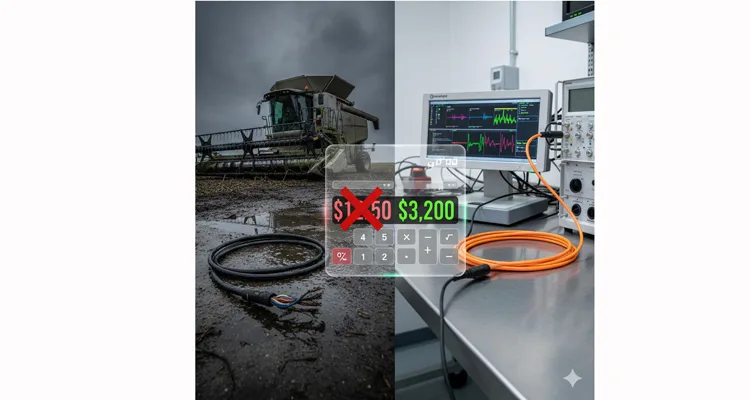
Let me tell you about Tuesday, November 12, 2024. I was standing in a muddy heavy equipment yard in Ohio, watching a technician struggle to diagnose why a $375,000 combine harvester was dead. The culprit? A $12.50 J1939 diagnostic cable. It didn’t snap or melt—it just started dropping signals, throwing three conflicting error codes.
The owner had saved $8 per unit by opting for a “cost-effective supplier.” That Tuesday, his harvest stalled for 6 hours. The service call ran $850. Two other machines showed identical faults. Total bill: roughly $3,200 in combined downtime and repairs.
The $64 he “saved” on eight cables ultimately cost him 50 times that amount.
Holding that failed cable, I wasn’t thinking about its piece price. I was calculating the hourly opportunity cost of that immobilized harvester. For the engineers on site, this wasn’t a procurement issue; it was a field audit of “System Reliability Debt.” Our entire purpose is to identify and retire this kind of debt—invisible on the BOM but accruing compound interest by the hour—before it’s ever drafted into a design.
The Bill for ‘Engineering Insurance’: A Line-Item Decode
Every quote for a custom cable assembly tells a story. That $4.70 per-unit delta between a commodity part and ours isn’t margin; it’s the premium for an insurance policy against field failure. Here’s where that capital is actually deployed.
The Engineering Surcharge: $0.90/unit
This line item funds what happens before a single wire is cut. Recently, a client sent drawings for a weatherproof OBD-II extension cable. Their design called for a 90-degree bend 28mm from the connector mold. Our system flagged it instantly—that’s deep within the 3cm fracture zone documented in our failure analysis library.
We invested 3.2 engineering hours:
- Cross-referencing the geometry against 147 cataloged fatigue failures.
- Running FEA simulations on three alternative strain relief designs.
- Building test samples with 15mm extended boots in varying TPE durometers.
- Drafting a 4-page design review complete with stress distribution maps.
The result? A modification that added $0.32 to their BOM cost but eradicated a projected 12% field return rate. That’s the engineering surcharge: not overhead, but preventative medicine.
The Validation Tax: $1.25/unit
We maintain a physical archive called “The Teachers.” Each shelf holds a lesson purchased with real capital: cables that failed thermal cycling, connectors that corroded in salt spray, insulation breakdowns.
Your validation tax funds:
- The thermal chamber running 7-day, -40°C to 125°C cycles per ISO 16750-4.
- The custom-built flexing rig that simulates 10,000 door actuations.
- The sacrificial units we intentionally destroy to find true breaking points.
- The formal test reports that serve as your objective, third-party evidence.
On a recent J1939 cable project, we allocated 35 units to destruction testing. Three failed at 142 hours in UV exposure—short of the 168-hour spec. That finding triggered a material supplier change. Your production run never encountered those defective lots. This is what $1.25 per unit secures: the certainty that failure modes are discovered on our bench, not in your end-user’s field.
‘The Thread’ & The ‘Immune System’: How Manufacturing Consistency is Engineered
In many factories, quality is a passive, post-event filter. In our ecosystem, it’s an active ‘immune response’ designed into the process DNA. Our 4-Step Inspection Choke Point System functions like checkpoints at critical lymph nodes in the production line.
| Inspection Point | What We Check | Typical Catch Rate | Cost Implication |
| 1. Post-Cut/Strip | Length tolerance (±0.5mm), strip length, integrity | 0.8% rejection | Prevents cascading assembly errors. |
| 2. Post-Crimp | Terminal position, crimp height (Go/No-Go gauge), insulation grip | 1.2% rejection | Catches the most costly electrical faults early. |
| 3. Post-Overmold | Visual defects, critical dimensions, material flow | 0.5% rejection | Ensures mechanical & environmental sealing. |
| 4. Final Assembly | 100% electrical continuity, insulation resistance, function | 0.3% rejection | The ultimate gate before shipping. |
Wang, our lead QC technician, doesn’t just log data. He monitors Statistical Process Control (SPC) charts in real-time. At the crimping checkpoint, he’s not just judging pass/fail; he’s tracking the subtle 0.02mm ‘drift’ in crimp height—like monitoring a fever’s onset—to trigger a corrective action before an ‘infection’ (a batch defect) spreads. You’re not paying for Wang’s time; you’re funding the operational fee for this active immune system.
The Thread: Traceability as a Core Deliverable
Every cable carries “The Thread”—a unique DNA code tracing back to:
- The exact position on the master wire spool.
- The calibration certificate of the specific crimper used.
- The operator ID for each manufacturing step.
- The batch number of every constituent component.
This system costs us in barcode scanners, software licenses, and administrative overhead. It saves you weeks in root cause analysis. When a field issue arises, we don’t speculate. We follow The Thread.
The Integrity Delta: Where Philosophy Meets The Spreadsheet
Case Study: Calculating the Real Cost of Reliability
A tractor monitoring systems manufacturer came to us with a 23% field failure rate. Their prior “cost-effective” custom cable assemblies were failing at the connector interface in dusty, high-vibration environments.
We redesigned with:
- Overmolded strain relief extending 40mm past the connector (beyond the fracture zone).
- IP67-rated sealing validated via 1-hour immersion testing.
- A shielded design with 360° termination to chassis ground.
Their piece price increased from $14.20 to $21.75—a 53% premium.
Eighteen months later:
- Field failures dropped to 0.7%.
- Annual warranty claims fell by $127,000.
- Service call volume decreased 68%.
- Their sales team cited “reliability” as a key differentiator in three major bids.
The $7.55 per-unit “premium” returned ~$42 in avoided costs per deployed unit. This is the Integrity Delta—the measurable financial canyon between a commodity and engineered reliability.
Custom Cable Assembly TCO: The Equation Your Spreadsheet Ignores
Let’s speak frankly, as engineers. The formula is simple yet routinely ignored:
Where:
Cost of Failure = (Service Labor + Parts + Downtime + Reputational Damage)
Apply it to the Ohio harvester:
Our Model: ($21.75 × 8) + (0.7% × $850) = ~$180 TCO
The “cheap” cable proved 18 times more expensive. This is the hard math of Total Cost of Ownership (TCO), a financial concept defined by Investopedia as crucial for evaluating long-term value.
Is This Partnership a Fit? A Three-Question Engineering Alignment Check
Before engaging, we ask you to consider three questions rooted in engineering philosophy:
- The Fault Cost Multiplier: In your system, what is the derived cost (downtime, troubleshooting, brand damage) of a single cable-induced failure, expressed as a multiple of the cable’s purchase price? If the multiplier is <10, we’re likely not your optimal solution.
- The Time Horizon Weight: In your project reviews, does the metric “field failure rate at 18 months” carry equal or greater weight than “procurement savings this month”?
- The Partner Archetype: Do you need a supplier who will push back on your CAD file upon spotting a latent flaw, or one who executes every instruction—including the flawed ones—perfectly?
If your answers lean toward the former, then our ‘Manufacturing Biography’ process, built on systems like IATF 16949:2016, was designed for you.
The Manufacturing Biography: What Actually Happens to Your Order
When you submit an RFQ, this is the unvarnished timeline:
Week 1: Engineering Review
- DFM analysis against our failure mode library.
- Material validation based on application environment.
- Process planning with defined inspection choke points.
- You receive a formal design review document.
Weeks 2-3: Validation Build
- Pilot run (typically 50-100 units).
- 30% allocated to destructive testing.
- Generation of formal test reports.
- Implementation of any design modifications.
Week 4+: Production with Embedded Quality
- Real-time SPC monitoring at all critical processes.
- Execution of the 4-step inspection system.
- 100% electrical testing pre-shipment.
- Complete traceability documentation included.
This biography is non-negotiable. It’s codified in our IATF 16949:2016 quality management system (governed by the International Automotive Oversight Bureau) and reinforced by internal standards like Carsun-1298-2. It’s why we maintain ISO 14001:2015 environmental controls—process stability extends to how we manage our entire ecosystem, including our supply chain’s environmental impact.
FAQ: The Questions Engineers Actually Ask
Q1: We have low volume (500-2,000 units). Are we penalized on unit cost?
A: The fixed costs of engineering and validation are amortized over fewer units, so yes—transparently. For a 500-piece run, engineering might add $1.80/unit versus $0.40/unit for 10,000 pieces. The alternative (skipping these steps) costs far more long-term.
Q2: Can you replicate a competitor’s sample without drawings?
A: Technically, yes. Ethically, no. We’ll reverse-engineer to understand, then redesign to improve. We recently analyzed a failed competitor cable and found six improvement opportunities in the strain relief design alone, a process informed by our documented failure analysis methodology .
Q3: How do you handle material shortages or price spikes?
A: With transparency and engineered options. When copper prices spiked 34% last year, we worked with clients on three paths: accept the increase, switch to a different AWG with similar performance, or redesign the harness to reduce length. Each option came with a full engineering analysis.
Q4: What’s the most common oversight in client specs?
A: Missing environmental requirements. Your drawing says “TPE jacket” but doesn’t specify UV resistance, oil immersion, or temperature range. We will ask, and often recommend a specific, validated compound grade for your actual use case, a practice stemming from our IATF 16949 pre-production checkup discipline .
Q5: Do you cut corners on “simpler” cables like OBD-II extensions?
A: No. The process is the product. A “simple” OBD-II extension gets the same 4-step inspection as a complex J1939 agricultural cable . What varies is the depth of validation testing based on risk assessment.
Q6: Why can’t I use you for development then switch to a cheaper production shop?
A: You can, but you’ll forfeit the manufacturing biography. The production factory must understand the ‘why’ behind every design decision. We’ve inherited projects from this scenario and spent months rediscovering what the development shop already learned.
Q7: How are custom branding/OEM requirements handled?
A: As part of the manufacturing biography. Your logo isn’t just printed—its application is specified in the work instruction, verified at inspection, and documented for consistency. We’ve maintained color matches within ΔE<2 for one automotive client for seven years.
Q8: What happens if we find a field issue?
A: We follow The Thread. You provide the lot number, we trace it through our system within hours. We’ll pull retained samples, review process records, and typically have preliminary analysis within 48 hours. This isn’t a warranty claim process—it’s a continuous improvement feedback loop, crucial for solving intermittent OBD-II communication issues .
The Unseen Cost of ‘Saving Money’
Back in Ohio, the equipment owner told me something telling: “I don’t mind paying for quality. I just need to know what I’m paying for.”
That’s the aim of this document: transparency in engineering economics. The $4.70 difference between a $16.80 cable and a $21.50 cable isn’t profit margin—it’s the quantified value of:
- Preventing the 3am service call.
- Avoiding brand reputation damage from field failures.
- Eliminating engineering time spent chasing phantom communication faults.
- Reducing inventory carrying costs for spare parts.
- Removing uncertainty from your supply chain.
Ready to Engineer Reliability?
If your calculus has shifted from “piece price” to Total Cost of Ownership, let’s have a technical conversation. Not a sales call—an engineering review.
What to do next:
- Chat with our engineering team on WhatsApp. Send us your current challenge or a failed sample analysis. We’ll provide specific, technical feedback within 24 hours.
- Submit your specifications for formal review. Use our contact form to upload drawings, requirements, or even photos of failed components. We’ll conduct a no-obligation DFM analysis.
- Reference this article. Mention “System Reliability Debt” or “Integrity Delta” when you contact us, and we’ll prioritize your request for a senior engineer review.
We don’t compete on price. We compete on making your total cost lower. If that aligns with your engineering philosophy, we should talk.
For deeper dives into specific aspects of reliability engineering:
- Learn about our systematic approach to intermittent OBD-II communication issues and why most diagnostic approaches miss the root cause.
- Understand the total cost analysis behind shielded vs. unshielded J1939 cable choices.
- See how we engineer J1939 cable solutions for agricultural machinery based on real failure modes.
- Review our documented failure analysis methodology that informs every design decision.
- Access our framework for auditing a J1939 cable supplier.
About our quality foundation:
This approach is built on our IATF 16949:2016 certification, reinforced by ISO 14001:2015 environmental management, and executed through disciplined internal standards like Carsun-1298-2. These aren’t framed certificates on the wall—they’re the operating system of our factory.
