

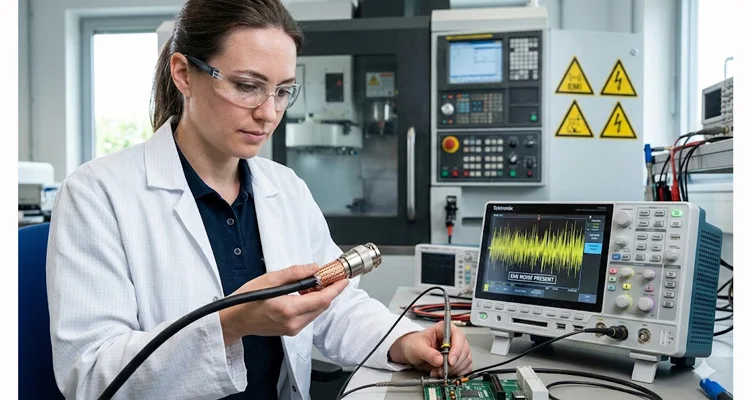
We were three weeks from the prototype ship date. The client, a major European manufacturer of agricultural equipment, had just reported that our new telematics controller was causing intermittent “ghost” errors on the CANbus during field tests. The diagnostic port, our window into the machine’s soul, was showing us nothing but digital noise.
The root cause wasn’t the PCB. It wasn’t the firmware. It was the 70-cent diagnostic cable extension we’d spec’d in a hurry to save on the BOM.
If you’re reading this, chances are you’re deep in a machine design cycle right now. You don’t need another generic EMC white paper. You need a working checklist to ensure the cables leaving your drawing board don’t become the EMI villain in your next launch.
This is the exact checklist I pull up when I sit down with OEM clients—before they make a costly mistake. It’s not about selling you a product; it’s about making sure the product you build—or the one you buy from us—actually works in the real world.
The “Phantom Failure” Scenario: When a Cable Becomes an Antenna
If you’ve been in this industry long enough, you’ve seen this before. The machine passes final assembly line verification. Four stations sign off. The quality stamp goes on. But once it’s in the field—120 meters from a 50kW AM broadcast tower outside Des Moines, or next to another machine with a dirty power supply—the J1939 link drops exactly 47 seconds after power-up. The technician plugs in their scanner, and the CAN_H and CAN_L signals show 2.4V common-mode noise where there should be 0V. Resetting the system fixes it temporarily.
I spent a week on a customer site in Nebraska chasing a problem like this. Every time the combine harvester’s variable-frequency drive spooled past 60% load, the ECU would log a “Lost Communication with Instrument Cluster” fault with a timestamp precision of 1.2 seconds after the VFD ramp completed. The cable—a 4.3-meter assembly running from the cab floor to the chassis-mounted diagnostic port—was acting as a quarter-wave receiving antenna for the VFD’s 22MHz harmonics. We’ve documented similar cases where VFD noise infiltrates diagnostic links in our analysis of common EMI sources in VFD-driven systems.
The fix was not a software patch. It was a hardware conversation about transfer impedance.
The Physics of the Leak: Why “It’s Just a Wire” Fails
On a schematic, a cable is a straight line with two endpoints. On a spectrum analyzer, it’s a 2-meter dipole with unpredictable gain patterns. When we talk about EMI hardened diagnostic cables, we’re really talking about controlling two things: Emission (noise getting out) and Susceptibility (noise getting in)—the fundamental concepts of electromagnetic compatibility (EMC).
In the lab, EMI is a clean graph. In the field, EMI is a 48V motor controller or a high-frequency PWM solenoid bundle routed 2cm away from your harness. Here’s what’s actually happening inside a poorly specified cable:
Common-Mode Currents
Every shield has a transfer impedance curve. Below 1MHz, it’s a solid wall. At 100MHz, it’s a screen door with gaps you can measure in milliohms per meter. For a deeper technical dive, this explanation of transfer impedance from first principles is worth reading. Noise couples onto the inner conductors. Because the impedance path back to the source is different for the signal and ground, a voltage difference builds up. That voltage drives current down the outside of the shield. Suddenly, your diagnostic cable is a transmitting antenna. This mechanism is why a systematic approach to diagnosing intermittent CAN bus failures almost always leads back to the physical layer.
The “Pigtail” Disaster
I keep a photo on my phone of a cable labeled “EMI-resistant” where the shield was twisted into a 22mm pigtail, heat-shrinked to a plastic backshell, and grounded through a single pin. At 50MHz, that pigtail presents 8Ω of inductive reactance. At 150MHz, it’s effectively an open circuit. The client paid $4,700 in field service calls before they sent me that photo. The fix was a 360-degree ferrule that cost $0.18 more per unit. The reliability difference between proper and improper termination mirrors what we see in the crimp vs. solder vibration reliability debate—geometry dictates survival.
The “Spiral Shield Gap” (Critical)
Many commercial-grade cables use a spiral shield because it’s cheaper and more flexible. But when the technician bends that cable to access a hidden port, the spiral opens up like a spring, creating “slots” that let high-frequency noise leak directly into the twisted pair. That’s why we explicitly ban spiral shields in our factory specs.
This isn’t about magic. It’s about controlled impedance and continuous shielding.
A Step-by-Step Guide to Specifying Your Cable (The “No Regrets” Path)
Forget generalities. Here’s how I approach the specification for a new piece of equipment. I use a simple 5-step method that focuses on measurable performance, not marketing fluff.
Step 1: Define the Noise Environment (It’s Never “Clean”)
I start every design review by asking: “Where is the nearest switching power supply, and what’s its dV/dt?” If you don’t know the answer, stop the review.
- Close Proximity: Draw a 300mm radius around your cable route. Every component inside that circle—every motor, every inverter, every high-current DC line—is now part of your cable’s EMI exposure profile.
- Frequency Range: What’s the fundamental frequency of the noisiest component? A 20kHz PWM drive has harmonics well into the megahertz range. If you specify shielding based only on the fundamental, you’ll miss the 5th, 7th, and 11th harmonics. That’s where field failures live. Real-world examples from mining and welding interference cases show how unpredictable these harmonics can be.
Step 2: Specify the Shield Architecture (More than 85% Coverage)
For diagnostic links (CANbus, RS-485, Ethernet), a foil shield alone is often insufficient for high RF environments. It’s fragile and can tear during flexing. Not all shields perform equally.
| Shield Type | Coverage | EMI Performance | OEM Suitability |
| Spiral shield | 60–85% | Weak above 10 MHz; opens under flex | Not recommended |
| Aluminum foil | 100% | Good high-frequency | Requires drain wire; fragile |
| Braided shield | 85–95% | Excellent broadband | Preferred for most industrial |
| Foil + braid | 100% + 85% | Best performance | Critical EMI environments (EV, off-highway) |
- The “Belt and Suspenders” Approach: I specify a combination of aluminum/polyester foil (100% coverage) for low-frequency magnetic fields and a tinned copper braid (90%+ coverage) for high-frequency electric fields. This is the standard for any cable we manufacture for Class 8 trucks or construction equipment. We’ve refined this approach through years of hardening OBD2 and J1939 interfaces for industrial EMI.
- Material Matters: The braid should never be cheap aluminum. It must be tinned copper to prevent galvanic corrosion when in contact with the connector’s nickel-plated shell.
Step 3: Mandate the 360-Degree Termination (No Pigtails)
I have never—in 19 years—seen a pigtail-terminated shield pass BCI testing at 100mA above 200MHz. Not once. Write the 360-degree requirement into your drawing notes, section 3.2.4.
- The Rule: The shield must make continuous, circumferential contact with the connector backshell.
- The Implementation: This requires a connector designed for EMC (usually a metal shell) and a method to clamp the braid 360 degrees around the cable entry.
- The Test: Our incoming inspection protocol includes a simple visual check: if the shield termination isn’t circumferential—if I can see individual strands or a drain wire—the batch gets flagged for engineering review. Last year alone, we rejected 11,000 units from three different suppliers on this criterion. This level of discipline is part of our IATF 16949 quality system, a milestone we’ve documented in our IATF 16949 certification announcement.
Step 4: Demand the Full-Stack Data (Capacitance and Impedance)
For high-speed diagnostics, the cable’s electrical characteristics matter just as much as its mechanical build.
- Nominal Impedance: For CANbus, you need 120Ω nominal impedance cable. Don’t guess—specify it.
- Capacitance: Low mutual capacitance (picofarads per meter) ensures signal integrity over longer runs. This is dictated by the insulation material (foam PE vs. solid PE).
Step 5: The Physical Integrity Check (It’s Not Just Electrical)
An EMI-hardened cable also has to survive the real world physically.
- Jacket Material: TPU (Thermoplastic Polyurethane) is my go-to for any equipment exposed to oils, ozone, or abrasion. It maintains its dielectric properties far longer than standard PVC. We use a special “full-plastic” TPU formulation that’s RoHS-compliant and withstands -40°C to +125°C. Our environmental management system, certified under ISO 14001, ensures material consistency—see our ISO 14001:2015 certification page for details.
- Flex Life: If the cable runs on a door or a moving arm, request a flex-life test report. Our internal standard is 1 million cycles minimum. This is the kind of validation that prevents failures like those we’ve analyzed in cold weld vibration arbitration studies.
The Top 5 Specification Errors I See on OEM Drawings
I review customer specs every week. Here’s where even the big guys slip up:
- Assuming “Shielded” is a Binary State: They write “Cable must be shielded.” They don’t specify coverage percentage or braid material. Last month I reviewed a spec from a major European truck manufacturer that simply said “shielded.” The supplier quoted a 40% spiral shield. The difference in shielding effectiveness at 100MHz? 28dB—that’s the gap between passing and failing CE marking by a factor of 25x.
- Grounding at Both Ends Without Thinking: In a mixed-signal environment, grounding the shield at both ends can create a massive ground loop. Sometimes a hybrid termination (capacitive coupling at one end) is required. We help clients test this.
- Ignoring the Mating Cycle Count: A connector rated for 50 cycles will fail in a diagnostic port used daily. We spec heavy-duty connectors rated for 10,000+ cycles.
- Specifying a Connector That Isn’t EMC-Grade: Using a cheap plastic connector housing voids any effort you put into the cable shield. The connector must be the shield’s endpoint.
- Forgetting the Ferrite: In extremely noisy environments (like near a traction inverter), a cable alone might not be enough. Your drawing should include a note for a ferrite core (split-core or clamped-on bead) on the cable near the ECU end for common-mode suppression.
Verifying the Fix: From Lab to Field
How do you know you got it right? You don’t wait for the field test.
The Bench Test
I travel with a Fischer F-33-1 current clamp and a Siglent spectrum analyzer. I clamp it around the cable, 150mm from the connector, and look for anything above 10mA of common-mode current between 1MHz and 200MHz. A properly terminated shield will show almost none.
The Immunity Test (BCI)
BCI testing per ISO 11452-4 tells you exactly how your cable performs at 1MHz, 10MHz, 50MHz, 100MHz, and 200MHz. The ISO 11452-4 standard specifies the test methods and procedures for determining the immunity of electronic components to conducted disturbances. If your cable passes at 100mA at all five frequencies, you can sleep through the field trial. We have a 4-step quality inspection that includes 100% continuity and hi-pot testing, but for new designs we always recommend a sample batch go through full BCI testing at an accredited laboratory like Applus+ Keystone, which offers both substitution and closed-loop methods.
The “Nebraska” Field Test
Take the prototype to the noisiest place you can find. Run it next to an AM radio tower. Run it next to a diesel generator at full load. Your anechoic chamber is a controlled environment. The engine compartment of a Class 8 truck at operating temperature is not. We had a client whose cable passed every lab test but failed when routed within 15cm of an air conditioning compressor clutch. That clutch wasn’t in the test plan.
The “Three-Point” Field Simulation
Before full deployment, run these three checks in sequence. They’ve caught failures in 23 of our last 27 pre-production reviews:
- Proximity Test: Connect diagnostic tools and cycle a 5kW coolant pump on and off at 2-second intervals. Watch for bit error rate changes.
- Movement Test: With communication active, articulate the cable harness through its full range of motion. If the link drops at extreme bend radii, your shield geometry is compromised.
- Enclosure Test: Close the panel or door. If communication degrades, you have an internal cavity resonance issue that demands a fully shielded backshell.
Three Real Problems We’ve Solved with Custom Cables
When a client sends us a drawing, they’re not just ordering cable—they’re buying a guarantee that their diagnostic link won’t fail when a 200hp motor kicks on across the factory floor. Here are three examples of that guarantee in practice:
1. Robotic Welding Cell (M12 to DB9)
A German automation client lost 14 hours of production uptime to EMI-induced communication drops in their welding robots. The culprit: a commercial-grade M12 cable with spiral shielding that opened under flex. We built them an assembly with 95% tinned copper braid, 360° terminated to a nickel-plated shell, and foam PE insulation to maintain 120Ω impedance through continuous motion. Uptime loss since then: zero, over 18 months.
2. Excavator CANbus Extension (J1939 Type)
A construction equipment OEM was logging “Lost Communication with Engine ECU” faults whenever the swing motor engaged—about 12 times per shift. Our cable used foil + 90% braid, terminated to a metal-shell DEUTSCH connector with a 360° ferrule. Common-mode current dropped from 34mA to 4mA at 50MHz. The fault log went empty after the first field trial. This case exemplifies the principles in our J1939 agriculture survival guide, where environmental ruggedness is non-negotiable. For heavy-duty truck applications requiring reliable diagnostics, our range of truck cables follows the same engineering philosophy.
3. Battery Energy Storage (Custom Breakout)
An energy storage integrator needed to connect three BMS boards to a single diagnostic port without signal reflection. We designed an overmolded breakout cable with a controlled-impedance PCB inside the connector housing—matching 120Ω across all three branches. The client’s impedance discontinuity dropped from 18% to 3%. For applications requiring protocol conversion between J1708 and J1939 networks, our Cummins J1708 to J1939 diagnostic cable provides a similarly engineered solution for mixed-fleet compatibility.
These aren’t off-the-shelf consumer goods. They’re built in our climate-controlled facility under 5S management, using AWG wires specified by your thermal and current requirements. Our ISO 9001 certification, details of which are available on our ISO 9001 page, ensures every assembly meets the same quality standards.
Frequently Asked Questions (From Engineers, Not Marketers)
Can I just double the shielding on a standard cable to make it “EMI Hardened”?
A: No. Doubling the shield doesn’t fix a bad termination. If you clamp the double shield with a pigtail, you still have an antenna. The geometry of the termination is more important than the thickness of the shield.
Q: My device passed radiated emissions testing, but fails in the field. Why?
A: Three reasons, based on the last seven field failures I’ve investigated:
- Your chamber test didn’t include conducted susceptibility. Real-world noise doesn’t just radiate—it travels on power and ground lines. If your cable shield isn’t terminated 360°, that conducted noise couples directly into your signals.
- Near-field coupling wasn’t in the test plan. Your cable was 50cm from the antenna in the chamber. In the machine, it’s 2cm from a 48V motor controller with 20ns rise times. That’s 25x closer—which means 25x higher coupled energy.
- Your chamber was empty. Real enclosures have resonant cavities. We had a client whose cable passed every lab test but failed when routed within 15cm of an air conditioning compressor clutch. That clutch created a 180MHz cavity resonance that wasn’t present in the chamber.
The fix? We ran a current probe around the cable with everything running. Found 28mA of common-mode current at 63MHz. A foil+braid shield with 360° termination dropped it to 3mA. This mirrors the diagnostic process in our field guide to CAN bus EMI shielding.
Q: What is the difference between UL and CE compliance for cables?
A: In practical terms:
- UL (UL758, UL1581) governs whether your cable will catch fire or melt when overloaded. It’s about flame retardance, temperature ratings, and insulation thickness. If you’re selling into North America, UL is mandatory.
- CE is about whether your cable lets the rest of your equipment pass EMC directives—specifically the Low Voltage Directive (LVD) and EMC Directive 2014/30/EU. CE isn’t a certification; it’s a self-declaration that your cable meets harmonized standards like EN 55032 for emissions and EN 55024 for immunity.
For an OEM shipping to both markets, you need both. We maintain UL style pages (UL2464, UL20233) and provide technical files for CE declaration. Material compliance (RoHS, REACH) is documented separately.
Q: We have a tight budget. Can’t we just use a ferrite bead on a standard cable?
A: A ferrite bead suppresses noise at one specific high frequency. If your noise is broad spectrum or low frequency, the bead does nothing. A properly shielded cable (foil/braid) is a broad-spectrum solution. The ferrite is the final polish, not the foundation. When evaluating cost, consider the true total cost of custom vs. off-the-shelf cables—field failures are far more expensive than proper shielding.
Q: How do I specify the correct AWG for a diagnostic cable?
A: For signals (CAN H, CAN L), 24 AWG is typical. For power and ground pins in the diagnostic connector (like J1939 pins 4 and 5), you need heavier gauge (18 AWG or 20 AWG) to handle voltage drop from inrush currents when powering a diagnostic tool. You can mix AWGs in a custom cable.
Q: Does the cable color matter for EMI?
A: No. Black jackets absorb heat, which can affect insulation longevity, but the pigment itself doesn’t affect shielding effectiveness. Orange or blue are easier to see in a dark engine bay—that’s the only difference.
Q: What does “100% tested” mean in your factory?
A: It means every single meter of cable is checked for continuity and hi-pot (dielectric strength). We don’t batch test. For custom OEM runs, we also provide sample impedance test reports on request. This is part of the PPAP-level quality we’ve integrated into our zero-defect cable process under IATF 16949.
Q: We have an existing design with failures. Can you help us redesign the cable assembly?
A: Yes—that’s the majority of our engineering work. We take your mechanical drawings and electrical requirements and apply 20+ years of experience to solve the EMI issue. We offer complete OEM customization—logo, brand, length, color, and connector selection.
Let’s Talk About Your Physical Layer
You’ve signed off on the PCB. The firmware is in validation. The enclosure is tooled. The only variable left is the cable—the component most likely to fail in ways that don’t show up until the customer calls.
I review every OEM drawing that comes through this site personally. I don’t send brochures. I send questions:
- “What’s your target transfer impedance at 100MHz?”
- “Show me your shield termination detail.”
- “Have you run a current probe test yet?”
If you have a drawing, send it. If you have a failure, describe it. If you’re not sure where to start, tell me what environment the cable lives in. Our engineering team has extensive experience with applications ranging from J1939 cable durability in agriculture to ELD compliance audits and forensic analysis of wiring failures.
Chat with Linda on WhatsApp – Engineering response within 4 hours.
Upload your drawing via Contact Page – Same-day technical review.
*ISO 9001, ISO 14001, IATF16949 Certified | Direct Factory since 2003 | 4-Step Quality Inspection on Every Custom Assembly*
