

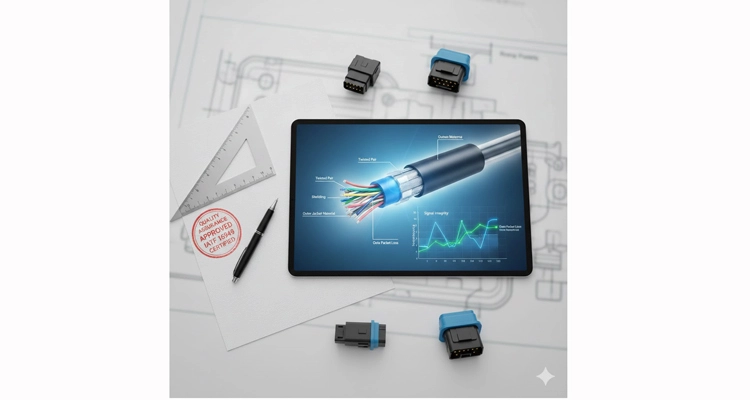
Procuring a J1939 cable is not a purchase order; it is the commissioning of a mission-critical data channel for heavy-duty equipment. A failure here triggers not an RMA, but a $15,000 roadside recovery, a day of lost harvest revenue, or a cascading warranty claim that systematically erodes OEM brand equity.
Selecting a supplier from a glossy brochure based on unit price alone constitutes professional negligence in engineering. The true cost lies buried in field failure data. This is not a collection of generic procurement tips. It is a forensic audit framework, battle-tested by our own engineering team to vet sub-suppliers. We will demonstrate how to see past the specification sheet to identify a partner engineered to prevent failures at the component level.
The High Stakes: When a “Cost-Optimized” Cable Fails in the Field
The Field Failure Scenario: A fleet of combines deploys. Months later, intermittent engine data and phantom fault codes surface. The root cause? The J1939 backbone cable. Connector seals, sourced at a 5% BOM saving, prematurely hardened under UV exposure, admitting moisture. The outcome was not a singular cable return, but a systemic, capital-intensive fleet-wide service campaign.
This is the hidden cost cycle. The Bill of Materials (BOM) cost—copper, plastic, connectors—is visible. The Total Cost of Ownership (TCO)—downtime, brand reputation, retrofit labor—remains hidden until it materializes as a financial invoice. Your objective must shift from finding the lowest-cost vendor to eliminating the statistical probability of that scenario. As detailed in our analysis of the real cost of reliability, the premium paid is actuarial insurance against this precise event.
J1939 Cable Supplier Audit Framework: Scrutinizing “Failure Mode Prevention” Capacity
Move beyond passive certificate verification. A competent supplier operates with a “Failure Mode Prevention” ethos. Your audit must resolve a single question: “Does this supplier possess the systemic controls and cultural discipline to intercept my specific failure modes before they reach my production line?”
Evaluate them across three core audit verticals where cost-driven suppliers compromise invisibly:
- Design & Engineering Foresight: The capacity to anticipate your application’s failure points.
- Process Consistency & Traceability: The machinery to replicate perfection across 10,000 units.
- Validation Honesty & Transparency: The commitment to prove survivability with forensic, destructive data.
Core Audit Area 1: Design & Engineering Foresight (Beyond the CAD File)
Any workshop can follow a drawing. A partner interrogates it.
J1939 Cable Supplier Audit: The “3cm Fracture Zone” Interrogation
Pose the question: “How do you manage strain relief design proximal to mold exits?” A supplier versed in real-world failure analysis will recognize this immediately. They maintain a library of historical pain points. Our investigation into the “3cm Fracture Zone” in OBD-II cables, for instance, originated from field returns on ruggedized diagnostic tools. This is pre-paid R&D that prevents failures at the design stage.
Material Forensics & Specification
Your drawing states “TPE, Black.” A commodity buyer sources the cheapest TPE. An engineer challenges: “Is this destined for a high-temperature, oil-saturated transmission tunnel or a UV-intensive roof-mounted application?” A true partner employs a material library curated from post-stress-test cross-sections and will recommend a validated compound—such as a hydrolysis-resistant polyether-based TPU certified for a 7-year service life in wet environments. This advisory function is embedded within our IATF 16949-mandated Pre-Production Checkup process, ensuring preventive action is systemic.
Your Audit Question:
“Walk me through your formal DFM (Design for Manufacturability) review process. Can you provide a redacted case study where you identified and rectified a latent field failure risk in a client’s initial drawing?”
Core Audit Area 2: Process Consistency & Traceability (The Machinery of Trust)
Consistency is not an aspiration; it is a machine built on systems.
The “4-Step Inspection” & Statistical Process Control (SPC)
Inquire about in-process verification. Is their quality gate merely a “final QC”? We mandate a non-negotiable 4-step inspection at defined choke points: cutting, crimping, molding, and final assembly. For critical parameters like crimp height, we utilize live Statistical Process Control (SPC) charts. Last quarter, a 0.02mm tooling drift, undetectable via spot-checking, was identified by our lead technician on an SPC chart, halting production proactively. This predictive vigilance is what your investment secures.
Full Traceability (“The Thread”)
In a failure scenario, can they trace a single cable back to the specific spool of wire and the calibration certificate of the crimping press used during its production? Our system, termed “The Thread,” provides this DNA-level genealogy, transforming root cause analysis from a multi-week investigation into a matter of hours.
Systemic Backbone
These are not ad-hoc measures. They are codified within an integrated system underpinned by IATF 16949:2016 certification (which governs our automotive quality management and mandates this level of documented control), and supported by ISO 14001:2015 environmental management systems (ensuring, for example, that all polymer compounds comply with global RoHS and REACH directives). This ensures stability from the microscopic (a single crimp cross-section) to the macroscopic (the 5S-managed, climate-controlled factory environment).This rigorous system extends to our adherence to internal specifications, such as Carsun-1298-2.
Your Audit Question:
“Demonstrate your traceability system using a finished cable. Given its serial number, what component-level and process-level data can you retrieve?”
Core Audit Area 3: Validation Honesty & Transparency (Proof, Not Paper)
Certificates are administrative artifacts. Data is empirical truth.
The “Teachers” Bin
During a lab tour, locate their bin of sacrificed samples. We label ours “The Teachers.” These are units destructively tested to uncover true failure modes, not merely to satisfy a minimum specification. One “Teacher” may demonstrate a terminal retention force of 85N against a 50N requirement—positive. Another may reveal a jacket crack after 142 hours in UV exposure, data which directly informed a material supplier change.
Testing Against Application Reality
Do they merely validate to the baseline SAE J1939 physical layer standard? Or do they stress-test the design against your operational environment? Demand to see controlled test reports for destructive pull tests (with metallurgical cross-section analysis per IPC-A-620 for gas-tight crimp validation), extended thermal cycling (-40°C to +125°C per ISO 16750-4), and corrosive salt spray. These reports must be controlled documents, not informal printouts. This is your objective evidence for internal or customer audits.
Your Audit Question:
“For a project with my environmental profile, what specific destructive test regimen would you prescribe, and can I review a sanitized data report from a comparable past project?”
The Audit Killers: 5 Supplier Evaluation Oversights That Inflate TCO
- Negotiating on BOM Cost in Isolation: Aggressively reducing per-unit cost for copper and plastic while disregarding the exponential, non-linear risk to Total Cost of Ownership (TCO).
- Accepting ‘Automotive-Grade’ as a Complete Specification: Failing to define the exact thermal cycle, chemical fluid exposure, UV irradiance dose, vibration power spectral density, and required mating cycles—the precise data set a true engineering partner requires.
- Omitting the On-Site Process Audit: Relying on virtual tours and PDF certificates. You must physically witness the 4-step inspection, observe live SPC charts, and inspect the “Teachers” bin.
- Compromising on Traceability Depth: Accepting batch-level traceability. For a complex, intermittent failure, you require component-level genealogy to isolate the variable.
- Treating the Supplier as a Commodity Vendor: Withholding application context (e.g., “for a mining vehicle”). A prevention-focused engineering partner requires this operational intelligence to mitigate failure.
Your Audit Checklist & Next Steps
Utilize this as your forensic starting point. A “Yes” must be substantiated by evidence, not assurance.
| Audit Point | What to Look For | Evidence to Request |
| Engineering Foresight | Proactive DFM review, documented failure mode library. | Redacted case study of a design flaw caught and corrected. |
| Process Control | Defined in-process inspections (e.g., 4-step), live SPC data monitoring. | Walk the production floor, view real-time control charts. |
| Traceability | Unique serialization per unit, traceability to raw material lot. | Live demonstration of their system using a sample cable. |
| Validation Integrity | Program for destructive limit testing, controlled test reports. | Sample test report for a similar environmental profile. |
| Systemic Quality | IATF 16949 certification, integrated systems (ISO 14001, internal specs). | Certificates and review of a Pre-Production Checkup document. |
| Problem-Solving | Formal 8D report capability, SCAR (Supplier Corrective Action Request) process. | Example of an 8D report they generated (redacted). |
How to Confirm a Qualified Partner: The correct partner’s systems will provide answers to your audit questions before you have finished asking them. The validation is in the seamless integration of their processes—evident in how our right-angle J1939 cable for confined spaces is born from the same DFM review and 4-step inspection as our precision OBD-II extension cables.
FAQ: From Engineers, for Engineers
Q1: We have low annual volumes. Does this level of rigor command a prohibitive premium?
A: While engineering and setup costs are amortized across fewer units, the necessity for rigor is inversely amplified. With low volume, you possess zero statistical margin for error; each unit must be flawless. We do not levy a penalty—we apply the same systemic controls because their value is even more critical at lower volumes.
Q2: What is the risk of using your team for prototype qualification, then transferring production to a lower-cost vendor?
A: Technically feasible, but strategically flawed. This action transfers 100% of the quality risk we have just mitigated. The “cheaper” factory won’t have the validated process parameters, tooling wear intelligence, or failure mode knowledge engineered during development. The ensuing quality fade and field failures typically obliterate all upfront piece-price savings.
Q3: Are certifications like IATF 16949 merely administrative?
A: In our operational context, unequivocally no. IATF 16949 provides the framework for our daily Pre-Production Checkups, real-time SPC charting, and 8D reports. It turns a quality system from a binder on a shelf into the live operating system of the production floor.
Q4: How are material shortages or substitution requests managed?
A: Via a fully transparent, formal Engineering Change Request (ECR) process requiring your written approval. Covert substitution is prohibited. We provide full comparative datasheets, test data (e.g., from our “Teachers” bin), and failure analysis reports to substantiate any claim of equivalence.
Q5: Where is the most common critical omission in cable assembly drawings?
A: Inadequate environmental specification. The term “automotive-grade” is functionally meaningless. We need the exact thermal cycle, exposure to fuels/oils, UV load, and required flex cycles. Precision here lets us engineer precisely, avoiding costly over-engineering.
Q6: Is the SAE J1939 standard universally sufficient for all heavy-duty applications?
A: SAE J1939 defines the core data protocol standard for the Controller Area Network (CAN bus). However, the physical layer components—the cables and connectors themselves—must be engineered to survive the specific, harsher environmental demands of your application (such as in agriculture, mining, or marine industries), which often exceed the baseline assumptions of the standard.
The Next Step: From Audit Guide to Technical Dialogue
This guide provides the analytical framework. Its application necessitates a technical dialogue concerning your specific project, its dominant failure mode risks, and your Total Cost of Ownership model.
If your procurement calculus is governed by lifecycle reliability and not isolated unit price, let’s talk. We are not the least expensive option. We are engineered to be the most reliable, and consequently, the most cost-effective partner over the operational lifespan of your product.
For a direct, technical consultation with our engineering team:
To submit your specifications for a formal pre-production review:
Let us build systems that do not merely function, but endure.
