

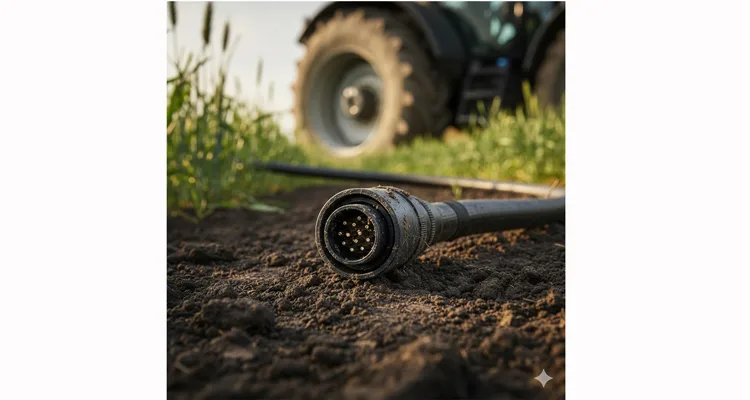
When a combine harvester’s yield monitor starts showing ghost values, or a tractor’s telematics go offline during critical application, the first instinct is to blame software or a faulty sensor. In our experience, that’s often a misdiagnosis. The most critical signals—from engine load to implement control—flow through a single, often underestimated component: the J1939 cable assembly. On a test bench, any compliant cable passes. But in a Nebraska wheat field in August or a Dutch potato farm during autumn harvest, the difference between a functional data link and a costly failure is defined by physics, chemistry, and mechanical fatigue, not just protocol.
We’ve torn down hundreds of failed agricultural machinery cables pulled from the field. The patterns are brutally consistent. This guide isn’t theoretical. It’s a forensic breakdown of what actually breaks, why, and the material science behind building a harness that doesn’t just survive, but endures.
Observed Failure Modes: A Systems-Level View
Forget clean lab environments. Think about the synergistic attacks on the cable system:
1. Abrasive Infiltration and Galvanic Corrosion
Mud here isn’t just dirt; it’s an abrasive, conductive slurry. Forced under tire pressure into microscopic gaps between seal and housing, it acts as both a grinding paste and an electrolyte. This can lead to seal degradation and, more insidiously, galvanic corrosion between dissimilar metals in the connector if moisture is present.
2. Selective Polymer Degradation
This is beyond “some oil.” We’re talking about distinct chemical reactions: aromatic hydrocarbons in diesel that swell and soften standard PVC, and the alkaline hydrolysis of certain polyurethanes (PUR) by concentrated AdBlue (urea) pooling. Each contaminant targets specific polymer chains.
3. Broad-Spectrum Mechanical Fatigue
Vibration isn’t a single force. It’s the superposition of low-frequency (<5 Hz) rocking from terrain, medium-frequency (10-50 Hz) shakes from implements, and high-frequency (>500 Hz) noise from hydraulic pumps. This composite stress acts like a persistent, multi-directional crowbar on every crimp terminal and wire strand.
4. Thermal Mismatch Stress
A cable on an engine block can see 120°C+. The same run to a winter-stored implement faces -30°C. The copper conductor, polyolefin insulation, and TPU jacket have different coefficients of thermal expansion (CTE). This mismatch creates internal shear forces during cycles, potentially leading to conductor cold flow and increased resistance at termination points over time.
Root Cause Analysis for Durable Agricultural Machinery Wiring
The “why” boils down to three fundamental mismatches between standard commercial components and the agricultural environment.
Jacket Material Incompatibility
Standard PVC or cheap PUR softens in diesel and hydrolyzes (breaks down) in AdBlue. The jacket gets tacky, swells, and loses its tear resistance. We’ve seen cables where the outer jacket was literally dissolved by repeated chemical exposure, leaving the braiding exposed.
Inadequate J1939 Connector Sealing Philosoph
A simple O-ring on a connector backshell isn’t enough. You need a multi-stage sealing approach: a primary seal at the connector interface, a gland seal where the cable enters the backshell, and often, a sealed transition if the cable is branched. Pressure washing is a standard farm maintenance procedure; your sealing must assume a direct, high-pressure blast.
Poor Strain Relief and Flex Design
Cables are often routed tight against sharp brackets or tied in positions where full machine articulation pulls on them. If the strain relief is just a plastic clamp that bites into the jacket, vibration will eventually cut through it. The cable needs to be designed to bend in its specific installed location, not forced into a bend radius smaller than its minimum.
This is why the debate over shielded vs unshielded cable in agriculture is secondary. If the physical layer fails, signal integrity is moot. The real Total Cost of Ownership (TCO) analysis, as we’ve argued in our piece on the true cost of a reliable cable, starts with survival.
A Four-Phase Specification Process for Field Reliability
Don’t just buy a “rugged” cable. Specify it like an engineer. Here’s our field-proven process:
Phase 1: Define the Application Environmental Profile.
Create a simple table for your application, including how you’d verify robustness:
| Location on Machine | Primary Threat | Secondary Threat | Temp Range | Our Validation Benchmark |
| Engine Bay (ECU to firewall) | High Temp, Diesel Vapor | Vibration | -40°C to 125°C | Heat aging per ISO 6722, followed by vibration per MIL-STD-202G, Method 214. |
| Lower Chassis (main run) | Mud immersion, Stone impact | Hydraulic Oil | -40°C to 105°C | IP67 immersion test, then abrasion resistance check per DIN 53516. |
| Implement Interface (quick-hitch) | Constant flexing, Chemical exposure | UV Radiation | -30°C to 90°C | >500,000 cycles on a custom flex fixture simulating implement articulation. |
Phase 2: Select Materials Based on the Profile.
- For omnipresent oil/fuel: TPU (Thermoplastic Polyurethane) with a Shore A hardness of 80-90 often provides the best balance of abrasion, chemical resistance, and flexibility. It’s tougher than standard PUR.
- For high chemical exposure (sprayers): Consider XLPE (Cross-linked Polyethylene) or specific oil-resistant rubber compounds. Avoid PVC entirely.
- Connector Housings: Must be rated for the chemicals listed. Metri-Pack or Deutsch DT/DRS series with appropriate seals are common starting points, but the specific seal material (e.g., fluorosilicone for broad chemical resistance vs. EPDM) must be confirmed.
Phase 3: Design for Mechanical Longevity.
- Strain Relief: Use overmolded, funnel-shaped boots that distribute bending stress over a long area, not clamp-style. The transition from cable to connector is the #1 failure point we document in our analysis of common OBD-II cable failure points.
- Routing & Protection: Specify where convoluted tubing or braided sleeving is needed for sections exposed to abrasion (e.g., near track systems). A few cents of sleeve prevents a $500 field service call.
- Shielding: For long runs parallel to high-current cabling (e.g., near traction motor lines), a full 360-degree foil + braid shield is non-negotiable. Proper termination of that shield to the connector backshell is critical. Our field guide to CAN bus EMI shielding details the “how-to.”
Phase 4: Execute Failure-Mode Validation Testing (FMVT).
Post-assembly, the harness must be tested under simulated duress:
- IP Rating Testing: At a minimum, IP67 (immersion) for connectors.
- Flex Test: For cables to implements, a standardized flex cycle test (e.g., 1 million cycles over a specified radius).
- Chemical Dip Test: Sample jackets and seals in your identified chemicals for 24/48 hours, checking for swelling >10% or hardness change.
This rigorous, PPAP-aligned validation mindset is what separates a drawing from a deliverable. It’s the core of our IATF 16949 pre-production checkup process, which is part of our broader IATF 16949:2016 quality management system.
Five Common (and Costly) Mistakes We See Repeatedly
1. Using Automotive-Grade Cable on a Sprayer
Automotive specs resist brake fluid and engine oil, not glyphosate or ammonium nitrate. The material swells and fails.
2. Ignoring the “Drip Loop”
Running a cable tight from a chassis point to an implement guarantees water will travel along the cable into the connector. Always design a low point loop so water drips off before the seal.
3. Over-Tightening Zip Ties
This is a huge one. A cinched-down zip tie creates a localized stress point that becomes a focus for vibration fatigue and cuts the jacket—a classic precursor to the kind of 3cm fracture zone failures we’ve documented. Use cushioned clamps or specific cable ties with a wide, smooth pawl.
4. Mixing Grounds
Using the J1939 cable shield as the primary ground for an accessory, creating ground loops and noise. The shield should be grounded at one end only (typically the gateway/ECU end), as a Faraday cage, not a current carrier. This is crucial for CAN bus signal integrity.
5. Assuming “Sealed” Connectors are Pressure-Wash Proof
Most are only rated for splash. Direct, sustained spray at 2 inches from a pressure washer will force water past seals. Specify and test for the actual cleaning procedures.
How to Know Your Solution is Actually Robust
The proof isn’t in the first day’s data. It’s in the 3rd harvest season. Success looks like:
Zero Intermittent Faults
Diagnostic tools like John Deere’s Service Advisor or generic J1939 readers show stable, error-free communication with no sporadic “Node Lost” messages, even during PTO engagement or hydraulic actuation. If you’re battling gremlins, our guide on fixing systematic intermittent OBD-II communication may help isolate the issue.
Physical Inspection Pass
After a season, connectors unplug smoothly (no grit grinding), seals are pliable and not cracked, and the jacket shows no signs of cracking, swelling, or “greenstick” fractures.
Data Integrity
Logs from the telematics unit show no implausible parameter jumps (e.g., sudden engine RPM spikes to 50,000) which are classic signs of EMI-induced corruption on an unprotected bus.
Related Products & Engineering Support
This isn’t about off-the-shelf magic. It’s about application-specific design. Our role is to provide the robust building blocks and the engineering dialogue.
- For diagnostic access on mixed-fleet farms dealing with both old and new equipment, a dual-protocol splitter cable that cleanly manages J1708 and J1939 data streams without conflict is essential. It prevents the “ghost in the machine” errors common with cheap adapters. Understand the protocol differences in our J1708 vs J1939 comparison.
- For prototyping or repairing in-house harnesses, a reliable 9-pin J1939 pigtail breakout cable with pre-crimped, tinned leads and a proper molded backshell gives you a solid starting point. For pure legacy support, see our Cummins J1708 to J1939 cable.
- Ultimately, most agricultural solutions require a custom cable assembly. This means selecting the exact jacket material, the correct gauge for voltage drop over long runs (think 30-meter planters), the right connector series, and designing the overmolded strain reliefs for your specific mounting points. This is the essence of our J1939 agricultural cable solutions.
This level of customization is where our IATF 16949:2016 certification and underlying ISO 9001 and ISO 14001 systems move from being certificates on the wall to active tools. They ensure that every material is traceable, every crimp is validated against a crimp height standard, and every custom design goes through a Production Part Approval Process (PPAP) before it ships.
Conversations with Our Field Application Engineers
Scenario 1: The Sprayer Cable That Cracked in the Same Spot
- Client: “We’re seeing consistent jacket cracks about 4-5 cm from the connector on all our sprayer boom cables after one season. Is this a material defect?”
- Our Engineer: “Not necessarily a defect in the standard sense. That’s the primary flex point during boom folding. The standard bend radius calculation often doesn’t account for the dynamic ‘whipping’ action during transport. We now specify a dynamic bend radius multiplier (often 1.5x) for such applications and use a TPU with a lower low-temperature hardness (Shore A 80) to resist stress crystallization at that exact point.”
Scenario 2: Intermittent Data After Pressure Washing
- Client: “Our telematics data gets flaky after every wash. We use IP67 connectors.”
- Our Engineer: “IP67 is for immersion, not necessarily for a concentrated, high-pressure jet. The water ingress is likely traveling along the cable jacket into the backshell. A proper multi-stage seal includes an integrated shrink tube or overmold at the cable entry to create a permanent barrier. We’d also recommend a drip loop in the harness routing.”
Scenario 3: Choosing Between TPU and XLPE
- Client: “For a fuel line area with occasional diesel spill, should we use TPU or XLPE?”
- Our Engineer: “For pure hydrocarbon resistance, XLPE is superior and won’t swell. However, it’s stiffer. TPU offers better abrasion resistance and flexibility. If the cable is stationary, XLPE is a great choice. If it needs to move or flex, a high-quality, hydrocarbon-resistant TPU compound is the balance. We can provide swell test data for both in diesel for your review.”
Frequently Asked Questions (FAQs) for J1939 Cable Reliability
Q: How can I quickly tell if my J1939 cable failure is due to chemical attack versus mechanical fatigue?
A: Look for distinct signs. Chemical degradation (e.g., from diesel or AdBlue) typically causes the cable jacket to swell, become tacky, or lose elasticity uniformly in exposed areas. Mechanical fatigue (vibration) usually results in localized cracks, especially at sharp bends or near clamps, and broken wire strands at termination points.
Q: For a cable exposed to both diesel and high-pressure washing, what is the single most critical sealing feature to specify?
A: Beyond the connector’s primary seal, the most critical feature is a permanent, overmolded gland seal or integrated shrink tube at the cable entry point into the connector backshell. This prevents the “wicking” effect where fluids travel along the cable jacket strands and bypass the main connector seal.
Q: Your article mentions TPU and XLPE. Which one is better for extreme cold environments below -30°C?
A: While both can be formulated for low temperatures, high-quality, cold-flex-resistant TPU generally maintains better flexibility and impact resistance at extreme sub-zero temperatures compared to XLPE, which can become stiff and brittle. Check the material’s specific low-temperature rating (e.g., -40°C or -55°C).
Q: We use our equipment year-round. How many thermal cycles can a well-designed J1939 cable typically withstand before termination points degrade?
A: There’s no universal number, as it depends on the temperature swing and conductor termination quality. However, a robust design using pre-tinned, high-cycle crimp terminals and strain-relieved connections should reliably endure thousands of thermal cycles (e.g., daily -20°C to 80°C swings over 5-10 years) without a significant increase in resistance.
Q: Is it worth paying a premium for a full foil+braid shield on all agricultural J1939 cables?
A: Not always. For short runs (< 2 meters) away from high-power cables (like welding leads or traction motor lines), a drain wire or foil shield may suffice. For long runs, or cables routed alongside hydraulic solenoids, VFDs, or ignition systems, the full 360° foil+braid shield is a necessary investment to prevent EMI-induced data corruption.
Q: How do I validate the “pressure-wash proof” claim of a connector if it’s only rated IP67?
A: Perform a real-world test. Mount the connector assembly on a fixture, connect it to a resistance monitor, and subject it to a sustained, close-range (2-4 inch) spray from a pressure washer (1200-2000 PSI) at various angles for 30-60 seconds per side. Any spike in resistance indicates water ingress and seal failure.
Q: Can I repair a damaged section of a shielded J1939 cable in the field, or must I replace the entire harness?
A: Permanent, reliable repair of the shield integrity is nearly impossible in the field. While a temporary splice may restore conductivity, it will compromise the EMI shielding. For long-term reliability, especially in noisy environments, replacing the entire harness section or the complete assembly is recommended.
Q: What is the most overlooked step in the “Four-Phase Specification Process” that leads to early failures?
A: Phase 1 – Defining the Secondary Threat. Teams often specify for the primary threat (e.g., mud) but fail to account for secondary threats like UV radiation degrading the jacket over time, or hydraulic oil dripping onto a cable rated only for diesel. A comprehensive environmental profile is crucial.
Q: How does IATF 16949 certification for a cable supplier translate to better reliability for my machine?
A: It means the supplier’s processes are aligned with automotive-grade rigor. Specifically, it ensures traceability of every material batch, statistical process control (SPC) on crimps to prevent weak terminals, and a mandatory PPAP process that proves the design meets your specific requirements before mass production—preventing batch-wide failures.
Q: For a mixed fleet, is it better to use a protocol-converting gateway or a simple passive splitter cable for J1708/J1939 diagnostics?
A: Almost always, a properly designed, passive dual-protocol splitter cable is more robust and reliable for diagnostic access. Active gateways add complexity, a potential failure point, and power requirements. A quality passive splitter keeps the networks electrically isolated while providing physical access, preventing the “ghost errors” caused by cheap, improperly wired adapters.
The Bottom Line for Engineers and Fleet Managers
The J1939 cable on your combine isn’t a commodity. It’s a critical, environmentally stressed component. Specifying it correctly requires a shift from viewing it as an electrical part to viewing it as a mechanical wear item that must be engineered for its specific hell.
This is where we operate. We don’t just sell cables; we help solve data link reliability problems in the most punishing conditions on earth. If you’re tired of chasing gremlins in your machine’s data network, or if you’re designing the next generation of smart agricultural equipment and need a partner who understands that the signal path is as important as the sensor, let’s have an engineering conversation.
Discuss your specific application, routing challenges, and chemical exposures with our engineering team. We can provide a free design review and recommend materials and construction tailored to your machine’s reality.
Contact our engineering team via our contact form
Chat directly with an application engineer on WhatsApp
External Authority References:
- The formal protocol and physical layer specifications are governed by the SAE J1939 standards suite published by SAE International.
- For understanding the chemical resistance of polymers, resources like UL’s iQ™ Platinum Directory or specific manufacturer datasheets for compounds like Glyphosate (a common herbicide) are essential starting points for any material selection.
