

The most costly defect in your custom cable assembly isn’t a bad solder joint or a flawed strand of copper. It’s a hidden assumption, locked in the CAD geometry or material callout, invisible to a standard RFQ process but destined to sabotage your pilot run. We’ve watched these “designed-in” flaws derail timelines for months.
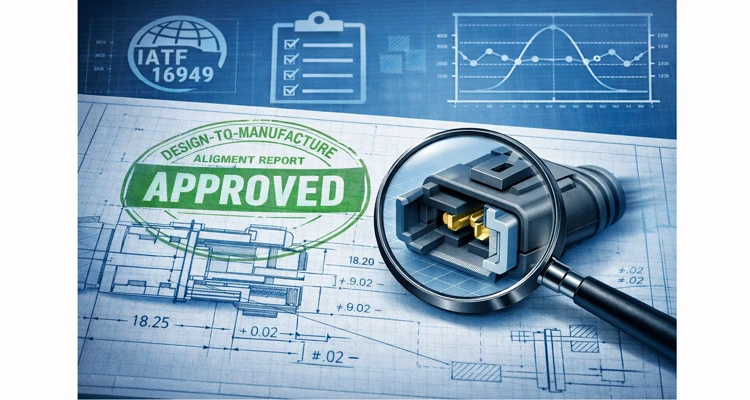
At Carsun, a drawing is not a command to manufacture; it’s an invitation to collaborate. Our IATF 16949 certification isn’t merely a credential for the wall (though we’re proud of it—you can view our certification milestone here). It’s the core operating logic for our mandatory “Pre-Production Checkup”—a formalized engineering dialogue that amplifies your design’s reliability by intercepting failure modes where they are cheapest to solve: in the digital realm, before any tooling is commissioned.
Think of it as a strategic investment of 3-5 business days upfront, reclaiming weeks of production stability and avoiding the severe costs of field recalls and brand erosion.
The Costly Gap in Cable Assembly Design: When “As Drawn” Fails
The root issue is rarely negligence. It’s a disconnect in risk foresight. The designer’s intent—optimal performance under real-world stress—can be unintentionally filtered out during the transition to manufacturing.
Here are typical scenarios our process uncovers:
- The Aesthetic Compromise: A sleek connector strain relief that creates an acute bend radius, directly inviting the classic “3cm fracture zone” failure we’ve detailed in our OBD2 cable failure analysis.
- The Incomplete Material Spec: A generic “PVC jacketing” callout that meets baseline requirements but fails under the specific cocktail of temperature extremes, chemical exposure, and mechanical abrasion in your application.
- The Digital Illusion: Tolerance stacks that appear perfectly mated in CAD software but create intermittent connections or assembly headaches at high-volume production without precise process design.
A factory that merely “builds to print” will deliver a part that passes a caliper check. A factory employing our IATF-based checkup delivers a product that passes your functional and durability validation on the first attempt.
Our “Feasibility Filter”: More Than a Gate, It‘s a Co-Engineering Session
This gap represents more than a skipped step; it’s a missed engineering dialogue. While Design for Manufacturing (DFM) and Failure Mode and Effects Analysis (FMEA) are established concepts, their value is determined by the timing and tangibility of their application.
Our approach is not a procedural checkpoint. It’s a collaborative review, crystallized in a tangible deliverable we call the “Design-to-Manufacture Alignment Report.” Generated before quotation finalization, this report is where our two decades of tooling, overmolding, and assembly experience are translated into preventive, actionable guidance for your design.
This session is mandatory for every custom project, from a modified J1962 OBD2 cable to a complete diesel engine diagnostic harness. The IATF 16949 standard’s emphasis on risk-based thinking institutionalizes this non-negotiable conversation.
Step-by-Step: Our 3-Stage Pre-Production Checkup in Action
Here is the exact workflow triggered when your RFQ and drawings enter our system:
Stage 1: The DFM & Assembly ‘Dry Run’ for Cable Assembly
We conduct a virtual production simulation, scrutinizing each manufacturing step for physical conflicts.
- Molding Feasibility Audit: Will that undercut trap the component in the mold? Does wall thickness variation risk sink marks or weak points? We propose specific draft angles and fillet radii (e.g., increasing a radius from 0.5mm to a 1.0mm fillet) to guarantee clean part ejection, extended mold life, and consistent cosmetic quality.
- Assembly Path Simulation: Can the cable bundle be routed smoothly during harness build-up? Does the overmolding process demand a specific sub-component orientation to avoid voids or wire damage? We map this logic to eliminate line bottlenecks and assembly stress.
Stage 2: Material Forensics: When ‘Meets Spec’ Isn’t Good Enough (Preventing Chemical/Thermal Failure)
We interrogate material specifications against real-world environmental and regulatory demands.
- The “Spec-as-Starting-Point” Principle: A callout for standard TPE may seek flexibility, but an operating environment of -40°C to 105°C with oil spray demands a different polymer. We flag this and can provide validated samples of oil-resistant, low-temperature-flex TPE compounds to prevent premature jacket cracking.
- Compliance & Regulation Verification: We cross-check all material callouts against your target market’s regulations (e.g., REACH, RoHS) and our own ISO 14001 environmental management systems, ensuring full compliance is designed in from the start
Stage 3: The ‘What-If’ Simulation: Building Our Control Plan From Your Risks (Preventing Process Variability)
This is where we preemptively solve production problems. We systematically ask, “What could fail during making this?”
- Proactive pFMEA Application: In one case, a customer’s design featured a flush-mounted LED adjacent to a connector. Our Process FMEA (a detailed extension of the industry-standard FMEA methodology) predicted a high probability of LED damage during automated connector mating. The solution was a minor, cost-neutral redesign adding a 0.5mm protective bezel. The outcome shifted from a projected 15% scrap rate to 100% first-pass yield.
- Statistical Process Control (SPC) Foundation: For critical-to-function dimensions (e.g., pin seating depth), we don’t plan for simple inspection. We design the manufacturing process to control them, targeting a Process Capability Index (CpK) >1.33 from the initial production run, applying core principles of statistical process control (SPC) methodology. We detail this application in our IATF 16949 SPC & Cpk case study.
5 Common Manufacturing Oversights (That Our Checkup Systematically Prevents)
| Common Oversight | Typical Consequence | How Our Checkup Intervenes |
| 1. “The Drawing is Gospel” Passivity | Manufacturing blind spots leading to low yield or tooling damage. | Proactive DFM feedback issued as part of the Alignment Report. |
| 2. Late-Stage Feasibility Discovery | Costly delays and tooling rework during sample or pilot phases. | Feasibility is rigorously vetted and signed off during the RFQ stage. |
| 3. Unilateral Material Substitution | Unpredictable field failures and compliance breaches. | Full material transparency; substitutions only with joint validation. |
| 4. Overlooking Tolerance Stack-Ups | Poor connector mating, intermittent signals, assembly frustration. | Tolerance analysis is a standard component of our Stage 1 review. |
| 5. Disconnected Process Controls | Batch-to-batch inconsistency, escaping defects. | Control plans are directly derived from the pFMEA (Stage 3). |
How You Know the “Checkup” Worked: Signs of a Healthy Project
- An Insightful First-Article Inspection (FAI) Report: This document goes beyond a pass/fail checklist. It narratively links measurement data back to the agreed-upon DFM optimizations, demonstrating that critical dimensions are statistically in control.
- Seamless Production Ramp-Up: The transition from prototype to mass production lacks drama—no last-minute tooling tweaks or material emergencies. The 1,000th unit is indistinguishable from the 10,000th.
- Uneventful In-House Validation: Your own testing protocols conclude without surprises, because potential failure modes were identified and mitigated during the design review phase.
- Proactive, Transparent Communication: You receive a concise summary of our engineering findings before production authorization, fostering a partnership built on informed confidence.
This Philosophy in Practice: Where Our Checkup Makes the Critical Difference
Reliability cannot be inspected into a product; it must be engineered into its DNA. Here is where our upfront diligence delivers tangible ROI:
For Heavy-Duty Diagnostic Cables
It’s more than robust sheathing. Our Stage 1 Dry Run specifically analyzes strain relief topology and latch mechanics to survive beyond-specification cyclic flex and pull tests that mimic brutal shop-floor abuse.
For High-Volume Data Harnesses
Dimensional consistency is non-negotiable. Our Stage 3 SPC planning guarantees that parameters like pin depth or insulation crimp height achieve CpK >1.33 at launch, ensuring the near-zero deviation synonymous with mature, controlled processes.
For Full OEM/ODM Integration
This is the ultimate test of our philosophy. We don’t just apply your logo; we evaluate the entire assembly against the benchmark of your brand’s reputation. Every unit, shipped from our climate-controlled, 5S-managed warehouse, carries a quality pedigree traceable to this foundational review.
FAQ: Your “Pre-Production Checkup” Questions Answered
Q1: Doesn’t this extra review delay our project kickoff?
A: It strategically reallocates time. By investing 3-5 days in this front-loaded engineering phase, we routinely eliminate 2-3 week delays during mass production and avoid month-long redesign cycles post-failure. It is the most direct route to a market-ready, reliable product.
Q2: What if our engineering team disagrees with your DFM recommendation?
A: You retain full design authority. We serve as your manufacturing consultant, providing supporting data—warpage simulations, mold flow analysis, comparative material test reports. We quantify the risk (e.g., “This may reduce production yield by X%”), empowering you to make the final, informed call.
Q3: Is this process reserved for large, complex projects only?
A: The rigor scales appropriately, but the systematic checklist is applied universally. Even a minor modification to a standard cable triggers the same disciplined review framework. It is integral to our operational DNA.
Q4: How does this differ from other IATF 16949-certified suppliers?
A: Many factories view IATF as a quality assurance framework for their output. We employ it as an engineering methodology for our input. The distinction is between proactive co-engineering and reactive inspection. The certificate validates our system; the Checkup is the system in action.
Q5: Can we see a redacted example of your Alignment Report?
A: Certainly. Upon engaging with a mutual NDA, we can share anonymized excerpts demonstrating how we’ve communicated specific design optimizations, such as refining a connector boot for superior strain relief—principles often aligned with robust design standards like IEC 62196-2.
Q6: Is there a charge for this initial engineering review?
A: For qualified projects with shared intent, the preliminary review is integrated into our quotation process, demonstrating capability and commitment. For extensive, dedicated co-engineering sprints, we structure transparent and fair agreements upfront.
Q7: How is our intellectual property protected during this deep design review?
A: With the utmost rigor. We operate under comprehensive NDAs. Your proprietary data is managed within access-controlled, secure systems and is never utilized for any purpose beyond your specific project.
Q8: What initiates this Pre-Production Checkup?
A: Sharing your requirements—whether a full drawing package, a specification sheet, or a description of a problem you need to solve—initiates the process. The initial technical conversation is, itself, the first step of the Checkup.
Tired of Serving as Your Factory’s De-Facto QA Department?
If you’re expending more energy validating samples and correcting manufacturing oversights than driving innovation, let’s redefine the partnership. Allocate a few days to our Pre-Production Checkup for your next design, and reclaim weeks of project timeline certainty.
Submit Your Design for a Focused, No-Obligation Stage 1 Review:
We’ll apply our “Dry Run” analysis to a critical aspect of your design—such as connector interface durability or material suitability—and provide you with actionable engineering insights, not generic sales pitches.
Let’s engineer reliability into your product, from the first line of the drawing to the last unit off the line.
