

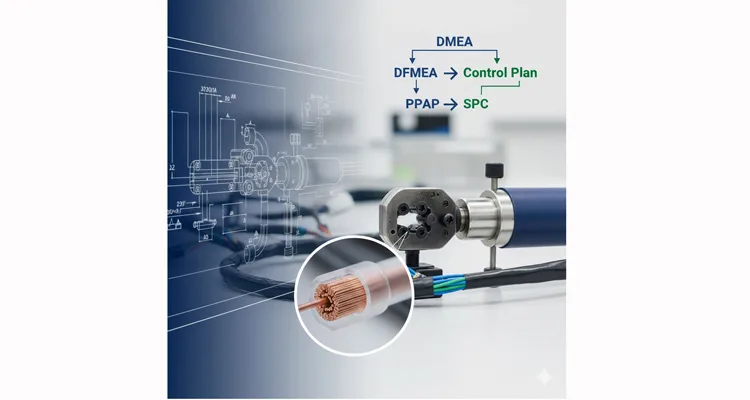
After enough projects, you see a pattern emerge. Getting a prototype harness to work is one thing. Getting five thousand, or fifty thousand, to work identically and reliably two years down the line is another. The first tests design; the second tests control over every variable in the manufacturing process. Many programs get stuck here—not because the drawing was wrong, but because the transition from sample to series production was uncontrolled. We treat the process designed to prevent this—the Production Part Approval Process (PPAP) under the IATF 16949 standard—as the core engineering workflow that locks down risk upfront. It’s not a “quality certificate” we deliver to you; it’s our internal mechanism for ensuring process consistency.
The Moment You Realize “Good Enough” Isn’t: A Typical Scenario
Picture this. Your prototype cables worked flawlessly. The supplier shipped the first production batch of 500, and they passed the basic continuity check. But now, on the assembly line, 3% of the units are failing the final system test. The diagnostic tool shows intermittent communication. It’s not every unit, and it’s not on every test cycle. The line slows down. Technicians start swapping cables, blaming the ECU, blaming the software. The issue is ghost-like. Your “qualified” supplier is pointing at the test report from their first article inspection, claiming the specification was met. You’re now managing a crisis, not a production schedule. The root cause, often traced back, is a process failure that a robust PPAP submission and ongoing IATF 16949 discipline would have caught before a single production unit was packed.
The Root Cause: It’s Rarely the Design, It’s Almost Always the Process
The failure in the scenario above isn’t usually a bad drawing. It’s a disconnect between the prototype process and the mass production process. It’s uncontrolled variables. Here’s the technical breakdown of why standard “quality checks” fail:
1. The Tooling Trap: Unvalidated Production Processes
The sample was hand-crimped with a calibrated lab tool. Production uses a different die set in a pneumatic press. The crimp height, compression force, and cycle time vary just enough to create an intermittent connection under vibration. *We learned this early on: a hand-crimped sample was perfect, but an automatic press with a closure speed off by 0.1 seconds caused copper strands to fatigue and break under vibration. Now, crimp height and pull force CPK is a non-negotiable check in our PPAP.*
2. The “Equivalent” Illusion: Material Substitution Without Validation
The prototype used Brand A’s PVC for insulation. For cost savings on the production run, the procurement team switched to Brand B’s “equivalent” PVC without a formal Engineering Change Request (ECR). Brand B’s material has a slightly different flex modulus, causing stress on the solder joints inside the molded connector after 500 mating cycles. *“Equivalent material” is a dangerous term. We once traced an intermittent short to a batch of secondary-source insulation whose dielectric strength degraded 15% faster at high temperature. Now, any material change must trigger a formal ECR with full validation data.*
3. The Spec-Boundary Failure: Insufficient Process Control Limits
The resistance test passes if it’s below 0.5 ohms. The prototypes measured 0.1-0.2 ohms. Production units are passing at 0.45 ohms. While “in spec,” this high-resistance boundary condition, when combined with other system tolerances, causes voltage drop and communication failure. A proper Process Failure Mode and Effects Analysis (PFMEA) would have identified this and set a tighter, internal control limit (e.g., <0.3 ohms). “Within specification” is not the same as “good.” If a CAN bus wire resistance consistently skirts the upper limit (say, 0.48Ω), the tester says “PASS,” but in a noisy vehicle environment, it’s the weakest link. Our PFMEA forces us to set stricter internal control limits (e.g., <0.3Ω) for such parameters.
In essence, the problem is a lack of evidence that every aspect of the manufacturing process—from raw material receipt to final packaging—is capable, stable, and monitored. This is precisely what the IATF 16949 framework, and PPAP within it, are designed to prove.
The Step-by-Step Solution: Our PPAP Pipeline in Action
This is not a paperwork exercise. It’s a parallel engineering and manufacturing validation track. Here is how we execute it for a new custom cable assembly program.
Step 1: Front-Loaded Risk Mitigation: Design Reviews and DFMEA
We take your schematic and requirements and conduct an internal Design for Manufacturability (DFM) review. We challenge connector choices, shielding methods, and strain relief designs based on our 20+ years of factory experience. We document potential failure modes related to our processes. Our principle: give the manufacturing engineer veto power at the drawing stage. A connector that’s difficult to crimp reliably or easy to mis-mate during assembly should be corrected at the source.
Step 2: Blueprinting the Process: Creation of Control Plans and PFMEA
For each production step—wire cutting, stripping, crimping, soldering, molding, assembly, testing—we define the exact method, equipment, and inspection criteria. The PFMEA assigns Risk Priority Numbers (RPNs) to each potential process failure. High RPNs force us to implement preventative measures before production starts.
Step 3: The Critical Validation: Manufacturing PPAP Samples on Production Tools
This is critical. The parts we submit for your approval are not made in a lab. They are made on the same assembly line, by the same operators, using the same 4-step quality inspection protocols and calibrated production tooling (molds, crimp dies, solder jigs) that will be used for the full order. This validates the process, not just the part. This is our iron rule: PPAP samples must come from serial production tooling and shifts. Samples from a “lab” or “pilot line” tell you nothing about batch stability. We even record the equipment serial numbers and mold IDs used for the PPAP run.
Step 4: The Evidence Package: Comprehensive Documentation & Testing (The PPAP Submission)
We compile the evidence of process capability. This packet isn’t just a certificate. For a Level 3 submission (the most common and thorough), it includes:
- Part Submission Warrant (PSW): The summary document
- Dimensional Reports: Full measurements proving conformance to print.
- Material Certificates: With RoHS/REACH compliance statements, traceable to the material batch used.
- Process Capability Studies (Cp/Cpk): For critical dimensions like crimp height or pull force, proving our process is centered and within control limits.
- Performance Test Results: Data from our in-house tests, which often exceed basic standards. For example, we don’t just test continuity for a J1939 cable; we test signal integrity under load, EMI shielding effectiveness, and mating cycle durability.
- Approved Copies of All Records: Inspection records, calibration certificates for all tools, and the signed Control Plan.
Step 5: Sustaining Perfection: Ongoing Production with Statistical Process Control (SPC)
After PPAP approval, the work isn’t over. Our Control Plan mandates ongoing checks. Key parameters are measured and charted in real-time. If a measurement trends toward a control limit, the process is stopped and corrected before a single defective part can be made. This is the heart of IATF 16949: prevention and continuous improvement. For us, SPC charts are not audit records; they are the production line’s heart monitor. Operators are empowered to stop the line on a trend anomaly—that’s ten times more valuable than sorting out defects later.
Five Common (and Costly) Errors Companies Make with Their Cable Supplier’s PPAP
Error 1: Accepting a “Level 1” or “Level 2” Submission for Critical Parts
Level 1 (Warrant only) or Level 2 (Warrant with limited data) provides almost no evidence of process control. For anything beyond a simple commodity, insist on a Level 3 PPAP submission. It’s your due diligence.
Error 2: Not Reviewing the PFMEA and Control Plan
These documents reveal how the supplier thinks about risk. A vague PFMEA is a red flag. A detailed one shows proactiveness. We’ve shared our audit framework for evaluating this depth in our J1939 supplier audit guide.
Error 3: Approving Samples Made on “Engineering” or “Soft” Tooling
If the samples aren’t from hardened, serial production tools, you have validated nothing about future quality. Always confirm this.
Error 4: Ignoring the Process Capability (Cpk) Data
A dimension can be “in spec” but have a terrible Cpk (<1.33), meaning it’s erratic and will eventually produce defects. A capable process has a Cpk >=1.67. We provide this data for all critical characteristics.
Error 5: Failing to Validate the Supplier’s In-House Testing Correlates with Yours
Does their “pass” on a communication test mean the same as your ECU’s pass? We often run correlation studies using customer-provided test units or software to ensure alignment, preventing the OBD2 port not communicating scenario from ever reaching you.
How to Confirm Your Cable Assembly Process is Truly Robust
Don’t just check the box. Do this:
Check 1: Audit the Raw Data, Not the Summary Certificate
Don’t look at the polished report they hand you. Ask to see the raw SPC charts for key dimensions from the last three months of production on a similar product. You want to see the day-to-day variation, not a client-ready summary.
Check 2: Visit During Production (Unannounced, If Possible)
See if the 5S management is real. Are calibrated tools clearly marked? Are the Control Plans at the workstations, or in a manager’s drawer? Is the climate-controlled warehouse actually maintained?
Check 3: Trigger a Mock Contamination Response
Ask how they would handle the discovery of a non-RoHS standard compliant batch of wire. The procedure should be immediate, documented, and part of their IATF 16949 system.
Check 4: Request a Full PPAP Package for an Existing Product
A confident supplier will provide a redacted version of a past submission. Its depth is revealing.
Check 5: Ask a Specific Traceability Scenario
“If we find a shielding braid failure on a harness in South Africa next March, how do you tell us within two hours which production day, batch of shielding yarn, and which braiding machine it came from?” Their answer reveals if their traceability system is operational or theoretical.
Related Products That Undergo This Same Scrutiny
The process described isn’t for “special” orders; it’s our standard for any custom build. Whether it’s a complex refrigerated transport harness built to survive thermal cycling or a simple J1939 9-pin pigtail breakout cable, the same PPAP discipline applies. This systematic approach is what ensures the long-term reliability of products like our Cummins J1708 to J1939 diagnostic cable, where protocol translation must be flawless, or our dual data stream splitter cable, where preventing bus conflicts is paramount.
FAQ: PPAP and IATF 16949 for Cable Assemblies
Q1: Is IATF 16949 just for automotive?
A: While it’s the automotive quality management standard, its principles of preventive risk management, process control, and traceability are the gold standard for any industry where failure is not an option—agriculture, heavy equipment, marine, and industrial automation.
Q2: Does a full PPAP submission delay the project timeline?
A: It builds time into the front end of the project. This front-loaded effort prevents massive, project-killing delays during mass production. It is the definition of “measure twice, cut once.” Our APQP (Advanced Product Quality Planning) schedule integrates PPAP milestones from day one.
Q3: What’s the difference between a “sample” and a “PPAP sample”?
A: A sample proves the design can work. A PPAP sample proves your factory’s process can make the design work, consistently and identically, thousands of times.
Q4: Who pays for the PPAP submission?
A: Typically, the supplier (us) covers the cost of the initial submission as part of the project development. It’s an investment in a qualified process and a long-term partnership.
Q5: What happens if there’s a design change after PPAP approval?
A: Any change triggers a review per the PPAP manual. Minor changes may require just updated documentation. Major changes may require a partial or full new submission. This controlled change management is a core part of the system.
Q6: How does this relate to your ISO 9001 and ISO 14001 certifications?
A: IATF 16949 includes all of ISO 9001 and adds automotive-specific requirements. ISO 14001 is our separate environmental management system. Together, they form a comprehensive framework for quality and sustainability. You can view our certificates here: IATF 16949:2016 Certificate, ISO 14001:2015 Certificate.
Q7: Can you handle PPAP for low-volume, high-mix projects?
A: Absolutely. The rigor of the process is scalable. For lower volumes, the focus shifts from statistical machine control to validating human operator consistency—through certified work instructions, training videos, and individual competency records. The principle of evidence-based quality remains identical.
Q8: What’s your typical on-time delivery rate for production orders post-PPAP?
A: Sustained above 98%. The process control that ensures quality also eliminates variability and unplanned stoppages in our production, creating predictable lead times. This reliability is part of the true cost of a custom cable we often discuss—it’s not just unit price.
Q9: What’s the real difference between you and another factory with the same IATF 16949 certificate?
A: The certificate is the entry ticket. The difference is in the reaction to a process anomaly. Many factories focus on sorting out the bad parts. Our system is designed to prevent the bad parts from being made in the first place. If a crimp force drifts, we don’t just adjust the batch; we check the pneumatic valve, the die wear, the operator technique, and update the control plan. The devil—and the real quality—is in the detail of the “Reaction Plan” within our control plans.
Q10: Doesn’t this rigorous PPAP approach make small, custom projects prohibitively expensive?
A: For low-volume projects, the PPAP effort is focused differently. Instead of proving machine statistical capability over 10,000 cycles, we prove human and process capability through meticulous documentation, jig validation, and operator certification for that specific build. The cost of this front-end engineering is bundled into the project. It’s far less expensive than the cost of a field failure or a production line stop later, for both of us.
This is how we bridge the gap between a working prototype and zero-defect production. It’s not magic. It’s a documented, auditable, and deeply ingrained system.
If you are comparing suppliers for a critical wire harness or custom cable assembly program, and the conversation hasn’t yet moved beyond unit price and samples, you’re discussing only 30% of the total cost equation. The real cost is in unmanaged risk.
Let’s discuss your project requirements and how our IATF 16949 process can be applied to de-risk your next build. Submit your specifications for a formal quote and project plan.
Contact Us for Engineering Support
Or, connect directly via WhatsApp for a more immediate conversation about your application needs.
External References for Deeper Understanding:
- The International Automotive Task Force (IATF) provides the foundational standards. Learn more about IATF 16949 on Wikipedia.
- The Automotive Industry Action Group (AIAG) publishes the definitive PPAP manual, outlining all requirements and submission levels. More information can be found on the AIAG website.
