

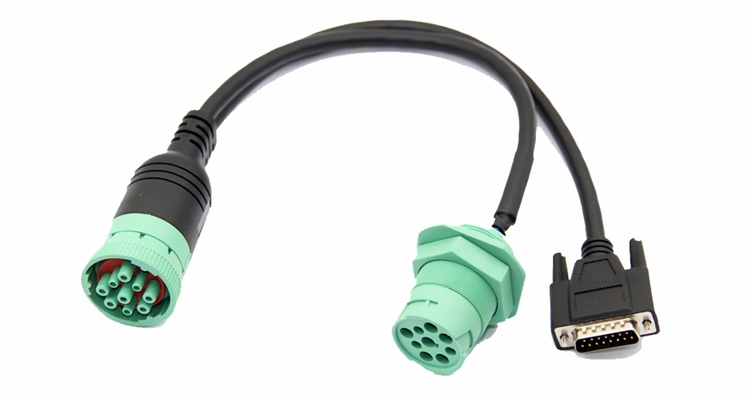
Need to bridge your heavy-duty vehicle’s diagnostic data to a monitor or data logger? This step-by-step guide shows you exactly how to connect a J1939 9-pin port to DB15 devices using a dedicated adapter cable, ensuring reliable data access for diagnostics, fleet management, and real-time monitoring.
Why You Need to Connect J1939 Data to DB15 Devices
In heavy-duty vehicles, capturing and monitoring diagnostic data is essential for maintaining optimal performance and reducing downtime. The J1939 interface, governed by the SAE J1939 standard, is the backbone for vehicle communication. Connecting it to DB15-compatible devices like telematics systems, data loggers, or in-cab displays allows technicians and fleet managers to access a wealth of data for informed decision-making.
What You’ll Need: The Essential J1939 to DB15 Adapter Cable
To establish this connection, you will need a specific and reliable cable: the J1939 9-pin Male to Female & DB15P Adapter Cable.
Key Components of the J1939 to DB15 Adapter Cable
- Green J1939 9-Pin Male Connector: Plugs directly into the vehicle’s diagnostic port
- Green J1939 9-Pin Female Connector: Allows for daisy-chaining or connecting extensions.
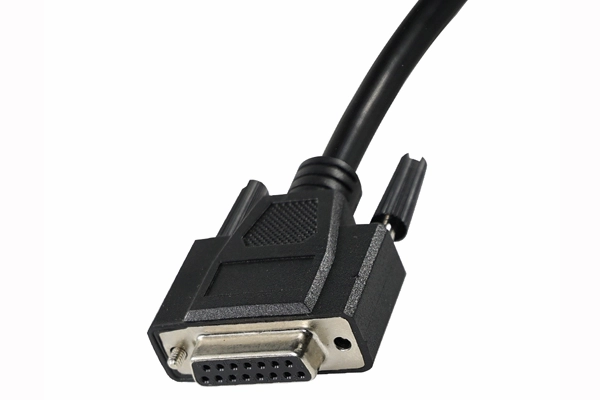
- High-Density DB15P Male Connector: Interfaces with your target monitoring or diagnostic device.
- Industrial-Grade Cable: Shielded for durability in demanding environments.
Why Our Adapter Cable is Your Best Solution
Our cables are engineered as solutions, not just components. Manufactured in our IATF 16949 certified facility with 20+ years of factory experience, every cable undergoes a 4-step quality inspection in a climate-controlled warehouse. We adhere to ISO 9001 quality management and ISO 14001 environmental standards, ensuring products that are RoHS, REACH, CE and UL compliant. We offer full OEM customization (logo, length, color, AWG) to meet your exact needs.
Recommended Related Products
- J1939 9-Pin Pigtail Breakout Cable – For custom wiring and prototyping projects.
- J1939 Splitter Y-Cable – For connecting one J1939 source to multiple devices.
Step-by-Step Connection Guide
Follow these four simple steps to establish a secure and functional connection between your J1939 data source and DB15 device.
Step 1: Locate the Vehicle’s J1939 9-Pin Port
Find the vehicle’s standard 9-pin J1939 diagnostic port. It is typically located in the truck’s cab, near the driver’s seat or under the dashboard.
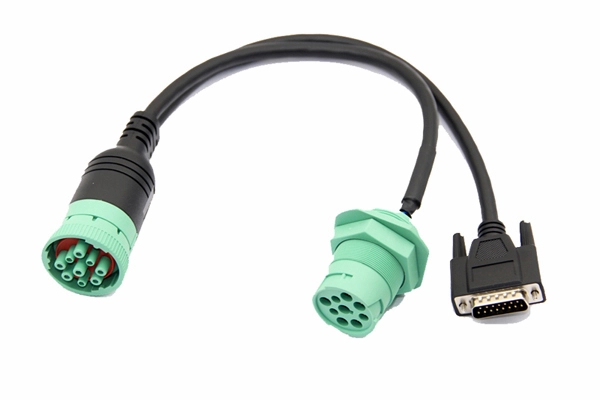
Step 2: Connect the J1939 Male End to the Vehicle
Take the green J1939 9-pin male connector from your adapter cable and firmly insert it into the vehicle’s port. Ensure a secure click or a tight fit to prevent disconnection
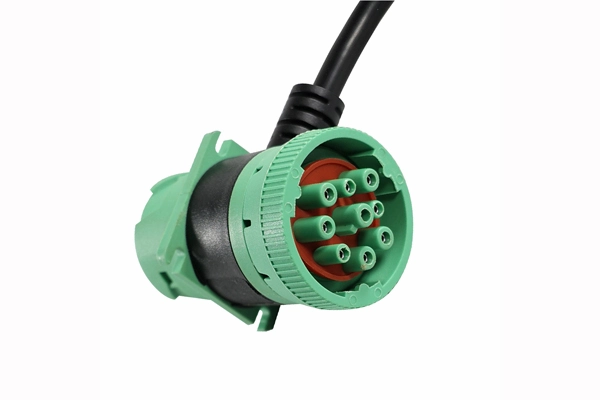
Step 3: Utilize the J1939 Female End (Optional)
If you need to extend the connection using a standard J1939 extension cable, or connect another J1939 device in-line, you can use the green J1939 9-pin female connector.
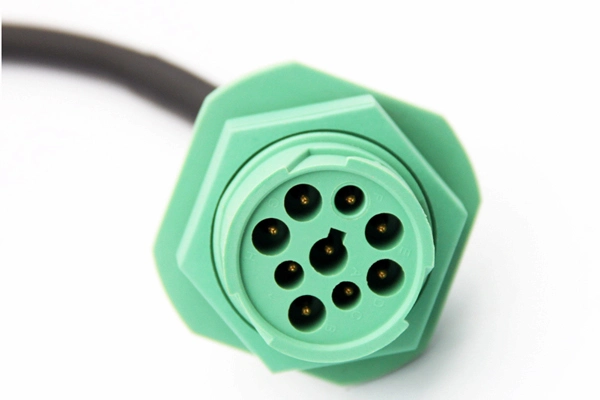
Step 4: Plug the DB15P Connector End to Your J1939 Data Logger
Finally, connect the DB15P male connector to your DB15 device, such as a data logger, telematics gateway, or in-cab display. Secure the connection to ensure stable data transmission.
Key Applications in Heavy-Duty Industries
This versatile adapter cable enables critical data access across various applications:
Vehicle ECU Data Diagnostics and Monitoring
Access real-time engine parameters, fault codes, and fuel consumption data for proactive maintenance and troubleshooting.
Fleet Management Data Logging
Capture and analyze vehicle data to optimize fleet efficiency, monitor driver behavior, and schedule predictive maintenance.
In-Cab Display and Telematics Integratio
Stream live J1939 data to aftermarket displays or GPS tracking systems, providing immediate operational insights.
Troubleshooting and FAQ
Find quick answers to common questions and solutions to typical connection issues below.
Q: I’ve connected everything, but my device isn’t receiving any data. What should I do?
A: First, double-check that all connections are secure. Ensure your DB15 device is powered on and configured to read the J1939 CAN bus protocol. Verify that the vehicle’s ignition is turned to the “on” position.
Q: Is the pinout of your J1939 to DB15 cable compliant with industry standards?
A: Absolutely. Our cables are manufactured to strictly follow the official SAE J1939 protocol and relevant IEC standards for electrical interfaces, guaranteeing correct pinout and reliable data transmission.
Q: Can I customize the cable length and specifications for my specific application?
A: Yes. As a direct factory, we specialize in OEM customization. You can specify the cable length, jacket color, wire gauge (AWG), and even add your branding to create a tailored solution.
Q: My vehicle has a J1939 9-pin port. Is this cable compatible with older J1708 systems?
A: No. While the connectors are physically similar, the J1939 and J1708 protocols are different. This cable is designed specifically for J1939 networks. A different adapter is required for J1708 systems.
Q: What quality certifications back your manufacturing process?
A: Our facility and processes are certified to multiple international standards, including IATF 16949 for automotive quality, ISO 9001 for quality management, and ISO 14001 for environmental management. We also comply with RoHS, REACH, and CE directives.
Q: What is the maximum data transfer rate this cable supports?
A: This cable is engineered to support the full J1939 CAN bus data rate of 250 kbps, ensuring no data loss during the transmission of all vehicle parameters.
Q: Are your cables built to withstand harsh automotive environments?
A: Yes. We use industrial-grade materials and our full-plastic, overmolded design is 100% tested to endure vibrations, temperature extremes, and moisture commonly found in heavy-duty vehicle operations.
Q: Do you offer technical support for integration?
A: Yes. We provide dedicated technical support to help you seamlessly integrate our cables into your systems. Don’t hesitate to contact our experts with your technical questions.
Get Your Custom J1939 Solution Today
This guide has shown you how simple the connection can be. The key to a reliable implementation is a high-quality cable. With over 20 years of manufacturing experience, IATF 16949 certification, and a full suite of quality assurances, we provide the durable, customizable J1939 solutions that the industry trusts.
Contact us today for a custom quote or technical consultation. Let our experts help you find the perfect cable solution for your application.
