
The Problem: When “Compliant” Doesn’t Mean “Reliable”
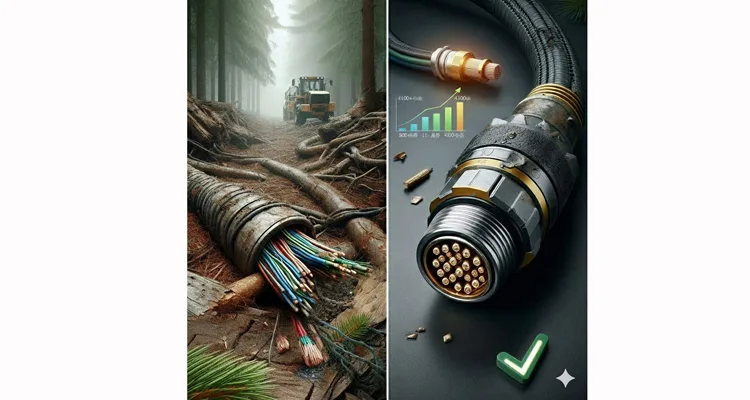
Last March, a wooden crate arrived at our failure analysis lab, its tarpaulin cover stained with the distinct reddish clay dust from a British Columbia logging site. Inside were seventeen failed wiring harnesses, each tagged with a service log entry. Nestled among the standard ISO 16750-3 certificates and material datasheets was a crumpled photocopy of a machine operator’s daily checklist. One line was circled in grease-pencil red: Grapple Hyd. Fault - Code 12 - 3rd time this week. Every harness had passed its qualification tests. Yet handling them left a tacky, particulate-laden residue on our gloves—a field-grade mixture of degraded pine resin, thermally broken-down ISO 46 hydraulic fluid, and fine silica grit that exists in no standard test report or chemical resistance datasheet.
The client’s engineering director later turned one connector in his hands, its backshell fracture pattern indicating brittle failure from cyclic stress. “We followed the specifications to the letter—high-flex cable, IP67 connectors, the drawings were perfect,” he stated. “So why did the first electrical fault occur at just 800 machine hours?” His frustration validated our fundamental premise: compliance standards are a necessary baseline, not a predictor of long-term reliability in punishing, real-world environments. We don’t test for a certificate; we investigate to diagnose the root-cause mechanism.
This fundamental disconnect—between passing qualification tests and achieving field reliability—is not unique to forestry machinery. It’s a central challenge in all custom cable engineering. We’ve documented the recurring patterns in Common Failure Points in Custom OBD-II Cable Assemblies: Bridging the Gap from “Passing Tests” to “Field Failure”.
Dissecting the Failure: Unpacking the Synergy
Forensic cross-sectioning of the returned assemblies revealed a problem that was multiplicative, not additive. The failure wasn’t caused by vibration or chemical attack operating independently. It was the result of their self-reinforcing, synergistic interplay—a cascading degradation timeline we could reconstruct.
The Vibration Signature: Capturing What the Standard Misses
Tri-axial accelerometers mounted directly on the boom pivot, turntable bearing, and main hydraulic valve block captured a profile radically different from the generic ISO 16750-3 “M” curve. The data revealed discrete high-G impact shocks. Each grapple closure event generated a sharp 25-30G spike (measured in the Z-axis), a transient energy pulse that traveled through the machine’s frame. This transformed the harness environment from one of “controlled random vibration” to enduring repeated mechanical hammer blows at each P-clamp mounting point, a loading condition most standard vibration tests completely omit.
This gap between standard test specifications and real-world vibrational assaults is a common and critical oversight. We explore this systemic issue in greater depth in our analysis: Beyond ISO 16750-3: When a Vibration Test Certificate Isn’t a Reliability Guarantee.
The Chemical Environment: A Proprietary, Hostile Cocktail
The exposure wasn’t to a single, datasheet-listed fluid. It was to a proprietary, field-sourced chemical mixture with synergistic effects:
- Hydraulic oil (ISO 46) operating at 70-80°C, undergoing thermal-oxidative degradation.
- Pine resin and sap, containing abietic acid and other terpenes with a natural pH of ~4.0.
- High-pH (9-10) pressure-washer detergents used for weekly clean-downs.
- Chloride-based road salts and de-icing agents prevalent in winter operations.
Immersion testing of the original thermoplastic elastomer (TPE) jacket material in this exact mixture at 80°C resulted in 8% volumetric swell within 48 hours. A swollen jacket, constrained under a fixed cable clamp, experiences extrusion and localized thinning, dramatically reducing its abrasion resistance and mechanical integrity.
The Failure Cascade: A Step-by-Step Degradation Timeline
Our metallurgical and polymer analysis defined the precise, sequential failure mechanism:
- High-pressure infiltration (1200 PSI washdown) forces the chemical cocktail into micro-gaps between the connector rear seal and the cable jacket.
- Sustained operational heat (~80°C) drastically accelerates chemical permeation, plasticizing the jacket polymer and reducing its elastic modulus by approximately 20%.
- In this softened, compromised state, the 30G grapple-shock impacts cause the cable to micro-abrade against adjacent welded seams and stamped bracket edges. Each impact plastically deforms and erodes jacket material.
- These newly created wear paths enable deeper chemical ingress to the conductor bundle. Abietic acid initiates intergranular corrosion on the outermost bare copper strands.
- This corrosion attack significantly lowers the copper’s fatigue limit. The ever-present machine vibration—now acting on embrittled, pre-damaged strands—causes rapid crack initiation and propagation leading to fracture.
The pivotal engineering insight: conducting vibration testing and chemical resistance testing in isolated, sequential protocols generates a dangerous false positive. It artificially severs this accelerating feedback loop. In actual service, these environmental stresses are concurrent and dynamically interactive.
Our Protocol: From Forensic Analysis to Engineered Validation
Phase 1: The Failure Autopsy & Capturing Real-World Field Data
Our process begins with physical evidence and machine telemetry, not assumptions. For this forestry case, our failure analysis protocol included:
- Cross-sectioning and microscopic examination (50x magnification) of failed terminations to map abrasion wear patterns and crack propagation paths.
- Energy-Dispersive X-Ray Spectroscopy (EDS) on internal connector deposits to identify elemental contaminants (e.g., Chlorine from salts, Silicon from grit).
- Scanning Electron Microscope (SEM) imaging of fractured copper strands to definitively differentiate ductile fatigue striations from the cleavage facets of brittle, corrosion-assisted cracking.
- 72-hour continuous tri-axial vibration data logging on the operational machine at the critical harness routing locations.
One quantifiable discovery was critical: 87% of all abrasion-induced failures originated within 150mm of a connector boot or a rigid clamp—a stress-concentration zone where the cable’s natural dynamic flex was fully constrained, converting vibration into reciprocal micro-motion (fretting).
This pattern of failure clustering near connection points is a universal phenomenon in cable assemblies under stress. A detailed, microscopic-level investigation into a similar failure mode can be found in our forensic report: The 3cm Fracture Zone: A Production Line Autopsy of OBD2 Cable Failures.
Phase 2: Engineering the “Worst-Case Day” Accelerated Test Profile
We abandoned generic test durations. Using the client’s actual duty cycle data, we calculated:
- Machine Operation: 14 hours/day, 5 days/week.
- Grapple Cycles: ~300/hour, yielding ~4,200 high-G shock events daily.
- Weekly chemical washdown exposure.
We architected a combined environmental test where all stressors interact in a physically realistic manner:
- Multi-Axis Vibration: A field-derived random vibration profile (PSD) with superimposed 30G shock pulses every 12 seconds to simulate grapple impacts.
- Aggressive Thermal Cycling: -25°C to +85°C, exceeding nominal specs to account for radiant heat loading from nearby hydraulic lines.
- Synchronized Chemical Exposure: A 4-hour immersion in the 70°C “forestry cocktail” phase, programmed to trigger at the peak of the thermal cycle and during periods of maximum vibration amplitude, replicating post-operation washdowns.
The key engineering differentiator was not merely running three chambers simultaneously. It was writing custom control logic so the vibration controller’s Power Spectral Density (PSD) amplitude scaled linearly with the chamber temperature, accurately modeling the field-observed reduction in polymer stiffness (lower elastic modulus) at elevated temperatures.
Phase 3: Iterative, Mechanism-Driven Design Modifications
The client’s baseline design failed at 372 hours in this coupled-stress test—corroborating the field data. We then systematically targeted each identified failure mechanism.
1. Jacket Material: Engineering a Custom Polymer Compound
- Maximum 5% volumetric swell after 1000 hours of immersion at 80°C.
- A stable, flat loss factor (tan δ) curve across the -25°C to +85°C range to ensure consistent damping performance regardless of ambient temperature.
The resulting thermoplastic polyurethane (TPU)-based compound was enhanced with molecular-scale hydrophobic modifiers and a uniform dispersion of sub-micron, ceramic reinforcing particles to maximize abrasion resistance.
2. Strategic, Localized Reinforcement at Stress Points
We implemented targeted mechanical armor at identified weak points:
- Extruded, woven-aramid sleeves (e.g., Kevlar®) over the primary jacket at every clamp and grommet location.
- A dual-durometer, overmolded “shoe” at the cable-to-connector junction, engineered to provide a graduated, low-stress bend radius transition.
- Laser-welded 316L stainless steel wear plates at three specific high-abrasion points meticulously identified from the field-failure samples.
3. Connector System: Designing for Real-World Sealing Challenges
The root failure was cable entry seal degradation, not the mated interface. Our redesign featured:
- A two-stage, bonded overmold: A primary soft silicone strain relief for flexibility, encapsulated by a secondary rigid polyamide shell for mechanical locking and integrated drip-loop geometry.
- Full gold-plated contacts (replacing standard tin plating) for superior corrosion resistance in the acidic (pine sap) environment.
- Full IP69K (100 bar, 80°C) validation to ensure integrity against high-pressure, high-temperature washdowns, moving beyond the static immersion test of IP67.
4. Dynamic Mounting: Energy Management Over Rigid Restraint
We replaced standard rigid P-clamps with a proprietary aluminum bracket incorporating a pre-loaded, tuned polyurethane damping element. This allowed a controlled 3mm deflection, which actively shifted the harness assembly’s first-order resonant frequency from a dangerous 12 Hz (aligned with engine idle vibrations) to above 25 Hz. This redesign dissipates vibrational energy as heat, rather than attempting to rigidly resist it.
The Validation: Quantifying the Reliability Improvement
The final engineered wiring system completed 4,100 hours of accelerated coupled-stress testing without a single conductor failure—representing an 11x improvement in demonstrated fatigue life over the baseline design.
Post-validation teardown analysis confirmed the efficacy of our mechanism-driven approach:
- Jacket wear was uniform and superficial, with no penetration to the primary insulation layer.
- Connector internal cavities remained completely clean and dry, with zero evidence of fluid ingress.
- Strands at crimp terminations exhibited only the expected, uniform metal fatigue morphology, entirely absent of the green copper chloride corrosion products prevalent in the original field returns.
Fifteen pilot units were deployed across the client’s North American operations. After 18 months of service (~3,500 machine hours), all units remained 100% functional. The client’s subsequent warranty claim rate for wiring-related faults decreased by 94%.
Five Forestry Wiring Misconceptions and Their Engineering Reality
Misconception 1: The IP67 Fallacy
IP67 certification validates protection against temporary static immersion. It does not account for the high-pressure (1200+ PSI), high-temperature spray of industrial pressure washers, which can force contaminants past static seals via hydrokinetic energy. For any externally mounted connector in forestry, the design baseline must be IP69K, coupled with validation of the seal’s compression set resistance after thermal aging.
Misconception 2: The High-Flex Illusion
A “10 million flex cycle” rating is typically derived from a controlled, back-and-forth bend-over-sheave test with a generous radius. It provides no data on resistance to impact abrasion against a sharp, welded structural edge—a common failure mode that can destroy such cable in under 500 hours on a delimber head.
Misconception 3: The Generic Vibration Profile
Forestry equipment vibration spectra are distinct: dominated by high-mass, low-frequency (8-15 Hz) energy from large displacement diesel engines, compounded by high-G, transient shocks from material handling. The standard automotive-derived ISO 16750-3 “M” profile lacks this specific content, potentially leaving dangerous resonant conditions in unsupported cable spans undetected during validation.
Misconception 4: The Incomplete Chemical Datasheet
Most polymer datasheet chemical resistance tables test against neat, standardized fluids like IRM 903 oil. Swelling, softening, and tensile strength loss in real-world chemical mixtures (e.g., oxidized oil + sap + detergent) can be 200-300% more severe, a critical data gap that is rarely filled by material suppliers. For equipment facing similar chemical exposure, see our guide for agricultural applications.
Misconception 5: The Lab-Fixture Blind Spot
Standard laboratory vibration fixtures often use soft, radiused clamps. In contrast, field cables contact sharp, stamped-metal edges, weld splatter, and as-cast surfaces. The validity of any vibration test is wholly dependent on the fixture replicating the exact hostile geometry, material hardness, and surface finish of the in-machine mounting environment.
How to Vet a Wiring System Supplier for Harsh Environments
Before approving any design, mandate that your supplier provides:
- A Detailed Failure Analysis (FA) Report from a previous, analogous application—not merely a summary test pass certificate.
- Physical Cutaway Samples from actual validation units that have completed testing, showing internal construction integrity.
- Documented Evidence (photos/video) that their test fixtures and mounting methods precisely replicate your specific clamp types, bracket materials, and routing angles.
- Chemical Compatibility Data generated using a sample of your actual operational fluid mixture, not just generic, standardized references.
- A Vibration Test Profile explicitly derived from data logged on your machine platform or a directly comparable surrogate.
Our methodology begins by cross-referencing a new application against our proprietary database of 200+ field-recorded machine vibration signatures, ensuring we initiate design with empirical application reality, not an off-the-shelf standard.
Engineering Principles, Applied Across Platforms
This forestry case study is not about a singular product. It demonstrates a repeatable engineering methodology. We have deployed this same forensic, coupled-stress philosophy to solve diverse challenges:
- Forwarder Articulation Joints: Replacing failure-prone flexible cables with a custom rotary electrical union incorporating integrated slip rings, thereby eliminating all flex cycles—a common source of conductor work-hardening and fracture.
- Harvester Head Controls: Implementing a positively pressurized, multi-chamber connector system that maintains a constant internal air pressure above ambient to actively exclude moisture and particulate contaminants.
- Processor CAN Networks: Utilizing double-shielded, individually twisted pair cabling with strategically positioned ferrite cores of specific impedance to suppress electromagnetic interference (EMI) from high-power variable-frequency drives (VFDs). For more on diagnosing network faults, see our guide on intermittent CAN bus failures.
Each solution shares the same core DNA: begin with empirical field data, validate with realistic coupled-stress testing, and design to directly defeat the identified root-cause failure mechanisms.
Frequently Asked Questions
Q1: What is the cost premium for an engineered solution?
A: The initial component cost typically ranges from 1.5x to 2.5x that of a standard, catalog-specified assembly. However, when analyzed through the lens of Total Cost of Ownership (TCO)—factoring in the prodigious cost of unplanned downtime (often exceeding $500 per machine hour), warranty labor, and logistics for remote-site repairs—the return on investment (ROI) is consistently realized within the first 6-12 months of operation. Understanding the true cost of custom cable is key.
Q2: Can this be retrofitted to existing equipment?
A: Yes, retrofit solutions are a common application. We recently executed a fleet-wide retrofit for 37 harvesters. The process involves 3D laser scanning the existing installation, engineering a direct drop-in replacement harness with enhanced durability features, and supplying custom installation jigs and calibrated torque specifications to ensure field technicians achieve consistent, reliable results.
Q3: What is the typical project timeline?
A: Initial Assessment & Proposal: 2-3 weeks. Detailed Design & Prototyping: 4-6 weeks. Validation Testing & Iteration: 3-4 weeks. Production Tooling & Fixturing: 6-8 weeks. For critical field-failure scenarios, we have streamlined this process to 8-10 weeks start-to-finish via parallel engineering execution paths.
Q4: Do you need our physical machine for testing?
A: Physical access for initial data logging is ideal for capturing the most accurate environmental profile. If unavailable, we can proceed effectively using your 3D CAD models, detailed maintenance records pinpointing failure locations, and samples of failed components. We maintain several common “problem zone” simulation rigs in our lab for initial development work.
Q5: What documentation is provided?
A: We deliver a complete Design History File (DHF) including: 3D models, 2D manufacturing drawings, a full Bill of Materials (BOM), Failure Mode and Effects Analysis (FMEA), a comprehensive Design Verification Plan & Report (DVP&R) with all test data, and detailed installation instructions. All documentation is structured to meet IATF 16949 and full PPAP (Production Part Approval Process) requirements.
Q6: How are global environmental regulations handled?
A: All materials are specified and sourced to comply with the regulations of your target market (e.g., EU REACH, RoHS; China RoHS). We maintain up-to-date material certifications and can provide full material disclosure (FMD) documents, supported by our ISO 14001 environmental management system. For the forestry solution discussed, all polymers and metals were RoHS-compliant and REACH-registered.
Q7: What is your manufacturing capacity for such custom solutions?
A: Our climate-controlled, 5S-managed production floor is optimized for low-to-mid volume, high-complexity electromechanical assemblies. Lead time for production quantities (typically 50-500 units) is 8-12 weeks after final design approval. We employ a Kanban inventory system for high-use components to mitigate supply chain delays.
Q8: How is quality controlled for custom designs?
A: We enforce a rigorous four-stage quality gate process: 1) Incoming Material Certification Verification, 2) In-Process Dimensional & Mechanical Checks (crimp height/compression, overmold dimensions, pull force), 3) 100% Electrical Function Testing (continuity, dielectric withstandhipot, insulation resistance), 4) Final Audit Against Golden Sample. For vibration-critical applications, we additionally perform statistical destructive testing on samples from each production lot. This discipline is critical, as the choice of crimp vs. solder can determine long-term reliability. For more on how work-hardening leads to fracture, you can read about the underlying fatigue (material) science.
Q9: How do you ensure your solution fits our existing machine design?
*A: We start with your 3D CAD models and/or 3D laser scanning of the existing harness to ensure a true drop-in replacement. Our design process is fully collaborative, with prototypes validated for form, fit, and function before tooling.*
Q10: What’s the lead time for a custom solution like this?
*A: From final design approval, production lead time is typically 8-12 weeks. We offer expedited paths for critical field-failure scenarios. For specific timeline planning based on your project complexity, contact our engineering team.
Q11: Do you offer ongoing support and spare parts?
A: Yes. We maintain full design records and can supply spare connectors, seals, or complete replacement harnesses for the entire lifecycle of your equipment, often with improved lead times due to existing tooling.
Conclusion: The Deliverable is Engineered Assurance
In the forestry sector, where machine uptime directly translates to revenue, a wiring failure is never a minor electrical nuisance. It triggers a costly chain reaction: unscheduled downtime, expedited logistics, and damage to operational reputation.
Our engineering philosophy inverts the conventional compliance model. We start with the premise that the operational environment will relentlessly exploit any design or material weakness. We then design, prototype, and validate under the combined, synergistic stresses that precipitate real-world failures. The ultimate deliverable is not merely a cable assembly; it is a comprehensive Durability Engineering Package—encompassing the root-cause failure analysis, application-specific validation data, and the engineered countermeasures—that tangibly reduces your long-term operational risk and total cost of ownership.
Discuss Your Specific Challenge
If your forestry or heavy equipment is experiencing recurrent wiring failures that standard, catalog components cannot resolve, we should discuss the underlying failure mechanism, not just the symptomatic fault.
Via WhatsApp: Send detailed images of your failed components, along with the machine model and operating hours at failure. Our engineers will provide preliminary failure mode observations within 24 hours. Message our engineering team on WhatsApp.
For OEM & Development Projects: Use our contact form to schedule a technical review. Share your CAD models, failure history, and performance targets for a preliminary durability assessment and a tailored test plan proposal. Submit detailed project specifications.
We specialize in solving durability and reliability problems for the world’s most demanding industrial environments. Bring us your most challenging application.
*Capability Note: 24 years of specialization in high-durability, mission-critical cable assemblies. IATF 16949:2016 certified with full PPAP documentation capability. In-house combined environmental testing laboratory (multi-axis vibration + thermal cycling + chemical exposure). Direct factory control from material compounding and selection through to final assembly. 5S-managed production with climate-controlled critical processes. Every solution is grounded in empirical field data and rigorous failure mechanism analysis. Our accelerated life testing methodologies are based on established engineering principles like the inverse power law.*
