

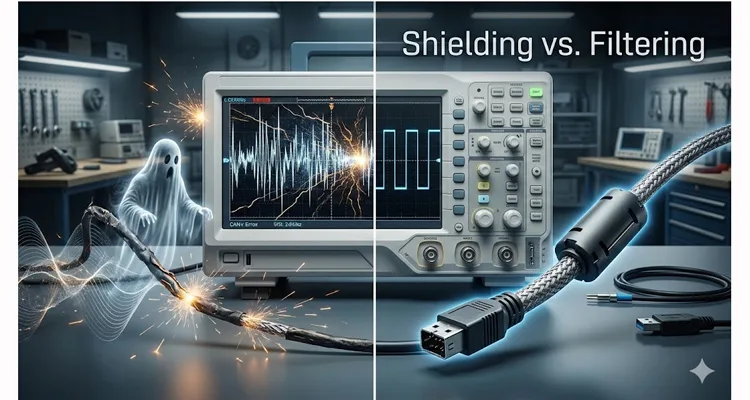
I spent last Thursday morning chasing a ghost.
A brand new automated guided vehicle (AGV) was dropping off the network every time its lifting mast activated. The team on site had already wrapped the CAN bus cable in enough copper foil to cover a small roof. They called it “heavy shielding.” It didn’t work. The bus still crashed.
They were ready to blame the cable manufacturer. (That’s us, by the way). But when I put a current probe on the line, the problem wasn’t external radiation getting in—it was common-mode noise generated by the motor drive getting out and destroying the differential signal.
This is the classic engineering trap I walk into on nearly every service call: confusing shielding with filtering. They are not interchangeable. In our IATF 16949-certified factory , we test both daily. Shielding is a passive barrier—a wall. Filtering is an active cleanse—a water treatment system. If you are designing or maintaining J1939 or CANopen networks in heavy equipment, automotive, or industrial controls, knowing when to deploy a ferrite core, a common-mode choke, or a shielded cable is the difference between a stable network and a service call at 2:00 AM. I’ve made that walk enough times.
For a deeper dive into how certification drives our zero-defect approach, see our article on IATF 16949 PPAP and the zero-defect cable process .
The Difference No One Talks About
Here’s how I explain it to new engineers on our shop floor during onboarding.
Shielding is an umbrella. It keeps the rain off your head. That rain is electrostatic fields, radio interference, radiated noise from nearby motors and VFD drives. The umbrella—our foil or tinned copper braid—deflects it.
Filtering is a towel. It dries you off after you’ve already walked through a puddle. That puddle is noise already on the wire—common-mode currents, power supply ripple, ground shifts from dirty DC/DC converters.
Most engineers reach for the umbrella because EMI is visible on the test report. (For a foundational understanding of EMI, the Wikipedia article on electromagnetic interference provides an excellent technical overview.) But in 20 years of building custom cable assemblies, I’ve learned that if your boots are already wet, you need the towel. You can’t shield what’s already inside the pipe.
For a comprehensive look at how we address EMI in the field, read our field guide to CAN bus EMI shielding .
The Root Cause: Differential vs. Common Mode
Think of CAN_H and CAN_L as two kids on a seesaw. When one goes up, the other goes down. The receiver only cares about the seesaw’s angle—not whether a bird lands on both ends at once. That’s differential signaling. Beautiful in theory.
Here’s where theory meets reality on the shop floor.
That bird represents noise. A spark from a relay. A PWM motor switching. A welder three bays over. It lands on both ends of the seesaw equally. CAN_H jumps. CAN_L jumps. The angle stays the same. The receiver should ignore it, right?
Wrong.
The receiver has a limit to how much bird weight it can handle. CAN transceivers have a common-mode voltage range (usually -2V to +7V for ISO 11898). Push past that limit—and the receiver throws its hands up. It shuts down to protect itself. You get Bus Off errors. The network stops. The machine stops. Your revenue stops.
- Shielding keeps the bird away from the seesaw entirely.
- Filtering with a common-mode choke catches the bird after it’s already landed.
If you’re dealing with intermittent CAN bus failures, our guide on how to diagnose intermittent CAN bus failures can help you identify the root cause faster.
A Step-by-Step Guide to Choosing the Right Weapon
I don’t believe in “best practices” without context. Here is my field guide, developed over two decades of OEM customization work.
Step 1: Identify the Frequency
| Noise Type | Where It Comes From | What Works |
| Low-frequency growl (below 1 MHz) | Alternator whine, relay chatter, 24V power dips | Ni-Zn ferrite bead, common-mode choke on power lines |
| High-frequency screech (above 10 MHz) | Radio towers, welders, VFDs, induction chargers | Full foil/braid shielding, 360-degree EMC clamp |
For real-world examples of VFD and welding interference, see our mining welding interference case study on J1939 shielding .
Step 2: Identify the Path
Is the noise coming from outside the harness?
Is your CAN cable zip-tied to a 440V motor cable? I see this daily in mobile equipment and EV battery packs. Use a shielded cable—specifically, our 110% coverage foil + tinned copper braid. The shield must be grounded properly. In our ISO 9001 facility, we terminate shields at one end only to avoid ground loops, unless your system design specifically requires multi-point grounding for high-frequency RF.
Is the noise coming from inside the system?
Are your own power supplies dirty? Is the DC/DC converter injecting noise onto the 24V line that feeds the ECU? The noise enters the CAN transceiver via the power pin. Here, shielding is useless. You need a common-mode choke on the CAN lines themselves. We integrate these into custom overmolded assemblies for legacy equipment retrofits.
For a deeper understanding of EMI sources in industrial environments, read our analysis of EMI sources: VFD and CANbus diagnostics .
Step 3: The Five-Second Field Test
Grab a clamp-on ferrite from your toolbox—the one that looks like a fat pill split in half. Open it, wrap the cable once, and snap it shut.
Now watch your error counter.
- If the errors disappear, you have common-mode noise. The ferrite core is killing it.
- If the errors persist, the noise is likely radiated into the bare wire, or the ferrite doesn’t have the right impedance for your frequency. Check the impedance curve—this matters more than most engineers realize.
5 Common Mistakes That Kill CAN Bus Reliability
I see these on almost every site visit. Write them down.
1. The Parts Bin Lottery
Slapping a random ferrite from the parts bin onto the cable. A ferrite for a USB cable (designed for ~500 MHz) does nothing for a 250 kbps J1939 network. You need to check the impedance curve and match it to your noise frequency. We learned this the hard way in our early days.
2. The Hum That Won’t Quit
In a facility with different ground potentials, grounding a shield at both ends creates a ground loop. Current flows through the shield, inducing noise into the inner conductors. Ground it at one point—usually the power source or the master ECU. Our REACH-compliant cables are designed for this.
3. The Twisted Pigtail Trap
Peeling back the shield, twisting it into a “pigtail,” and screwing it to a chassis. That pigtail is an inductor at high frequencies. It destroys the shield’s effectiveness. Use a 360-degree EMC clamp or a connector with a shielded backshell. All our UL-recognized assemblies use this method.
For an in-depth comparison of termination methods, see our guide on crimp vs. solder for vibration reliability and termination .
4. Impedance? What Impedance?
A filter changes the impedance of the line. If you add a common-mode choke with high inductance, it can interact with your 120-ohm termination resistors and cause reflections. Always verify signal quality after adding filters. We do this on every prototype in our climate-controlled warehouse.
5. Armored Tank, Paper Skin
A thick rubber jacket protects against abrasion, not EMC. A cable can be mechanically “armored” but electrically “naked” if it has no foil or braid. We test this in our 4-step quality inspection—visual, dimensional, electrical, and Hi-Pot.
For agricultural applications where both mechanical and electrical reliability matter, read the J1939 cable agriculture survival guide .
How to Verify Your Fix (Without Expensive Gear)
You don’t always need a $20,000 oscilloscope. Here is the “poor man’s” confirmation we use in the field.
The Eyeball Test
Walk the harness route like you’re inspecting a crime scene. Is the CAN cable separated from high-power cables by at least 6 inches (15cm)? I use the thumb rule—if you can’t fit your thumb between them, they’re too close. This is CAN bus filter vs shield troubleshooting 101.
The CAN Monitor Test
Run a CAN monitor tool (like PCAN-View) overnight. Compare the error frames before and after your fix. A drop from 1,000 errors/hour to 10 errors/hour is a success. We document this for every OEM customization project.
The Hand of God Test
Put one hand on the cable. Watch the error counter. If the screen lights up like a Christmas tree when you touch it, your body just became an antenna feeding noise into an ungrounded system. Congratulations—you’re the problem. Now fix your grounding. This is why our shielded cables use proper drain wire termination.
For a systematic approach to hardening your diagnostic chain, review our OEM engineer checklist for EMI-hardened diagnostic cables .
The Right Tools for the Right Job
After 20 years in this factory, we’ve learned that guessing doesn’t work. We build cables for specific threats. Here’s how we match the tool to the problem.
For High-Radiated Environments (Inverter Drives, EV Battery Packs)
You need our Ultra-Flex Shielded CAN Bus Cable . It features a 110% tinned copper braid shield. It doesn’t just block noise; it absorbs it and drains it to ground efficiently. We test this against ISO 7637-2 for transient conduction.
For extreme vibration environments, consider the J1939 ArmorLink vibration-validated cable assembly .
For Installed Noise (Retrofit, Dirty Power, Legacy Equipment)
If you can’t reroute the harness, you need filtering. We offer custom overmolded cable assemblies with integrated common-mode chokes inside the connector housing. It filters the noise right at the transceiver pin, where it matters most. This is ideal for retrofit applications.
For Unpredictable Environments (Mobile Equipment)
Combine both. A shielded cable with a ferrite core snapped onto the cable near the ECU. This gives you the barrier and the filter in one go. We can pre-install ferrites based on your specific frequency needs (OEM spec). This is standard for mobile equipment and AGV applications.
For harsh port environments where salt spray and humidity compound EMI issues, read our analysis of port environment cable failure and transfer impedance .
*Need a custom solution? We can integrate ferrites, customize cable lengths, and select the exact foil/braid combination for your J1939 or CANopen application. Send us your drawing.*
Frequently Asked Questions (The Real Answers)
Q1: Will a ferrite core fix my “Bus Off” errors?
A: It can, but only if the error is caused by common-mode noise. If the error is caused by voltage drops (low power) or a broken wire, a ferrite will do nothing. We see this confusion daily. For a deeper dive, see our guide to cold weld and vibration arbitration .
Q2: Should I use a ferrite on both ends of the cable?
A: Usually, one is enough, placed near the source of the noise or near the receiver. Putting them on both ends is rarely harmful, but can add unnecessary cost and bulk. Our OEM customization clients often specify single-end placement.
Q3: My cable is shielded. Why do I still have noise?
A: 99% of the time, it’s the termination. Your shield is not connected to ground, or it’s connected via a long pigtail. Check your connector backshells. This is why our IATF 16949 process mandates 360-degree EMC clamps.
Q4: Can I use a common-mode choke on a 500kbps CAN bus?
A: Yes, but you must select a choke designed for high-speed CAN. Some chokes have too much capacitance and will round off your square wave edges, closing the eye diagram. We test this in our lab.
Q5: What is the difference between a ferrite bead and a common-mode choke?
A: A ferrite bead is a single-component filter that adds impedance to the line. A common-mode choke is a transformer-based filter that specifically targets currents flowing in the same direction on both wires (common mode) while ignoring differential signals. Both have their place in CAN bus filter vs shield strategy.
Q6: Does the length of the cable affect shielding requirements?
A: Absolutely. Any cable longer than 1/20th of the noise wavelength acts as an efficient antenna. The longer the run, the more critical shielding becomes. This is why we offer custom lengths with consistent foil/braid coverage.
Q7: Do you offer cables with built-in ferrites?
A: Yes. We can overmold or clamp ferrites to the cable during assembly based on your OEM specifications or our engineering recommendations. This is part of our custom cable assemblies service. Learn more about the true cost of custom cables .
Q8: Can a shield cause a ground loop?
A: Yes. If the shield is connected to ground at both ends and there is a difference in ground potential, current will flow in the shield. This is why we usually recommend single-point grounding for audio/control frequencies. Our engineering team can advise on your specific application.
Q9: What is “Ferrite Saturation”?
A: If you run too much DC current through a ferrite, it can saturate magnetically and stop working. For CAN bus (low current), this is rarely an issue. For power lines, it is critical. We select materials accordingly in our ISO 9001 facility. The Wikipedia article on ferrite cores provides additional technical background on saturation and material selection.
Q10: Why do my errors only happen when it rains?
A: Moisture changes the dielectric properties of the cable insulation and can create leakage paths to ground. You likely have a micro-fracture in the cable or a connector seal has failed. Shielding won’t fix a wet connector; potting or better IP ratings will. For a forensic approach to this problem, read our guide to reefer wiring harness failure analysis .
Let’s Solve Your Noise Problem
We don’t just sell cables. We build solutions for electromagnetic compatibility. Whether you need a specific ferrite installed, a custom braided shield, or a complete harness redesign for your next AGV or heavy truck project, let’s talk.
Skip the trial and error. Send us your drawings or tell us about the noise symptoms. We’ll recommend the exact combination of shielding and filtering based on 20 years of factory experience.
For ELD compliance issues related to cable integrity, see our guide to J1939 cable ELD compliance and audit failure analysis .
ISO 9001 | IATF 16949 | 20+ Years Factory Experience | OEM Customization: Length, Color, AWG, Connectors, and Ferrite Integration | RoHS | CE | UL | REACH | 4-Step Quality Inspection | 5S Management | Climate-Controlled Warehouse
