

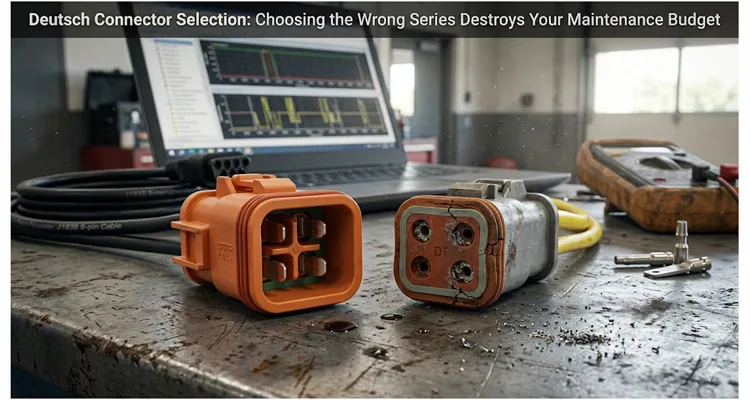
If you’ve ever stood in front of a panel at 2 a.m., wrestling with an intermittent electrical fault that’s been haunting your fleet for weeks, you know the feeling all too well. That sinking moment when you finally pull apart a Deutsch connector and realize it’s the wrong series for the application. Not broken. Not defective. Just the wrong tool for the environment it lives in. And you’re the one who approved the bill of materials eighteen months ago.
I’ve stood in that exact spot more times than I’d care to admit. Across more than two decades of building wire harnesses and delivering connector solutions into heavy equipment, agricultural machinery, and commercial vehicle fleets, I’ve seen the long arc of what happens when Deutsch connector selection goes sideways—when a DT series connector gets dropped into a spot that demanded a DTP connector, or when an HD10 finds its way into an engine bay that really needed the bulk and contact mass of an HD30. The upfront savings vanish. What remains is a maintenance budget line item that swells silently, quarter after quarter, until someone finally asks why the operating cost keeps drifting upward.
This isn’t a connector catalog walkthrough. I’m not going to recite every Deutsch series against a feature matrix. What I will do is map out exactly how a seemingly minor series mismatch metastasizes into genuine, trackable maintenance costs—expenses that compound year over year, multiplied across dozens or hundreds of units. If you’re accountable for specifying connectors for production runs, fleet maintenance, or custom harness builds, this is the conversation we ought to have had before the first purchase order was signed.
Table of Contents
The Moment You Realize You Chose Wrong
What Makes Deutsch Series Different—and Why It Matters More Than You Think
The Maintenance Cost Equation: How a $0.50 Decision Becomes a $500 Problem
Three Real-World Scenarios (and What They Cost)
An Engineer’s Checklist for Getting the Series Selection Right
Common Mistakes That Cost You Later
How to Verify You’ve Made the Right Call
When Custom Harness Support Actually Saves Money
FAQ: Questions I Get from Engineers Every Week
The Moment You Realize You Chose Wrong
The pattern usually reveals itself long before anyone consciously connects the dots—and that’s precisely what makes it so dangerous to your maintenance budget. A piece of equipment that rolls back into the service bay more frequently than its identical siblings. A technician who begins stashing a spare connector in the truck, “just in case.” A warranty claim that gets flagged for a closer look.
I recall one particular instance: a manufacturer of compact street sweepers had standardized on DT series 4-pin connectors for a vibration-heavy sensor harness. The DT series connector is a proven workhorse—I’ve written it into hundreds of applications myself. Yet in this specific location, subjected to constant high-frequency vibration and the occasional power-wash at 1800 psi, those DT connectors were eating through interface seals roughly every six to eight months. Nothing catastrophic. Nothing that triggered a recall. Just enough to generate a steady stream of field service calls, replacement harness shipments, and unplanned technician hours.
The true culprit wasn’t the DT connector itself. It was the absence of the right questions during design. What’s the actual vibration profile? Which cleaning chemicals will contact this connector? How many mate/unmate cycles will accumulate over five years? A DT-XT with its revised seal compression, or an HD10 with a different sealing geometry, would have fundamentally altered the maintenance profile.
These are the moments this article addresses. The decisions captured in a CAD file or a BOM spreadsheet that no one revisits until the service records begin telling an expensive story.
What Makes Deutsch Series Different—and Why It Matters More Than You Think
Before we tally costs, we need to confront a point that’s buried in too many spec sheets—and it’s the single biggest reason fleet maintenance costs spiral out of control. Deutsch series are not merely “different sizes” of the identical connector concept. They are engineered around fundamentally distinct operating envelopes. And the tidy figures on a datasheet don’t always translate to what actually occurs when you attach that component to a machine destined to be abused for the next five years.
DT Series: The Workbench, Not the Answer Key
The DT series functions as the industry’s workbench. When an engineer calls and can’t provide a vibration profile or a cleaning spec, I’ll often steer them toward a DT series connector based purely on statistical likelihood of survival. The glass-filled PBT housing doesn’t mind getting splashed with diesel, though I’ve learned to keep an eye on the seal interface if DEF is in the mix. It’s a 13-amp playground.
But here’s what the glossy brochures omit: that 13A rating presumes a clean, cool interface with a textbook crimp. If you’re loading those Size 16 contacts with 20 AWG wire inside an engine bay at 105°F ambient, you’ve already surrendered roughly 15% of that headroom before the key turns. That’s before vibration even begins working on the contact interface.
One area where the DT genuinely shines—and a detail that receives far too little attention—is that the interface seal is replaceable. It isn’t bonded to the housing. When it degrades—and all seals eventually do—you can swap the seal in the field without discarding the entire connector body. That’s a design feature with direct maintenance budget impact.
DTM Series: Smaller, and Less Forgiving
The DTM series borrows the same sealing concept but packs size 20 contacts into a tighter envelope. The current rating falls to approximately 7.5A continuous. These are intended for space-constrained applications where signal integrity outweighs power delivery—ECU connections, sensor harnesses, diagnostic interfaces.
The recurring mistake I witness: engineers specify DTM because “it fits better,” then push 8A through it intermittently and puzzle over why the contact resistance drifts upward after a handful of thermal cycles. That’s not a connector failure. That’s a specification failure. The contact spring inside a DTM simply lacks the mass to shed that kind of heat over time.
DTP Series: When the Amps Demand Respect
If there’s one series mismatch that quietly destroys maintenance budgets, it’s running DT where DTP belongs. The DTP series moves up to size 12 contacts. These are built for the thermal load that accompanies genuine power transmission. If you’re operating anywhere near the DT’s ceiling, or if your “intermittent” load stays at peak for more than a few seconds, you belong inside a DTP housing. The wedge lock on a DTP takes noticeably more thumb pressure to seat—that extra engagement depth is what keeps the contact aligned when the housing starts heat-soaking. And the contact mass supplies thermal margin that directly extends service intervals.
HD10 vs. HD30: Cylindrical but Worlds Apart
The HD10 series consists of the round bodies you encounter on diagnostic ports and compact circular applications. They’re offered with 3 to 9 cavities and accommodate a mix of contact sizes. Dependable, widely adopted, and the industry standard for SAE J1939 diagnostic connections. If you’ve ever wrestled with an unreliable diagnostic session on a Freightliner Cascadia or a John Deere tractor, you already grasp why the 9-pin Deutsch connector diagnostic fix carries weight—and why economizing on the HD10 diagnostic connector at the diagnostic interface is shortsighted.
The HD30 series is the larger, heavier-duty counterpart, with contacts capable of handling up to 50A. These are what you call out for genuine power distribution—engine interfaces, main power feeds, high-current accessory circuits. Attempting to save space by shoehorning an HD10 into a location that demands an HD30 doesn’t save anything. It merely postpones a failure.
The Sealing Reality Nobody Talks About
IEC 60529 establishes what IP68 and IP69K signify in a laboratory context. But the field reality is different: IP68 handles a puddle or a flood. IP69K is built for a hot water pressure washer at close quarters. IP68 seals will wick moisture if you catch them at a 45-degree angle with 1500 psi. IP69K employs an altered rib geometry on the seal—the DT-XT and DTSK series—that sustains compression under conditions that would defeat a standard DT seal.
I’ve watched connectors that were “IP68 on paper” succumb within two seasons on equipment that underwent steam-cleaning at shift’s end. The spec sheet wasn’t inaccurate. It just didn’t convey the full story. That’s the granularity that distinguishes a five-year maintenance budget from a three-year one. If your fleet sees pressure washing at the end of every shift, an IP69K sealed connector isn’t an upgrade—it’s non-negotiable.
The Maintenance Cost Equation: How a $0.50 Decision Becomes a $500 Problem
Let’s assign real numbers to what “wrong connector” signifies financially—because until you see it on a spreadsheet, it’s easy to dismiss as someone else’s problem. I’ve assembled these figures from actual field data across numerous fleets, and the pattern holds up remarkably well. If you’d like to run your own calculations, our diagnostic downtime cost calculator guide follows the same methodology I rely on when auditing fleet maintenance budgets.
Direct Failure Costs
When a connector fails, someone must remedy it. The replacement part itself may run $8 to $35, influenced by the series and pin count. That isn’t the costly portion.
The technician time is where the figures escalate. Pinpointing an intermittent connection consumes far more time than swapping out a visibly failed component. At $85 to $150 per hour fully burdened, a two-hour diagnostic and replacement visit translates to $170 to $300 in labor alone.
Now extend that across the units deployed. A fleet of 50 pieces of equipment, each logging one avoidable connector-related service call annually: that’s $8,500 to $15,000 in yearly maintenance labor that simply never needed to occur.
Indirect Costs: Where the Budget Actually Bleeds
The cost of the component is the invoice amount. The cost of the failure is the burden rate of the asset. I’ve witnessed a single temperamental DTM on a GPS receiver stall a $500-per-hour grading operation for 45 minutes while the technician cleaned dielectric grease from a connector that should never have required it.
That’s not a connector issue. That’s a line-item migration from “Capital Expense” to “Operational Expense” that no one formally approved. When you amplify that across a fleet of rental telehandlers where the operator has little incentive to preserve the seal because it isn’t his machine—that’s when the budget silently hemorrhages, quarter after quarter.
Equipment that’s idle isn’t producing revenue. A street sweeper that misses its morning route. A combine parked during harvest. A service truck unable to answer calls. The hourly downtime cost fluctuates by application, but it never lands at zero.
Then there’s the damage that’s tougher to measure: fleet managers who lose faith in your equipment. Buyers who recall which manufacturer’s machines spent extra time in the service bay. Warranty reserves that expand to absorb predictable yet unaddressed failure patterns.
The Field Serviceability Factor
Here’s a question I pose to every engineer during selection: When this fails five years from now, how does my technician repair it?
If the answer includes a soldering iron and heat shrink applied in the field, you’ve already lost.
Deutsch DT products are designed to be serviceable. The interface seal is replaceable rather than permanently bonded to the housing. A degraded seal can be exchanged in minutes for a few dollars, instead of requiring cutting and re-crimping an entire harness segment. The contact removal tools remain standardized across DT, DTM, and DTP families, so a single tool investment addresses the majority of the connector portfolio.
This is the type of design decision that never surfaces in a unit-cost comparison yet dominates the maintenance budget across the life of the equipment.
Three Real-World Scenarios (and What They Cost)
These are not hypothetical exercises. They’re pulled from actual projects where I’ve either participated in the initial specification or been summoned to help manage the consequences. Each one represents a maintenance budget impact that could have been avoided with better Deutsch connector selection upfront.
Scenario 1: The Construction Fleet That Ran DT Where DTP Belonged
A rental fleet operator had standardized on DT 2-pin connectors for all auxiliary lighting connections spanning 200+ pieces of equipment—excavators, skid steers, telehandlers. The reasoning was sound: a single connector type across the fleet reduced SKUs in the parts room and streamlined technician training.
What escaped notice: several of the LED light bars were drawing 12A continuously, pressing against the DT’s rated ceiling. On mild days, no issue. On 95°F days with the engine bay heat-soaked, contact resistance began climbing. Connectors weren’t melting—they were simply degrading at an accelerated pace.
The cost: Over three years, the fleet logged roughly 14 connector-related failures per month during summer months. Each failure required a technician to drive to a job site, replace the connector, and document the repair. At roughly $95 per incident fully loaded, that equates to $1,330 per summer month, or approximately $5,300 annually in avoidable maintenance costs—attributable solely to lighting connectors.
The fix: Migrating the affected circuits to DTP 2-pin connectors with size 12 contacts rated for 25A continuous. Same pin count, comparable footprint, marginally larger housing. The parts cost differential was under $1.80 per connector at volume. The annual maintenance spend on those circuits fell to near zero.
Scenario 2: The Agricultural Equipment That Couldn’t Handle Power Washing
An OEM producing precision planting equipment had called out standard DT connectors throughout the chassis harness. The equipment operated in fields—dust, fertilizer residue, crop debris—and received thorough pressure-washing at each season’s end. This is the exact environment we detailed in our J1939 cable agriculture survival guide—aggressive washdown cycles paired with chemical exposure demand a fundamentally different sealing approach.
The standard DT seals, though IP68 rated, were not the IP69K-rated variants engineered for high-pressure washdown. Water ingress wasn’t instantaneous, but it accumulated. By year three, connectors exhibited internal corrosion and intermittent signal loss on vital seed monitoring sensors.
The cost: The warranty claims on these harnesses crested in year three, with certain units needing complete harness replacement. A harness that cost $42 to manufacture was triggering $380 in replacement parts and labor—plus the immeasurable cost of a farmer who could no longer rely on his planting data during the narrow spring planting window.
The fix: DT-XT series connectors with IP69K rating and J2030 power-wash test validation. The per-unit cost increase was roughly $0.90. The warranty claims declined by over 70% the subsequent year.
Scenario 3: The Diagnostic Port That Needed HD10
A manufacturer of off-highway equipment had deployed a generic 6-pin connector for J1939 diagnostic access—something that physically fit and was “sealed enough.” Over time, technicians noted that certain diagnostic tools couldn’t sustain stable communication, and some ports displayed signs of corrosion after only a few seasons. This is precisely the failure mechanism we examined in our heavy duty diagnostics 9-pin connector $3,500 mistake analysis—the diagnostic port is the one connector that undergoes hundreds of mate/unmate cycles over the machine’s lifespan.
HD10 series connectors represent the industry standard for diagnostic applications. The distinction extends beyond sealing—it encompasses contact design, plating thickness, and mating cycle durability. When you’re managing J1939 Type 1 vs Type 2 adapters and cables, the integrity of that HD10 diagnostic connector dictates whether your diagnostic session consumes five minutes or forty-five. And if you’re operating in cramped engine compartments where a straight connector won’t clear the frame rail, a solution like a J1939 90-degree right-angle cable with Deutsch DT connectors becomes essential—but only if the underlying connector series is appropriately rated for the environment it inhabits.
The cost: Difficult to measure precisely, but consider: a technician unable to retrieve diagnostic codes due to an unstable connection wastes time swapping cables, restarting the diagnostic tool, or—worst of all—misdiagnosing the underlying issue. At fleet scale, that’s genuine money lost in squandered diagnostic hours.
The fix: Transition to a genuine HD10 6-pin connector configured for J1939. The per-unit cost difference was less than $4. The diagnostic reliability complaints vanished.
An Engineer’s Checklist for Getting the Series Selection Right
Here’s how I approach series selection when I’m specifying connectors for a new harness build or auditing an existing BOM. This isn’t a marketing exercise. It’s the actual workflow I follow—and it’s saved more than one fleet maintenance budget from slow-bleeding over the years.
1. Define the Electrical Envelope—With Margin
Don’t settle for nominal current draw. Investigate:
- What’s the peak current, even if transient?
- What’s the ambient temperature where this connector will reside?
- How significantly does contact resistance shift as temperature climbs?
- Is there any inductive load generating voltage spikes?
I apply an 80% rule on current rating as a personal floor. But that’s just a number on a screen. The genuine inquiry is: What occurs to that contact spring after it heat-soaks for 8 hours? If the answer is “I don’t know,” then move up to DTP. The cost difference in the housing is less than the fuel for the service truck dispatched to address it once.
2. Map the Mechanical Environment
- Vibration profile: What frequencies and amplitudes will this connector endure over its service life?
- Mate/unmate cycles: Is this a permanent connection or does it experience regular disconnection?
- Space constraints: Can the larger housing of a DTP or HD30 physically accommodate the installation?
- Strain relief: Will the harness encounter pulling or twisting forces at the connector?
If your application involves persistent vibration—envision mining equipment or construction machinery—you must consider beyond the connector body alone. Our J1939 ArmorLink vibration-validated cable assembly case study illustrates what happens when you manage the entire interconnect as a system rather than merely selecting a part number.And before you assume a vibration test certificate guarantees field survival, it’s worth understanding where ISO 16750-3 falls short of real-world operating conditions.
3. Assess the Chemical and Cleaning Exposure
- Which cleaning agents contact this connector? Pressure washer? Steam cleaner?
- Is there exposure to hydraulic fluid, diesel, DEF, fertilizer, road salt?
- UV exposure: Does this connector face direct sunlight for years?
If pressure washing forms part of the maintenance routine, IP69K-rated choices like DT-XT or DTSK become non-negotiable.
4. Plan for Serviceability
Revisit the question I raised earlier: When this fails, how does someone repair it?
Deutsch connectors employ crimp-style terminations. Contacts are fabricated from 98% pure copper and plated with either nickel or gold. The contact removal tools remain standardized across DT, DTM, and DTP families. A single tool investment addresses most of the connector portfolio.
5. Validate the Sealing Requirements
Not all “sealed” connectors are sealed equally. IP68 indicates dust-tight construction and protection against continuous immersion—but immersion depth, duration, and pressure are critical variables.
For applications facing high-pressure washdown, the DT-XT series with IP69K and J2030 power-wash test validation represents the appropriate specification. You can actually detect the difference when mating them—it’s a firmer, more decisive click as the seal compresses against the housing wall.
Common Mistakes That Cost You Later
This is where I observe competent engineers stumble—not from ignorance, but because the failure mode is subtle and requires years to manifest. Here are five that recur most often in my post-incident discussions, each one a direct line to unnecessary fleet maintenance costs.
Mistake 1: Using Current Rating as the Only Differentiator
Current rating is significant, but it isn’t the complete narrative. A DT series connector operating at 10A within a clean, climate-controlled enclosure will outlast a DTP running at 15A in a vibrating engine bay with chemical exposure. The environment dictates the series as forcefully as the amps do.
Mistake 2: Assuming All Deutsch Seals Are Interchangeable
DT, DTM, and DTP share comparable sealing concepts, yet the seals themselves are series-specific. Attempting to use a DT wedge lock in a DTM housing won’t function correctly. Ordering an incorrect seal kit for field repairs strands the technician—or worse, invites an attempt to “make it work” that compromises the seal.
Mistake 3: Mixing Contact Sizes Within a Connector Without Understanding the Implications
Certain Deutsch connector bodies accommodate multiple contact sizes. The HD10 series, for instance, can accept size 4, 12, or 16 contacts within the same housing. This offers considerable flexibility—but it also demands that you’re deliberate about which cavity receives which contact size and how that influences wire routing and current distribution.
Mistake 4: Ignoring the Wedge Lock
The wedge lock is not decorative. It’s the component that guarantees contacts remain seated and correctly aligned. An absent or improperly seated wedge lock can produce intermittent connections that are exceptionally challenging to pinpoint. These are frequently misattributed to sensor failures or ECU problems when the underlying cause is a $0.30 piece of plastic that wasn’t fully engaged.
Mistake 5: Specifying the Wrong Plating for the Application
Nickel plating serves as the baseline for most power and control applications. Gold plating delivers superior corrosion resistance and reduced contact resistance for low-voltage signal circuits. Specifying nickel in a gold-appropriate application yields elevated contact resistance and possible signal degradation over time. This is a nuanced error that surfaces gradually, making it difficult to trace back to the initial specification.
How to Verify You’ve Made the Right Call
After you’ve settled on a series selection, here’s how I validate it before committing to production quantities:
- Build a small test batch. Not a single unit. At least 10 to 20 samples, constructed with the precise wire gauge, crimp tooling, and sealing process intended for production.
- Subject them to accelerated life testing. If the application experiences temperature cycling, cycle the test samples through the projected range. If it encounters vibration, mount them on a shaker table. If it faces washdown, apply the actual pressure washer that will be used in the field.
- Measure contact resistance before and after. A connector that begins at 2 milliohms and climbs to 8 milliohms post-testing isn’t “failing”—but it’s signaling what will unfold over years of field operation. This is the identical principle we employ in our J1939 voltage drop field test methodology—small resistance changes compound into significant issues.
- Inspect the seals. Disassemble samples after testing and examine for any evidence of moisture ingress, seal deformation, or contact movement. If you observe any, your series selection or assembly process requires adjustment.
- Talk to the people who will actually maintain this equipment. This step is omitted far too frequently. Spend an hour with a field service technician and ask: “What complicates your job when you have to address these?” The responses will guide series selection in ways no spec sheet can.
These steps won’t eliminate all risk, but they surface the failure modes that would otherwise emerge after hundreds or thousands of units have entered the field.
When Custom Harness Support Actually Saves Money
This is the point where the discussion transitions from “which connector do I purchase” to “how do I execute this correctly at scale.”
At our facility, we’ve invested over 20 years manufacturing cable assemblies and wire harnesses for heavy equipment, automotive diagnostics, and industrial automation. We’re not a distributor—we’re the factory that produces what you specify, precisely as you require it.
What does that translate to in practical terms?
- OEM customization: Logo, branding, exact wire lengths, custom AWG configurations, color coding aligned with your existing fleet documentation. We fabricate to your drawing, your specifications, your standards.
- Factory-direct quality controls: We operate under ISO 9001:2015 and ISO 14001:2015 certified management systems, with comprehensive IATF 16949:2016 automotive quality certification across our production lines. RoHS, CE, UL, and REACH compliance is standard. Every assembly undergoes four-step quality inspection before leaving the floor, managed within a 5S framework with climate-controlled warehousing for raw materials and finished goods.
- Engineering support during specification: If you’re uncertain whether DT, DTM, DTP, HD10, or HD30 suits your specific application, we can examine the electrical requirements, environmental conditions, and serviceability needs together—before you commit to a production run.
- No retail noise: Our website does not list prices or inventory counts. We’re a B2B manufacturing partner, not an online store. The conversation begins with your requirements, not with what’s sitting on a shelf.
The connectors themselves—the DT, the DTM, the DTP, the HD series—are available from numerous sources. What’s far scarcer is a manufacturing partner who comprehends the downstream maintenance implications of series selection and produces harnesses that endure years of real-world use.
That’s the distinction between purchasing connectors and solving problems.
FAQ: Questions I Get from Engineers Every Week
Q: Can I sneak 22 AWG wire into a Size 16 contact if I double it over?
Technically, you can. I’ve witnessed it performed. And I’ve observed the field failure roughly 18 months afterward, when vibration fractures the doubled-over segment right at the crimp wing because it transformed into a rigid stress riser. Employ the correct barrel size. If you’re adapting downward from 22 AWG, install a reducing splice prior to the connector body. It’s cleaner and doesn’t return on warranty.
Q: What’s the real-world difference between IP68 and IP69K?
IP68 addresses a puddle or a flood. IP69K addresses a hot water pressure washer at close range. The field distinction is that IP68 seals will wick moisture if contacted at a 45-degree angle with 1500 psi. IP69K (such as the DT-XT) employs an altered rib geometry on the seal. You can discern the difference during mating—it’s a firmer, more decisive click as the seal compresses against the housing wall. If your equipment receives a wash at each shift’s conclusion, the 68 will eventually disappoint.
Q: How do I know if I need gold-plated contacts instead of nickel?
If you’re managing sensors with millivolt-level outputs—consider thermocouples, precision pressure transducers, any scenario where a few additional milliohms of contact resistance alters the measurement—select gold. The oxide layer on nickel can introduce sufficient variation to disrupt a sensitive circuit. For power and control circuits, nickel suffices and costs less.
Q: Can I mix Amphenol AT Series with Deutsch DT in the same fleet?
Yes, they’re intermateable. The housings and seals share dimensional compatibility. From a maintenance standpoint, this proves helpful in a pinch. Yet for production consistency, choose one manufacturer and adhere to it. Minor differences in plastic compound and seal durometer can produce subtle aging variations, and standardization eliminates that variable.
Q: What crimp tool do I actually need for Deutsch contacts?
Deutsch contacts demand a dedicated 4-indent or 8-indent crimp tool, varying by contact size. I’ve pulled apart crimps made with generic pliers that showed visible gaps under 20x magnification—air gets in, oxidation starts, and six months later you’re chasing a 2-ohm resistance drift that mimics a failing sensor. A standard automotive terminal crimper will not yield a gas-tight crimp. I’ve traced more “connector failures” to inadequate crimps than to any other single factor. The proper tooling represents an investment in long-term reliability.
Q: How many mate/unmate cycles can a Deutsch DT connector handle before the seal gives out?
Deutsch DT connectors are generally rated for 50 to 100 mate/unmate cycles under standard conditions. If your application entails daily disconnection, you’ll surpass that threshold within months. For frequent-cycle applications, consider a connector engineered for elevated cycle counts, or modify the connection strategy—perhaps a bulkhead connector that remains mated while a separate service loop accommodates the movement.
Q: Does UV exposure actually damage these connectors?
Yes, over time. Deutsch thermoplastic housings are UV-stabilized, yet extended direct sunlight will eventually degrade any polymer. The housing will begin to chalk, become brittle, and forfeit some of its mechanical integrity. For connectors destined to endure years of direct sunlight without covers or enclosures, incorporate UV inspection into your maintenance schedule or add supplementary physical shielding.
Q: What wire gauge works with DT series size 16 contacts?
The nominal span is 14-20 AWG. However, there’s nuance: a 20 AWG wire inside a size 16 contact barrel leaves considerable void space that must be correctly crimped to achieve gas-tight compression. If your wire lies at the thin extreme of the range, devote extra attention to crimp quality and contemplate a reducing adapter or a smaller contact size if your current requirements permit.
Q: Can Deutsch connectors be used underwater continuously?
Deutsch connectors bearing IP68 or IP69K ratings are safeguarded against immersion and high-pressure washdown, but they are not intended for continuous underwater operation. Prolonged submersion, particularly at depth with fluctuating pressure, may eventually undermine seals through wicking along the wire insulation. For genuinely submersible applications, engage engineering for application-specific solutions.
Q: What’s the most common field failure you see that has nothing to do with the connector itself?
Crimp quality. A correctly specified Deutsch connector assembled with improper crimp tooling or technique will fail irrespective of how effectively the connector is sealed. I’ve observed entire harnesses replaced because of an inadequate crimp that was incorrectly diagnosed as a connector body failure. The connector is only as dependable as the termination.
Key Takeaways for Fleet and Design Engineers
- DT connectors can handle 13A on paper, but ambient heat and vibration can erode 15% of that headroom before you start the engine.
- IP68 and IP69K are not interchangeable in the field—if your equipment sees a pressure washer at shift end, standard DT seals will eventually wick moisture.
- The diagnostic port (HD10) is the only connector that gets mated hundreds of times over the machine’s life—skimping here guarantees wasted diagnostic hours.
- A $1.80 per-unit cost difference between DT and DTP translates to thousands in avoided service calls when scaled across a fleet.
- Always ask: “When this fails five years from now, how does my technician fix it?” If the answer involves a soldering iron, you’ve already lost.
Let’s Talk About Your Specific Application
Here’s the bottom line after twenty years of watching maintenance budgets bleed from series mismatches: the right Deutsch connector selection isn’t about picking a part number off a shelf. It’s about understanding the operating envelope your equipment actually lives in—not the one the spec sheet assumes.
The central message of this article is that connector selection is not a one-size-fits-all determination. What functions perfectly in a clean, low-vibration indoor application may not survive on a piece of construction equipment subjected to daily pressure washing and 100°F temperature swings.
If you’re specifying connectors for a new product development initiative, overseeing fleet maintenance across dozens or hundreds of units, or procuring custom wire harnesses for OEM production, we can assist in securing the series selection before it transforms into a budget line item.
We’re a direct factory with over 20 years of experience, certified to ISO 9001:2015, ISO 14001:2015 and IATF 16949:2016 standards. We provide OEM customization covering logo, branding, length, color, and AWG specifications. Our quality control encompasses 4-step inspection, 5S production management, and 100% testing on every assembly.
Engineering support forms the core of what we deliver. Whether you require a few hundred harnesses for a pilot run or sustained production quantities, the dialogue begins with your requirements, not with a catalog page.
- WhatsApp: Chat with Linda on WhatsApp for technical questions or to explore your application
- Contact Page: Submit your requirements through our contact form for comprehensive engineering support
No pricing. No inventory. Simply an engineering conversation about what you’re constructing and how we can help you construct it correctly—the first time.
This article reflects real-world experience with Deutsch connector applications across heavy equipment, agricultural machinery, and commercial vehicle fleets. Specifications referenced derive from current TE Connectivity Deutsch product documentation as of 2026. Always confirm specific ratings and certifications against official manufacturer datasheets for your precise part numbers and application conditions.
