

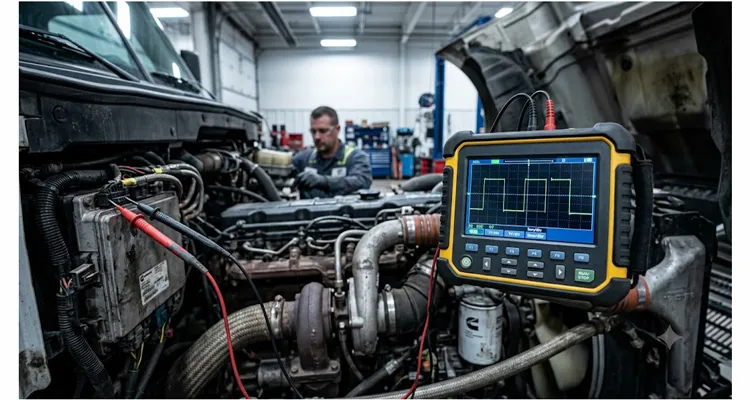
I remember a call from a fleet manager in Ohio three winters ago. His shop had a 2017 Freightliner Cascadia with a sporadic crank-no-start. No codes, no MIL, and the thing would fire up perfectly every time they towed it into the warm shop. Two different mobile techs had thrown a cam sensor, a crank sensor, and a full set of batteries at it. The bill was north of four thousand dollars in parts and labor, and the truck still stranded a driver the following Tuesday in ten-degree weather.
The root cause? A camshaft sensor signal that collapsed by forty-two percent only when the block temperature dropped below fifteen degrees Fahrenheit — a sag that lasted nine milliseconds, invisible to the ECU’s rationality checks and completely invisible to a generic scan tool. The shop didn’t own a scope. They had to borrow mine. That one capture took twenty minutes and cost zero dollars in parts.
Failures like this aren’t edge cases. They’re the steady background hum of any heavy-duty fleet operation. The question I’ve been asked a hundred times since that call is the same one we’ll unpack here: Do you actually need an oscilloscope in your shop, or is it an expensive box that gathers dust next to the A/C machine?
Here’s the straight answer, the one you won’t find in a catalog: For a shop that only handles scheduled services, brake jobs, and component swaps on trucks still under warranty, probably not. But if your bays handle trucks that only misbehave under specific conditions — cold-soak no-starts, aftertreatment derates without a solid fault code, or network dropouts that vanish the moment the sun hits the chassis — and any kind of “the light comes on but only when it’s raining on a Thursday” complaint more than twice a month, then a scope changes the math completely. Let me walk through why, using failure data pulled directly from shop tickets — not marketing bullet points.
The Real Difference Between a Scan Tool and a Scope
A scan tool reports the ECU’s best guess after filtering and time-averaging the raw input. The scope reveals the 9-millisecond voltage sag that occurred while the scan tool was still refreshing the live data PID. These two tools aren’t answering the same question.
On a modern heavy-duty truck, the ECU never evaluates raw voltage directly — it polls the sensor, runs an analog-to-digital conversion, applies software filtering, and only triggers a fault when the processed value breaches a pre-programmed threshold for longer than a calibrated debounce period. If the event falls outside that narrow window, you get silence. No code. No pending code. No freeze frame.
A scope bypasses that entire software chain. You’re inspecting the physical signal: amplitude, rise time, noise, dropout, phase relationship. This matters because a substantial share of real-world failures show up as waveform distortion that never matures into a DTC.
Example: A DEF tank level sensor on a Cummins X15 that reads correctly at key-on but drops to implausible values during high-speed slosh conditions. The ECU sees the level mismatch and derates the engine, but often logs a generic “SCR efficiency” fault, not a sensor circuit fault. A scope connected to the sensor output during a road test shows the erratic switching that confirms a mechanical float issue, not a dosing problem. Without the scope, a tech may replace the DEF doser — a two-thousand-dollar component — and the truck returns three days later with the same complaint.
What a Scan Tool Can and Cannot D
| Capability | Scan Tool | Oscilloscope |
| Read DTCs, freeze frame, live data PID | Yes | No (unless combined with a logic analyzer) |
| Detect intermittent power/ground drops under 50ms | No | Yes |
| Visualize CAN bus signal integrity (reflections, noise, incorrect termination) | No | Yes |
| Measure inrush current on a sticking EGR valve actuator | Yes (with current clamp) | |
| Confirm a CKP/CMP correlation offset | No (only final value) | Yes (can overlay channels) |
| Check alternator diode ripple | No | Yes |
If the fault is a hard failure — a sensor stuck at 0 volts, a short to ground that’s always present — a multimeter and a scan tool will find it. Scopes earn their keep when the fault is dynamic, temperature-dependent, vibration-dependent, or timing-related.
When a Scope Pays for Itself: A Cost-Benefit Framework
I’m not going to quote you a scope price. Prices shift, and the exact number isn’t the point. The point is whether the investment returns to the business in reduced diagnostic time, fewer misdiagnosed parts, and less vehicle downtime. Let’s think in terms of hours and parts cannons.
Scenario A: Intermittent Aftertreatment Fault, No Codes
A medium-duty fleet shop I worked with runs twenty-eight International MV trucks. Over a six-month period, they had seven instances of a truck entering derate with no active fault code, only a historical “SCR operator inducement” entry. Their protocol was: inspect DEF quality, check doser, perform a forced regen, and if no obvious fault, clear codes and release the truck. Average diagnostic time: 3.5 hours. The truck stayed fixed about forty percent of the time.
They added a four-channel oscilloscope. The next time a truck presented with the same symptom, the tech back-probed the DEF tank temperature sensor, doser nozzle heater current, and NOx sensor signal. He found that the DEF tank temperature sensor would momentarily read 178 degrees Fahrenheit for 300 milliseconds during a cold start — a physical impossibility when the ambient temperature was forty degrees. It was a whisker of conductive debris floating inside the sensor housing, making intermittent contact. The scan tool never showed it because the value didn’t persist long enough to update the PID display at a typical refresh rate.
That capture took under an hour. The sensor replacement cost is negligible compared to a doser. Multiply that by seven events, and the scope had already justified its existence in reduced diagnostic hours and avoided parts costs across half a year. And that’s just one failure mode.
Scenario B: CAN Bus Physical Layer Issues
Modern trucks have multiple CAN networks. A fault on the J1939 backbone — the SAE-defined standard that governs most heavy-duty onboard communication — can manifest as ghost codes, gauge dropouts, or intermittent communication failures affecting the transmission ECU, aftertreatment controller, or ABS. A scan tool will tell you “Lost communication with transmission ECU” — it won’t tell you why.
A scope with a math function can measure differential CAN voltage and reveal a node that’s pulling the bus to a recessive state, a corroded splice pack that introduces resistance only when the chassis flexes, or a termination resistor that’s drifted to seventy-eight ohms instead of sixty. I’ve seen this exact drift pattern on a hot-soaked truck where a J1939 termination resistance shift from heat turned a sixty-ohm backbone into an erratic seventy-eight ohms — and the scan tool never flagged it. Without a scope, a technician might spend a full shift wiggling harnesses and hope to catch a change on a multimeter. I’ve seen shops swap entire cab harnesses over CAN issues — a job that can eat up four or five thousand dollars in parts and twenty-plus hours of labor — when the real problem was a corroded three-way splice buried in the frame rail. If you want a deeper look at how something as small as a 0.3V ground shift can cascade into a nine-thousand-dollar misdiagnosis, I’ve documented it here.
The True Cost of a Misdiagnosis in a Fleet Context
The cost isn’t just the part. It’s:
- The technician’s hours wasted chasing a ghost.
- The part that can’t be returned once installed.
- The truck down for an extra day or two.
- The tow bill if it fails on the road.
- The cascading effect on dispatch and customer commitments.
When you add those up, even a single avoided misdiagnosis per quarter can make the case. I’ve consistently seen shops over a certain size reach a tipping point where not having a scope is more expensive than having one.
Step-by-Step: Setting Up a Scope for a Heavy-Duty Sensor Test
I want to walk through a real test you’d do, because it’s in the physical setup that a lot of people make mistakes that corrupt their waveforms — and those mistakes often trace back to the leads and adapters they use.
What you’re testing: Camshaft position sensor, Hall-effect type, three wires: power (5V or 12V reference), ground, signal.
Tools needed:
- 4-channel oscilloscope, 100 MHz minimum bandwidth (50 MHz is borderline for catching fast glitches on CAN or high-resolution crank sensors, but works for most sensor tests).
- Back-probing pins or a breakout harness.
- Shielded BNC-to-probe-tip test leads.
- Optional: DC current clamp for actuator tests.
Setup procedure:
- Identify the circuit type. Don’t guess. Pull the wiring diagram from the OEM service information. Hall-effect sensors switch between high and low states; a scope on the signal wire should show a clean square wave, not a sine wave or a ragged mess.
- Back-probe, never pierce. Piercing a wire’s insulation with a needle probe damages the jacket and invites moisture wicking, which leads to green death corrosion months later. Use quality back-probing pins or invest in vehicle-specific breakout harnesses.
- Use the correct ground reference. Clip your probe’s ground lead to the sensor ground wire at the ECU pin or as close to the sensor as possible, not to chassis ground somewhere convenient. A ground offset between sensor and chassis can introduce a false waveform shift that looks like a fault — exactly the trap that common-mode voltage diagnostics are designed to catch. I’ve seen this mistake eat up two hours of a good tech’s time.
- Set timebase and voltage scale appropriately. For a cam sensor at idle, you might set 2 volts/division and 10 milliseconds/division, then adjust. Trigger on the rising edge.
- Capture and inspect. A healthy Hall-effect cam sensor should show a flat, level high state, a sharp vertical transition, and a flat low state — no rounding, no overshoot, no intermediate voltage steps. If you see a step in the transition, you could have a high-resistance ground or a sensor starting to fail internally.
The Hidden Variable: Test Leads and Signal Integrity
Here’s something few people talk about but anyone who uses a scope daily knows intimately: your test lead assembly is a critical part of the measurement system. A poorly shielded, high-capacitance lead on a high-impedance circuit can filter out the very glitch you’re trying to catch. Conversely, an unshielded lead draped across an engine harness can pick up ignition noise that looks like a sensor fault. I’ve even traced a “phantom” CAN error to nothing more than a twelve-percent mismatch in cable pair symmetry — a story for another day, but the numbers are here.
I’ve learned the hard way that not all shielded cable is the same. A scope probe I used early in my career had a jacket that turned brittle inside six months because the insulation compound wasn’t formulated for engine-bay heat cycles. That’s why, when we set up our own production line, we didn’t just specify plastic — we qualified it under the same standard that Tier-1 suppliers use for wiring harnesses (IATF 16949), and we test aging performance in a chamber that simulates ten years of thermal cycling. Every cable still gets a full signal integrity sweep on a reference scope. There’s no batch testing; it’s one at a time. The certifications — ISO 9001, ISO 14001, RoHS, REACH — are simply the documentation that the engineering discipline already demands. When we produce a custom BNC-to-OBD breakout or a sensor back-probe kit for an engineering team or a diagnostic tool provider, every assembly goes through that same process. It’s not exotic; it’s basic engineering discipline, but you’d be surprised how rare it is off the shelf.
Common Mistakes Shops Make When They First Get a Scope
- Believing every anomaly is a fault. A waveform that looks “noisy” on a 5 mV/div scale may be perfectly normal electromagnetic interference from the alternator. You need to learn what a healthy signal looks like on each vehicle. Build a reference library.
- The missing DC current clamp lesson. I once watched a tech spend ninety minutes trying to prove a sticking EGR valve by tapping it with a screwdriver while watching the position PID. A clamp on the actuator power feed showed an 8-amp inrush that decayed too slowly. We had the answer in five minutes. If your scope kit doesn’t include at least one DC current clamp, you’re leaving the fastest path to the root cause on the shelf.
- Trusting the “Auto” button. The auto-setup can scale a cam sensor signal and hide a 50-millisecond dropout because it averages the display. I’ve seen a colleague waste an afternoon trusting the default view when the fault was right there at a faster timebase. Learn what the circuit should do, then set the scope manually.
- Forgetting to zero the current clamp and degauss it periodically. Residual magnetism gives you a DC offset that can look like a parasitic draw or an incorrect actuator current.
- Connecting to the wrong bus pin on a CAN test. J1939 uses pins C and D on a 9-pin Deutsch connector. But not all trucks use that connector, and sometimes you need to test the private CAN between ECU and aftertreatment module that runs on different pins. If you’re unsure about connector types, a quick reference like this Deutsch DT and HD series guide can save hours of head-scratching. Wiring diagram, always.
How to Confirm a Repair Was Actually Successful
A code that doesn’t come back after clearing doesn’t guarantee a fix. For an intermittent fault, you need to recreate the conditions that triggered it. If the fault occurred at a specific engine temperature, road speed, or vibration frequency, reproduce those exact conditions while monitoring the repaired circuit with the scope. A fixed waveform will sit within the known-good envelope through the entire operating range.
For example, after replacing that temperature-sensitive cam sensor I mentioned at the beginning, I insisted the fleet run the truck overnight in the cold, then capture the signal during the first crank of the morning while the scope was set to single-shot trigger mode. The waveform was textbook-clean. Only then did we close the repair. Without that confirmation, you’re guessing.
FAQ: Oscilloscopes in the Heavy-Duty Shop
Q1: Do I need a four-channel scope, or will a two-channel work?
For most sensor and circuit diagnostics, two channels are enough. But for CAN bus work (CAN H and CAN L simultaneously) plus a trigger, or for checking cam/crank correlation, four channels let you see the whole picture at once. If you can stretch to a four-channel oscilloscope, do it.
Q2: What bandwidth is sufficient for heavy-duty diagnostics?
A 100 MHz scope is the practical sweet spot. It covers CAN FD (which can have faster edges than classical CAN), high-resolution digital sensors, and any noise you need to characterize. A 20 MHz or 50 MHz scope will work for basic sensor checks but may miss sharp transients — exactly the kind we track when chasing a CAN bus glitch at faster edges.
Q3: Can I use a USB-based PC scope?
Yes, many are excellent and have deep memory and good software. The main disadvantage is that a laptop on a roll-around cart in a busy truck bay is vulnerable to dirt, grease, and battery issues. Ruggedized tablet-based scopes or dedicated handhelds are more practical in a fleet environment.
Q4: How much training does a tech need to be useful with a scope?
A competent technician who understands basic electricity and can read a wiring diagram can be capturing useful waveforms after a one-day hands-on course, provided they have good reference waveforms to compare against. The learning curve isn’t the scope itself; it’s developing the mental library of known-good versus known-bad patterns.
Q5: What’s the first thing I should scope if I suspect a J1939 issue?
Measure DC voltage on CAN H and CAN L with a multimeter first: should be roughly 2.7V and 2.3V respectively. Then scope both lines together, looking for the classic differential waveform. Pay attention to the recessive voltage level and check for rounding or steps on transitions. A methodical approach like the one in this J1939 physical layer troubleshooting guide can cut diagnostic time dramatically.
Q6: Is there a risk of damaging the scope on a 24-volt heavy-duty system?
Most scopes can handle inputs up to 300V with 10x probes. But always check the probe rating. Use 10x attenuation probes, and be mindful of voltage spikes from solenoids and injectors. Some techs use differential probes for extra protection and floating measurements.
Q7: We have twelve trucks. Is renting a scope once in a while actually cheaper than owning one?
Renting makes sense for very small fleets. But once you’re running more than ten or twelve trucks and doing in-depth diagnostics, the friction of renting — waiting for delivery, not having it on a Saturday afternoon when a truck is down — often outweighs the ownership cost over a couple of years. It’s an availability equation.
Q8: What’s the one thing that ruins scope measurements even before you hook up the probes?
A low-quality connection to the circuit. You can have the most expensive scope on the market, but if you’re using cheap back-probing leads or a worn breakout harness, the data is suspect. The cables and adapters are not an afterthought — they’re the foundation.
Q9: Can a scope diagnose DEF quality sensor problems?
Yes, you can capture the PWM or SENT protocol signal from the DEF quality sensor and decode the concentration and temperature values directly, comparing them against scan tool PIDs to verify sensor integrity.
Q10: How do I store and organize waveform captures?
Save them to USB or network storage with a consistent naming convention: unit number, date, circuit tested, condition (e.g., “Unit 4215_20260215_CKP_cold_start_known_good”). Build a reference database. It saves hours on future diag.
The Right Tool for the Right Job — and the Right Support
Whether you eventually add a scope to your shop floor depends on the failure patterns you actually face. I’ve known fleet managers who run fifty trucks with minimal electrical issues and never need one. I’ve known others with fifteen vocational trucks operating in wet, corrosive environments where a scope becomes as essential as a socket set.
What I can tell you from two decades of working with engineering teams, diagnostic equipment manufacturers, and fleet maintenance operations is this: the quality of the physical connection between your test equipment and the vehicle is never a detail. It dictates whether you capture a genuine fault or chase a phantom noise. After twenty years on the floor, the rule is simple — prove the insulation can survive a decade of thermal shock, run every assembly across a reference scope, and keep the data. The plaques on the wall — IATF 16949, ISO 9001, ISO 14001 — are just the paperwork that proves we actually follow that rule. And because we own our factory and manage the floor under 5S discipline with climate control, the OEM-customized cable you get today behaves the same as the one you’ll get three years from now.
If your team is developing a diagnostic tool kit, building an engineering test bench, or needs OEM-customized cables with your own branding, specific lengths, colors, and AWG configurations, that’s what we’ve done for over twenty years. No minimum order quantity theatrics — just a direct conversation with an engineer who understands what you’re trying to measure, at what frequency, in what environment.
You can reach us through the Contact Page or send a message directly on WhatsApp. There’s an actual person on the other end who can discuss signal integrity, connector options, and what AWG you need for a 10-meter run without dropping your signal. No bots, no sales scripts — just engineering support.
Deciding on an oscilloscope is really about deciding how precise you need to be. If you’re comfortable with occasional diagnostic ambiguity and the occasional parts swap that doesn’t fix the problem, you can operate without one. But if you want to know, definitively, what a circuit is doing when it misbehaves — and you want to stop throwing parts at problems you haven’t actually seen — then a scope changes everything. And once you have it, make sure the cables between that scope and the vehicle don’t lie to you. Because the smartest tool on a bad connection is just an expensive guessing machine.
