

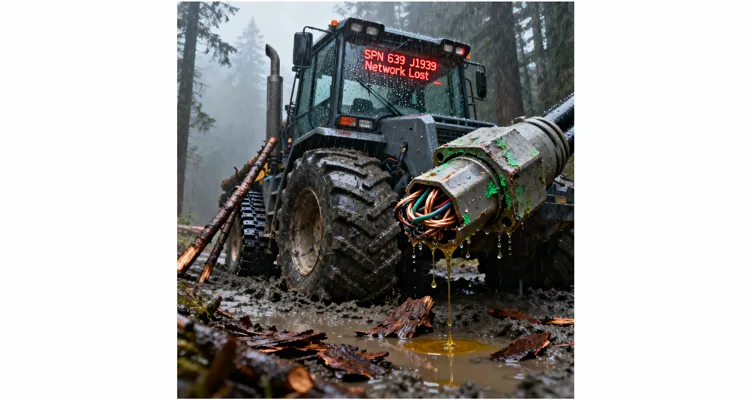
It’s two in the morning somewhere in the Pacific Northwest, and a forwarder has gone dark on the stump. The operator cycles the key three times. Nothing. The control display flashes SPN 639 — J1939 network lost. Rain is hammering the cab roof, the ground is sucking at the tires, and a full bunk of logs is stuck mid-slope. Nobody needs a sales pitch at two in the morning. They need to know why the machine’s nervous system just died, and how to make sure it doesn’t happen again tomorrow.
This isn’t a white paper — it’s what we tell a logging contractor who’s losing money on the stump. After more than twenty years of pulling failed forestry harnesses out of the woods, we’ve catalogued the environmental failure modes that actually kill J1939 communication on logging equipment. And we’ve developed harness protection strategies that hold up under choker chains, slash, hydraulic oil, and the kind of cold that makes wire insulation snap like a cracker.
Where J1939 faults show up first in forestry iron
After two decades of tearing apart failed harnesses, we can tell you: most J1939 communication faults in forestry equipment don’t originate inside a controller. They hatch in the places nobody checks until the machine is dead.
Articulated steering knuckles
A feller buncher or a wheeled harvester pivots several hundred times a day. Inside that center joint, the J1939 backbone is twisted, pulled, and compressed every single cycle. We’ve seen a CAN high wire that measured 60 ohms at rest jump to 6,000 ohms the moment the machine swung right — because a terminal had backed halfway out of its Deutsch connector. The harness jacket looked fine. The problem was invisible until the motion exposed it.
The boom belly and knuckle area
On stroke delimbers, processors, and harvesters, the main harness rides up the boom where it gets pinched between steel plates, bathed in bar oil, and pelted by bark shrapnel. When a wire chafes through its insulation and moisture wicks inside, the J1939 signal doesn’t always disappear. It gets intermittent. That’s worse. Intermittent faults send fault codes that self-clear, log “ghost” events, and chew up diagnostic hours.
Harness runs near the diesel particulate filter or regeneration zone
Modern Tier 4 forestry machines run hot. Harness legs that pass within six inches of an active DPF can see ambient temperatures above 260°F when the machine is doing a park regen on a dry slash site. Standard PVC jacket begins to plasticize and shrink back from connector seals at around 195°F sustained. After one fire season, you end up with exposed pins and a green film of corrosion starting.
Washdown and condensation traps
Every logging crew has a pressure washer, and sooner or later it finds the one connector that wasn’t mated with a solid click. We’ve sectioned backbone connectors that looked weather-tight externally but had standing water inside because the rear wire seal had been pierced during factory assembly. Combine that with freeze-thaw cycles in northern latitudes and you get cracked terminal bodies and galvanic corrosion that eats a pin in one winter.
The floor pan and operator entry point
Mud, snow, and calcium chloride road mix get tracked into the cab. Over time, the floor harness connectors can sit in a permanent soup of brine. We once root-caused a random SPN 625 (proprietary engine comm loss) that only happened after the operator scraped his boots on the floor plate — the vibration was just enough to short two partially corroded pins inside a weathered 12-pin Metri-Pack. The harness never threw a consistent fault because the short depended on mechanical movement.
The physics of why “a good harness” still fails
Forestry electrical faults rarely come from one big event. They accumulate, and J1939 twisted-pair backbones are uniquely sensitive to small impedance changes that plain power circuits would shrug off.
Inside every forestry machine, the J1939 backbone is just a twisted pair — CAN high, CAN low — ticking at 250 kbps on older iron, 500 kbps on newer. At each physical end of the bus, a 120-ohm terminating resistor sits there to stop the signals from bouncing around like a rock in a steel drum. When we put a meter across the two wires with everything else unplugged, we want 60 ohms. Not 59.6, not 60.3 — 60. If you get 120, you’re missing a terminator. If you get open loop, your backbone has a break somewhere. Once a connection corrodes, or moisture provides an alternate path to ground, the differential impedance shifts outside the controller’s bit timing tolerance, and you start seeing error frames. Enough error frames, and a node goes bus-off.
The environmental stressors that shift impedance aren’t always visible, but they all leave a signature if you know what to look for:
- Vibration fretting doesn’t look like much — just a dark dust on the pin — but that dust is tin oxide, and it pushes a terminal’s contact resistance into the hundreds of ohms.
- Moisture wicking inside copper stranding doesn’t short the circuit; it adds capacitance between CAN high and low, rounding off the square edges the transceiver needs to read bits. We’ve seen moisture travel six feet inside a wire strand and turn a clean bus into a flurry of error frames.
- Chemical swelling of connector seals — from diesel, lube, or degreaser — makes them gummy and swollen, leaving a micron-wide path for humidity to bridge two adjacent pins. Pop a seal off a delimber that spent a season in diesel mist and you’ll see it.We documented a full case study on conquering the dual challenge of extreme vibration and chemical corrosion in forestry machinery, where a standard harness lasted less than four hundred hours before the J1939 bus went silent.
- Thermal cycling loosens crimp zones. A crimp that feels rock-solid on a spring morning can relax after a winter of deep cold, losing 15 percent of its mechanical grip because copper and the terminal barrel never shrink at the same speed. This is exactly why J1939 termination resistance drifts between a cold start and a hot regen, and it’s a failure we screen for on every forestry harness build.
The fix isn’t to buy a “better” harness and hope. It’s to engineer out each failure vector with a deliberate strategy.
Five protection strategies we bake into every harness we build for logging equipment
I’m going to walk you through the approach the same way our line engineers do when a logging OEM sends us a failure analysis report and says, “Make this stop.”
1. Route for motion, not for assembly convenience
The easiest harness to install is often the first one to fail. On articulated machines, the harness crossing the hitch must include a service loop with a defined bend radius — we use no less than eight times the cable outer diameter — and the loop must be oriented so that the natural machine motion tightens the bend gently, never reverse-bends it. A reverse bend fatigue-cracks copper strands inside the jacket without leaving a mark on the insulation.
Where the harness transitions from the chassis to the boom, we specify a high-flex wire construction with a minimum 19-strand (for 18 AWG) count per conductor and a thermoplastic elastomer (TPE) jacket. This combination withstands the constant rolling flex better than standard SAE J1128 thin-wall PVC.
2. Water doesn’t get in; condensation gets out
2. Water doesn’t get in; condensation gets out
3. Mechanical armor that breathes
Split loom and convoluted tubing are fine for protecting against light abrasion inside a cab, but they’re a liability when hydraulic oil drips onto them. Polypropylene split loom absorbs oil, swells, and traps grit against the wire insulation. We’ve moved to a polyester monofilament braided sleeving for boom sections: it’s open-weave so it doesn’t trap liquids, highly abrasion-resistant, and it won’t shrink when the DPF runs a regen.
At pinch points — where a harness passes between a frame rail and a guard — we add a stainless steel spring guard in short sections. It’s rigid enough to prevent crushing but flexible enough not to fatigue.
4. Crimp-and-weld terminals in high-vibration zones
Standard open-barrel crimps are sufficient for sheltered areas, but on the engine block, near the harvester head, or anywhere the harness sees 10G+ vibration peaks, we ultrasonically weld the terminal to the wire after crimping. This eliminates fretting corrosion at the contact interface. The difference in long-term resistance stability is dramatic: an ultrasonic weld holds within two percent of its initial resistance after 10,000 vibration cycles, whereas a crimp-only terminal can drift by forty percent or more once oxidation sets in.
Is it overkill? For a pickup truck, maybe. For a stroke delimber that shakes the operator’s teeth out for ten hours a day, it’s the only way the bus stays quiet.
5. Positive locking for every connector that moves
Any connector that an operator or mechanic can reach — and will unplug for service — needs a positive locking mechanism beyond friction. We standardize on connectors with a secondary lock piece (such as a wedge lock or CPA) that requires a deliberate action to disengage. When that secondary lock is bright orange and contrasts with the connector body, it also acts as a visual “fully seated” indicator during assembly.
After servicing, a quick walk-around with a flashlight is enough to spot an unlatched secondary lock. That alone prevents the number one post-service fault we see: a partially mated connector that loses contact on the first bounce over a stump.
The five most common mistakes contractors make — and what they cost
| Mistake | What happens | What to do instead |
| Strip-and-crimp butt splice with a wrap of electrical tape | You’ve just put an impedance speed bump in the middle of a high-speed data highway. The bus may work at idle, but under vibration that splice becomes a tiny antenna, and moisture rides the wick of the tape within days. We’ve metered one of these field repairs and watched the differential voltage collapse the moment the boom moved. | Use a sealed Deutsch or Ampseal repair connector with proper 120-ohm termination if you shorten the bus, or replace the entire harness segment. |
| Replacing one terminating resistor with the wrong value | A 90-ohm or 150-ohm resistor shifts the differential voltage levels, causing marginal bit sampling. | Always check the resistor color code: J1939 requires 120 ohms, 1% tolerance, 0.5W minimum, across CAN high and low at each end. |
| Routing a replacement harness too tight | A tight harness transmits vibration directly to the connector pins and accelerates fretting. | Leave at least a two-inch service loop with gradual bends at every connector interface. |
| Ignoring wire gauge when extending a backbone | Doubling the length with 20 AWG where 18 AWG was specified adds enough voltage drop to degrade dominant-state differential voltage at the far node. | For backbone extensions over 1.5 feet, use 18 AWG or heavier and verify you still measure 60 ohms ±10% between CAN H and CAN L with all modules disconnected. |
| Not logging error frames after a repair | The machine works, so you call it fixed. But the node may be re-transmitting and recovering, masking a weak connection. | Plug in a J1939 diagnostic interface and monitor the “RxErr” and “TxErr” counters for each node under load. A healthy node should show zero error increments over a complete duty cycle. |
How to confirm a harness fix actually took
How to confirm a harness fix actually took
- Static resistance check
I always start with the diagnostic connector because it’s the one place I can reach without pulling floor plates. Battery disconnected, every ECU unplugged — meter across pins C and D. 60 ohms means the two terminators are still talking to each other. If I see 120, a terminator is either missing or hiding inside a module someone swapped last month. Open circuit? The backbone has a cut or a connector that’s backed out so far it might as well be cut. - Hi-pot test on new or repaired segments
Apply 500 VDC between each conductor and its neighbors, and between conductors and shield. Any leakage current above 1 milliamp at commissioning tells you there’s moisture or a nicked insulation that will become a failure later. - Dynamic network health under load
Reconnect everything, start the machine, and run it through the full articulating range, full boom movement, and a stationary DPF regen if applicable. With a CAN bus analyzer on the diagnostic port, watch the bus load and error counts. On a 250 kbps network, bus load should stay below 60% in worst-case conditions; error counts should hold at zero. Any spikes when the boom hits a hard stop hint at a marginal connection flexing. - Dynamic network health under load
Reconnect everything, start the machine, and run it through the full articulating range, full boom movement, and a stationary DPF regen if applicable. With a CAN bus analyzer on the diagnostic port, watch the bus load and error counts. On a 250 kbps network, bus load should stay below 60% in worst-case conditions; error counts should hold at zero. Any spikes when the boom hits a hard stop hint at a marginal connection flexing.
If it passes those four, the harness isn’t the next thing that will fail. And that’s really what you want: the confidence to focus on production, not on dash lights.
When you’ve had enough of patchwork, we build harnesses that match the punishment
If your local dealer’s replacement harness lasted exactly one season before you got SPN 639 again, the harness was never designed for your ground conditions. It was a generic part built to a cost target, not to a life expectancy in a slash-filled bog.
When a logging contractor sends us a harness that’s been failing after one season, we don’t just copy the old one. We look at it like a post-mortem: where did the water get in, where did the insulation chafe, where did the terminal relax. Then we build a replacement that fixes each of those failure points, inside a factory floor that stays at a steady temperature and humidity level all year — because crimp tolerances don’t forgive a hot, sweaty shop. Every finished assembly gets a hipot, an impedance sweep, and a dimensional check before it leaves. We cut, strip, crimp, weld, and test under one roof, with a four-stage quality gate: incoming material verification, in-process continuity, finished-assembly hipot and impedance check, and a final cosmetic and dimensional audit.
Our standard materials comply with RoHS, CE, UL, and REACH requirements. Our manufacturing operates under an ISO 9001 / IATF 16949 quality system, and our environmental management is certified to ISO 14001. We can build to your existing drawing, or we can reverse-engineer a failed sample and propose improvements — thicker jackets, better seals, flex-rated conductors, anti-abrasion sleeving — based on what actually killed the old one.
You get to choose the details: wire gauge, length, jacket color, connector brand, custom labeling, and even your logo laser-etched on the sleeving. No minimum order that forces you into inventory you don’t need. No catalog pricing sheet. Just an engineered solution for the machine that feeds your business.
Got a harness headache that won’t quit? Let’s talk specifics.
You can send me a photo of the failed harness, the machine model, and the fault codes you’re seeing. I’ll have our engineering group look at the failure signature and come back with a one-to-one replacement spec or a reliability upgrade proposal — whichever makes more sense for your fleet.
Reach out on WhatsApp at +86 173 0716 8662 and mention what you’re running. If a structured RFQ works better, use our contact page and we’ll get a technical package to you within a working day. Either way, the conversation starts with your machine, not with a sales script.
Frequently asked questions from forestry equipment owners
Does a J1939 fault always mean the harness is bad?
No. A J1939 communication loss can also come from a failing ECU, a software mismatch, or a corroded power supply module. But in our failure analysis lab, roughly sixty-five percent of intermittent J1939 network faults we diagnose trace straight back to the physical wiring harness and its connectors. Rule out power and ground first, then dig into the physical layer.
Can I run J1939 at 500 kbps in forestry applications?
Yes, many newer machines use 500 kbps. The faster bit time makes the bus far less forgiving of impedance mismatches, so your harness protection strategies need to be even tighter — shorter untwisted stub lengths, spot-on termination values, and zero room for sloppy crimps.
How do I protect harness connectors that get submerged during water crossings?
IP67 connectors handle temporary immersion up to a meter. For sustained submersion, go with IP69K and always pack dielectric grease into the rear wire seals and the mating face. Even then, schedule a connector inspection after every wet season. When we find water behind a seal, it usually means the backshell wasn’t properly clocked during the original build.
What’s the best way to test a J1939 harness without expensive tools?
A basic digital multimeter with a min/max recording function gets you a long way. Measure resistance between CAN H and CAN L (you want 60 ohms). Check each pin to ground for stray leakage. Then measure CAN H to battery positive and CAN L to battery positive while you wiggle every harness branch — any flicker in the reading means an intermittent short is forming.
Why does my machine lose communication only when I use the hydraulic thumb?
This almost always points to a harness routing problem near the solenoid valve or its hydraulic line. When the coil pulls in, the magnetic field can couple noise straight into an unshielded J1939 pair. Or hydraulic pressure physically nudges a frayed wire against a bracket. Look within two feet of the solenoid bank.
Should I use shielded twisted pair for J1939 in a forestry machine?
SAE J1939-11 allows unshielded twisted pair for most backbone runs, but we recommend shielded cable anywhere it runs parallel to high-current PWM valve cables for more than twelve inches. Terminate the shield at one end only — preferably at the controller chassis — to keep ground loops out of your data.
Can I splice into the J1939 backbone to add a monitoring device?
Yes, but use a “T” connector to keep the backbone continuous. Keep the stub to your add-on device under three feet for 250 kbps, and under one foot for 500 kbps. Any longer and that stub turns into a reflection point that eats signal margin.
What’s the difference between a DTM and DT connector for forestry?
Deutsch DT connectors are the larger workhorse, handling 13 amp contacts for power and general signals. DTM connectors are the compact version, rated for 7.5 amps, and we use them constantly in space-tight boom harnesses. Both seal well with the right wedgelock and wire seal. Just don’t mix DT and DTM shells in the same bracket — they don’t mate, and forcing them cracks the latch.
How often should I visually inspect a forestry harness?
Every 250 operating hours, or at each seasonal changeover. Focus on sections that flex, anything near a heat source, and every connector that gets handled during daily greasing. Spotting a stretched boot or a missing secondary lock early saves you a tow bill.
Can OBD-Cable match my OEM harness exactly, even if it’s been discontinued?
Yes. Send us the old harness, the equipment make and model, and we’ll replicate the form, fit, and function — usually with material upgrades that extend service life while following the original routing exactly. It’s a core part of what we do for independent logging contractors and equipment dealers.
A harness is the one part on a forestry machine that touches every environmental extreme and is expected to last. When it’s built with a full understanding of the conditions, it will. When it’s treated as an afterthought, the best diagnostic tool in the world won’t keep the wood moving. We’d rather build it right the first time.
