

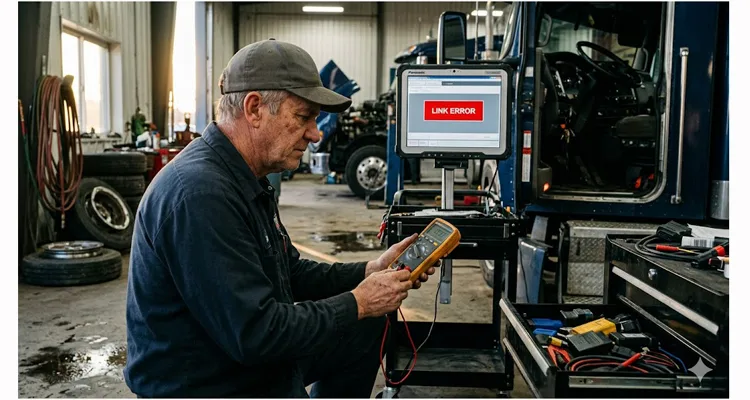
Last Thursday, 3:17 PM. A 2005 Kenworth T600 with a Cummins ISX sits dark in the bay, third time this month. The driver is clocking overtime. The fleet manager is watching the hour meter. And the diagnostic tool says “Link Error.”
I’ve stood behind enough technicians chasing this exact problem to know what comes next: three hours of cable swapping, adapter testing, forum scrolling, and eventually—a $450 service call to someone who remembers how to talk to a J1708 network.
Here’s what I want to walk you through today. Not generic advice. Not marketing. Just the practical reality of keeping mixed-fleet diagnostics profitable, and why ignoring that old 9.6 kbps network is costing you real money. We’ve been building cables for these trucks since before most of today’s techs were in trade school, and the patterns don’t change.
The Problem You Won’t See Coming
Last month I walked into a shop outside Phoenix that services 300 mixed fleet vehicles. Their newest tech can flash a 2024 Volvo in twelve minutes. But a 2007 International with a dead telematics gateway? That truck sat three days while they argued with the GPS provider about whose protocol was broken. The gateway was speaking J1708. Nobody thought to check.
Then a 2007 freight hauler rolls in. Or a motorhome with a 2001 chassis. Or—and this is the one that bites—a 2022 truck with a legacy telematics gateway that still pulls J1708 data for the fleet management system. We documented a similar case in our 1999 Freightliner J1708 diagnostic guide, where a truck sat for a week over a corroded pin.
The tool connects. The screen says “J1708: No Communication.” And suddenly your $85/hour technician is staring at a 25-year-old protocol like it’s Latin.
The real cost isn’t the diagnostic time. It’s the downtime. It’s the tow to a “specialist.” It’s the truck that sits because nobody remembers how to check pin E voltage.
Why J1708 Refuses to Die
Let’s be clear about what we’re dealing with. I’ve been diagnosing these trucks since before CAN bus was common, and here’s what the spec actually means when you’re holding a meter:
- 9600 baud means each bit takes about 104 microseconds. Slow enough that you can watch data move on a $200 scope—and slow enough that you can miss it if you’re not paying attention. But slow also means robust; I’ve seen J1708 communicate through corrosion that would kill CAN entirely.
- RS-485 differential signaling means it laughs at electrical noise—but hates a bad ground. I’ve seen a corroded pin E take down an entire terminal because nobody understood common-mode voltage. This is the same physical layer principle we cover in our heavy-duty diagnostics 9-pin connector failure analysis, just at a slower speed. As defined in the RS-485 standard, this differential signaling is what gives the protocol its noise immunity, but it relies entirely on a stable ground reference. The difference is, J1708 gives you more warning before it fails completely.
- J1587 carries PIDs, MIDs, and SIDs the same way J1939 does, just slower and with less attitude. But when it stops talking, the truck stops moving. I’ve seen fleets replace engines because they couldn’t read a J1708 fault code that would have pointed to a $200 sensor.
J1708 is the physical layer standard published by SAE in the late 1980s. According to the ITS Standards Program, it defines the interface requirements and connecting devices necessary for transmitting signals among electronic components in trucks and buses. It runs at 9600 baud over twisted pair, uses RS-485 signaling, and carries J1587 messages. It’s slow. It’s simple. And it’s still embedded in millions of vehicles for one reason:
Manufacturers don’t redesign 20-year validated systems for fun.
From 1995 through the mid-2000s, J1708 was the backbone of heavy-duty diagnostics. When J1939 arrived (250 kbps, CAN-based), it didn’t replace J1708 overnight. Most trucks ran both networks in parallel—J1939 for high-speed control, J1708 for diagnostics and legacy device support. Some ECUs, particularly transmission controllers and ABS modules, still only accept firmware updates via J1708. If your tool can’t talk J1708, you can’t flash that module. Period.
I’ve watched engineers spend hours chasing J1939 errors when the real problem was a J1708 module that had gone silent and was pulling the whole network down. The two protocols share a connector, not a brain. That distinction matters more than most diagnostic training covers. We’ve had customers replace ECUs three times before realizing the J1708 bus was the actual offender. Our 9-pin Deutsch connector diagnostic fix walks through exactly this scenario.
Today, that architecture still exists. Many ECUs remain J1708-capable. Some telematics devices still pull data from J1708 because it’s deterministic and stable. And the 9-pin Deutsch connector you plug into? It carries J1708 pins right alongside J1939.
| Pin | Signal | What Goes Wrong | How to Verify |
| A | J1708 + | Corrosion inside Deutsch pins—water wicks past the seals | Measure A to B—should show varying voltage; steady DC means trouble |
| B | J1708 – | Same as A—corrosion is symmetrical | Check both; if one fails, both are likely compromised |
| C | Battery Power | Blown fuse (often #12 or #17—check your manual) | Key on, C to E = battery voltage; if not, trace the circuit |
| D | CAN Shield | Broken drain wire inside the jacket | Continuity to ground; intermittent shielding causes ghost errors |
| E | Battery Ground | Loose terminal at chassis or corroded crimp | Voltage drop test C to E under load—anything over 0.1V is suspect |
| F | J1939 + | Short to power from pinched wiring | Should read 2.5–3.5V; outside range means trouble |
| G | J1939 – | Short to ground from chafed insulation | Should read 1.5–2.5V; check with scope for clean square waves |
| H | OEM Proprietary | Varies by manufacturer—sometimes switched power | Don’t touch unless you have the pinout; guessing here burns modules |
When your tool says “no communication,” the fault is rarely the protocol. It’s almost always physical layer—a pin, a wire, a ground, or a module pulling the bus down. I’ve seen this pattern repeat across four continents. In twenty years, I’ve never seen a J1708 chip fail that wasn’t preceded by a connector problem.
Three Failure Modes I’ve Seen Cost Fleets Real Money
1. The Intermittent Ground That Took Down a Terminal
A container terminal operator in the Gulf Coast called us two years ago. They had 120 trucks moving 40-foot boxes, each fitted with a telematics unit pulling data from J1708. Every morning, 5–7 trucks would fail to report. The telematics provider blamed the trucks. The shop blamed the telematics. Meanwhile, trucks sat.
We sent a cable with test points. The technician found pin E voltage fluctuating between 0.8V and 3.2V on the affected trucks. The ground circuit at the diagnostic connector had corrosion—not enough to kill power, but enough to shift the RS-485 common-mode voltage outside the transceiver’s tolerance. The J1708 bus looked alive on a scope, but the telematics units couldn’t lock onto the signal.
Fix: Cleaned the connector, replaced the Deutsch pins, applied dielectric grease. Cost: $12 in parts. Downtime saved: 18 hours per week across the fleet. That’s $936 per week at their shop rate—from a $12 fix.
2. The Aftermarket GPS That Spoke Out of Turn
A construction company installed consumer-grade GPS trackers on 40 trucks. Three months later, six trucks started throwing intermittent “Check Engine” lights with no codes. The drivers learned to ignore them. Then one truck derated on a grade.
The aftermarket unit was tapped into J1708 incorrectly—not terminated, not shielded, and transmitting at slightly off timing. It wasn’t enough to crash the bus, but it corrupted enough J1587 messages that the engine ECU started logging communication faults and eventually entered a safe mode. The J1708 communication errors were intermittent, so three different shops missed the root cause.
Fix: Disconnected all aftermarket taps, restored factory wiring, installed a proper J1708-compliant Y-cable for the telematics. Cost: $90 per truck. Repair cost if ignored: $12,000+ for a tow and roadside service when that derate happened on a remote job site. The Y-cable gave them a way to isolate the telematics from the diagnostic bus when needed.
3. The “Bad ECM” That Was Just a Dead Diag Fuse
A technician in Alberta replaced an engine ECU on a 1999 Freightliner because it wouldn’t communicate. The new ECU didn’t communicate either. The truck had been in the shop four days.
I asked: “Did you check the diagnostic power fuse?”
Silence. He stared at the fuse box for thirty seconds. Then he laughed.
J1708 requires switched battery power on pin C. Some vehicles have a dedicated fuse for the diagnostic connector—often 5–10 amps, sometimes labeled “DIAG” or “CIG/ACCY.” If that fuse is blown, the entire J1708 bus might still function (modules talking to each other), but your scan tool won’t see anything because it’s not powered. The J1708 pins were all working, but the tool had no juice.
Fix: Replaced a $0.50 fuse. The original ECU was fine. The technician told me later he now checks fuses first on every no-communication complaint. He also started carrying spare fuses in his tool box.
Step-by-Step: How I Troubleshoot a J1708 No-Comm in 20 Minutes
When I train new engineers, I hand them a cable I’ve deliberately broken. Then I say: “Talk to the truck.” Most start by swapping adapters. The good ones start with a meter.
Here’s the sequence we use when a fleet calls at 4 PM on Friday:
Is the connector actually powered?
C to E, key on. If you don’t see system voltage, stop. Check the diagnostic connector fuse—often #12 or #17 in the cab panel. I’ve seen four ECUs replaced for a $0.50 fuse. Also check for voltage drop under load; a corroded terminal can show 12V with no load but drop to 4V when the scan tool draws power. This is the most overlooked step in J1708 diagnostics.
Is the bus biased correctly?
A to B should hover around 2.5V. If it’s pegged at 5V, something is holding the bus dominant. Start pulling modules. If it’s at 0V, the bus is shorted or dead. This single check tells you whether the J1708 network is electrically alive. I’ve watched technicians spend hours swapping cables when this five-second test would have told them the bus was fine.
Is the termination intact?
Key off, disconnect batteries or ensure no power. Measure A to B. 50–70Ω means two terminators are happy. Below 10Ω? Short between A and B. Above 120Ω? Open termination or broken wire. I’ve found fleets running with no termination at all—the bus works until you add one more module, then it crashes. J1708 needs those terminators.
Can you see data?
Scope on A, ground on B. You’re looking for 104 µs pulses—that’s 9600 baud. Flat line means nobody’s talking, or the bus is locked up by a stuck module. If you see pulses but your tool still can’t connect, check your J1708 adapter—some cheap cables swap A and B. We’ve seen this more times than I can count.
Who’s the offender?
Start unplugging one by one: telematics gateways, transmission ECUs, ABS controllers, aftermarket add-ons. After each, re-check bus voltage or resistance. When the bus recovers, you’ve found your problem. I had a case where a telematics gateway was transmitting at the wrong voltage—it looked fine on a meter but corrupted every third packet. Only unplugging it revealed the issue.
The Real Cost of Ignoring J1708
A fleet in Ohio ran the numbers last year. They had seventeen J1708-related comebacks—trucks that left the shop and returned within a week with the same “no communication” complaint.
Each comeback cost them:
- 2 hours of re-diagnosis they couldn’t bill
- The original technician’s frustration (hard to quantify, real)
- A driver who stopped trusting the shop
They calculated $8,700 in lost labor and customer credits. Then they found out three of those trucks had corroded pin E connections—a $45 fix across all three. The other fourteen were various physical layer issues: broken wires, loose terminals, aftermarket devices misbehaving on the J1708 bus.
The alternative? One of their competitors outsources every legacy diagnostic. They pay a mobile tech $175 just to show up, plus $95/hour, plus a truck that’s down 6 hours minimum. At ten incidents a year, that’s north of $10,000—and they still haven’t trained anyone in-house. They’re completely dependent on someone else whenever a J1708 problem appears.
Now add the hidden costs:
- Driver overtime waiting for repairs
- Missed delivery windows
- Customer frustration that walks to another shop
- Technicians losing confidence because their tools “don’t work”
How We Build Cables That Don’t Cause These Problems
I’ve been in this factory 20 years. I’ve seen every failure mode you can imagine—and some you can’t.
Five years ago, we got a rush order from a German telematics company. They needed 500 cables in two weeks. We shipped early. Three months later, they called—cables were failing in the field.
Turns out, the plastic compound we’d used for the overmold was specified for indoor use only. In a truck cab in a North Dakota winter, it cracked. The J1708 pins were exposed, moisture got in, and suddenly their telematics gateways couldn’t talk to the ECUs.
We replaced every cable. Then we changed our material spec to -40°C rated TPE. Then we added a cold-flex test to our 4-step quality inspection. Now every batch gets frozen and bent before it ships.
That’s why our current cables don’t fail that way. We’ve already made that mistake for you.
When we design a diagnostic cable, we start from the assumption that the cable is the last thing you should suspect. That means:
- Full-plastic overmold with -40°C rated TPE, not cheap strain reliefs that crack in winter
- RoHS-compliant materials because we sell globally and regulations vary—and because OEMs won’t accept less
- 100% tested—every cable, not a sample. We verify continuity, isolation, and contact resistance on each one. If a J1708 pin has high resistance, we catch it before it ships.
- 4-step quality inspection during production: raw material verification, in-process checks, final assembly test, and pack-out audit
- Climate-controlled warehouse because humidity kills connectors before they ever ship. We’ve seen “new” cables fail because they sat in a damp shed for six months.
We hold ISO 9001, ISO 14001, and IATF 16949 certifications. You can view our GB/T 24001-2016 ISO 14001:2015 certification and our IATF 16949:2016 certification documentation online. Not because customers ask—but because large equipment manufacturers won’t work with suppliers who don’t prove quality systems. One OEM customer audits us every year. They don’t care about the certificate—they care that we can trace every cable back to the batch of pins installed last Tuesday. If a J1708 diagnostic cable fails in their assembly plant, they want to know which machine crimped it and which operator ran that machine.
IATF 16949 exists because automotive suppliers have to prove their processes don’t create hidden failures. Our 5S management isn’t about neat shelves—it’s about knowing that the torque driver used for terminal screws was calibrated three weeks ago. It’s about having the work instructions posted so a new technician assembles a J1708 adapter exactly the same way as someone with 15 years experience. Our IATF 16949 PPAP zero-defect cable process page explains how we maintain this discipline.
When you order from us, you’re not getting a “cable.” You’re getting a component engineered for 20+ years of field service, built in a facility that follows 5S management, and backed by people who actually know what J1708 pin A is supposed to do.
If You Need Something Custom
Standard cables solve standard problems. But last month:
- A mining operation in Chile needed 15-meter extensions because their diagnostic ports are on the roof of haul trucks. We built them with heavier 18 AWG wire to prevent voltage drop over that distance. Standard 22 AWG would have dropped nearly 2V—enough to make the J1708 bus unreliable.
- A military vehicle contractor needed cables with no logos—just matte black overmold and a specific pinout that doesn’t match any commercial standard. We built 200 without asking why. The J1708 pins are in the right places, but the shell is different so no one can plug the wrong tool into their vehicles.
- A diagnostics tool maker in Europe wanted their brand name on the cable, with a right-angle connector that clears their enclosure. We modified the mold tool. Now their J1708 diagnostic cables look like they built them themselves—but they didn’t have to invest $50,000 in injection molding equipment.
If your requirement doesn’t fit a catalog page, send a drawing. Or a photo. Or a napkin sketch. We’ll look at your vehicle, your tool, and your use case, and tell you if it works. If it doesn’t, we’ll tell you why.
Engineering support is part of what we offer—not an upsell. We’ve designed custom J1708 cables for mining equipment, agricultural machinery, military vehicles, and even some marine applications where the protocol showed up in unexpected places.
Frequently Asked Questions (From Real Engineers)
Q: Can a J1708 and J1939 network coexist on the same wires?
No. They share a connector, not a nervous system. I’ve watched technicians swap cables for an hour because they didn’t realize the J1708 bus was fine—they were looking at the wrong pins. The two protocols are electrically incompatible; one uses RS-485, the other uses CAN. They just happen to live in the same shell. If you need to connect both, you need proper adapters, not jumper wires.
Q: Why does my J1708 bus show 5V DC between A and B?
Likely a stuck transmitter—one module holding the bus dominant. Start disconnecting modules. Common suspects: transmission ECU, ABS, or aftermarket telematics. The module that’s silent when unplugged is your culprit. I’ve seen telematics gateways fail in a way that makes them transmit constantly, locking up the entire J1708 network. Unplugging them is the only way to confirm.
Q: What’s the typical resistance for a healthy J1708 bus?
Between 50 and 70 ohms, measured at the diagnostic connector with power off. This accounts for two 120-ohm terminators in parallel plus wire resistance. If you see exactly 60Ω, your terminators are perfect and your wiring is short. If you see 120Ω, you’re missing one terminator—the bus will work but be sensitive to noise. If you see open line, someone cut the terminators out.
Q: Can I use a J1939-only adapter on a J1708 truck?
No. The physical signaling is completely different (RS-485 vs. CAN). You need a tool that supports J1708, or a gateway that translates. I’ve seen shops destroy $3,000 adapters by forcing them into J1708 ports. Don’t be that shop. The pins are different voltages for a reason. If you’re unsure, measure first.
Q: My 2023 truck still has J1708 pins in the diagnostic port. Why?
Many manufacturers retain J1708 for backward compatibility with fleet telematics or for specific diagnostic functions. It’s common to see both protocols active. Some modules also require J1708 for firmware updates—especially transmission controllers. We’ve seen 2024 model-year vehicles that still need J1708 to flash the transmission ECU. That protocol isn’t going away.
Q: What causes intermittent J1708 communication?
Ninety percent of the time: corrosion in the connector, broken wire strands inside insulation, or loose terminal pins. The other ten percent is a module transceiver that works cold and fails hot. We keep a heat gun in the diagnostic bay for exactly that reason. Heat the suspected module; if the J1708 bus dies, you’ve found it. Cool it with freeze spray; if it comes back, same answer.
Q: How do I verify a J1708 repair without a scan tool?
Measure pin A to B voltage with a multimeter—you should see varying voltage during module activity. Or use an oscilloscope to confirm 9600 baud data bursts. Some old-school techs use a simple LED tester: if it flickers, something’s talking. Not precise, but enough to know the J1708 network is alive. I’ve used this method in fields where scope batteries were dead.
Q: Does cable length affect J1708 reliability?
Yes. I once watched a fleet daisy-chain three extension cables to reach a truck cab. The reflections on that bus looked like a skipping rope. Keep extensions under 5 meters, or call us and we’ll build you a continuous cable with the right gauge. J1708 wasn’t designed for long runs; respect the physics. If you need longer, you need a repeater.
Q: Your website shows RoHS compliance. Does that matter for diagnostics?
For the cable itself, less so. For the factories we supply, absolutely. If you’re an OEM building equipment for the EU market, every component must be RoHS-certified. Our documentation supports that, including our 1298-2 compliance certification. If you’re a shop fixing trucks, it means the cable won’t outgas or degrade in a hot cab. We’ve seen non-RoHS cables turn brittle after three summers in Arizona.
Q: Can you build a cable with a right-angle connector?
Yes. We offer custom molding for angle, length, wire gauge, and overmold color. Minimum quantities vary; contact engineering to discuss. If you only need one, we can probably still help—just ask. We’ve made single prototypes for engineers who needed to prove a concept before ordering 500.
Q: Do any ECUs still require J1708 for firmware updates?
Yes. Some transmission controllers, ABS modules, and older engine ECUs only accept programming via J1708. If your tool chain can’t initiate that handshake, you’re sending that module out or replacing it. We’ve seen fleets strand trucks over this exact issue—brand new telematics systems that don’t support legacy protocols, so they can’t update the transmission. Always verify J1708 support before buying new equipment.
Final Thought
Last week, a technician in Sweden sent us photos of a 1998 Scania with a communication fault. He’d replaced three modules. We zoomed in on the diagnostic connector photo—pin E was green with corrosion.
That email took four minutes to read and reply to. He was back online in twenty.
J1708 isn’t going away this decade. Too many vehicles still depend on it. Too many telematics systems still read it. Too many ECUs still speak it as a second language—or require it for updates. Every time a manufacturer builds a new transmission controller, they have to decide whether to keep J1708 support. Most do, because the aftermarket still demands it.
The shops and fleets that handle it confidently save money. Not because they buy cheaper cables, but because they eliminate the diagnostic guesswork and get trucks back to work. They don’t chase ghosts; they check pins C and E first, then A and B, and they know what the numbers mean.
If you’ve got a J1708 problem you can’t solve—or if you just want a cable that won’t become next week’s problem—send me a message. I can’t promise I’ll answer instantly, but I will answer. And I’ll tell you what I’d check if I was standing in your bay.
That’s what 20 years in this factory looks like: not perfect, but experienced enough to know where to look.
Need to talk through a specific application?
WhatsApp: +86 17307168662
Contact Page: https://obd-cable.com/contact/
