

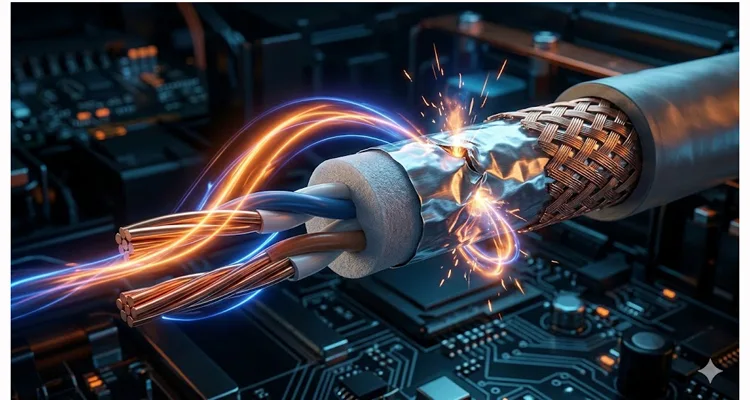
The Day the Silicone Jacket Stopped Being Enough
Last spring, a calibration engineer I know—let’s call him Markus—spent six hours chasing a ghost. He was validating a new zone controller on a prototype EV that was scheduled for media launch. The vehicle had more cameras than a broadcast studio, and the data backbone was the new 10Gb automotive Ethernet. Every time he ran the full suite of diagnostic routines, the link would drop. Not completely. Just enough to corrupt the log files. Just enough to make him curse the laws of physics.
He swapped cables three times. He tried ferrites. He even held the cable up with nylon zip ties to keep it away from the high-voltage traction cable. Nothing worked. The problem, as we eventually figured out, wasn’t his software. It was the fact that his “shielded” cable—the same one that worked perfectly on a 100BASE-T1 CAN gateway last year—was acting like a broken umbrella in a monsoon at 10GHz.
If you are designing diagnostic interfaces for the next generation of vehicles, you are about to meet Markus’s ghost. I’ve seen it haunt three validation labs this year alone. And no amount of firmware patching will lay it to rest. For a deeper look at how we systematically track down such intermittent issues in lower-speed networks, our guide on how to diagnose intermittent CAN bus failures provides a useful forensic framework.
The Scenario Nobody Talks About at Trade Shows
Last month at Electronica, I counted seventeen presentations on zonal architectures. Not one mentioned the cable. Not one. Meanwhile, inside the center console of every prototype at the show, there’s a physical layer nightmare waiting for the engineer who actually has to validate the thing.
Here is the reality we are facing:
The High-Voltage Neighbor
That 800V traction battery isn’t just for propulsion. In our lab, we’ve measured third harmonics from SiC inverter switching that land precisely at 2.3GHz—right in the middle of the 5GBASE-T1 operating band. The diagnostic cable didn’t stand a chance. Your cable, running from the OBD-II port (often packaged inches from high-voltage junction boxes) to your test equipment, is passing through a forest of interference. Understanding the spectrum of these disturbances is key; our analysis of common EMI sources from VFDs affecting CANbus diagnostics offers relevant insights into inverter noise.
The Frequency Climb
Every time the in-vehicle network speed ticks up, the diagnostic interface gets harder to design. CAN at 500kbps was forgiving. 100BASE-T1 started to show cable sensitivity. 1000BASE-T1 made us pay attention to connectors. Now, with 2.5GBASE-T1, 5GBASE-T1, and 10GBASE-T1 moving from committee drafts to OEM requirements, the cable isn’t just part of the path—it is the path. The new standard, formally defined as IEEE 802.3ch , enables multi-gigabit operation over a single pair of wires. The QC/T 1226-2025 standard in China already outlines requirements for cables handling bandwidth up to 10GHz. Ten gigahertz. That is not just “high speed.” That is microwave territory.
At those frequencies, a cable stops being a wire and starts being a transmission line. Everything matters. The geometry of the twist. The dielectric material. The way the shield is terminated. And most critically, the type of shield you are using. Our detailed field guide on CAN bus EMI shielding covers the principles that become even more critical at these higher speeds.
The Physics of the Leaky Pipe
To understand why shielding changes at 10Gb+, you have to forget everything you know about DC electricity. Think about water hammer in a pipe—except at these frequencies, the water is moving at the speed of light, and the pipe walls are only a few micrometers thick. One crease, and you get a pressure wave that reflects back and cancels the flow.
At frequencies above 1GHz, three things happen that make traditional shielding approaches fail.
The Skin Effect Goes Deep
High-frequency current does not flow through a conductor. It flows on the surface. At 5GHz, the skin depth in copper is about 0.9 micrometers—roughly the thickness of the oxide layer that forms on unplated contacts in humid storage. We once traced a 10Gb link failure to a connector that looked fine but had enough surface oxidation to push the skin current into a longer path, changing the impedance by 12Ω. If your shield is a simple foil wrap with a crease from bending during installation, that crease is a canyon relative to the skin depth. The current has to go around it, which creates impedance mismatches and reflections.
The Transfer Impedance Trap
Shield effectiveness is often quoted in decibels of absorption. That is a lab measurement with perfect boundaries. In a vehicle, with the cable routed next to a DC-DC converter, the parameter that matters is transfer impedance. The IEC 62153-4-15 standard gives a method for measuring it, but from our bench data over the past three years, keeping it below 10 milliohms per meter all the way to 10GHz is the real threshold for diagnostic reliability. Most “shielded” cables we’ve put through our transfer impedance test fixtures cross that line at 2GHz. We’ve explored this concept in depth in our piece on port environment cable failure and transfer impedance analysis .
For a braided shield at low frequencies, the transfer impedance is just the DC resistance of the braid. At higher frequencies, things get ugly. The holes in the braid (the “optical coverage”) become antennas. Energy couples through them. A 90% braid coverage sounds good, but at 5GHz, the wavelengths are so short that those tiny rhombus-shaped holes are efficient entry points for interference.
For 10Gb operation, you cannot rely on braid alone. The ISO 21111-13 draft and the SAE J3117/3 specification specifically address fully shielded cabling systems because the industry knows that the old tricks don’t work.
Common Mode Currents and the Choke Paradox
Diagnostic cables are unbalanced by nature. They connect a balanced differential pair (the Ethernet PHY) to an unbalanced environment (your test equipment’s chassis ground, the vehicle’s body ground, the laptop power supply). This creates common mode currents.
We usually fix this with common mode chokes. But at 10GHz, a choke that worked at 100MHz might have a parasitic capacitance that turns it into a band-pass filter. We characterized a popular 100MHz automotive choke last quarter and found its first self-resonance at 1.8GHz. By 5GHz, it was passing common mode noise better than a straight wire. This phenomenon is central to the debate on ferrite cores vs. common mode chokes for CAN bus , which becomes exponentially more critical at 10Gb+. The ESD protection devices you used on lower-speed lines have junction capacitances that look like short circuits at microwave frequencies. The OPEN Alliance now mandates that protection devices for unshielded twisted pair maintain capacitance below 2pF—and for 10BASE-T1S, the optimal threshold is considerably lower. For 10Gb, the margins are even tighter.
Step-by-Step: Engineering the Diagnostic Cable for 10Gb Survivability
You cannot just “specify a shielded cable” anymore. You have to engineer the entire path. Here is the methodology we use when qualifying a new diagnostic harness for a client running 5GBASE-T1 or 10GBASE-T1.
Step 1: Where 90% of Shield Failures Actually Start — The Return Path
The shield is only as good as its termination. If your diagnostic cable uses a drain wire that is pigtailed (soldered to a pin and then flying to ground), you have already lost the battle at 10GHz. That pigtail is an inductor. It forces the shield current to take a detour, which radiates like a small antenna.
The Fix: Demand 360-degree termination. The shield must be terminated around the entire circumference of the connector backshell. This is why the new automotive Ethernet connectors for high-speed grades are moving to coaxial-style crimps for the shield, not just IDC contacts.
Step 2: Reading Between the Lines of a Datasheet — Construction Details That Matter
Ask for a cable datasheet. Look for the construction details.
- Is there a foil layer? Good.
- Is the foil bonded to the dielectric? Better. This prevents the foil from wrinkling during flexing.
- Is there a braid over the foil? Necessary. The braid provides low-frequency ground return and mechanical integrity. The foil provides the high-frequency sealing.
- What is the material? Aluminum foil with a polyester backing is common. For extreme environments, you might need a silver-plated copper tape shield.
To make the difference clear, here is how conventional shielded cables compare to a design optimized for 10Gb+ environments. For reference, the strict electrical requirements for these higher speeds are outlined in documents like the SAE J3117/3 standard:
| Feature | Standard Shielded (Old) | 10Gb+ Optimized (Carsun Standard) |
| Shield Type | Single Braid or Foil | Hybrid (Foil + High-Density Braid) |
| Termination | Drain Wire / Pigtail | 360° Circular Crimp |
| Impedance Control | ±10% | ±5% (TDR Verified) |
| Data Rate Support | Up to 1Gbps | 2.5G / 5G / 10G / 25G |
| Frequency Range | < 600 MHz | Up to 10 GHz |
Step 3: Why the Cable Is Never the Whole Story — Channel Characterization
A cable is not an island. It terminates in connectors, which terminate in PCB traces, which terminate in PHY chips. At 10Gb, every via on the PCB is a discontinuity.
When you are designing a diagnostic interface, you need to simulate or measure the entire channel. The ISO 21111-13 standard is designed to provide a common scale for evaluating complete channels, cable assemblies, and individual components. If your cable supplier cannot provide mixed-mode S-parameter data (specifically SDD21 for insertion loss and SDC11/SCC11 for mode conversion), you are flying blind.
Step 4: The 85°C Surprise — Thermal Effects on Dielectrics
Automotive is not a data center. That diagnostic cable might be sitting in a footwell that hits 85°C in summer, or frozen at -40°C in winter. The dielectric constant of the insulation changes with temperature. If the dielectric constant changes, the impedance changes. If the impedance changes, you get reflections.
Qualify your cable assembly over the full temperature range. We have seen cables from other vendors that passed at 25°C with flying colors and failed completely at 85°C in our thermal chamber because the foam dielectric expanded and changed the velocity of propagation.
Step 5: What Lab Tests Miss — Validating Under Real Inverter Noise
Lab tests use pure sine waves. Vehicles use inverters. Connect your diagnostic setup to a running EV. Put a scope on the power lines and the shield. Look at the noise spectrum. You will often see spikes at the inverter switching frequency and its harmonics. If your cable’s shielding effectiveness drops at those specific frequencies (due to resonances in the shield structure), you will see those spikes coupled onto your data lines. This gap between standard tests and real-world conditions is a theme we’ve explored in our analysis of the ISO 11452-2 standard and its real-world gap .
Five Common Mistakes That Will Kill 10Gb Diagnostics
I see these mistakes on nearly every first-generation prototype that comes through for validation.
1. The 25% Overlap Trap — Why “Shielded” on a Datasheet Hides More Than It Reveals
A cable labeled “shielded” might have a foil shield with 25% overlap. Another “shielded” cable might have foil plus braid. At 10Gb, these are not the same thing. If you don’t specify the construction, you will get the cheapest thing that meets the letter of the requirement.
2. Three Points of Contact — How Stamped Connector Shells Become GHz Bottlenecks
The cable has beautiful shielding. The connector? It has a stamped metal shell that makes contact in three small points. That is a bottleneck. At 10GHz, you need a connector with a continuous conductive path. Look for connectors designed to meet the physical-layer demands of standards like SAE J3117/3 , which cover shielded balanced pair for high-speed Ethernet.
3. PVC’s Dirty Secret — Dielectric Absorption at Frequency
PVC is cheap. It is also a terrible dielectric at high frequencies. It has high loss and a dielectric constant that varies with frequency. For 10Gb, you need materials like foamed polyethylene, FEP, or PEEK. They cost more, but they maintain impedance control.
4. The Grounding Religion — Why Both Ends Usually Wins, and When It Doesn’t
Shield grounding is a religion with multiple sects. Ground at both ends, and you risk ground loop currents at low frequencies. Ground at one end, and you lose high-frequency shielding effectiveness. The engineering answer (which makes procurement unhappy) is: it depends. For 10Gb diagnostic cables, you generally need 360-degree bonding at both ends because the high-frequency noise coupling requires a low-inductance return path. But you must ensure the vehicle and test equipment grounds are at a similar DC potential, or use isolation techniques at the equipment side.
5. The Coil in Your Toolbox — How Bend Radius Kills Shield Integrity Permanently
That high-spec cable with the foil-and-braid shield and the foam dielectric has a minimum bend radius. If you coil it tightly in your toolbox, you might delaminate the foil or stress the dielectric. Once that happens, the impedance changes permanently.
How to Know If Your Cable Is Ready for 10Gb
You cannot tell with a multimeter. You need better tools.
TDR: Finding the Bump That Kills the Link
Time Domain Reflectometry (TDR) sends a fast pulse down the cable and looks at reflections. It will show you exactly where impedance mismatches occur. If you see a bump at the connector, you have a termination problem. If you see a gradual slope, you have a dielectric issue.
Return Loss: The 10% Rule You Can’t Ignore
This is a frequency-domain view of the same phenomenon. At 10GHz, most systems require return loss better than -15dB or -20dB over the band. If your cable assembly has a return loss of -10dB at 5GHz, you are reflecting 10% of the signal energy back to the transmitter. That energy doesn’t reach the receiver.
Line Injection: Plotting the Transfer Impedance Curve
This test injects a known current on the outside of the cable and measures what appears on the inside. It gives you the transfer impedance curve. A good 10Gb cable will have a transfer impedance that stays low (milliohms per meter) all the way to 10GHz. If you see it start to rise above 1GHz, the shield is leaking.
The Hardware That Lives at the Edge
The cables we build for this environment are not off-the-shelf items. They are engineered assemblies that reflect the realities of the vehicle.
Consider our triple-shielded diagnostic assemblies. They start with a differential pair designed for 100Ω impedance, held to tolerances of ±5%. The foil bonding process uses a heated nip roller system we built in-house because off-the-shelf lamination equipment couldn’t hold the ±0.5mm registration we needed for consistent impedance at 10GHz. Around that pair is a conductive polymer layer (for low-frequency shielding and to prevent triboelectric noise), then a foil shield with 100% coverage bonded to the dielectric, then a tinned copper braid with greater than 90% coverage. The jacket is a cross-linked, flame-retardant, oil-resistant compound that survives the footwell.
The connectors are machined, not stamped. The backshells are conductive and designed for 360-degree termination. The overmold provides strain relief that protects the critical shield-to-backshell junction. The debate on crimp vs. solder for vibration reliability is central here—we always choose crimped terminations validated for high-cycle vibration.
We run these assemblies through a four-step quality inspection. They are 100% tested for continuity and HiPot, but also sampled for TDR and return loss. We maintain climate-controlled warehouses because humidity affects the dielectric properties of some materials. This level of control is part of our IATF 16949 PPAP zero-defect cable process .
This is what happens when you stop thinking about cables as commodities and start treating them as precision transmission lines. It is the difference between a cable that works in the lab and a cable that works in a 2027 production vehicle with three electric motors and a 900V architecture. Our journey to this capability was formalized when we achieved IATF 16949:2016 certification , a milestone that shapes our engineering culture.
Frequently Asked Questions
Q: I have a spool of CAT6a in the lab. Can I use it for automotive 10GBASE-T1 validation?
A: No. CAT6a is designed for structured cabling in buildings with different impedance (100Ω is correct) and different noise environments. Automotive cables must meet specific automotive standards like SAE J3117/3 , which include tighter mechanical requirements, temperature ratings, and EMC performance tailored for the vehicle.
Q: Will snap-on ferrites fix the packet loss I’m seeing at 5GHz?
A: Ferrites work at lower frequencies (kHz to low MHz). At GHz frequencies, the parasitic capacitance of the ferrite bead creates a bypass path. You might actually make the problem worse by creating a resonant structure. This is why we emphasize proper CAN bus shielding and filtering design from the start, rather than relying on bolt-on fixes.
Q: Foil vs. braid — which one actually matters at 10GHz?
A: Foil provides 100% coverage and excellent high-frequency shielding if it remains intact. Braid provides lower DC resistance, better mechanical strength, and good low-frequency shielding but has holes. For 10Gb, you typically need both: foil for the high-frequency sealing, braid for the ground return and low-frequency integrity.
Q: What’s the shortest acceptable pigtail for shield termination?
A: Ideally, with a 360-degree contact inside the connector. If you must use a pigtail (a wire soldered to the shield), keep it as short as physically possible—under 3mm. Anything longer becomes an inductor.
Q: I need a 7-meter diagnostic cable. Is that possible at 10Gb without signal loss?
A: Yes, but not in the way you think. The issue isn’t just loss (attenuation). It’s also the accumulation of small impedance mismatches. Every connector, every slight bend, every manufacturing tolerance creates a reflection. At longer lengths, these reflections add up. For diagnostic cables, keep them as short as practical for the task, and ensure the cable assembly is characterized for the length.
Q: A supplier says they meet IATF 16949. What else should I ask for?
A: Look for IATF 16949 (automotive quality management), ISO 14001 (environmental), and adherence to the relevant standards: SAE J3117/3 , ISO 21111-13, or QC/T 1226-2025 depending on your market. Also, ask for specific test data, not just “meets standard”—particularly S-parameters and transfer impedance plots. You can view our ISO 14001:2015 certification and IATF 16949 certificate online.
Q: Can I solder a broken 10Gb Ethernet cable in the field?
A: You can, but you likely won’t maintain the shielding integrity. A field repair with electrical tape and a hand-twisted pair will have completely different impedance and no shield continuity. It might work for low-speed fallback, but for 10Gb, replace the cable.
Q: My current projects are still 1Gb. When should I start worrying about 10Gb diagnostics?
A: Today? Maybe not. But consider the data from a future vehicle: multiple 8K cameras recording simultaneously, LIDAR point clouds, radar data, and vehicle state information. If you are developing the tools for 2028-2030 vehicles, you need to validate on the data rates those vehicles will generate. Based on OEM timelines we’re seeing, 2027 model-year vehicles with 10Gb backbones will hit validation labs in late 2025. That’s about 18 months from now.
The Practical Path Forward
You do not need to throw away your current diagnostic cables. You do need to start thinking about the next generation. Based on the OEM timelines we’re seeing, 2027 model-year vehicles with 10Gb backbones will hit validation labs in late 2025. That’s about 18 months from now.
When you are specifying a new diagnostic interface or a test harness for a prototype ECU, ask the hard questions. A great starting point is our OEM engineer checklist for EMI-hardened diagnostic cables .
- What is the maximum frequency this assembly will carry?
- What is the transfer impedance at that frequency?
- How is the shield terminated in the connector?
- Can I see the TDR profile?
- And can you show me the same data after 500 hours at 85°C?
If the supplier looks at you blankly, you are talking to the wrong supplier. The cost of getting this wrong extends beyond the cable itself; you should consider the true cost of a custom cable over its entire lifecycle.
We have been building automotive cable assemblies for over twenty years. We have watched the data rates climb from K-line at 10kbps to 10Gb Ethernet. We have ISO 9001, IATF 16949, and the scars from every mistake you can make with shielding. Our 5S management and climate-controlled warehouses ensure that the cable you get is the cable we designed.
If you are working on a project that involves 10Gb automotive Ethernet, or if you are trying to figure out whether your current diagnostic cables will survive the next generation of vehicles, let’s talk. Not about price lists. About the physics of your specific application.
You can reach me directly through the contact page on our site. Tell me what you are seeing in the lab. Tell me what ghost you are chasing. I may not have an immediate answer, but I have been in the same spot as Markus, and I know how to find the source of the leak.
Contact Our Engineering Team
Not sure if your current cable assembly is ready for 10Gb? Let us review your requirements and test data.
Contact Us
Or message me directly on WhatsApp for a faster response:
Chat with Linda on WhatsApp
ISO 9001, ISO 14001, IATF 16949 Certified | RoHS, CE, UL, REACH Compliant | 20+ Years Factory Experience | OEM Customization: Logo, Branding, Length, Color, AWG | 4-Step Quality Inspection | 100% Tested
