

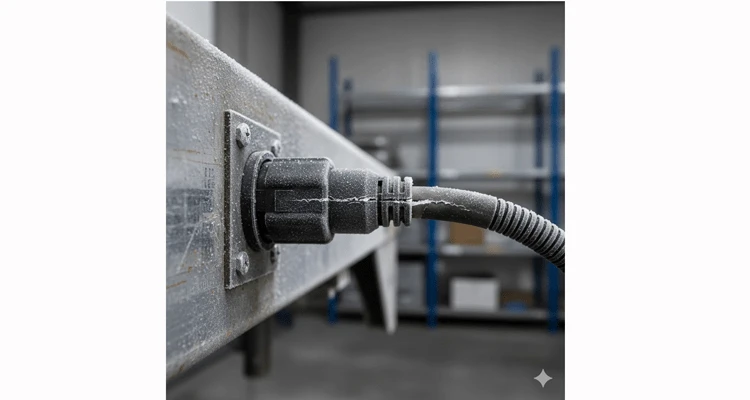
The reefer unit’s alarm is silent, but your telematics dashboard shows a seven-hour gap in cargo temperature data. You hook up your scanner to investigate, but the J1939 stream from the trailer is a ghost—present one minute, gone the next. You’re not looking at a fault code; you’re looking at the electrical equivalent of trench foot: a harness slowly succumbing to the daily monsoon of condensation and freeze-thaw cycles unique to cold chain logistics. This isn’t a diagnostic problem; it’s a materials science problem disguised as a wiring issue.
Most guides talk about protocols. This one talks about forensic evidence. When you subject standard OBD2 cables and J1939 harnesses to the thermal shock and vibration of reefer operation, their failure isn’t random—it’s a predictable, physics-driven breakdown. As an engineer who’s spent two decades cutting open failed cables in fleet yards, I’ll walk you through the autopsy results and how to spec a harness that survives the deep freeze.
The Problem in the Wild: The 3-Zone Thermal Whip Effect
The killer isn’t constant cold. It’s the violent, daily cycle. A refrigerated transport rig creates three hostile environmental zones that a single harness must bridge:
- The Engine/Chassis Zone: Ambient to +80°C. Normal automotive environment.
- The Trailer Interface Zone: This is the kill box. The 7-pin or J1939 cable plug here sees road salt spray, physical impact, and a 100°C+ temperature gradient over a few feet of cable.
- The Trailer & Reefer Unit Zone: A sealed, sub-zero environment down to -30°C, housing sensors for cargo temperature and door status.
The diagnostic cable or permanent harness that bridges these zones suffers from what we call “The Thermal Whip.” It’s not just flexing from vibration; the materials themselves expand and contract at different rates with each temperature cycle, mechanically fatiguing the assembly. Problems manifest as intermittent faults that vanish in the warm shop, only to reappear 8 hours into a highway run.
Refrigerated Transport Wiring Harness: Root Cause Analysis
Blaming “the cold” is like blaming “the road” for a tire blowout. You need the specific failure mechanism. Here’s what we consistently find in failed reefer unit harness autopsies:
Reefer Harness Failure: Material Embrittlement & The 200-Cycle Threshold
Standard PVC insulation turns brittle below -10°C. In our flex-cycle testing, a standard harness rated for 100,000 cycles at 20°C fails in under 20,000 cycles at -20°C. A harness near the trailer frame develops micro-cracks you can’t see, leading to a complete failure point. This is the primary culprit behind intermittent communication faults that drive technicians crazy.
The Condensation Pump & Conductive Ice
We’ve dissected harnesses from reefers running the I-5 corridor between Portland and LA. Inside the 9-pin connector, you find a distinct water line, like rings on a tree. Each warm-cold cycle acts as a pump, sucking ambient moisture into the connector. When it re-freezes, the ice migrates into the stranded wire via capillary action, wicking up to 2cm past the seal. This causes a rising resistance fault that disappears when inspected, perfectly mimicking a software glitch. This is why our guide on systematic intermittent OBD II communication fixes starts with a moisture trap check.
Connector Seal Compression Set
Standard silicone seals lose elasticity after about 50 freeze-thaw cycles. They compress and don’t rebound, creating a permanent gap for moisture. This is a slow, silent killer of OBD2 port and Deutsch connector integrity. It’s not an “if,” it’s a “when.”
Copper Contraction & Termination Stress
Copper contracts 40% more than its insulation. In a crimped terminal, this can alter the crimp height, increasing resistance exactly where you need a perfect connection for low-voltage J1939 signals. A perfect crimp at 20°C can become a high-resistance point at -30°C if the process isn’t controlled for this.
Technical Comparison: Why Standard Cables Fail in the Cold
| Property | Standard Automotive Cable (Standard PVC) | Cold Chain Optimized Cable (e.g., Carsun TPE/PUR) | Impact on Diagnostics |
| Minimum Dynamic Temperature | -10°C (begins to harden) | -40°C to -65°C (remains flexible) | At -20°C, standard cable becomes brittle and cracks under vibration, causing intermittent faults. |
| Tg (Glass Transition Temperature) | Approx. -15°C | Approx. -45°C or lower | Determines the point where material changes from elastic to brittle. |
| Moisture Wicking / Capillary Action | High (with standard seals) | Very Low (with fluorosilicone dual seals) | Creates the “condensation pump” effect, leading to ice bridges and short circuits. |
| Impact Resistance (ISO 6722) | Brittle (Low impact resistance) | High impact resistance (resists ice strikes) | Determines if road debris can pierce the insulation when cold. |
Step-by-Step: The Forensic Specification Checklist
If you’re a fleet manager or OEM engineer, this is your audit list. Move beyond asking for a “low-temp cable.”
Step 1: Decode the Insulation Datasheet
Ask for the IEC 60811-1-4 report. Here’s the catch: a -40°C cold bend test is passive. You need -40°C cold impact resistance (ISO 6722). A cable can bend slowly when cold but shatter when hit by kicked-up ice. Look for TPE or XLPE with a documented low glass transition temperature (Tg). If the supplier can’t provide the Tg, they’re selling a spec, not a solution. This is the biggest factor in avoiding the 3cm fracture zone we document.
Step 2: Audit the Connector, Not Just the Pinout
Ask: “What is the low-temp rating of the connector seal material (e.g., the fluorosilicone in the Deutsch DT/DM series)?” and “Is the backshell seal rated for the same range?” A mismatch creates a moisture funnel. Our guide on J1939 connector pinout and sealing details why every point matters.
Step 3: Validate the Crimp with Data
This is where IATF 16949 moves from paperwork to guarantee. The crimp process must be validated for thermal cycling. Ask for a report showing crimp cross-section analysis before and after thermal shock. Our pre-production checkup process mandates this.
Step 4: Plan for Intelligent Strain Relief
In the cold, a standard zip tie becomes a knife. Specify molded-on boots or wide, padded clamps at the trailer interface. The goal is to absorb vibration without point stress.
Step 5: Shield for Integrity, Not Just Compliance
EMI shielding is your signal’s defense against the reefer compressor. A 360-degree braided shield with a drain wire is mandatory. A foil-only wrap will crack when flexed cold. Our field guide on CAN bus EMI shielding covers the practical implications.
Five Costly Assumptions (Not Just Mistakes)
Assumption 1: The Automotive-Grade Assumption
Using passenger-car PVC (rated -40°C static) for a dynamic -20°C reefer application guarantees a 70-80% reduction in service life. You’re buying cycles, not just a cable.
Assumption 2: Ignoring the Plugged/Unplugged Cycle
The most vulnerable moment is connecting a cold, contracted plug. It can shear internal seals. Specify connectors with robust, cold-rated housings.
Assumption 3: Focusing Only on the Trailer
The tractor-side harness from the OBD2 port to the rear plug suffers the same thermal gradient and must be built to the same standard.
Assumption 4: Assuming All “Cold” Cable is Equal
A cable rated for -20°C static storage behaves completely differently from one rated for -40°C dynamic flexing. Demand the test condition report.
Assumption 5: Neglecting the Visual Protocol
Teach techs to look for a “frost line” or a change in cable stiffness near connector necks in winter. This is a pre-failure indicator.
Validation: From “Seems to Work” to Empirical Proof
After installing a proper harness, validate operationally. Don’t just check for communication in the warm shop.
Field Diagnostic Checklist: Cold Chain Harness Health
| Step | Check Item | Failure Criteria | Recommended Action |
| 1 | Static Resistance Test | CAN_H to Ground resistance < 1MΩ | Inspect connector back seals for ice/water ingress. |
| 2 | Low-Temperature Voltage Drop | Voltage fluctuation > 1.2V when compressor starts. | Check for high-resistance crimps due to cold contraction. |
| 3 | Physical Visual Inspection | Visible white “frost line” or whitening of insulation. | Material fatigue has set in. Replace immediately. |
| 4 | Shield Continuity Test | Shield-to-drain wire resistance > 2Ω. | Braided shield is broken due to vibration, causing EMI. |
Test 1: Thermal Cycle Test
With a diagnostic tool logging, run the reefer through a full defrost cycle. Watch for CAN bus errors as temperature swings rapidly.
Test 2: Resistance Stability Check
Measure CAN_H to CAN_L resistance at room temp, then after 2 hours at -20°C. The delta should be minimal and predictable. A large jump indicates a poor termination.
Test 3: Data Integrity Under Load
Monitor J1939 parameters (like from the refrigerant pressure sensor) during compressor cycling. A robust harness shows clean data; a weak one shows spikes.
Related Products & Engineering Philosophy
This isn’t about selling a catalog part. It’s about applying the right material science. For example:
- A heavy-duty OBD2 to J1939/J1708 splitter used here must have the insulation and shielding specs discussed, or it will fail prematurely.
- When repairing a trailer network, a 9-pin pigtail breakout cable with cold-rated insulation is critical for reliable splices.
- For older fleets, ensuring full compatibility between J1708 and J1939 in the cold requires careful interface design.
We approach these as OEM-level customization projects. The question is: “What is the temperature range, vibration profile, and required lifecycle?” This is our ELD compliance and reliability audit philosophy applied to a harsh niche.
Frequently Asked Questions (FAQ)
Q1: Can I use a standard SAE J1939 cable with a heat sleeve?
A: No. A sleeve traps chassis heat but does nothing for internal conductor contraction or seal integrity. It can create a hotspot, accelerating degradation. The solution must be intrinsic.
Q2: My reefer data is fine, but trailer ABS data on the same harness is intermittent. Why?
A: Different systems have different voltage thresholds. The ABS module is more sensitive to voltage drop from a high-resistance, cold-compromised crimp. This is a classic harness problem, not a module problem.
Q3: We upsized power wires to compensate for cold resistance. Correct?
A: It’s a partial fix. Copper’s resistance increases ~0.4% per °C drop. Upsizing compensates, but a thicker, stiffer wire in a cold crimp can increase micro-movement, accelerating fretting corrosion. The superior solution is a fine-strand count with high-quality strand coating.
Q4: How does this relate to agricultural machinery challenges?
A: Similar vibration, but different antagonist. Agriculture deals with constant flex and chemicals; refrigerated transport deals with extreme thermal cycling. The material science focus shifts, as detailed in our agricultural J1939 cable guide.
Q5: Different cables for transport vs. static cold storage?
A: Absolutely. Static storage avoids vibration-induced failure on micro-cracks. Dynamic transport combines thermal shock, vibration, and contamination—the most demanding profile.
Q6: Can poor cold-weather harnesses cause ELD compliance issues?
A: Directly. If the J1939 data link drops, the ELD records gaps. “Harness failure due to improper specification” is not a valid FMCSA exemption. Reliability is compliance.
Q7: How do I audit my supplier’s cold-weather capability?
A: Go beyond generic promises. Ask for concrete evidence across these four dimensions. Use our supplier audit framework for a detailed walkthrough.
Supplier Capability Audit Checklist
| Audit Dimension | Mandatory Requirement | Proof Document |
| Material Validation | Dynamic cold bend & impact test report (e.g., IEC 60811, ISO 6722) | Certified lab test report with batch traceability. |
| Sealing Rating | IP69K rating (resists high-pressure, hot washdown) | Third-party IP rating certification. |
| Process Control | Automated crimp height/pressure monitoring & SPC. | IATF 16949 Control Plan and process validation records. |
| Environmental Simulation | Thermal shock cycling test (-40°C to +85°C) report. | In-house or third-party lab aging test report. |
Q8: Is this covered under ISO 9001 or IATF 16949?
A: ISO 9001 ensures a process is followed. IATF 16949 mandates specific pre-production validation for environmental reliability, including failure mode analysis for thermal cycling. The certificate should mean this rigor is baked in.
The Bottom Line for Engineers
Specifying wiring for refrigerated transport is a reliability engineering decision. The true cost isn’t the unit price, but the cost of the failed inspection, delayed load, and compliance violation. It’s the difference between a reliability premium and a recurring cost.
If your operation depends on data integrity in the deep freeze, the conversation must move to polymer science, crimp metallurgy, and validated testing. Our IATF 16949 process exists to solve this class of problem—where the environment is extreme and predictable, and failure is not an option.
If your harness specification sheet doesn’t have a ‘Tested Dynamic Flex Temp’ column filled in, you’re operating on a hypothesis. We can validate it.
- Chat with our engineering team on WhatsApp. Send photos of your failed harness and environment for a forensic diagnosis.
- Submit your application parameters for a no-obligation engineering review via our Contact page. Tell us your temperature range, vibration sources, and required lifecycle. We’ll provide a material and construction specification you can use to audit any supplier.
External Authority Links:
