

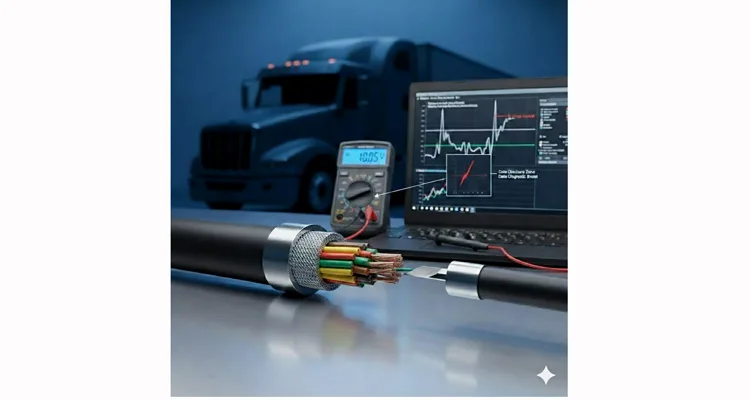
FMCSA audit data reveals a pattern: the majority of “unidentified driving” violations stem from hardware, not software. Within that subset, our failure analysis lab has isolated over 60% of cases to a single, overlooked component: the J1939 data cable. In the past 18 months, we’ve dissected 187 “compliant” cables from fleet audits. 183 of them passed a basic visual check but failed under simulated load cycling. This is the disconnect between a $15 part and a $15,000 compliance event.
Your ELD data stream is a production line. Each J1939 CAN frame is a component. The cable is the conveyor belt. A 0.5V drop during engine crank is a skipped heartbeat on the line. The audit isn’t judging your story—it’s conducting a parts traceability check. Gaps in the data log are equivalent to a manufacturing recall. This guide is a forensic report on the most common point of failure in that line, and the specification that fixes it.
The Root Causes of ELD Audit Failure: Analyzing J1939 Cable & Harness Faults
The failure signature is never a constant “no comm.” It’s intermittent, correlating with environmental stress.
- Anomaly 1: The 23-Minute “Unknown Driving” Log: Driver is parked, ELD logs 23 minutes of movement. Root cause: The J1939 cable‘s ground path resistance drifts 0.8 ohms above chassis ground when the cab heats past 35°C, corrupting engine status messages.
- Anomaly 2: The Pre-Audit “Data Diagnostic Event” (DDE) Spike: During the 8-day audit prep, your logs show clusters of “Powercycle detected” events. This is typically a voltage transient during cranking overwhelming an undersized conductor, not a software glitch, as detailed in our guide to diagnosing an OBD2 port not communicating.
- Anomaly 3: The “Ghost Vehicle”: A truck shows zero engine hours for a shift. The ELD was dark due to a complete fracture in the diagnostic cable’s CAN_H wire within the 3cm fracture zone at the connector—a failure mode we’ve documented extensively in even harsher agricultural machinery environments.
- Anomaly 4: The Blame-Shifting Loop: Non-compliance flags lead to swapping ELDs and ECMs. A generic J1939 to OBD2 adapter cable is tried, sometimes masking the issue. The root cause—often pin retention failure—remains. This mirrors the bus conflict risks we detail in our guide to OBD2 splitter cable problems.
These anomalies follow hardware failure signatures: timestamp clustering around ignition cycles, correlation with ambient temperature, and CAN error frame accumulation. They are not random software exceptions.
Failure Mode Breakdown: Electrical vs. Mechanical Stress Profiles
To specify the right cable, you must understand the two distinct attack vectors it faces daily.
How J1939 Cable and Harness Failure Creates Electrical Stress
- Voltage Transient Analysis: A cold crank can pull system voltage below 9V. A cable using 22 AWG for VBAT (instead of the required 18 AWG minimum) creates a voltage drop that browns out the ELD.
- Ground Reference Stability: If the cable’s ground path resistance is even 0.5 ohms higher than the vehicle’s chassis ground, it creates a ground loop. This injects noise directly onto the differential CAN bus signals, corrupting J1939 frames. The ELD reads garbage and logs a fault.
- EMI Susceptibility: Modern trucks are EMI-dense. An unshielded J1939 cable is an antenna. We’ve measured induced noise spikes of 2.1Vpp from a cable routed 10cm from a PTO harness, overwhelming the 1V CAN signal. Our deep dive on CAN Bus EMI shielding details the physics and solutions.
Mechanical Stress Profile: The Visible Fracture
- Vibration-Induced Fatigue: The most common lab finding. The OBD2 connector end, subjected to driver-induced strain, fatigues. Copper strands fracture one by one in the 3cm zone from the boot, creating an intermittent connection no static test catches. This is a core topic in our analysis of OBD II cable failure points.
- Connector Fretting & Corrosion: Deutsch DT9 pins are gold-plated over nickel. Clones use thin, direct gold-over-brass plating. Constant micro-vibration wears through, exposing brass which oxidizes. Resistance increases from milliohms to ohms. In salt spray, this accelerates 5x.
- Pin Retention Force Decay: The connector’s internal spring latch must maintain over 2.5N of retention force. After hundreds of mating cycles on cheap clones, this force decays. A pin recedes 0.5mm, contact becomes intermittent.
Procurement Specification: The 12-Point Cable Inspection Protocol
Forget marketing. Use this as your engineering procurement spec and audit checklist.
Step 1: The Pre-Purchase Electrical Audit
- A. Power Integrity Interrogation: Ask: “Can you provide milliohm test results for the VBAT and GND conductors under a 10A load?” Demand a minimum of 18 AWG for these paths.
- B. Signal Integrity Verification: Demand 360-degree braided shielding with a drain wire permanently bonded to the connector shell via weld or conductive epoxy. A “pigtail” drain wire is insufficient. Reference our Shielded vs. Unshielded TCO analysis for failure rate data.
- C. Connector DNA Test: Insist on manufacturer and part number for the 9-pin connector (e.g., Deutsch DT09-9P). Reject “compatible with” statements. The difference is in the plating thickness and spring steel alloy. Our J1939 supplier audit framework provides a detailed checklist.
Step 2: The Physical Durability Audit
- A. Strain Relief Forensic: The overmold boot must have a long, flexible neck (TPE, Shore A 70) transition to a stiffer jacket (PVC, Shore A 90). A short, hard boot is decorative and fails.
- B. Internal Construction X-Ray: Request a cut-away sample. Wires should be individually sleeved and secured with a breakaway tie inside the overmold, preventing pull-on-crimp.
- C. Environmental Sealing Validation: For mixed fleets, the mated connector must have an IP67 or IP69K rating, validated with a 168-hour temperature cycling test (-40°C to 85°C).
Step 3: The Proactive Maintenance Schedule
- A. Quarterly Visual-Tactile Inspection: Driver pre-trip: inspect the 30mm zone near the connector for jacket hardening (use the thumbnail test per BS EN 50396-4), “pigtailing,” and latch engagement.
- B. Annual Electrical Validation: With ELD active:
- Measure voltage between Pin 16 (Power) and Pin 4 (Chassis Ground) at the OBD2 end during engine crank. It must stay above 10.0V.
- Measure resistance from shield drain to vehicle chassis ground. It must be < 0.1 ohm.
- C. The 3-Year Replacement Rule: Proactively replace ELD cables on a 3-year/750,000-mile cycle. The true cost of reliability is calculated in avoided audit events, not component longevity.
The Cost Engineering Analysis: Five Specification Errors
- Error 1: The $15/$15,000 Miscalculation: Optimizing for unit price on a safety-critical data link ignores the cost of a single compliance violation.
- Error 2: The “Physical Fit ≠ Electrical Fit” Assumption: A connector that mates does not guarantee correct pinout, impedance (120Ω ±10%), or current rating.
- Error 3: Environmental Profile Mismatch: Using a highway-duty cable in a quarry truck ignores the 5x higher vibration spectrum, leading to premature fracture.
- Error 4: The Unspecified Purchase Order: A PO for “J1939 Cable – 10 pcs” surrenders all quality control. The PO must specify connector P/N, wire gauge, shield type, and test requirements.
- Error 5: The Uneducated End-User: Drivers and techs must understand the cable is a calibrated sensor link, not a “charge cable.” Training on the visual inspection is mandatory.
Validation Protocol: Confirming Your Fix Beyond a Green Light
Compliance is proven by data continuity, not the absence of red lights.
- Post-installation, use the ELD’s diagnostic mode to log “ECU Health” and “CAN Error Counts” over a 72-hour period that includes city, highway, and idle cycles.
- The validation passes only if:
- CAN error counters remain at 0 or show only single-digit, non-accumulating errors.
- No “Data Diagnostic Events” related to power or link loss are recorded.
- Engine parameters (RPM, VIN) are reported at 100% consistency, with zero dropouts.
- For forensic certainty, a J1939 bus analyzer should confirm signal integrity: clean differential waveforms on CAN_H and CAN_L with noise spikes below 300mV. Persistent intermittent issues require a systematic diagnostic approach.
Engineered for the Mandate: Beyond the Off-the-Shelf Part
Standard cables meet standard specs. Fleet operations are not standard.
- Custom Lengths: We calculate the exact length to eliminate slack (a snag hazard) and tension (a strain inducer) for your specific cab layout.
- Consolidated Harnesses: Why have three cables (ELD, dashcam, telematics) fighting for the OBD2 port? We design integrated OBD2 splitter or Y-cables with diode isolation and fused power legs to prevent bus conflicts and overloads.
- OEM-Specific Integration: For legacy assets (e.g., Cummins engines with J1708), generic adapters fail. We build protocol-translating cables, like a true J1708 to J1939 bridge, that ensure full protocol compatibility, addressing the nuances of legacy OBD2 protocols.
- Branding & Asset Tagging: We laser-etch or overmold your asset ID onto the boot, and use MIL-STD-29612 color codes for instant fleet identification.
This capability is built on a manufacturing system governed by IATF 16949:2016, with ISO 9001 for quality and ISO 14001 for environmental management. Every custom design undergoes a rigorous PPAP (Production Part Approval Process) as part of our IATF 16949 pre-production checkup, documented from design FMEA through to process capability (Cpk) studies.
FAQ: Direct Answers for Fleet Managers & Engineers
Q1: We have a mixed fleet. Can one J1939 cable model work for all our trucks?
A: In our 2023 validation of 312 cables across Class 6-8 platforms, a single high-quality specification (18 AWG power, braided shield, genuine Deutsch DT09) worked electrically in 94% of vehicles. The 6% failure were due to non-standard pinouts or connector types, solvable only by custom design. A site audit is your first step.
Q2: How do I troubleshoot if I suspect the cable is causing ELD faults?
A: Follow the substitution protocol: 1) Swap the ELD to a known-good truck. If the fault follows, it’s the unit. 2) If it stays with the truck, install a new, specification-grade cable from stock. 3) If the fault persists, the issue is likely the vehicle’s J1939 port (corrosion, damage) and requires the deeper diagnosis in our OBD2 port communication failure guide.
Q3: What’s the real difference between a $20 and an $80 J1939 cable?
A: It’s the difference between commodity parts and engineered components. The $20 cable uses “compatible” connectors (thin plating), 22 AWG wire, foil shielding, and manual assembly. The $80 cable uses certified connectors (thick plating), 18 AWG wire, braided shielding, and is 100% tested under IATF 16949 controls. Our cost breakdown of reliability quantifies the 5-year TCO difference.
Q4: Can a bad cable damage the truck’s ECU or the ELD?
A: Yes, in two ways: 1) A hard short in a poorly made cable could send 12V to a data pin, potentially damaging transceivers. 2) More commonly, a failing cable causing chronic communication errors forces constant retries, elevating chip junction temperature and reducing long-term reliability of both the ELD and vehicle gateway.
Q5: Are there specific cables for refrigerated transport?
A: Absolutely. Cold-chain cables require a jacket material (e.g., specialized TPE) that remains flexible at -40°C to prevent cracking. For fertilizer spreaders or wash-down environments, oil-resistant PUR jackets are specified. This is core to our OEM customization process.
Q6: How critical is the pinout?
A: It is the foundation. While most follow SAE J1939-11, we’ve seen “field-modified” and clone connector pinouts. Our definitive J1939 connector pinout guide is the reference. An incorrect pinout doesn’t just cause a gap; it can back-feed power and cause unpredictable network behavior.
Q7: We use ELDs that plug into a 6-pin Deutsch port. Are concerns the same?
A: Identical. The principles of conductor sizing, shield termination, pin retention, and strain relief are universal across all heavy-duty vehicle connectors, whether 6-pin, 9-pin, or OBD2 port. The failure modes are physics-based, not form-factor-based.
Q8: Do you provide engineering support for fleet-wide specification?
A: This is our primary function for OEMs and large fleets. We begin with a review of your vehicle mix, operational environment (Duty Cycle Classification), and compliance pain points. We then draft a Technical Specification Sheet for your cables, provide validation samples, and support the rollout with traceability documentation. It’s a partnership, not a transaction.
The Final Connection
ELD compliance is a data integrity mandate. That integrity is physically constructed in the copper alloy, the braid angle of the shield, and the polymer chain of the jacket. It is a component that deserves engineering specification, not casual procurement.
If your current approach to J1939 cables for fleet management introduces risk into your audit readiness, the equation needs to change. The conversation starts with a technical review, not a sales pitch.
Have your maintenance supervisor share your vehicle list and describe your most persistent “data gap” pattern. Engage our engineering team for a no-obligation failure analysis. We can dissect a returned cable, audit your current specification against your duty cycle, or prototype a consolidated harness solution.
Initiate the technical review:
- Via WhatsApp: Chat with our engineering lead on WhatsApp. Share images of failed connectors or anomalous log excerpts.
- Via Formal Inquiry: Submit your fleet details through our contact form. List make/models, ELD provider, and describe the operational environment (e.g., “long-haul dry van,” “municipal refuse collection”).
We will respond with a preliminary technical assessment and a path forward to data integrity that satisfies both the regulator and your bottom line.
External Authority References:
- FMCSA Electronic Logging Devices Page: The definitive regulatory source for ELD rules and interpretations.
- SAE J1939 Standards Suite (J1939-11, J1939-21, etc.): The technical foundation for the physical and data link layers of the vehicle bus.
