

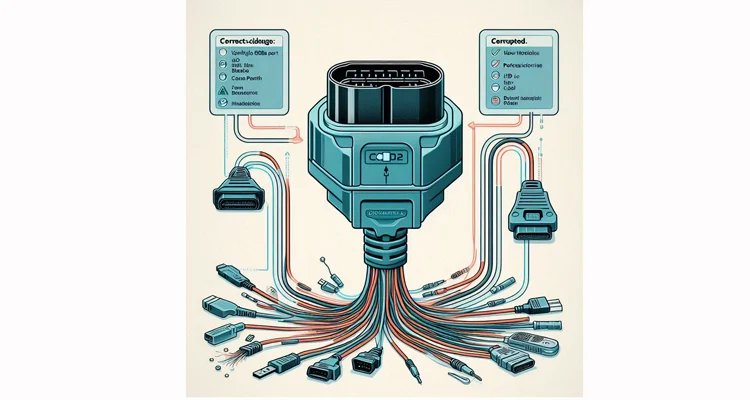
Let’s be honest: the moment you consider an OBD2 splitter cable, you‘re already in a technically compromised situation. The OBD-II port was designed as a single point of diagnostic access, not a hub. But real-world diagnostics, fleet management, and data logging often demand concurrent access. The problem isn’t the splitter itself; it‘s the naive assumption that all splitters are created equal. I’ve seen too many “ghost” communication errors, intermittent CAN bus failures, and even vehicle ECUs entering limp mode because of a poorly considered OBD2 splitter Y cable.
This guide exists to help you diagnose these common OBD2 splitter cable problems, understand their root causes, and make an engineering-driven selection to avoid them. It won’t sell you a product. It will teach you how to think like a systems engineer when you absolutely must split that signal.
When Do You Actually Need an OBD2 Splitter? The Real-World Scenarios
You‘re not browsing for this part on a whim. Typically, the pressure comes from one of these situations:
The “Permanent Install” Dilemma
A fleet manager needs to run a Geotab, Samsara, or other ELD (Electronic Logging Device) 24/7 but must keep the port free for periodic mechanic diagnostics. Unplugging the ELD is not an option for compliance.
The Workshop “Multi-Tool” Challenge
In a service bay, a technician needs his diagnostic scan tool connected while also running a secondary monitor—perhaps an oscilloscope to watch CAN bus signal integrity or a bespoke calibration tool from a component supplier. Two tools, one port.
The Data Logger’s Conundrum
An engineer performing validation testing needs to capture raw J1939 or OBD2 data streams to a PC-based logger while simultaneously allowing the vehicle‘s own display or a handheld reader to function normally.
In each case, simply plugging in a passive, off-the-shelf splitter cable is a gamble. The price of losing that gamble is wasted diagnostic time, corrupted data, or, in the worst case, compromising the vehicle network’s stability.
Solving OBD2 Splitter Cable Problems: The Root Causes of Data Loss & Bus Errors
The issue stems from violating fundamental principles of serial bus design. Here’s what‘s happening under the plastic shell:
1. Protocol Collision & Bus Contention: The Silent Data Wa
This is the primary killer. CAN bus is a multi-master, contention-based protocol. When two active devices (like a scan tool and an ELD) talk at exactly the same time, they cause a frame collision. Cheap splitters offer no arbitration. We‘ve decoded logs where robust ECUs handled it with a flood of error frames, while less robust ones triggered a communication module reset. This manifests as intermittent “no communication” errors. For older protocols like ISO 9141-2 or KWP2000, the initialization sequence from two masters can completely lock up the K-line—a fault that’s notoriously difficult to trace without the right approach, as we’ve covered in our guide to systematic intermittent OBD II communication fixes.
2. Electrical Load & Voltage Drop: The Silent Brown-Out
The OBD2 port’s Battery positive (Pin 16) is typically fused for 5A, but that‘s for the entire socket. A splitter cable passively divides this power. If Device A draws 2A and Device B draws 1.5A, you’re at 3.5A total—seemingly fine. But add the inrush current of both devices powering on, plus the resistance of a long, thin cable (we’ve measured sub-10V at the device end on poorly made splitters under load), and voltage can sag below operational minimum, causing brown-out resets. This is why our custom cable assembly designs mandate a power audit and often specify heavier-gauge wires for Pin 16, a principle born from our work on high-current diesel car cables.
3. Physical Layer Degradation: The Reflective Stub
Every connection point introduces impedance discontinuity. A passive splitter essentially creates a “stub” on the network. For high-speed CAN (500kBaud for J1939, 1MBaud for diagnostic CAN), these stubs cause signal reflections. The result? Increased error rates at the edges of the data frame, leading to sporadic failures. This is why in a proper vehicle network, drop lines are kept short. A poor splitter cable is a long, un-terminated drop line. Ensuring signal integrity is a core part of our IATF 16949-governed design process, detailed in our IATF 16949 pre-production checkup article.
4. Ground Loop and EMI Susceptibility: The Invisible Antenna
A passive OBD2 Y-cable parallels all pins, including grounds. If the two devices have slightly different ground potentials (common when one is powered externally), you create a ground loop, inducing noise. Furthermore, a non-shielded OBD2 splitter in an electrically noisy environment (think near inverters in hybrid vehicles) becomes an excellent antenna, injecting EMI directly onto your CAN Hi and CAN Lo lines. The importance of proper shielding isn‘t just theory; we’ve quantified its impact in our TCO analysis of shielded vs. unshielded J1939 cables.
Step-by-Step: How to Select a Splitter That Won’t Fail You
Forget “buy this one.” Follow this evaluation process. Your specific need dictates the solution
Step 1: Diagnose Your OBD2 Splitter Cable Problems – The Protocol Autopsy
Don‘t just list protocols; understand the dialogue. Is it CAN only (11-bit/29-bit)? Does it require ISO 9141-2 (K-Line)? J1850 VPW/PWM? Crucially, determine if each device is a “talker,” “listener,” or both. If multiple active protocols are needed, a simple passive splitter will fail. You need isolation or smart switching.
Step 2: The Power Audit
Check the actual current draw (in Amps) of each device with a multimeter, not the “requirements.” Add them up. If the total exceeds 3A continuously, avoid a passive splitter that simply parallels Pin 16. You need one with individual fusing or an external power input.
Step 3: The Active vs. Passive Decision
- Passive Splitter: A calculated risk. Only consider if BOTH devices are CAN-only AND one device is truly passive (a listener only). I relegate them to short-term bench testing.
- Active Splitter / Isolator / Switch: The professional choice. These units contain circuitry that buffers, isolates, or intelligently switches lines to prevent bus conflicts. They often include surge protection and better EMI filtering. This is what we build for OEM and fleet management clients who need 24/7 reliability, applying the same rigorous PPAP and production discipline documented in our IATF 16949:2016 certification milestone and backed by our ISO 9001 and ISO 14001 management systems.
Step 4: The Environmental Interrogation
Where will this live? In a dry cab, or in a harsh environment like agricultural machinery (mud, vibration, chemicals) or refrigerated transport (thermal cycling)? The cable must match. Look for shielded cables with a drain wire, genuine strain relief, and IP-rated connectors if exposed. Our solutions for J1939 agricultural cable challenges are built on this principle.
Step 5: The Verification Test
Before deployment, test. Monitor the CAN bus error frame count with a tool like PCAN-View. Watch for an increase. Check for voltage drop at the device end under full load. This final verification mirrors the last stage of our 4-step quality inspection, designed to catch the types of failures we analyzed in our study on OBD2 cable failure points.
Five Common (and Costly) Mistakes Engineers and Technicians Make
Mistake 1: Assuming “OBD2” Means Universal Compatibility
Plugging a generic splitter into a heavy-duty truck using J1939 and expecting it to work with a passenger car using ISO15765 is a recipe for confusion. The physical connector is the same; the electrical and protocol expectations are not. Understanding these nuances is key to a proper supplier audit framework.
Mistake 2: Ignoring the Need for Termination: The Phantom 60-Ohm Network
We investigated a case where an engineer added a passive splitter with a device that had a built-in 120-ohm resistor. The network‘s total termination became 60 ohms (two 120-ohm in parallel), causing signal edge distortion and erratic dashboard warnings. Always measure resistance between CAN_H and CAN_L before and after connecting anything—a critical step in any diagnostic cable troubleshooting.
Mistake 3: Using a “Data-Only” Splitter for Powered Devices
Some splitters only connect data pins (6, 7, 14, 15), leaving Pin 16 (power) disconnected on one leg. If your device needs port power, it will fail. Always verify the pinout diagram.
Mistake 4: Daisy-Chaining Splitters
Never do this. The impedance mismatch and voltage drop compound exponentially, creating a network so unstable it can make you doubt your own diagnostic skills.
Mistake 5: Prioritizing Unit Price Over Total Cost
A $15 splitter that corrupts data during a critical ELD compliance audit or adds hours to a diagnosis has a true cost hundreds of times its price. This encapsulates the reliability premium argument we always make.
How Do You Know Your Splitter Solution is Actually Working?
Success isn’t just “it powers on.” Look for these signs:
1. Zero Communication Errors
Both devices establish communication consistently, 100% of the time, with no “linking” or “initializing” delays.
2. Stable Power
Voltage at the device connector remains above 11.5V during device startup and operation, even with the vehicle‘s accessories on.
3. No “Ghost” ECU Modules
Your scan tool doesn’t suddenly see phantom modules or report implausible “U” codes for communication between gates that shouldn’t exist.
4. Long-Term Stability
The system works flawlessly not just in the shop, but over weeks of operation through temperature cycles and vibration. This is where manufacturing quality—like automated crimping to precise crimp height standards and 4-step quality inspection—makes all the difference, preventing failures in the 3cm fracture zone common at connector necks.
Beyond the Generic Shelf: When Your Application Demands a Tailored Solution
Sometimes, the correct OBD2 splitter doesn’t exist off-the-shelf. That‘s when you move from being a buyer to a specifier. Here’s what we’ve engineered for clients:
Fleet-Grade Isolated Splitters
With built-in TVS diodes for surge protection, common-mode chokes for EMI, and optical isolation on the CAN bus lines to prevent ground loops. These are built to the same IATF 16949 processes as our OEM harnesses, documented from PPAP to production.
Protocol-Specific Solutions
A splitter that only switches the CAN pins for an ELD and a tool, but leaves the K-line dedicated to a single device to avoid collision.
Heavy-Duty, Environmentally Sealed Units
For agricultural, construction, or other demanding machinery applications —including those requiring custom interfaces beyond the standard OBD2 port, like our 14-pin splitter solutions for proprietary protocols— these units are based on the same rugged principles as our J1939 cables for agricultural machinery, featuring overmolded connectors and extra-heavy-duty shielding.
Our standard ranges, like J1962 OBD2 GPS Cables, showcase the baseline. A true custom cable assembly for splitting takes this further, considering your exact protocol mix, power budget, and environmental stresses. The “unit price” becomes a small part of the story when you factor in engineering, tooling, and lifecycle reliability—a full reliability premium cost breakdown we‘ve explored before.
FAQ: Answering the Real Questions on OBD2 Splitters
Q1: Will using a splitter damage my vehicle’s ECU?
A: A properly designed and selected one will not. A poor-quality splitter that creates short circuits, excessive voltage drop, or severe signal reflections can, in theory, stress ECU transceivers. Protection is key, which is why our designs undergo rigorous validation under our ISO 14001:2015 and IATF 16949 frameworks.
Q2: Can I use a splitter to connect two diagnostic scan tools at once?
A: Almost certainly not with a passive cable. Both tools will attempt to act as the bus master, causing constant bus conflicts. You would need an active splitter with master arbitration or a switch.
Q3: My ELD and tire pressure monitor both need the OBD port. What should I look for?
A: First, identify their protocols. If both are CAN-based, an active isolator is the safest bet. Ensure the splitter‘s power handling exceeds the sum of their draws. This is a common scenario we address in fleet management solutions.
Q4: Why does my splitter work in some cars but not others?
A: Different vehicle manufacturers implement OBD-II power fusing, wake-up sequences, and even pin assignments (like using Pin 9 for manufacturer-specific needs) differently. A splitter that taxes the system might work in a truck with a robust 5A feed but fail in a car with a 2A fuse. This variability is why a supplier audit framework that understands these nuances is critical.
Q5: Is there a difference between a “splitter” and a “switch”?
A: Critically, yes. A splitter connects both devices simultaneously. A switch connects only one device at a time, physically or electronically toggling between them. A switch eliminates bus contention entirely and is often the wiser choice for mixed-protocol environments.
Q6: How important is shielding on a splitter cable?
A: In modern vehicles, especially hybrids/electric vehicles or those near high-power wireless transmitters, it’s very important. A shielded cable drains noise away from the sensitive differential CAN bus pair. We‘ve analyzed the total cost of ownership between shielded and unshielded options, and for critical data, shielding is cheap insurance.
Q7: Can I make my own OBD2 Y-cable?
A: Technically, yes. But without understanding impedance control, proper crimp height standards for the terminals, and shielding termination, you’ll likely build a source of intermittent problems. The connector alone requires specialized tooling to assemble reliably—the kind of tooling calibrated and monitored under our IATF 16949 system.
Q8: I need a splitter for a mining vehicle with extreme vibration. What’s critical beyond shielding?
A: Vibration kills connections. Focus on the connector-to-cable interface. Standard overmolding may not suffice. Our solutions for such environments often use a two-step molding process: a soft silicone-based strain relief followed by a hard PVC overmold, creating a gradient modulus to disperse stress. The connector‘s secondary lock mechanism must also be mechanically superior. These details are specified in our IATF 16949 control plans and are non-negotiable for custom cable assemblies in harsh environments.
Design Your Solution With Our Engineers
Choosing an OBD2 splitter or Y-cable is an engineering decision, not a purchasing one. If your diagnostic setup, data-logging rig, or fleet management system is being held back by OBD port conflicts, let’s solve it together.
We don’t stock generic splitters. We engineer and manufacture robust interconnection solutions, whether it’s a one-off custom cable assembly for a prototype vehicle or a production run of isolated splitter harnesses for a fleet management system. Our process, governed by IATF 16949:2016 and supported by our ISO 14001:2015 environmental management system, is built to deliver zero-defect reliability.
If you‘re facing a concurrent access challenge that standard parts can’t solve, here’s how to engage our engineering team:
- For a detailed technical consultation and formal quote: Submit your requirements via our Contact page. Outline your vehicle types, devices, and required functionality.
- For a quick preliminary design review: Message our engineering team directly on WhatsApp. We can provide immediate feedback on protocol compatibility and power requirements.
External Reference & Further Reading:
- For an authoritative overview of the OBD-II system and its standardization, the SAE International J1939 Standards page is the foundational source.
- The Wikipedia entry on OBD-II provides a good general history and summarizes the various mandated protocols.
