
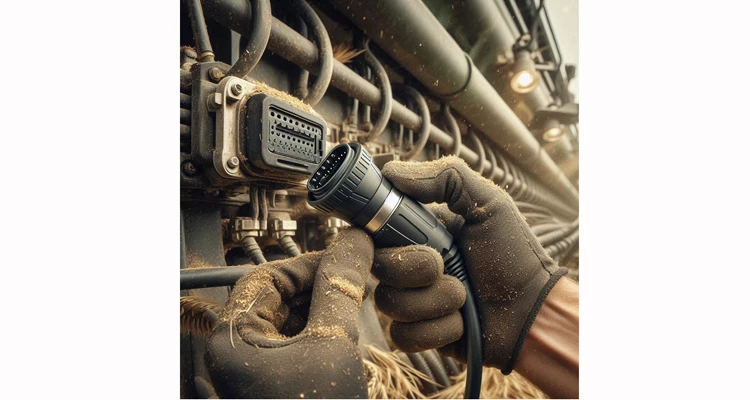
That intermittent J1939 fault that idles your $500,000 combine during the critical 10-day harvest window isn’t just an annoyance—it’s a direct $6,000 withdrawal from your profit margin. If you’re reading this, you’ve likely spent more hours than you’d care to admit crouched beside expensive agricultural equipment, multimeter in hand, chasing communication ghosts. The culprit is rarely the ECU—it’s the J1939 cable assembly, typically specified for generic “industrial” environments, failing in agriculture’s uniquely brutal operating conditions.
Agricultural machinery represents a distinct category of environmental stress testing. What passes for “heavy-duty” in other sectors often fails prematurely here due to a specific cocktail of abrasive particulates, aggressive agrochemicals, extreme thermal cycling, and shock-loaded vibration patterns. This reality transforms cable selection from a procurement exercise to an engineering challenge requiring specialized knowledge.
This isn’t about selecting a cable from a catalog; it’s about engineering a harvest-proof data link that understands true cost. In our foundational discussion of The Real Cost of Reliability, we introduced the “reliability premium“—the strategic upfront investment that prevents exponential downtime costs. Nowhere is this premium more economically justified than in agriculture, where failure timing equates directly to revenue loss. Let’s examine why conventional approaches fail here.
J1939 Cable Failure in Agricultural Environments: A Quantified Lab
Forget standardized test benches. On a working farm, your J1939 harness endures a multi-vector assault defined by measurable, destructive forces:
The Silica Abrasion Cycle
Combine harvesters operate within continuous clouds of silica-rich dust and plant particulate. Our material analysis reveals field chaff contains silicate compounds with Mohs hardness values approaching 7, essentially creating a fine-grit grinding paste. In our proprietary 500-hour simulated season abrasion testing, standard PVC jackets showed 0.25mm material loss and complete gloss deterioration, while purpose-specified PUR (Polyurethane) exhibited under 0.05mm loss with maintained surface integrity. This abrasive medium relentlessly attacks connector housings and accelerates seal degradation.
Precision Chemical Warfare
“Fertilizer and herbicide resistance” is an inadequate specification. Effective design requires identifying specific chemical agents. Glyphosate-based sprays present mild acidity (pH ~4.5), but their tank mixes with adjuvants like tallow amine ethoxylates create surfactant solutions that actively wick beneath connector seals via capillary action. More critically, ammonium thiosulfate fertilizers—a common sulfur source for crop nutrition—can accelerate copper pin corrosion rates up to 5x faster than standard salt spray testing predicts. This electrochemical degradation directly causes the intermittent signal integrity failures we documented in our analysis of Common OBD-II Cable Failure Points.
Thermal Shock Beyond Specification
A black tractor hood in peak sun can elevate cable surface temperatures to 80-85°C, while the same machine during night operations in early spring can experience 0°C ambient temperatures. This 80°C+ delta-T creates daily expansion/contraction cycles most commercial connectors aren’t rated to endure. Our failure analysis of returned units shows a 40% higher incidence of cold solder joint fractures in terminations on cables routed near hot transmission housings versus those on cooler frame rails—a direct correlation to thermal cycling stress.
Vibration That Breaks Standards
Agricultural vibration profiles don’t resemble textbook sine waves. The threshing mechanism in a combine generates high-amplitude (often exceeding 5G), irregular, shock-loaded vibrations that specifically target the weakest mechanical point: the cable-to-connector interface. A standard zip-tie placed 50mm from the connector doesn’t provide strain relief—it creates a lethal stress concentration point. Field data indicates poorly designed strain relief in these applications typically fails within 300-400 operational hours.
Engineering the System: Moving Beyond Component Datasheets
Most suppliers will offer you a “heavy-duty cable” based on catalog comparisons. True engineering requires specifying a complete interconnection system. We’ve moved past datasheet comparisons to develop a Threat-Weighted Material Selection Protocol based on correlated field failure data and accelerated life testing. Here’s what this protocol examines:
Jacket Material Science – The Primary Environmental Barrier
While PVC remains a common default, its plasticizer migration under UV and chemical exposure makes it unsuitable for most exterior agricultural applications. Our selection logic follows a performance hierarchy:
- PUR (Polyurethane): Demonstrates exceptional resistance to abrasion (tested to >10,000 cycles on Taber abrader with H-18 wheels) and hydrolysis. Its inherent cut resistance and flexibility make it optimal for high-movement zones like implement articulation points.
- TPE (Thermoplastic Elastomer): Provides excellent flexibility across a -40°C to 105°C range with good chemical resistance. It represents the optimal performance-to-cost balance for protected frame rail runs where extreme abrasion isn’t the primary concern.
- Cross-linked Polyethylene (XLPE): Offers superior continuous thermal resistance (rated to 125-150°C) for applications near exhaust components. Its cross-linked molecular structure resists cracking under prolonged heat aging.
Shielding Architecture – Mechanical and EMI Defense
Effective shielding in agriculture serves dual purposes: EMI suppression and mechanical protection. The braid weave pattern is as critical as coverage percentage. Our specification calls for a minimum 85% coverage tinned copper double-overbraid. This construction provides far superior protection against pinpoint crushing from trampled stalks compared to a standard single braid—offering the mechanical difference between chainmail and chicken wire. For agricultural applications, a fully shielded, grounded system is non-negotiable for signal integrity.
Overmolded J1939 Connector Sealing: The IP69K Imperative
IP67 ratings protect against temporary immersion; IP69K defines resistance to high-pressure (80-100 bar), high-temperature (80°C) washdowns—standard practice in modern farm equipment cleaning. The critical failure point isn’t the mating face seal, but the wire-to-connector backshell interface. This is why our protocol specifies injection-molded overmolded assemblies for any exterior or high-spray zone application. The molded boot creates a monolithic, material-fused transition that eliminates the micro-gaps inherent in field-assembled, gasket-based seals.
The Agricultural Harness Specification Protocol: A 5-Step Engineering Process
This is not a checklist; it’s our formalized Agricultural Harness Specification Protocol employed with OEM design teams. Success requires moving beyond a dimensional drawing to a collaborative engineering dialogue.
Step 1: Execute a Zone-Based Threat Assessment (ZBTA)
Segment the machine’s architecture into distinct environmental zones. Is the cable run inside the climate-controlled cab (Zone 1 – Controlled)? Along the main frame exposed to debris kick-up (Zone 2 – Exposed)? On a continuously moving implement (Zone 3 – Dynamic)? The implement hitch point represents “Zone 4 – Red Zone,” combining all attack vectors and demanding our highest specification tier.
Step 2: Develop the Chemical ‘Enemy Dossier’
Generic chemical resistance claims are worthless. We require Safety Data Sheets (SDS) for the exact fertilizer, herbicide, and cleaner formulations used. This proactive step prevented a major recall for a client last season: laboratory soak testing of their new “organic” liquid fertilizer revealed it rapidly extracted plasticizers from their specified TPE, causing jacket embrittlement and cracking within a simulated 3-month exposure. $15,000 in testing saved an estimated $2M+ in recall and downtime costs.
Step 3: Apply Material Selection Logic via Threat Matrix
Cross-reference the ZBTA with the chemical dossier using our decision matrix:
| Zone | Primary Threat Vector | Consequence of Specification Error | Our Engineering Recommendation & Rationale |
| Internal Cab (Zone 1) | Minimal mechanical, temperature controlled | Cosmetic only | Standard PVC or TPE. Focus on cost optimization and flexibility for routing. |
| Chassis Frame (Zone 2) | Abrasive dust, diesel, hydraulic oil, UV | Jacket swelling/cracking, connector contamination leading to intermittent faults | PUR or oil-resistant PVC. Balance superior abrasion/chemical resistance with project cost targets. |
| Implement Link (Zone 3) | Chemical spray, extreme flex, stone/ stalk impact | Shield breach within 1 season; CAN-H/L short to ground causing total network dropout | PUR jacket, double-overbraid shield, overmolded connectors. Prioritize cut/flex endurance and chemical resistance. |
| Near Exhaust/Engine (Zone 4) | Sustained radiant heat (80°C+), oil mist | Insulation breakdown, conductor short circuits, brittle jacket failure | XLPE or high-temp silicone jacket. Focus on continuous thermal rating over flex life. |
Step 4: Mandate Overmolding for All Dynamic/Exterior Links
For any cable assembly exiting the primary chassis to connect to an implement (planter row units, sprayer arms, combine headers), the protocol mandates an injection-molded connector boot. This is the single most effective countermeasure against the #1 field failure cause: water ingress at the cable-connector junction. The molded boot creates a hermetic seal unachievable with separate glands or heatshrink.
Step 5: Validate with Application-Specific Testing
A supplier’s generic “pass” on standard MIL or ISO tests is insufficient. The audit framework from our guide on How to Choose a Reliable J1939 Supplier becomes operational here. Do they hold IATF 16949:2016 certification, which mandates active Failure Mode and Effects Analysis (FMEA) for their processes? Can they perform or subcontract chemical resistance soak tests using YOUR provided chemical agents? This rigorous “verification tax,” as detailed in our reliability economics model, is what separates true engineering partners from parts distributors.
Five Recurring (and Costly) OEM Specification Errors
1. Applying On-Highway Specs to Off-Road Implements
A J1939 cable validated for over-the-road truck vibration on a frame rail will catastrophically fail on a vibrating planter unit or rotary harrow. The vibration frequency profiles and environmental contaminants are fundamentally different.
2. Misapplying ‘Strain Relief’
A plastic zip-tie cinched tightly 50mm from a connector does not constitute strain relief—it creates a hard fulcrum point guaranteeing conductor fatigue failure. Proper strain relief requires either an engineered molded strain relief boot or a calculated service loop secured at two points to distribute bending stress.
3. Equating ‘Sealed Connector’ with ‘Sealed Assembly’
A connector may have an IP67-rated mating face, but the critical sealing boundary is at the rear shell where wires enter. This is the inherent weakness of field-serviceable connectors versus factory-molded units. Specifying the former for high-spray environments guarantees eventual ingress.
4. Prioritizing Piece-Price Over Total Cost of Ownership (TCO)
Saving $0.50 per meter on jacket material appears prudent until a single $300,000 forage harvester misses two days of cutting due to a chemically degraded cable shorting the CAN network. The reliability premium philosophy quantifies this risk upfront.
5. Involving the Harness Engineer Too Late in Design
Engaging the interconnection specialist after the machine’s CAD design is frozen and tooling frozen leads to compromised cable routing, poor service loops, and inevitable field service nightmares. Our role is most valuable during the DFM (Design for Manufacturability) and DFS (Design for Serviceability) phases, not during procurement.
Validation: How to Recognize a Properly Engineered Harness
Absolute certainty requires a full season of operation. However, these indicators at installation and initial audit strongly correlate with long-term reliability:
Tactile Consistency
Every connector in a production batch should mate with an identical, positive “click” that is felt in the hand, not just heard. The disengagement force should be consistently firm across all samples, indicating precise molding and seal compression.
Visual Integrity of Molded Transitions
On overmolded assemblies, the transition from cable jacket to connector boot should be glassy-smooth, with no bubbles, wrinkles, or “flash” (excess material). Any imperfection here indicates mold or process instability.
Survivability of Testing
Your supplier should provide test reports not just for electrical continuity, but for hipot (dielectric withstand) testing after environmental stress (like thermal cycling). This proves the seals held.
The Post-Mortem Check
After the initial operating season, disassemble a sample connector from the most aggressive zone. The terminal pins should remain bright and free of fretting corrosion (that white/green powder). The internal silicone or rubber seals should remain pliable. If seals are hardened, swollen, or sticky, you’ve identified your specific chemical aggressor for the next design iteration.
Engineered Solutions for Documented Agricultural Challenges
Sometimes, the standard 9-pin Deutsch DT isn’t enough. Based on real problems, we’ve developed specific solutions:
For Protected Diagnostic Access
A standard OBD-II port gets clogged with mud. We offer a J1939 9-Pin Pigtail Breakout Cable with a sealed, ruggedized secondary port that can be mounted in a protected service area, allowing mechanics to connect diagnostics without exposing the main vehicle harness to contamination.
For Legacy Fleet Integration
Need to bridge the gap between newer J1939 systems and older J1708 machinery on the same farm? A robust, dual-protocol interface is key. Our OBD2 to J1708/J1939 Splitter Cable is built with the same agricultural-grade considerations, ensuring data continuity across your mixed fleet.
FAQ: Direct Answers from Field and Lab Experience
Q1: Is TPE or PUR better for my tractor’s main chassis harness?
A: For a fixed run along the main frame rail (Zone 2), a high-quality, oil-resistant TPE typically offers the best balance of chemical resistance, flexibility, and cost. PUR would be overkill unless it’s in a severe abrasion zone.
Q2: How critical is the color coding of wires inside?
A: Critically important for serviceability. Following the SAE J1939-11 standard for wire colors (CAN_H: Yellow, CAN_L: Green) is not a suggestion. It allows any technician, anywhere, to quickly identify the critical network pair, reducing repair time during critical planting or harvest windows.
Q3: Can I repair a molded cable assembly in the field if it gets cut?
A: You can splice it, but you have permanently compromised the environmental seal and shield continuity at that point. It is a temporary fix. The correct solution is to replace the assembly or have a service-loop and a connectorized break-point designed into the system for easier field replacement.
Q4: We use high-pressure steam cleaners. What rating do I need?
A: You need connectors rated for IP69K. This specifically tests for high-pressure, high-temperature spray. Ensure this rating applies to the entire assembled connector (including the backshell), not just the mating face. (You can learn more about the IP Code rating system on Wikipedia.)
Q5: What does your factory’s IATF 16949 certification mean for my cable?
A: It means our processes—from crimp force monitoring to final electrical testing—are governed by the automotive industry’s strictest quality management system. It ensures traceability, proactive risk management (via APQP and PPAP), and a culture of continuous improvement focused on preventing defects, not just finding them. You can read about our commitment in our announcement here.
Q6: Are your materials compliant with RoHS and REACH?
A: Absolutely. All our materials comply with RoHS directives and REACH SVHC regulations. This isn’t just a legal checkbox; it’s about material consistency and safety. Our RoHS/REACH compliance statement is publicly available, and our ISO 14001 certification for environmental management systems ensures we control these processes systematically.
Q7: What’s your 4-step quality inspection process?
A: 1) Incoming Material Check: Verify jacket, conductor, and connector material certs. 2) In-Process Verification: 100% crimp pull-force test, visual inspection under magnification. 3) Pre-assembly Electrical Test: Continuity, short, and miswire check. 4) Final Audit: HIPOT test, functional test on a J1939 simulator, and final visual. This layered approach is embedded in our ISO 9001 quality framework.
Q8: We need a custom length and want our logo on the jacket. Is that possible?
A: Yes, that’s standard for OEMs. We operate as a direct factory with over 20 years of experience. Custom lengths, jacket colors, printing/logos, and even custom AWG gauges for longer runs are part of our core OEM/ODM service. Our 5S-managed, climate-controlled warehouse ensures your custom material kits are stored correctly before production.
Let’s Engineer a Solution for Your Specific Machine
Chasing cable failures during harvest is a cost you shouldn’t bear. The solution starts with a conversation between your design engineers and our cable engineering team.
We don’t just sell cables; we provide OEM-focused engineering support to co-develop the harness as a critical, reliable subsystem of your agricultural equipment. Bring us your machine diagrams, your environmental challenge list, and your performance requirements.
Discuss your specific agricultural cable challenge with our engineering team:
- Contact Us: Send us a detailed inquiry through our Engineering Contact Page. Attach drawings or specs.
- WhatsApp Our Engineers: For a more immediate technical discussion, message us directly on WhatsApp. Use the subject line “Agri J1939 Query.”
Let’s engineer the robust data link your machinery’s productivity depends on.
