

Introduction
Professional workshops and OEM repair centers know that failed ECU Flashing or unstable Vehicle Communication can cause downtime, module lockouts, and costly rework. The MB16P to HDB26P Cable is engineered to solve these challenges. It ensures reliable OBD Interface connectivity, precise ECU Programming, and stable high-speed data transfer for Mercedes-Benz diagnostics. This guide explores its applications, features, and benefits for professional automotive environments.
Product Highlights
Seamless Vehicle Communication and ECU Flashing with the MB16P to HDB26P Cable
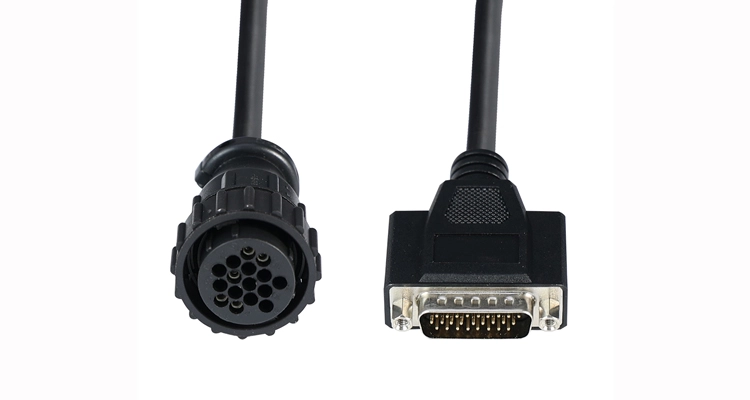
The MB16P to HDB26P Cable connects Mercedes-Benz MB16P diagnostic ports to HDB26P D-SUB interfaces, delivering secure, error-free data flow during ECU Reprogramming and Module Coding tasks.
Vibration-Resistant and Certified Durability for Workshop Reliability
Each cable uses TPE insulation, resists chemicals and vibration, and operates within -40°C to 105°C. Verified for over 5,000 insertion cycles, it withstands the demands of professional automotive ECU Programming environments.
Certified and Trusted Factory Standards
Manufactured under ISO 9001, ISO 14001, and IATF16949 systems, our cables meet RoHS, REACH, UL, and CE requirements. This guarantees safe, compliant solutions for global repair and OEM networks.
Key Features
- Connector Type: MB16P ↔ HDB26P (26-Pin D-SUB) for stable Vehicle Communication
- Cable Length: Standard and fully customizable options for OEM or aftermarket workshops
- Material: Molded, shielded automotive-grade wiring; vibration- and chemical-resistant
- Testing & Quality: 100% verified for continuity, shielding, and durability
- Certifications: RoHS, CE, REACH, UL, ISO 9001, ISO 14001, IATF16949
- Applications: ECU Flashing, Module Coding, OBD Interface testing, and Mercedes-Benz ECU Programming
Compatibility
The MB16P to HDB26P Cable works seamlessly with Mercedes-Benz ECUs, OBD2 diagnostic tools, and professional programming devices such as Xentry, Vediamo, and DTS Monaco.
Related Products:
Applications & Use Cases
- Professional ECU Programming and Module Coding for Mercedes-Benz vehicles
- OBD Interface testing, diagnostics, and ECU Reprogramming
- OEM workshops, authorized service centers, and high-performance repair facilities
- Advanced tuning environments requiring multi-module ECU Flashing
Step-by-Step Guide for Safe ECU Reprogramming
- Preparation: Confirm vehicle battery stability and correct ignition setting.
- Connection: Attach the MB16P connector to the diagnostic port and the HDB26P connector to your ECU programming device.
- Process: Execute ECU Flashing or Module Coding with certified diagnostic software.
- Verification: Validate successful Vehicle Communication and ECU acceptance.
Tips for Optimal Use
- Verify compatibility with specific Mercedes-Benz ECU models.
- Always maintain proper grounding when performing ECU Programming.
- Use certified OBD tools to avoid signal interference.
- Inspect connectors before each use for long-term signal integrity.
- Follow ISO quality standards for workshop procedures.
- Learn more about SAE J1939 vehicle network protocols
- Consult IEC standards for electrical reliability.
Why Choose Our Factory?
- 20+ Years of Expertise in automotive diagnostic cables for Mercedes-Benz and other OEMs
- In-House Engineering ensures faster customization and strict EMI shielding control
- Certified Manufacturing: ISO 9001, ISO 14001, IATF16949, RoHS, CE, REACH, UL compliance
- Proven Reliability: Widely used by OEM workshops and aftermarket service providers worldwide
FAQ (17+ Expert-Level Questions)
Q1: What does the MB16P to HDB26P Cable do?
A1: It enables stable ECU Programming, Module Coding, and diagnostics for Mercedes-Benz vehicles.
Q2: Is it compatible with OBD2 diagnostic tools?
A2: Yes, it integrates with OBD Interface scanners and professional Mercedes-Benz ECU tools.
Q3: Can I request OEM customizations?
A3: Yes, including cable length, color, and connector modifications.
Q4: How is quality controlled?
A4: Every cable undergoes 100% testing for continuity, shielding, and insertion cycles.
Q5: Does it support simultaneous ECU Flashing?
A5: Yes, optimized for multi-module Mercedes-Benz ECU Programming.
Q6: Can it resist extreme environments?
A6: Operating range -40°C to 105°C, vibration- and chemical-resistant.
Q7: Which certifications are provided?
Q7: Which certifications are provided?
Q8: Is it designed for professional workshops?
A8: Absolutely, ideal for OEM centers and advanced service facilities.
Q9: What’s the difference between MB16P and HDB26P?
A9: MB16P is a 16-pin Mercedes-Benz interface; HDB26P is a 26-pin D-SUB port for ECU diagnostics.
Q10: Does it support Module Coding?
A10: Yes, stable for both Module Coding and ECU Reprogramming.
Q11: How many insertion cycles is it tested for?
A11: Over 5,000 plug-in cycles with no signal loss.
Q12: Is OEM branding available?
A12: Yes, including logo printing and packaging customization.
Q13: Can this cable handle high-speed ECU data transfer?
A13: Yes, shielding ensures reliable communication for ECU tasks.
Q14: How to order or request support?
A14: Contact us via WhatsApp or Email Inquiry.
Q15: Does it work with Vediamo and DTS Monaco?
A15: Yes, fully compatible with both.
Q16: Can it support J1939 or other protocols?
A16: Yes, when used with certified diagnostic tools.
Q17: Do you provide compliance reports?
A17: Yes, with every shipment for full traceability.
Contact & CTA
WhatsApp:
Email:
Customization, consultation, and technical support are available — without pricing or stock details on this page.
