

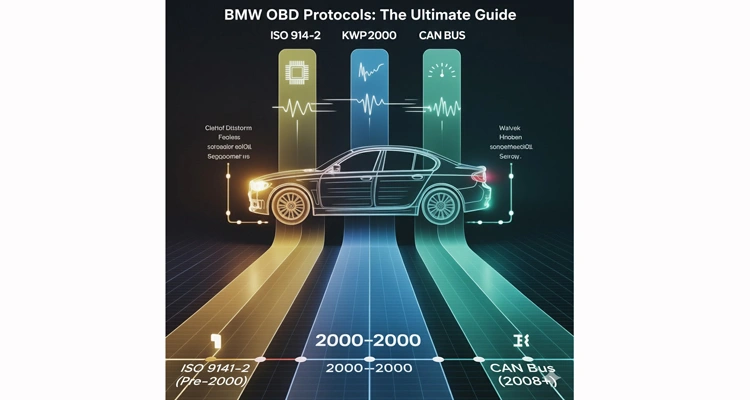
When it comes to vehicle diagnostics, the On-Board Diagnostics (OBD) system plays a crucial role in monitoring the performance of your car’s engine and other essential components. If you own a BMW or are considering purchasing one, you might be wondering: What OBD protocol does BMW use? Understanding this can be vital for anyone looking to perform diagnostics, repairs, or simply monitor their vehicle’s health.
Understanding OBD Protocols
First, let’s break down what OBD protocols are. OBD systems are standardized by different protocols that dictate how the vehicle’s systems communicate with external diagnostic tools. These protocols have evolved over time, with newer vehicles generally supporting more advanced protocols.
The most common OBD protocols include:
1. SAE J1850 PWM (Pulse Width Modulation)
2. SAE J1850 VPW (Variable Pulse Width)
3. ISO 9141-2
4. ISO 14230-4 (KWP2000)
5. ISO 15765-4 (CAN Bus)
What OBD Protocol Does BMW Use? A Detailed Guide
BMW vehicles, like many other European cars, predominantly use the ISO 9141-2 and ISO 14230-4 (KWP2000) protocols in their older models. These protocols are used in vehicles manufactured before 2008. They are relatively straightforward, allowing for basic diagnostics and reading of engine codes.
However, as technology has advanced, BMW has adopted the ISO 15765-4 (CAN Bus) protocol in its newer models. The CAN Bus (Controller Area Network) protocol is a more sophisticated system that allows for faster communication between the car’s various electronic control units (ECUs). This protocol became the standard for OBD-II vehicles in 2008 and is used in almost all modern cars, including BMWs.
BMW OBD Protocol by Model Year
• Pre-2000 BMW Models: Typically use the ISO 9141-2 protocol.
• 2000-2007 BMW Models: Often use a mix of ISO 9141-2 and ISO 14230-4 (KWP2000) protocols.
• 2008 and Newer BMW Models: Primarily use the ISO 15765-4 (CAN Bus) protocol.
Why Does This Matter?
Understanding the OBD protocol your BMW uses is crucial for several reasons:
1. Diagnostic Compatibility: If you’re planning to use a diagnostic tool to troubleshoot or monitor your BMW, knowing the correct OBD protocol ensures that you choose a compatible device.
2. Accurate Diagnostics: Using a diagnostic tool that matches your vehicle’s protocol can provide more accurate readings, helping you diagnose issues more effectively.
3. Enhanced Functionality: With the CAN Bus system, you can access a wider range of data and diagnostic capabilities, giving you deeper insights into your vehicle’s health.
Choosing the Right Diagnostic Tool for Your BMW
When selecting an OBD-II scanner or diagnostic tool for your BMW, ensure it supports the correct protocol. Most modern OBD-II scanners are compatible with multiple protocols, including CAN Bus, but it’s always wise to double-check compatibility, especially if you own an older BMW model.
Some highly recommended OBD-II scanners for BMWs include:
• Carly for BMW: A popular choice that offers comprehensive diagnostics and coding options specifically for BMW vehicles.
• Foxwell NT510 Elite: A versatile scanner that supports all BMW OBD protocols and offers advanced diagnostics.
• Autel MaxiCOM MK808: Another excellent option with wide compatibility and robust features for BMW diagnostics.
Conclusion
BMW has transitioned through several OBD protocols over the years, starting with ISO 9141-2 in older models and moving to the more advanced ISO 15765-4 (CAN Bus) protocol in recent years. Understanding which protocol your BMW uses is essential for effective diagnostics and maintenance. Whether you’re a DIY enthusiast or a professional mechanic, having the right knowledge and tools will ensure that your BMW remains in top condition.
🚗 Recommended BMW Diagnostic Solutions
If you need reliable diagnostic cables for your BMW vehicle, we offer professional-grade solutions tailored to different needs:
📱 Ultra-Low Profile OBD2 Cable
Specifically designed for BMW models with recessed diagnostic ports. No modification needed for hard-to-reach connectors.
View Solution🔧 BMW X-Series OBD2 Splitter
Dual-port access for BMW X1, X3, X5, X7 models. Allows simultaneous connection of diagnostic tools and other devices.
View Solution⚡ Complete BMW Cable Collection
Explore our full range of BMW-specific diagnostic cables, adapters, and custom solutions for all model years.
Browse All BMW Cables💬 Need Technical Support or Custom Solution?
We provide expert technical consultation and custom cable manufacturing for BMW diagnostic systems.
Our Support: Custom manufacturing • Technical drawings • Compatibility verification • OEM/ODM services
🏆 Why Choose Our BMW Diagnostic Solutions?
20+ Years Expertise
Direct factory manufacturing since 2005
Full Customization
Logo, length, color, AWG, connectors
Rigorous Testing
4-step quality inspection • 100% tested
Additional Certifications: RoHS • CE • UL • REACH • 5S Management • Climate-controlled warehouse
📋 Frequently Asked Questions: BMW Diagnostic Protocols & Cables
1 What’s the difference between ISO 9141-2 and ISO 14230-4 (KWP2000) protocols in BMW vehicles?
ISO 9141-2 was used in BMW models from the late 1980s to early 2000s, featuring a single K-line for bidirectional communication. ISO 14230-4 (KWP2000) is an enhanced version with faster initialization and improved fault tolerance, commonly found in BMWs from 1996-2004. Both use similar physical connections but require different initialization sequences.
2 Can I use a generic OBD2 cable for BMW diagnostics, or do I need a specific adapter?
For modern BMWs (2000+) with standard OBD2 ports, a high-quality universal OBD2 cable usually works. However, for:
- Classic BMWs (pre-2000): You need a 38-pin round adapter
- Models with recessed ports: Ultra-low profile cable is essential
- Simultaneous tool access: OBD2 splitter is required
We recommend checking your specific BMW model’s diagnostic port type before purchasing.
3 My BMW diagnostic tool shows “No Communication” – could it be a cable issue?
Yes, cable issues are among the most common causes. Troubleshoot in this order:
- Cable connection: Ensure secure fit in both diagnostic port and tool
- Protocol compatibility: Verify your cable supports the correct BMW protocol
- Pin continuity: Test with a multimeter (pins 7-K-line and 16-power are critical)
- Cable length: Excessively long cables (>3m) may cause signal degradation
For professional diagnostics, we offer certified BMW diagnostic cables with guaranteed compatibility.
4 Which BMW models use CAN Bus protocol, and when did the transition happen?
BMW began transitioning to CAN Bus (ISO 15765-4) around 2001-2002:
- Early adopters (2001-2004): E65 7 Series, E60 5 Series
- Full transition (2004+): Most models from 2004 onward
- Mixed systems (transition period): Some models used KWP2000 for engine, CAN for chassis
For accurate diagnosis, always verify the specific protocol for your BMW’s model year and system.
5 Do I need special cables for BMW coding and programming vs. basic diagnostics?
Yes, there are important differences:
| Feature | Basic Diagnostics | Coding/Programming |
|---|---|---|
| Cable quality | Standard shielded | High-quality, low-resistance |
| Signal stability | Moderate requirements | Critical – interruptions can brick ECUs |
| Our recommendation | Standard OBD2 cable | Professional-grade cable with gold-plated contacts |
6 How do I identify if my BMW uses PWM or VPW protocol?
BMW vehicles typically do not use SAE J1850 PWM/VPW protocols. These are primarily found in:
- PWM: Ford, Lincoln, Mercury (primarily North American)
- VPW: GM, Chrysler vehicles
BMW predominantly uses:
- ISO 9141-2 (1988-1996)
- ISO 14230-4/KWP2000 (1996-2004)
- ISO 15765-4/CAN Bus (2001-present)
7 What’s the maximum recommended length for a BMW diagnostic cable?
Cable length depends on the protocol and application:
- ISO 9141-2/KWP2000: Max 3 meters (10 feet) for reliable communication
- CAN Bus: Up to 5 meters (16 feet) with proper shielding
- Programming/Coding: Keep under 2 meters (6.5 feet) for maximum stability
Pro tip: Longer cables require better shielding. Our professional cables use double-shielded construction to maintain signal integrity even at extended lengths.
8 Can you customize BMW diagnostic cables for specific tools or applications?
Absolutely! As a direct factory since 2005, we specialize in custom solutions:
OBD2, DB15, USB, specific tool interfaces
From 0.5m to 10m+ with optimal shielding
Custom colors, logos, packaging
📧 Contact us with your specific requirements for a custom quote
9 Are there voltage requirements for BMW diagnostic cables?
BMW diagnostic systems operate at standard automotive voltages:
- Power (Pin 16): 12V nominal (9-16V operating range)
- Signal lines: 0-5V digital signals
- K-line/L-line: 0-12V pulses
Our cables are designed with proper wire gauge (typically 22-24 AWG) to handle these voltages without voltage drop, even during extended programming sessions.
10 What warranty do you offer on BMW diagnostic cables?
We stand behind our quality with comprehensive warranty coverage:
- Standard cables: 12-month warranty against manufacturing defects
- Professional-grade cables: 18-month warranty
- Custom solutions: Warranty tailored to the specific application
All cables undergo 100% testing before shipment and are backed by our IATF 16949 certified quality management system.
Still Have Questions About BMW Diagnostics?
Our technical team is ready to help with protocol identification, cable selection, and compatibility verification.
💬 Get Technical Support on WhatsApp